
Orson Welles masterpiece kicks off centennial celebration of controversial auteur’s birth
CITIZEN KANE (Orson Welles, 1941)
Film Forum
209 West Houston St.
January 1-8
Series continues through February 3
212-727-8110
www.filmforum.org
www2.warnerbros.com
 Film Forum is ringing in 2015 with the greatest American movie ever made, the epic Citizen Kane, kicking off a massive centennial celebration of the birth of its creator, the rather iconoclastic writer, director, producer, actor, and wine spokesman Orson Welles. In 1941, a young, brash, determined Welles shocked Hollywood with a masterpiece unlike anything seen before or since — a beautifully woven complex narrative with a stunning visual style (compliments of director of photography Gregg Toland) and a fabulous cast of veterans from his Mercury radio days, including Everett Sloane, Joseph Cotten, Ray Collins, Paul Stewart, and Agnes Moorehead. Each moment in the film is unforgettable, not a word or shot out of place as Welles details the rise and fall of a self-obsessed media mogul. The film is prophetic in many ways; at one point Kane utters, “The news goes on for twenty-four hours a day,” foreseeing today’s 24/7 news overload. And it doesn’t matter if you’ve never seen it and you know what Rosebud refers to; the film is about a whole lot more than just that minor mystery. Like every film the Wisconsin-born Welles made, Citizen Kane was fraught with controversy, not the least of which was a very unhappy William Randolph Hearst seeking to destroy the negative of a film he thought ridiculed him. Kane won only one Oscar, for writing — which also resulted in controversy when Herman J. Mankiewicz claimed that he was the primary scribe, not Welles. The film lost the Academy Award for Best Picture to John Ford’s How Green Was My Valley, but it has topped nearly every greatest-films-of-all-time list ever since.

Orson Welles was one of a kind, as splendid Film Forum series shows
A classic American story that never gets old, Citizen Kane, in a 4K restoration, will run at Film Forum January 1-8, igniting “Orson Welles 100,” a four-week festival programmed by Bruce Goldstein along with consultant Joseph McBride, author of What Ever Happened to Orson Welles? A Portrait of an Independent Career. Welles’s career was fraught with controversy, with battles over editorial control, finances, and politics, with more unfinished projects than completed ones. As McBride points out at the start of his 2006 book, “‘God, how they’ll love me when I’m dead!’ Welles was fond of saying in his later years, with a mixture of bitterness and ironic detachment. But that’s a half-truth at best. More than two decades after Welles’s death, his career is, in a very real sense, still flourishing. But it is a disturbing irony that Welles is more ‘bankable’ now than when he was living.” The Film Forum series confirms this statement, consisting of more than thirty films that Welles directed and/or appeared in, including multiple versions of Touch of Evil and Macbeth; the lineup ranges from the familiar (The Magnificent Ambersons, The Third Man, Compulsion, A Man for All Seasons) to the obscure (Prince of Foxes, The Black Rose, Man in the Shadow, Black Magic), from the Shakespearean (Chimes at Midnight, Macbeth, Othello) to the Muppets (The Muppet Movie). Among the double features are The Immortal Story and F for Fake, The Stranger and Journey into Fear, and Jane Eyre and Tomorrow Is Forever. McBride will be on hand to present the rarities collection “Wellesiana” as well as the “Preview version” of Touch of Evil on January 14 and the “Scottish version” of Macbeth on January 16, joined by Welles’s daughter Chris Welles Feder.



 Although writer-director Rob Zombie refuses to call this a sequel to 2003’s House of 1000 Corpses, The Devil’s Rejects is a sequel to Zombie’s 2003 horror hit House of 1000 Corpses. Mad clown Captain Spaulding (Sid Haig) is back, as are murderous siblings Otis (Bill Moseley) and Baby (Sheri Moon Zombie, Rob’s wife). Mother Firefly, played by the vixenous Karen Black in the first flick, is here portrayed with delicious delight by Leslie Easterbrook (of Police Academy fame). In this gorefest, Otis and Baby are on the lam from Sheriff Wydell (William Forsythe), who is determined to avenge his brother’s death; they hole up in a skeevy motel with a quartet of hostages that includes perennial Clint Eastwood bad boy Geoffrey Lewis and Three’s Company escapee Priscilla Barnes. Zombie cleverly plays with genre cliches throughout the film; what you think is going to happen — or not happen — gets turned upside down, so you never quite know where things are heading (although you can always count on a shot of his wife’s butt). Zombie, leader of the heavy metal band White Zombie, injects a wry sense of humor by including such ’70s pop music as Elvin Bishop’s “Fooled Around and Fell in Love,” Steely Dan’s “Reelin’ in the Years,” David Essex’s “Rock On,” and even Lynyrd Skynyrd’s “Freebird,” always at extremely appropriate moments. Add a star if you love films that relish gore; delete two and a half if you can’t stand them. The Devil’s Rejects is being shown January 2 and 3 at 12:10 am as part of Nitehawk Cinema’s Nitehawk Nasties and Nitehawk Midnite Screenings series.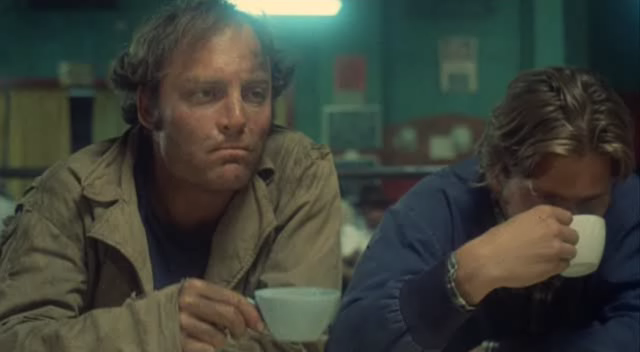
 Genre master and onetime boxer John Huston returned to the ring in Fat City, a gritty 1972 drama about a group of has-beens and never-will-be’s struggling to survive in Stockton, California. Stacey Keach stars as Billy Tully, a down-on-his-luck fighter looking to make a comeback at the ripe old age of twenty-nine. He spars at the local Y with eighteen-year-old Ernie Munger (Jeff Bridges) and likes what he sees in the kid, telling him to meet his old manager, Ruben (Cheers’ Nicholas Colosanto), who decides to take on the unseasoned youngster. While Ruben lands Ernie — who seems more interested in bragging about having scored with his girlfriend, Faye (Candy Clark), than training properly — his first few bouts, Tully gets day work picking vegetables and hangs out at a local gin joint with a seedy, whiskey-voiced barfly named Oma (an Oscar-nominated Susan Tyrrell). Legendary cinematographer Conrad Hall, who shot such wide-ranging gems as Cool Hand Luke, In Cold Blood, Butch Cassidy and the Sundance Kid, Marathon Man, and American Beauty, casts a gray pall over the proceedings as dashed hopes and dreams come falling down on these disillusioned perennial losers. In many ways Fat City, based on the novel by Leonard Gardner — who also wrote the screenplay — is an update of Elia Kazan’s On the Waterfront, but moved to the hard times of early ’70s America, when so many people had no way out. You do not have to be a fight fan to fall in love with this film. A clear influence on such auteurs as Martin Scorsese, Fat City is screening January 1, 4, and 5 as part of the Film Society of Lincoln Center series “Let There Be Light: The Films of John Huston,” which runs through January 11 and consists of forty films directed by Huston, in addition to a handful of other works he either appeared in or that demonstrate his lasting influence.