twi-ny recommended events

COIL — ALEXANDRA BACHZETSIS: FROM A TO B VIA C

COIL

Swiss choreographer Alexandra Bachzetsis examines beauty and the act of viewing in free COIL presentation, FROM A TO B VIA C

Swiss Institute / Contemporary Art
18 Wooster St.
Performance: Wednesday, January 14, free with advance RSVP, 7:00
Installation: January 12-13, free, 12 noon – 6:00 pm
212-352-3101
www.ps122.org/from-a-to-b
www.swissinstitute.net

Swiss choreographer Alexandra Bachzetsis once again explores gender identity, body language, concepts of beauty, and the very nature of art and performance in today’s communication-obsessed world in her latest work, From A to B via C, inspired by the fascinating history of Diego Velázquez’s “The Toilet of Venus.” In that painting, which is also known as “Venus at Her Mirror” and “The Rokeby Venus,” Cupid holds up a reflecting glass so his nude, reclining mother, Venus, the goddess of love, can admire her visage. The controversial work, completed by the Spanish painter in 1651, stirred one viewer, Canadian suffragette Mary Richardson, to repeatedly slash it in March 1914; her attack was a very public response to the brutal treatment being given fellow feminist activist Emmeline Parkhurst. “I have tried to destroy the picture of the most beautiful woman in mythological history, as a protest against the government for destroying Mrs Pankhurst, who is the most beautiful character in modern history,” Richardson wrote at the time. “Justice is an element of beauty as much as colour and outline on canvas.” One hundred years after that attack, Bachzetsis’s multimedia performance installation From A to B via C, taking place this week at the Swiss Institute as part of PS122’s tenth annual COIL festival, investigates this strange conjunction of art, protest, and feminism. In the hour-long U.S. premiere, Bachzetsis and Gabriel Schenker, wearing Cosima Gadient’s costumes depicting the inner musculature of the human body, are joined by a naked Anne Pajunen, who holds up a monitor showing a live feed as Bachzetsis reclines on a couch and looks at herself. The Zurich-born Bachzetsis’s previous work includes The Stages of Staging, Bluff, and Mainstream; the installation From A to B via C can be seen January 12 & 13 from 12 noon to 6:00, while the final live performance is scheduled for January 14 at 7:00. Admission is free with advance RSVP.

NEW YORK JEWISH FILM FESTIVAL OPENING NIGHT: THE MUSES OF BASHEVIS SINGER

THE MUSES

Documentary delves into Isaac Bashevis Singer’s love of women and their work as his translators

THE MUSES OF BASHEVIS SINGER (Asaf Galay & Shaul Betser, 2014)
Film Society of Lincoln Center, Walter Reade Theater
165 West 65th St. between Eighth Ave. & Broadway
Wednesday, January 14, 4:00 & 8:45
Festival runs January 14-29
212-875-5050
www.filmlinc.com
www.the-muses-of-bashevis-singer.com

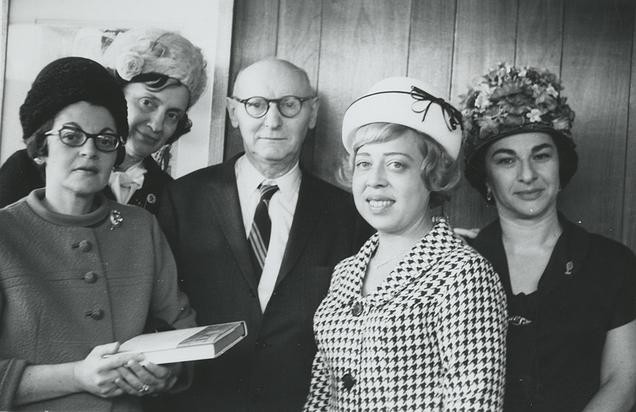
Who ever thought that little old Yiddish mensch Isaac Bashevis Singer was such a horndog? Asaf Galay and Shaul Betser begin The Muses of Bashevis Singer, their light and playful documentary, with the following quote from the Nobel Prize-winning author: “In my younger days I used to dream about a harem full of women. Lately I’m dreaming of a harem full of translators. If those translators could be women in addition, this would be paradise on earth.” Well, it seems that Singer, who was born in Poland in 1902, emigrated to the United States in 1935, and died in Florida in 1991 at the age of eighty-eight, found that paradise, as Galay and Betser meet with a series of women who were among many hand-picked by Singer, the man who nearly singlehandedly preserved Yiddish literature in the twentieth century, to serve as his translators, and not necessarily because of their language skills. “There were certain women who were more than just translators to him. It happened quite often,” says his Swedish publisher, Dorothea Bromberg, who also talks about Alma, Singer’s wife of more than fifty years. “He loved her, I’m sure, in his own way,” she adds. “She was very jealous of him, and she was completely right.” Galay and Betser meet with translators Eve Fridman, Evelyn Torton Beck, Dvorah Telushkin, Marie-Pierre Bay, Duba Leibell, and Dr. Bilha Rubenstein as well as Singer biographers Florence Noiville and Janet Hadda, his granddaughters Hazel Karr and Merav Chen-Zamir, Yentl the Yeshiva Boy playwright Leah Napolin, and his longtime secretary and proofreader, Doba Gerber, who share intimate, surprising tales about the author of such books as The Family Moskat, The Magician of Lublin, Shosha, and Enemies, a Love Story and such short stories as “Gimpel the Fool,” “A Friend of Kafka,” and “Zlateh the Goat.”


The seventy-two-minute film, lifted by a bouncy, airy soundtrack by Jonathan Bar-Giora, also includes footage of Singer making speeches, appearing on interview programs, going to a Jewish deli, walking on the Coney Island boardwalk, and writing with pen on paper and on a typewriter with Yiddish characters. But as the title implies, The Muses of Bashevis Singer doesn’t depict him as a callow cad but as a determined writer — and father and husband — who just loved women, loved being surrounded by women, using them as inspiration for his marvelous stories that mixed fiction with reality. “Isaac was a very frisky old man,” says Leibell, who worked with Singer in his later years after he moved to Florida with Alma. “That’s to put it very mildly.” The Muses of Bashevis Singer will have its U.S. premiere as the opening-night selection of the New York Jewish Film Festival on January 14 with screenings at 4:00 and 8:45 at the Walter Reade Theater, both followed by Q&As with the directors. The twenty-fourth annual festival continues through January 29 with screenings and special events at the Film Society of Lincoln Center and the Jewish Museum.

BOOK RELEASE PARTY: IN LOVE IN NEW YORK

in love in new york

Who: Caitlin Leffel and Jacob Lehman
What: Book party celebrating release of In Love in New York: A Guide to the Most Romantic Destinations in the Greatest City in the World (Rizzoli, January 13, 2015, $24.95)
Where: The Corner Bookstore, 1313 Madison Ave. at 93rd St., 212-831-3554
When: Tuesday, January 13, free, 6:00
Why: Forget Paris, Rome, or Bayonne; there is no better place to be in love than our very own backyard, New York City. Caitlin Leffel and Jacob Lehman have followed up The Best Things to Do in New York: 1001 Ideas with In Love in New York, which features such chapters as “Love at First Sight,” “Getting Serious with the City,” and “Will You New York Me?” In the introduction, “The City that Never Sleeps Alone,” they write, “Whether you’re new to your relationship, new to the city, or an old pro at both, New York is there to seduce, excite, console, and entertain.” Their romantic suggestions are accompanied by photos of the Temple of Dendur, Lincoln Center, Central Park, the High Line, and other sensuous locations, with each chapter kicked off with an old-fashioned iconic postcard image of a favorite part of the city. And they include the top-ten make-out spots as well, in addition to the forty best places to propose, in case the kissing sessions were a big hit.

TICKET ALERT: TIBET HOUSE US BENEFIT CONCERT XXV

tibet house benefit concert 25

Who: Artistic director Philip Glass, the Flaming Lips, Laurie Anderson, Tenzin Choegyal, Ashley MacIsaac, and more performers to be announced, with honorary chairpersons Chuck Close, Maggie Gyllenhaal, Peter Sarsgaard, Uma Thurman, and Arden Wohl
What: Twenty-fifth annual concert raising funds for the nonprofit Tibet House US, celebrating the Year of the Wood Sheep and Tibetan New Year
Where: Carnegie Hall, Stern Auditorium / Perelman Stage, 881 Seventh Ave. at 57th St., 212-247-7800
When: Thursday, March 5, $35-$200 (special packages with meet-and-greets and dinner reception start at $500), 7:30
Why: Tibet House US was founded in 1987 at the request of the Dalai Lama, “dedicated to preserving Tibet’s unique culture at a time when it is confronted with extinction on its own soil”; the annual benefit concert is always one of the cultural highlights of the year in New York City (for a look back at past concerts, including full setlists, go here)

COIL 2015 — MOLLY LIEBER + ELEANOR SMITH: RUDE WORLD

(photo by Maria Baranova)

Molly Lieber and Eleanor Smith come together as one in revealing new work (photo by Maria Baranova)

The Chocolate Factory Theater
5-49 49th Ave., Long Island City
January 7-12, $20
718-482-7069
www.ps122.org/rude-world
www.chocolatefactorytheater.org

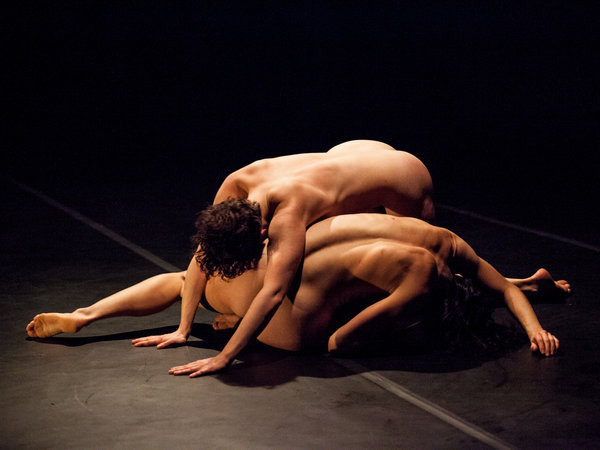
With Rude World, Molly Lieber and Eleanor Smith conclude their intimate trilogy that started with 2012’s Beautiful Bone and continued with 2013’s Tulip, a trio of works danced and choreographed by the two women, who have been collaborating since 2006. Part of PS122’s COIL festival, Rude World takes place in the black box space at Long Island City’s Chocolate Factory, with two rows of folding chairs at the north and south ends and black curtains forming the east and west sides. The forty-five-minute improvisation-based performance begins as Lieber and Smith, both naked, enter the small, dark room. Lieber sits on a reserved chair as Smith stands right in front of her. Over the course of several minutes, Lieber slowly caresses Smith’s body, from shoulder blades to calves, while her face moves into Smith’s backside. The only sound heard is that of a far-off ventilation system, barely audible, as well as the soft gulps of the audience members. The opening sets the tone for the rest of the show, as each dancer gets a solo in which they embrace the space with runs and jumps; in between, the central section features their bodies entwining, virtually becoming one as they twist, turn, and roll, pushing and pulling each other, using various body parts in a creative vocabulary of movement bordering on the sexual. They also stand face-first against the black curtain, slowly moving up and down as if trying to merge with the barrier. Through it all, Madeline Best’s lighting shifts ever so subtly, melding with the silence, which is interrupted only by Lieber’s and Smith’s heavy breathing — and yet more audience gulps.

Developed during a residency at the Baryshnikov Arts Center, Rude World is a mesmerizing work that gently tantalizes and taunts the audience. Lieber, who has danced for luciana achugar, Neil Greenberg, Maria Hassabi, Juliette Mapp, and Melinda Ring, and Smith, who has performed with Ivy Baldwin, Katie Workum, Juliana F. May, Vanessa Anspaugh, and Molly Poerstel, boldly reveal themselves, daring the crowd to look at them and their bodies. The piece gets confusing when each dancer puts on at least one article of clothing, perhaps emphasizing the nudity too much. But the brief wardrobe changes also tell the audience that the dancers know that they’re being examined in a way costumed dancers aren’t, with usually hidden body parts on view and moving along with hands, legs, heads, etc. Of course, nudity in contemporary dance is nothing new, but it can still be bold and thrilling when used in intelligent, unique ways.

DYING FOR IT

(photo by Ahron R. Foster)

Semyon Semyonovich Podeskalnikov (Joey Slotnick) tells his wife (Jeanine Serralles) and mother-in-law (Mary Beth Peil) that he’s had enough in DYING FOR IT (photo by Ahron R. Foster)

Atlantic Theater Company
Linda Gross Theater
336 West 20th St. between Eighth & Ninth Aves.
Tuesday – Sunday through January 18, $20-$86.50
866-811-4111
www.atlantictheater.org

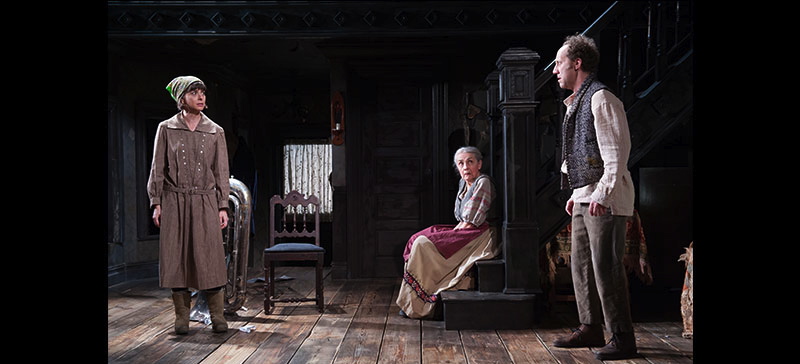
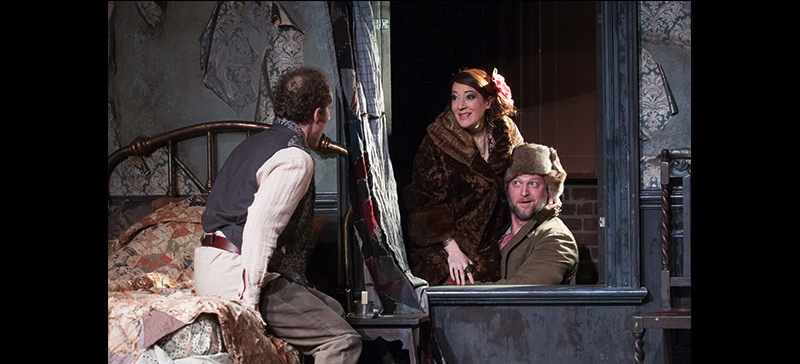
Living in 1920s Russia was no walk in the park, as so cleverly depicted in Moira Buffini’s Dying for It, a rollicking good “free adaptation” of Nikolai Erdman’s long-banned 1928 play, The Suicide. Twenty-seven-year-old Semyon Semyonovich Podeskalnikov (Joey Slotnick) is at the end of his rope. “I’m a parasite,” he tells his wife, Masha (Jeanine Serralles). “I’m a bloodsucking leech. I have no work in this worker’s paradise.” They have such little money, they live in the hallway of a miserable apartment building, their bed under the stairs. One of their upstairs neighbors, the hulking, recently widowed Alexander Petrovich Kalabushkin (C. J. Wilson), tries to convince him that “life is a miracle, full of wonder,” but Semyon is adamant that it’s too late to change his mind. “I have no dignity, no labor, no value at all,” he says. But shortly after he decides to off himself, he is bombarded by various members of Soviet society, each of whom wants to make him their martyr — one imploring him to write a suicide note crying out about what they believe is wrong with the social order, another protesting the revolution, the next a victim of Communism, et al. Too afraid to speak out themselves, they want the soon-to-be-dead Semyon to be their personal mouthpiece. Among those who want to turn Semyon’s last act into a heroic gesture are comrade Aristarkh Dominikovich Grand-Skubik (Robert Stanton), an intellectual who tells him, “You are in a position of great power. . . . Nowadays, only the dead may say what the living think”; Kleopatra “Kiki” Maximovna (Clea Lewis), a kittenish romantic who believes she has found a kindred soul in Semyon; Father Yelpidy (Peter Maloney), a priest who wants Semyon to consider the damnation he faces; and Viktor Viktorovich (Patch Darragh), “the people’s poet,” who sees this as an important career opportunity for himself. Also involved in the festivities are Masha’s mother, Serafima Ilyinichna (Mary Beth Peil), who can’t wait for Semyon to be out of her daughter’s life; Yegor Timoveivich (Ben Beckley), a postman who prefers to play by the very strict rules; and Margarita Ivanovna Peryesvetova (Mia Barron), a married, carefree vamp having an affair with Alexander. Semyon might have had no purpose in life, but he has suddenly found his true calling in death.

(photo by Ahron R. Foster)

Kleopatra “Kiki” Maximovna (Clea Lewis) and Alexander Petrovich Kalabushkin (C. J. Wilson) have an idea for Semyon Semyonovich Podeskalnikov (Joey Slotnick) as his suicide approaches (photo by Ahron R. Foster)

Dying for It gets off to a rocky start, with silly, lackluster slapstick that quickly grows tiresome. But once Semyon gets rid of the blood sausage and the tuba, the play, keenly helmed by Atlantic Theater artistic director Neil Pepe (3 Kinds of Exile, A Life in the Theatre), finds its groove on Walt Spangler’s appropriately dilapidated boarding-house set, evolving into an engaging farce about trying to find meaning in one’s life. The cast is a mixed bag: Slotnick (Boston Public, The Altruists ) is charming as the suicidal Semyon, Lewis (Ellen, Writer’s Block) is delightful as the spirited Kiki, Stanton (A Free Man of Color, All in the Timing) is stalwart as the determined Aristarkh, Barron (Domesticated, Knickerbocker) is fiery as the wild Margarita, and Wilson (The Lady from Dubuque, Gore Vidal’s The Best Man) proves once again that he is one of New York theater’s finest character actors as the bold and beefy Alexander, but Serralles (The Jammer, Stunning) is too brusque as Masha, the usually dependable Maloney (Outside Mullingar, Glengarry Glen Ross) falters with comedic timing as the priest, and Darragh (The Jammer, Appropriate) overdoes it as the poet. The Suicide was never staged in Erdman’s lifetime (he died in Moscow in 1970); it made a brief run on Broadway in 1980, with Derek Jacobi in the lead role. With Dying for It, Buffini (Gabriel, Handbagged) has thankfully brought it back from the dead, reinvigorating it for another time, when rampant surveillance, cyber-bullying, and terrorism have people around the world questioning what they say and do in public.

FAREWELL, HERR SCHWARZ

FAREWELL HERR SCHWARZ

A filmmaker uncovers heart-wrenching secrets of her family’s past in FAREWELL, HERR SCHWARZ

FAREWELL, HERR SCHWARZ (SCHNEE VON GESTERN / היה שלום פטר שווארץ) (Yael Reuveny, 2013)
Quad Cinema
34 West 13th St.
Opens Friday, January 9 (also at the JCC in Manhattan January 10-11)
212-255-2243
www.quadcinema.com

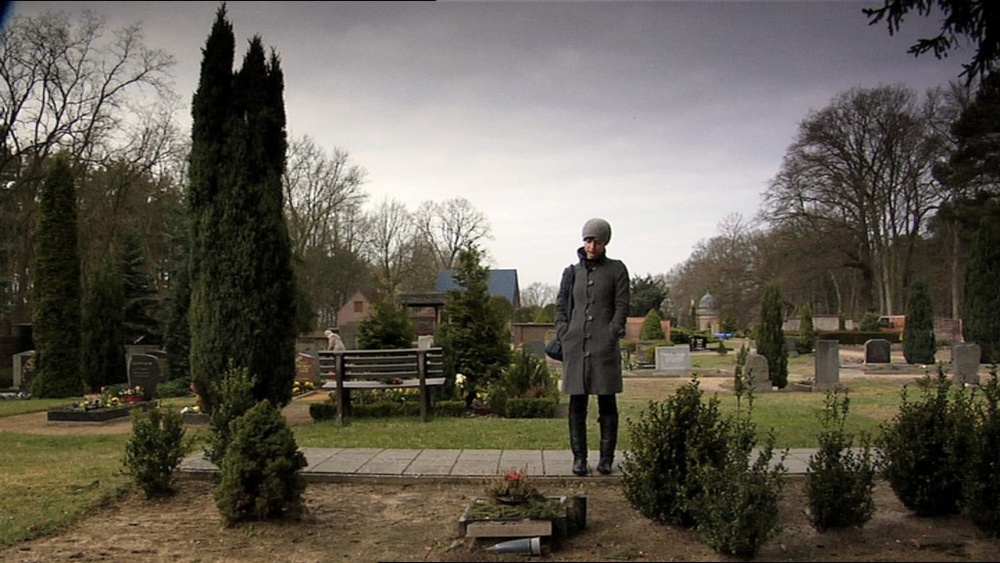
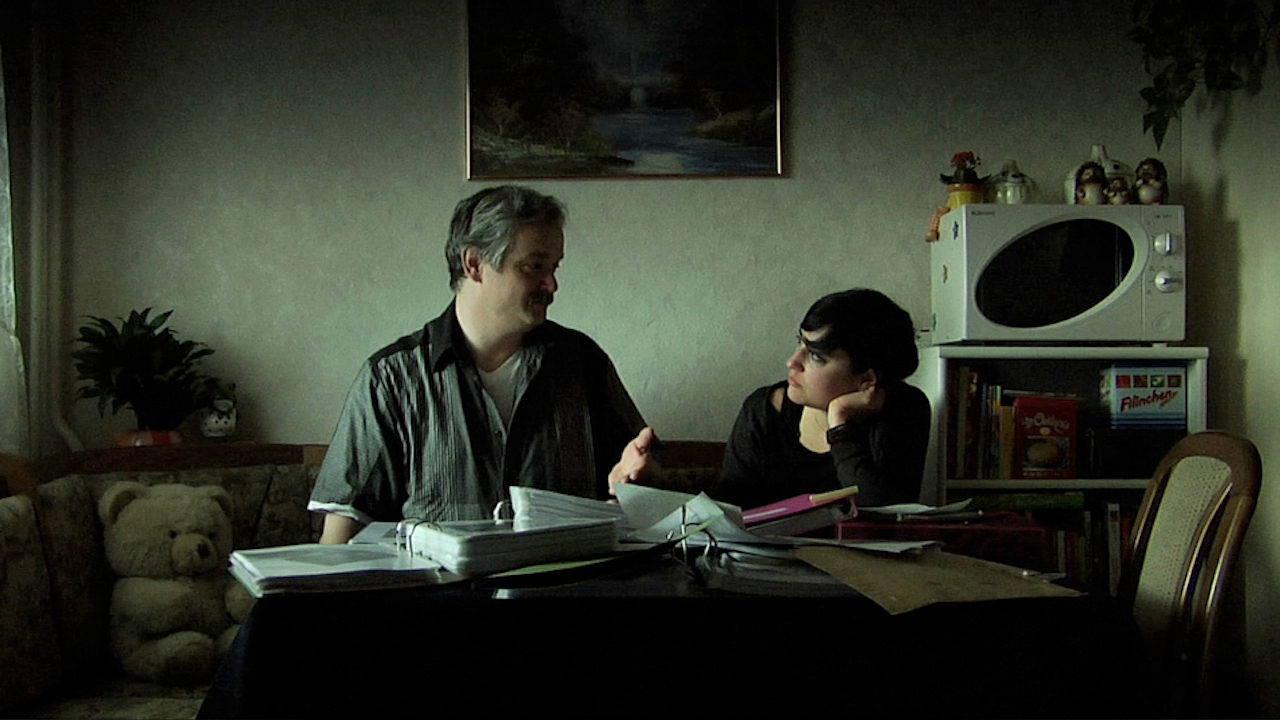
Named Best Documentary at the 2013 Haifa International Film Festival, Yael Reuveny’s Farewell, Herr Schwarz offers a unique look at the Holocaust and its continuing effects on her and her family through three generations. “We were raised to reject the Diaspora,” the Israeli-born, Berlin-based writer and director says near the beginning of her first feature-length film. “I was supposed to be ‘the new Jew’ but somehow I ended up living in Germany, in the land I wasn’t allowed to set foot in. I wasn’t allowed to be here because of my grandmother’s story. But still, her story, which haunted my childhood, eventually made me build my home here.” And a haunting story it is, filled with intrigue, mystery, and powerful emotions. Sensitively shot by cinematographer Andreas Kohler and featuring an elegiac score by Volker “Hauschka” Bertelmann, the film explores what happened between Reuveny’s grandmother, Michla Schwarz, and Michla’s beloved brother, Feiv’ke. During the war, Feiv’ke was sent to the Schleiben concentration camp in Germany, where Michla thought he perished. Yet Reuveny discovers that her great-uncle actually survived the Holocaust but remained in the same town he had been held in, changing his first name to Peter, marrying a non-Jewish German woman whose brother was a Nazi, and starting a family.
FAREWELL HERR SCHWARZ

Yael Reuveny (r.) meets relatives she never knew she had in gripping documentary

Traveling from Israel to Poland to Germany, Reuveny meets with Peter’s widow, Helga Krüger, and two surviving children, Uwe and Barbara; speaks with some of her late grandmother’s longtime friends; and talks to her own parents, Etty and Shaul, and brother, Oded, who share their thoughts and feelings about what Feiv’ke/Peter did. Although Oded thinks that Yael should move forward instead of looking back, others are deeply troubled and fascinated as more and more of the truth is revealed. It’s a gripping tale that Reuveny divides into three generational chapters, focusing first on her grandmother and great-uncle, who grew up together, and then on the next generation: her parents and their cousins, the children from Peter and Helga’s marriage. Finally, she looks at the third generation: herself, a young Jewish woman born in Israel but now living in Germany, and Peter’s grandson, Stephan, who curiously works in a synagogue and is studying Judaism. Reuveny is obsessed with the past, “not knowing how much I’m allowed to forget, how much I am allowed to let people around me forget,” and she captures her torn feelings in this captivating film that reveals yet another side of the haunting after-effects of the Holocaust. Farewell, Herr Schwarz opens Friday, January 9, at the Quad, with Columbia professor Annette Insdorf on hand to introduce the 6:00 show; the film will also be screened January 10 & 11 at the JCC in Manhattan.