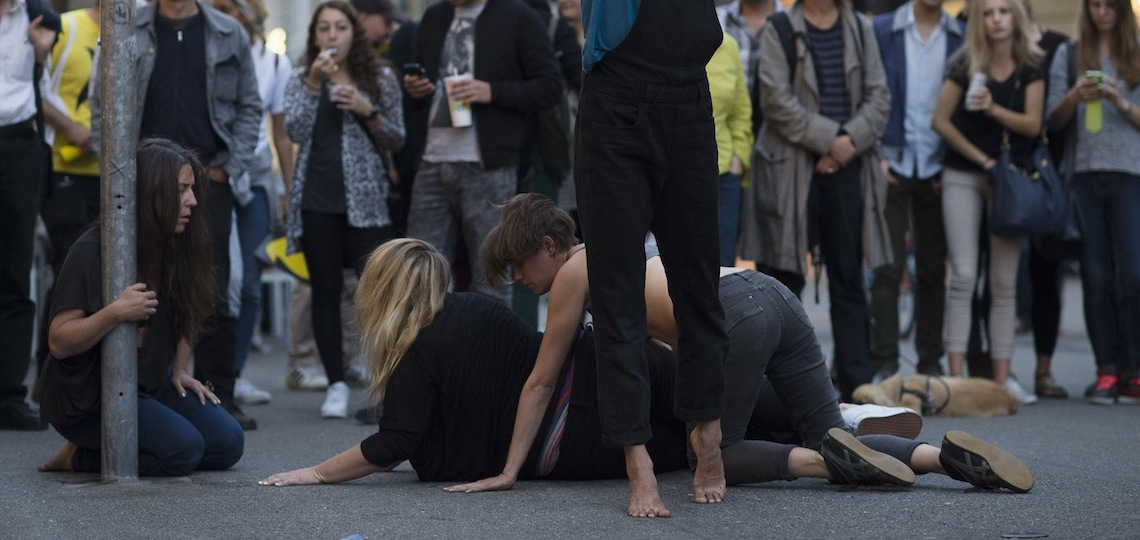
David Foster Wallace’s love of tennis informs unique production based on his readings and interviews (photo by Brian Rogers)
Anspacher Theater at the Public Theater
425 Lafayette St.
Through January 16, $25
212-967-7555
www.publictheater.org
www.danielfish.net
Daniel Fish returns to the Public Theater’s Under the Radar Festival with an ingenious take on the work of Infinite Jest author David Foster Wallace, who committed suicide in 2008 at the age of forty-six. But A (radically condensed and expanded) Supposedly Fun Thing I’ll Never Do Again isn’t about the life or death of the Ithaca-born writer, nor is it a theatrical adaptation of the title short story. It’s not even a celebration of the written word; instead, the ninety-minute show, continuing at the Public’s Anspacher Theater through January 16, focuses on the spoken word, inspired by the way Wallace vocalized, whether narrating an audiobook, giving an interview, or making a speech. Moved by the rhythm, tone, and pattern of Wallace’s voice, Fish, who presented Eternal at last year’s Under the Radar Festival, scoured the archives of the David Foster Wallace Audio Project for essays, short stories, excerpts, and interviews with Wallace and created various setlists of the pieces over the last few years; one stretched to a four-hour marathon. But the audience doesn’t actually hear Wallace; instead, Fish sends Wallace’s audio recordings into headphones worn by performers Mary Rasmussem (Trade Practices), Jenny Seastone Stern (Our Planet), Therese Plaehn (Family Play), and John Amir (All Your Questions Answered), who repeat the words out loud. Fish often changes speeds in the recordings he feeds them, resulting in the actors’ sometimes having to speak very fast, using their bodies to help them keep up.
The current iteration of the show includes such Wallace writings as his outrageously funny 1996 Harper’s piece “Shipping Out: On the (Nearly Lethal) Comforts of a Luxury Cruise”; “Forever Overhead,” which takes place at a swimming pool as a boy turns thirteen; and “How Tracy Austin Broke My Heart,” an essay/book review that delves into Wallace’s longtime love of tennis. In fact, the sport plays a central role in the production. As the audience enters the theater — seating is general admission — a tennis machine is shooting yellow balls at a picture of Tracy Austin taped to the wall. The tennis balls remain on the stage throughout the show. The actors, who at one point move all the balls to the back of the stage, are in a kind of tennis match themselves, waiting for the words to come to them (they don’t know which parts Fish will send them or how fast he’ll make them) as if preparing for the next tennis shot, ready to volley Wallace’s words at the audience, but it goes beyond mere repetition and into a sheer love of language. Even at ninety minutes, A (radically condensed and expanded) Supposedly Fun Thing I’ll Never Do Again feels a little too long — when you’re reading a short story or listening to an audiobook, you have the ability to stop for a while and ponder what you’ve read or heard, but in this case there’s no off switch — but it’s most definitely a fun thing, even if we haven’t decided whether we’ll ever do it again. But one thing we’ll definitely do is read or listen to a whole lot more by Mr. Wallace.




 They don’t come much bigger than Orson Welles in his dark potboiler Touch of Evil, as he nearly bursts through the frame as spectacularly dastardly police captain Hank Quinlan. A deliciously devious corrupt lawman, Quinlan is an enormous drunk who has no trouble breaking the rules to get his man. Charlton Heston took a lot of criticism playing Mike Vargas, a Mexican drug enforcement agent newly married to beautiful blonde Susan (Janet Leigh), who soon finds herself menaced by a dangerous gang as a weak-kneed, pre-McCloud Dennis Weaver looks the other way. The film famously opens with a remarkable crane shot that goes on for more than three minutes, setting the stage like no other establishing shot in the history of cinema. And the final scene with Marlene Dietrich as sultry hooker Tana is a lulu as well, highlighted by one of the great all-time movie lines. What goes on in between is a lurid tale of murder and revenge filled with unexpected twists and turns, featuring appearances by such Welles regulars as Joseph Cotten, Akim Tamiroff, Joseph Calleia, and Ray Collins. There was a lot of hype surrounding the film in 1998 when it was restored to match Welles’s original desires, but the final product lives up to its billing. As part of its “Orson Welles 100” festival, honoring the centennial of the always controversial auteur’s birth, Film Forum is screening three different versions of this deeply affecting noir masterpiece: the 108-minute pre-release version on January 14 (with the 7:00 show introduced by Welles historian Joseph McBride), the 93-minute original theatrical edition on January 29, and the 111-minute reconstruction on February 1-2. The Welles festival continues through February 3 with such double features as The Lady from Shanghai and The Third Man, Compulsion and The Long, Hot Summer, and Jane Eyre and Tomorrow Is Forever, multiple versions of Macbeth, and two evenings of Wellesiana rarities hosted by series consultant McBride, author of What Ever Happened to Orson Welles? A Portrait of an Independent Career.