AMERICAN REALNESS
Abrons Arts Center Playhouse
466 Grand St. at Pitt St.
Sunday, January 18, $20, 7:00
212-598-0400
www.americanrealness.com
www.jackferver.org
In 1964, dancer, actor, and choreographer Fred Herko, a native New Yorker, took a bath at a friend’s house, then danced naked right out the window, committing suicide at the age of twenty-eight. A half century later, dancer, actor, and choreographer Jack Ferver, born in Wisconsin fifteen years after Herko’s death, uses Herko’s story to examine his own life, which includes battling depression and suicidal thoughts. The bare-bones show, which premiered this past week at the Abrons Arts Center Playhouse as part of the American Realness festival, begins with Ferver prancing around an empty stage while glancing at himself, and the audience, through an oval mirror in his hands, immediately announcing that while Night Light Bright Light might ostensibly be a tribute to Herko, it is very much about Ferver. In such previous works as Two Alike, Rumble Ghost, and All of a Sudden, Ferver has employed pop-culture references, awkward and inventive movement, experimental music, and public confession with a bold intimacy that makes his devoted audiences burst out in laughter as well as squirm uncomfortably in their seats — often at the same time — and that’s very much the case with this latest piece. Joined by friend and costume designer Reid Bartelme, who displays a fine balletic grace and wry sense of humor, Ferver apologizes for Night Light Bright Light being so spare while his previous piece, Chambre, which debuted at Bard in November, was so elegant and fancy; reenacts a memory from his childhood, force-feeding himself imaginary pudding; delves into the nature of therapy and rehab, wondering if they could have helped save Herko; channels Madonna and Blanche DuBois; talks about the surprise suicide of a young costar in a 1999 film; and playfully performs several pas de deux with Bartelme, featuring some very funny choreography. Ferver ends the nearly hour-long show with a video that gets to the heart of what his work is all about, combining extreme highs and devastating lows in riotous yet heartbreaking ways that will have some people in stitches, others praying that it ends quickly. Fortunately, there seems to be no end to Ferver’s unique brand of creativity.

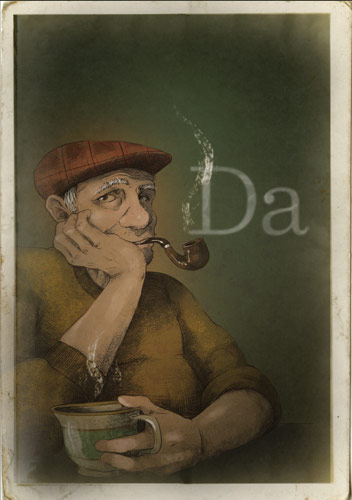
 “I am a self-taught raving maniac, but not as crazy as Tomi, or as great as Tomi,” Maurice Sendak says early on in Brad Bernstein’s engaging documentary, Far Out Isn’t Far Enough: The Tomi Ungerer Story, adding, “He was disarming and funny and not respectable at all.” Another children’s book legend, Jules Feiffer, feels similarly, explaining, “Tomi was this wonderfully brilliant, innovative madman.” Born in Alsace in 1931, Tomi Ungerer developed a remarkably diverse career as an illustrator, incorporating the emotional turmoil he suffered after losing his father when he was still a young child and then living under Nazi rule. In Far Out Isn’t Far Enough, Ungerer takes Bernstein and the audience on a fascinating journey through his personal and professional life, traveling to Strasbourg, Nova Scotia, New York City, and Ireland, which all served as home to him at one time or another as he wrote and illustrated such picture books as The Three Robbers and Crictor for editor Ursula Nordstrom, made bold political posters in support of the civil rights movement and against the Vietnam War, and published a book of erotic drawings, Fornicon, that ultimately led to a twenty-three-year exile from America during which he stopped making books for children. “I am full of contradictions, and why shouldn’t I be?” the eighty-one-year-old Ungerer says in the film. Ungerer discusses how he uses fear, tragedy, and trauma as underlying themes in his stories, trusting that kids can handle that amid the surreal nature of his entertaining tales.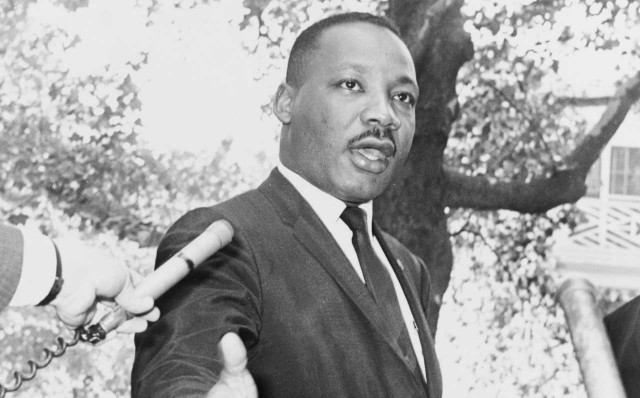


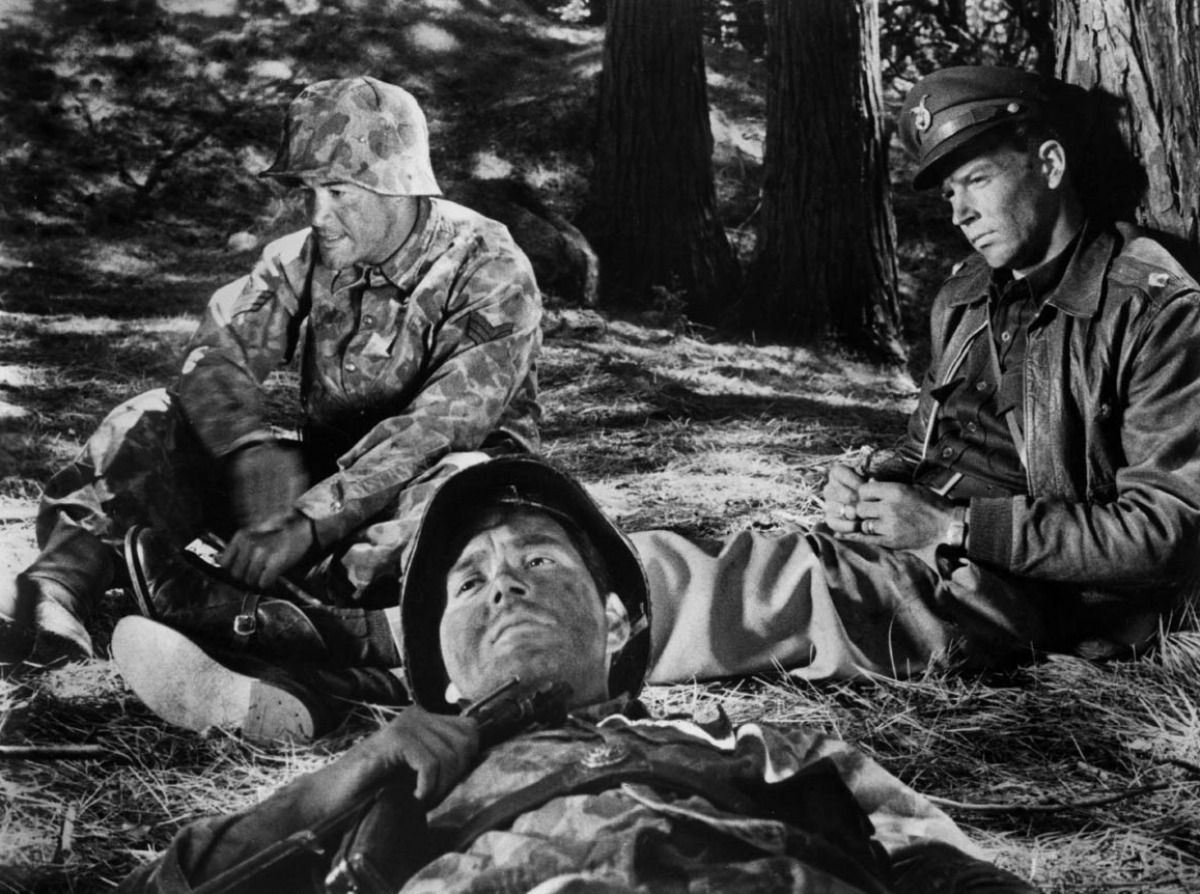
 Fear and Desire, Stanley Kubrick’s seldom-seen 1953 psychological war drama and his first full-length film, made when he was just twenty-four, is a curious tale about four soldiers (Steve Coit, Kenneth Harp, Paul Mazursky, and Frank Silvera) trapped six miles behind enemy lines. When they are spotted by a local woman (Virginia Leith), they decide to capture her and tie her up, but leaving Sidney (Mazursky) behind to keep an eye on her turns out to be a bad idea. Meanwhile, they discover a nearby house that has been occupied by the enemy, and they argue over whether to attack or retreat. Written by Howard Sackler, who was a high school classmate of Kubrick’s in the Bronx and would later win the Pulitzer Prize for The Great White Hope, and directed, edited, and photographed by the man who would go on to make such powerful, influential war epics as Paths of Glory, Full Metal Jacket, and Dr. Strangelove or: How I Learned to Stop Worrying and Love the Bomb, Fear and Desire features stilted dialogue, much of which is spoken off-camera and feels like it was dubbed in later. Many of the cuts are jumpy and much of the framing amateurish. Kubrick was ultimately disappointed with the film and wanted it pulled from circulation; instead it was preserved by Eastman House in 1989 and restored twenty years later, which was good news for film lovers, as it is fascinating to watch Kubrick learning as the film continues. His exploration of the psyche of the American soldier is the heart and soul of this compelling black-and-white war drama that is worth seeing for more than just historical reasons.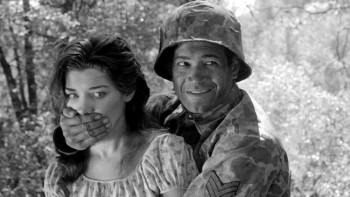
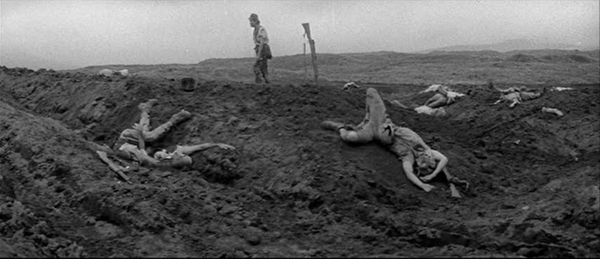
 Kon Ichikawa’s Fires on the Plain is one of the most searing, devastating war movies ever made. Loosely based on Shohei Ooka’s 1952 novel and adapted by Ichikawa’s wife, screenwriter Natto Wada, the controversial film stars Eiji Funakoshi as the sad sack Tamura, a somewhat pathetic tubercular soldier on the island of Leyte in the Philippines at the tail end of World War II. After being released from a military hospital, he returns to his platoon, only to be ordered to go back to the hospital so as not to infect the other men. He is also given a grenade and ordered to blow himself up if the hospital refuses him, which it does. But instead of killing himself, Tamura wanders the vast, empty spaces and dense forests, becoming involved in a series of vignettes that range from darkly comic to utterly horrifying. He encounters a romantic Filipino couple hiding salt under their floorboards, a quartet of soldiers stuffed with yams trying to make it alive to a supposed evacuation zone, and a strange duo selling tobacco and eating “monkey” meat. As Tamura grows weaker and weaker, he considers surrendering to U.S. troops, but even that is not a guarantee of safety, as the farther he travels, the more dead bodies he sees. Fires on the Plain is a blistering attack on the nature of war and what it does to men, but amid all the bleakness and violence, tiny bits of humanity try desperately to seep through against all the odds. And the odds are not very good. Fires on the Plain is screening January 19 at 1:00 at the Walter Reade Theater as part of the War Against War sidebar program of the twenty-fourth annual New York Jewish Film Festival, which focuses on antiwar films from the 1950s and 1960s; the schedule also includes Gillo Pontecorvo’s Battle of Algiers, Stanley Kubrick’s Fear and Desire, Konrad Wolf’s I Was Nineteen, Jean-Luc Godard’s Les Carabiniers, and Peter Watkin’s The War Game, anchored by a panel discussion on January 19 at 3:00 at the Elinor Bunin Munroe Film Center (free with