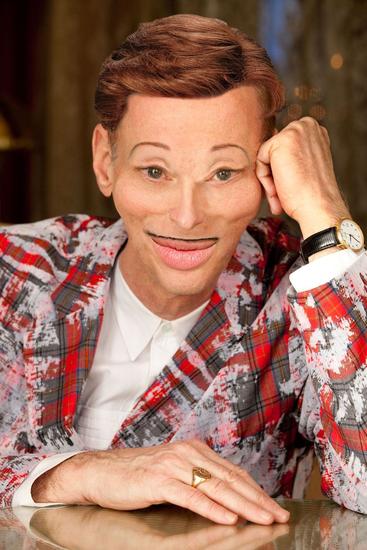
John Waters, “Beverly Hills John,” C-print, 2012 (courtesy of the artist and Marianne Boesky Gallery)
Marianne Boesky Gallery
509 West 24th St. between Tenth & Eleventh Aves.
Tuesday – Saturday through February 14, free, 10:00 am – 6:00 pm
212-680-9889 www.marianneboeskygallery.com
King of Filth John Waters gives Hollywood celebrity culture, and himself, an extremely funny and clever facelift in his latest exhibit at Marianne Boesky in Chelsea. “Beverly Hills John” consists of photography, collage, sculpture, installation, and a new full-length film, his first as writer and director since 2004’s A Dirty Shame. (In the meantime, the Baltimore native has been performing his one-man show, This Filthy World, and writing such books as Role Models and Carsick: John Waters Hitchhikes Across America.) “Separate But Equal” is a black-and-white C-print of a black man drinking from a water fountain labeled “Gay Single,” which is connected to a sink labeled “Gay Married.” In “Library Science,” Waters offers adult takes on classic literature covers, turning, for example, Ian Fleming’s Chitty Chitty Bang Bang into Dion Dermot’s Clitty Clitty Bang Bang and Erskine Caldwell’s God’s Little Acre into Channy Wadd’s God’s Little Faker. Waters pays homage to innovative multimedia artist Mike Kelley, who committed suicide in 2012, with “R.I.P. Mike Kelley,” a miniature sculpture of a cozy living room with a fireplace, comfy chair, and cat urn. The Death character from Ingmar Bergman’s The Seventh Seal hovers over a deplaning John F. Kennedy and Jackie O in “Grim Reaper.” In “Brainiac,” Waters reconstructs a tabloid magazine cover with such headlines as “Joan Didion Hits 250 Pounds!” and “Nude Photos of W. H. Auden Found!” Waters alternates pictures of a flustered Curly from the Three Stooges with shots of rectal exams in “Probe.” (In an odd coincidence, a man named John Waters served as assistant director on the 1933 film Broadway to Hollywood, in which Moe and Curly make cameos as clowns.) “Stolen Jean Genet” is a re-creation of the headstone of French writer and activist Jean Genet, which was actually stolen and is still missing. And in “Mom and Dad,” Waters repurposes stills from William Beaudine’s 1945 film Mom and Dad, which features a notorious sexual hygiene movie used as a terrifying teaching tool.
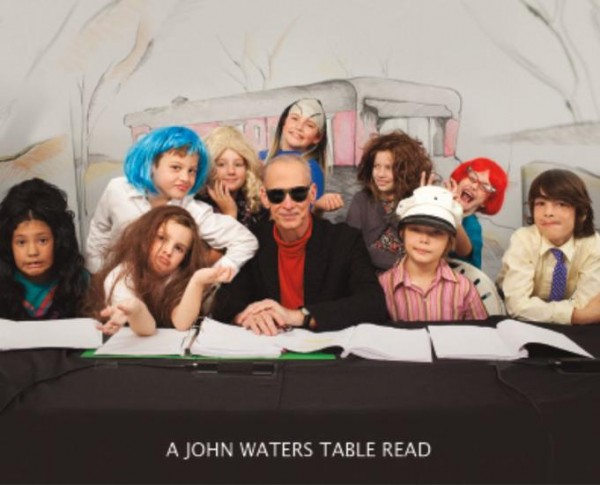
John Waters’s latest exhibit is highlighted by new film showing children reading script of cleaned-up version of PINK FLAMINGOS retitled KIDDIE FLAMINGOS
The centerpiece of the show is the seventy-four-minute Kiddie Flamingos, in which Waters films children doing a table reading of a somewhat, er, watered-down version of the script of Waters’s breakthrough 1972 trailer-park cult black comedy, Pink Flamingos, about Babs Johnson (Divine), her son, Crackers (Danny Mills), her mother, Edie (Edith Massey), their friend Cotton (Mary Vivian Pearce), and their battle with the mean and nasty Marbles (David Lochary and Mink Stole). The children, in various stages of garish makeup, including one boy with a pencil-thin mustache playing the narrator (Waters), don’t always understand what they’re saying, but it’s a riot to watch them tell this hysterical tale of oddballs who have rather extreme eccentricities. Waters, of course, is not above making fun of himself and his own eccentricities as well. The title piece is a creepy self-portrait that depicts him as a victim of plastic surgery gone terribly wrong, in between photos of fellow knife casualties Justin Bieber and Lassie. Sitting empty in the gallery is “Bill’s Stroller,” emblazoned with the names of strip clubs and boasting a spiked leather harness meant for Waters’s fake baby, Bill. (He really does have an angry doll-child he calls Bill who he keeps at home.) And in “Self Portrait #5,” Waters casts himself as a dogcatcher, smiling devilishly at the viewer and holding a carrier with a cute little puppy inside. It’s a wonderfully sly image, emblematic of all of us who treasure Waters’s ongoing counterculture shenanigans, willing to be carried by him wherever he may go as he continues to fight the establishment in his unique, wickedly subversive ways.
Chargaux and Cedar Lake team up for exciting immersive performance installation in Chelsea (photo by twi-ny/ees)
Cedar Lake Contemporary Ballet
547 West 26th St. between Tenth & Eleventh Aves.
February 6-7, $35, 7:00 & 9:00
212-244-0015 www.cedarlakedance.com
Cedar Lake Contemporary Ballet’s latest biannual immersive performance installation is their best yet, a thrilling display of movement and music that cohesively melds the vast skills of the talented sixteen-person Chelsea company with the unique sounds of Brooklyn-based string duo Chargaux. About fifteen minutes before the start of the event, which is choreographed by the full company along with artistic director Alexandra Damiani, the dancers start walking around the Chelsea space as the audience filters in. Dressed in all black, the serious-faced dancers occasionally pair off into brief pas de deux as they make their way around a central circular stage in silence. They hug, push, lift, and writhe on the floor with one another, weaving through the growing crowd. At the top of the hour, Jasper Gahunia’s electronic score kicks in and the show revs into high gear. Over the course of the next hour or so, the performers range about the room, gathering on the center stage, jumping onto large and small platforms on the south and east sides, climbing the light riggings to the north, and popping up high on a riser to the west. Charly and Margaux, wearing long, colorful skirts and tight tan bras, sometimes find themselves in the middle of the action — or grinding off to the side with one of the hulky male dancers. Nicholas Houfek’s lighting will suddenly shine on a specific area where a dance will break out, then shift to another corner. The eight women dancers (Vânia Doutel Vaz, Ida Saki, Rachelle Scott, Ebony Williams, Madeline Wong, Jin Young Won, Navarra Novy-Williams, and apprentice Daphne Fernberger) take over the stage, followed by the eight men (Jon Bond, Joaquim de Santana, Joseph Kudra, Matthew Rich, Nickemil Concepcion, Guillaume Quéau, Raymond Pinto, and apprentice Patrick Coker), in a kind of battle of the sexes. At one point, the dancers form into two horizontal lines and circle the stage, the audience moving with them, a rapturous moment of intimate bonding. Soon the black skirts and tops come off, the women magically manipulate the men from above, and then everyone joins in for an exciting finale featuring a musically erotic flourish. There will be two more performances on February 7; Cedar Lake will then hit the road, returning to New York City in June for four shows at BAM consisting of Crystal Pite’s Ten Duets on a Theme of Rescue, Johan Inger’s Rain Dogs, and a new piece by Richard Siegal on June 3 & 5 and Jacopo Godani’s Symptoms of Development and Emanuel Gat’s Ida? on June 4 & 6.
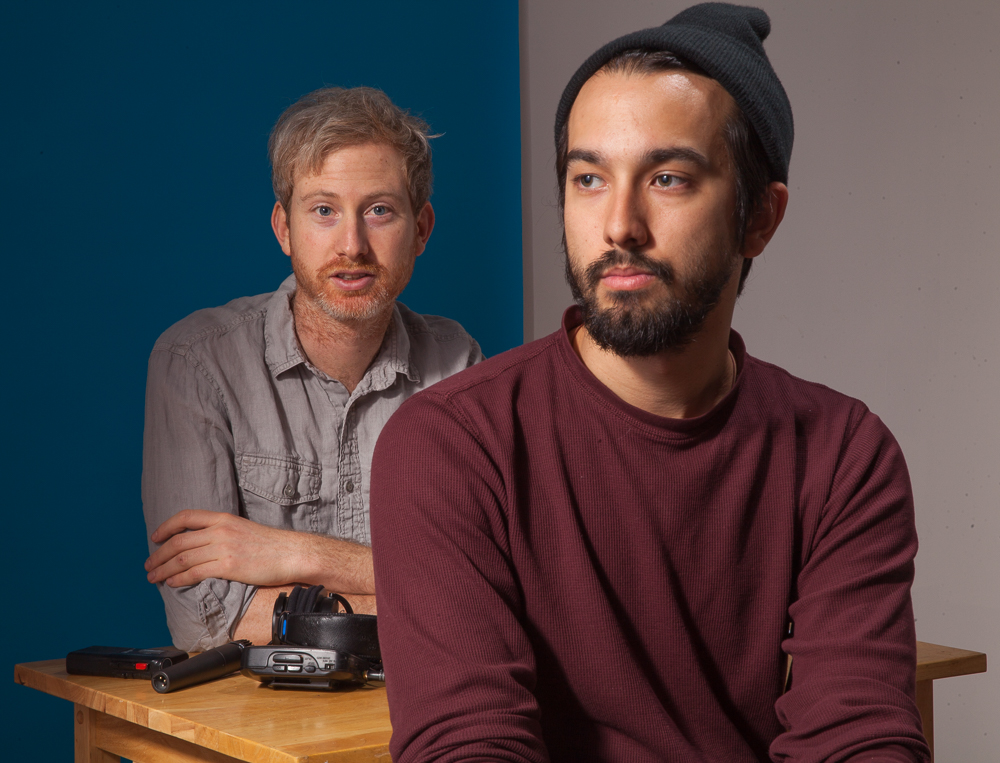
Writer Paul Rome and composer Roarke Menzies have collaborated on new audio fiction work (photo by Joshua Simpson)
COMPOSERS NOW FESTIVAL: PHILADELPHIA AND OTHER STORIES
Walkerspace
46 Walker St. between Church St. & Broadway
Wednesday – Saturday, February 11-21, 8:00 www.philadelphiaandotherstories.com
It’s a match made in Brooklyn. Writer Paul Rome and composer Roarke Menzies got to know each other at the Wyckoff Starr Coffee Shop in Bushwick, where Rome works as manager. Soon they were collaborating, working on audiocentric stage presentations that were written and performed by Rome, with an electronic score composed and played live by Menzies. They first worked together on the radio play And Once Again, followed by the audio epic The You Trilogy, a series of monologues about a fiction writer created for online streaming and download. For their next project, Calypso, Rome and Menzies took to the stage of the Bushwick Starr to investigate Homer and Virgil, young love and a tandem bicycle ride. They are now collaborating on Philadelphia and Other Stories, a collection of short pieces that is moving to Walkerspace in downtown Manhattan following a sold-out run at the Bushwick Starr. The work, which mythologizes memory, will be performed by Rome and Menzies, along with actress Katie Schottland and songs by Katie Mullins and David Kammerer. Rome, whose debut novel, We All Sleep in the Same Room, was longlisted for the 2014 PEN/Bingham Prize for debut fiction, and Menzies, who composes scores for such choreographers as Adam H. Weinert, Adam Barruch, and Jack Ferver, recently discussed their creative process, the City of Brotherly Love, and making the move from Brooklyn to the Big Apple as they prepared for the Manhattan debut of Philadelphia and Other Stories, part of the month-long Composers Now Festival.
twi-ny: How did the two of you meet?
Roarke Menzies: Paul and I were neighbors for a long time in Bushwick. He kept mentioning this “radio play” he was working on at the time. This was early 2010. We’d bump into each other pretty often at the coffee shop. One day he asked me to come over and listen to what he had. I was immediately into it. The writing was really strong and I just saw so much potential in developing this format. It had certain similarities to things I was familiar with from experimental theater and contemporary performance practices, but the way it zeroed in on the sound world, and more specifically the audio world — the microphonic voice, recorded sounds, everything mediated by loudspeaker and transistor — felt particularly vital and fresh. It was right up my alley.
Paul Rome: The only thing I’d ever heard of Roarke’s was a participatory improvisation at this salon my ex-girlfriend used to host in our living room. He passed out three or four Walkmen with these prerecorded textural patterns on them and people could manipulate the sounds by rewinding or fast-forwarding or changing the tape speed while he listened and did a vocal improvisation with effect pedals. It worked really beautifully.
twi-ny: What initially made you want to work together?
PR:I was really impressed by Roarke that first day he came over to listen to my radio play, And Once Again. He was really supportive and enthusiastic and seemed to intuitively get what I was trying to accomplish. He’s also technically capable in ways I’m not, so he was able to do things like mixing and rearranging my music, coaching my performance and really helping to turn a piece of text into a work for the stage. We became close friends during that project.
twi-ny: You’ve now worked together on four projects. How has the process of your collaboration evolved?
RM: When we first started working together, the projects were really Paul’s and I would play a supporting role, helping shape and realize the vision from behind the scenes. Calypso, a show we premiered in 2012, was really our first equal collaboration where we shared the stage, shared the bill, and had equal creative duties. Paul then asked me to work with him on substantive edits to his novel. So we’ve also developed a strong writer–editor relationship.
I think the best thing about our collaborative relationship is that there’s a unity of vision and an intense amount of trust. When you’re working on something new, you don’t necessarily know what that thing is yet, but there’s this vision in your imagination that you’re trying to pursue. Because we’ve worked so intensely on a number of projects, and because we’ve had so many fruitful conversations, there’s this shared vocabulary and a thorough thematic or dramaturgical language that we can refer to. In a collaboration like this, it’s really rare, I think, to be able to trust that when you each look at that vision in your heads, you’re both seeing the same thing.
PR: It’s true. We also argue a lot over the details. For me, that ability to argue and speak openly is the most important aspect of collaboration. We both want everything to be perfect and to adhere to a unified aesthetic and vision. We’re not above arguing over the angle of a chair onstage or the color of the text on the back of a promotional flyer for a few hours. Everything is important. If we fail, whatever that means, I still get to have the satisfaction of knowing that we didn’t fail out of laziness or succumbing to any preconceived notion of what our work ought to look like or sound like. The downside of collaborating with a friend is that it gets hard to talk about things other than our various projects. Roarke told me that for months after my novel came out, I talked about little else. I still feel bad about that.
twi-ny: You’ve previously presented your pieces, including Philadelphia and Other Stories, at the Bushwick Starr, but now you’re making the big move to Manhattan, performing the show at Walkerspace. How did that opportunity come about? Are you more excited or nervous about the Manhattan run?
RM: When we were mounting the premiere of Philadelphia at BWS, we really hit it off with Chip Rodgers, the production manager there. Chip also used to work at Soho Rep. and has been involved in a number of other important productions, including Ira Glass’s touring show with the choreographer Monica Bill Barnes. When the BWS run ended, Chip and I discussed the possibility of him coming on board as a producer for a potential remount of our show. Shortly after that, Chip came to us about this last-minute opportunity at Walkerspace.
With regard to the run in Manhattan, I’m mostly just thrilled to be performing this work again, and glad more people will get to see it. It’s in such a beautiful and well-equipped space, and a more substantial run, so we’ll really get to dig into the material.
PR: I agree; it’s gratifying to be able to extend this performance. I feel lucky. I can’t really separate my nervousness from my excitement. Both emotions are firing simultaneously right now. On a personal note, I’m looking forward to spending a few weeks in Manhattan. My life has become pretty Brooklyn-centric, but I spent two of my first years in New York living on Lafayette just south of Walker Street, and apparently my uncle lived next door to the theater in the ’80s, so it’s exciting to be downtown again. Manhattan, at least in memory, still possesses this incredible energy and stimulating confluence of different cultures and people.
twi-ny: You’re also collaborating with singer-songwriters Katie Mullins and David Kammerer. How did that come about?
PR: We were both big fans of their work prior to this production. I’ve seen each of them live on a number of occasions and have always been moved. Both have beautiful solo records. We wanted musicians who could accompany themselves and deliver stories in the same way that Roarke, Katie Schottland, and I do during the show. Their songs have a moody, introspective quality as well as a rhythmic pulse that conveys a traveling and Americana feeling to me, both of which are central themes in the show. Roarke shot each of them an email and they said yes. We found out later that Katie had been taking a break from music since wrapping promotion and touring for her last record. But after the performances at BWS, she’s started writing again. To help inspire something like that is really satisfying. It makes it all worth it.
twi-ny: Do you each have personal experience with Philadelphia? What made that city the centerpiece of this project?
RM: I first went to Philadelphia when I was in high school. Our choir did a minitour to DC, Philly, and Baltimore, performing in a few venues and churches, including the Washington National Cathedral. The only other time I’ve been was in 2013 when I composed a score for the choreographer Adam Barruch, who was making a piece on a Philadelphia-based contemporary ballet company called BalletX. So I’ve only ever spent a day or two there at a time. I guess it’s always felt like a place to visit, or a stop on a tour, the kind of place you pass through.
PR:Philadelphia was the first story we completed for this project and it has a lot of the themes embedded in it. Certain aspects of that narrative are autobiographical: I went to Philadelphia a few years ago on New Year’s to see an automaton I read about in the New York Times. Although it’s only momentarily alluded to in the story, Philadelphia has this incredible parade called Mummers on New Year’s Day, which I was completely unaware of. When I left New York in the morning, everyone I passed on the street looked depleted and sad, presumably hung over from New Year’s Eve, but the moment I arrived in Philly, which took less than two hours to get to, everyone appeared upbeat and cheerful. People were friendly and drinking on the street. It was a surreal experience. I felt inspired, and gradually the idea for writing a series of stories around traveling took shape. It seemed like an effective way to explore relationships and memories and time without it feeling forced.
Cities, generally, I think, especially ones you don’t know intimately, can possess a certain allure — just hearing the name “Philadelphia” or “Memphis” or “Grand Rapids,” etc. You know that if you went there you’d encounter this whole separate ecosystem of lives and habits and restaurants and relationships. Sometimes actually visiting these places can feel disconcertingly familiar or disappointingly mundane, yet something exotic and mysterious remains. There’s all this potential.
twi-ny: Your work has a kind of analog feel in the digital age. What attracted you to this kind of staging? Just the term “radio play” is very old-fashioned, very Beckett.
RM: The physical and visual staging, even the placing of the work on a stage, is meant to frame the audio/aural experience. We dress the room in spare furnishings and lamplights, but in a lot of ways the “setting” of the work is similar to some of Beckett’s works, in that it sort of takes place “in your head” (the character’s and/or the audience’s).
It’s funny you bring up Beckett. My dad is a theater director and acting coach in LA, and he’s also a huge Beckett fan. I only found out recently, last year maybe, that one of the experiences that got him really into theater, and Beckett in particular, was acting in a production of Krapp’s Last Tape back when he was twentysomething. I’m not terribly familiar with Beckett’s body of work, and I hadn’t heard of that one before. It turns out Krapp’s Last Tape is a one-person play in which a man sits at a desk with a reel-to-reel tape player (it was written in the ’50s) that he uses to play back and record various memories from his life. I was really struck not only by the similarities between the Beckett play and my work with Paul but also by the similarities between what my dad was doing in his twenties and what I’m now doing in mine.
PR: Creating work for the stage, translating the type of literature I’m drawn to into something performative, has never been motivated by a conscious desire to do something old-fashioned. This is my way of bringing storytelling to an audience in a format that I feel is conducive to close listening. Since I was a kid, close listening, whether it was a bedtime story from my dad or a record by Miles Davis, has remained incredibly important to me. I find it sustains me somehow in a way that’s both intellectually stimulating and cathartic. I can’t deny that there’s something particularly inspiring and charming to me about the radio play, the unadorned and ingenious methods used and the way it requires the audience to rely on her or his imagination. I don’t consider Philadelphia and Other Stories a radio play in the traditional sense, but it certainly draws from that tradition. I think there’s a lot of potential to marry the old and the new, analog and digital, in thoughtful and fluid directions.
RM: There’s been some writing and theorizing about the relatively recent dominance of “visual culture” over “aural culture.” I guess it’s pretty obvious when you look at the ubiquity of televisions or flatscreens, graphic user interfaces or, more recently, touch screens and mobile devices. But an “unforeseen” aspect of this visual overstimulation is that the auditory faculties seem to be underappreciated. People relate this to recent technological advances, but some argue that it started with the transition of power from oral to written word as the more dominant use of language. You can also consider architecture, the built environment, where thin walls create visual privacy but are next to useless with regard to aural privacy or noise pollution. I think part of the reason Philadelphia and Other Stories feels anachronistic is because it’s an audiocentric work. But I think that’s all the more appropriate, since it deals with memory and retrospection, with presence being out of time.
twi-ny: What’s next for the two of you?
RM: It’s a pretty busy season for me. Jack Ferver will be bringing Chambre, a new work of his that I soundtracked, to the American Dance Institute in DC on February 20-21. I’m finishing another commission for Adam Barruch for a piece he’s making on River North Dance Chicago. That’s premiering at the Auditorium Theatre in Chicago on March 28. Then I’m also finishing up some music for a feature that’ll premiere at the Tribeca Film Festival in April. (It hasn’t been announced yet, so I can’t name names.) From there, I’m hoping to focus on an audio work I’ve got planned.
PR: I’d really like to make some audio recordings with Roarke of our projects. I also want to collaborate again with the filmmaker Natalie Leite. A few years ago, she and I did a film short based on a short story of mine [The Game]. We’ve been discussing some ideas for a new feature. Somewhere inside me the elements of a second novel are brewing.
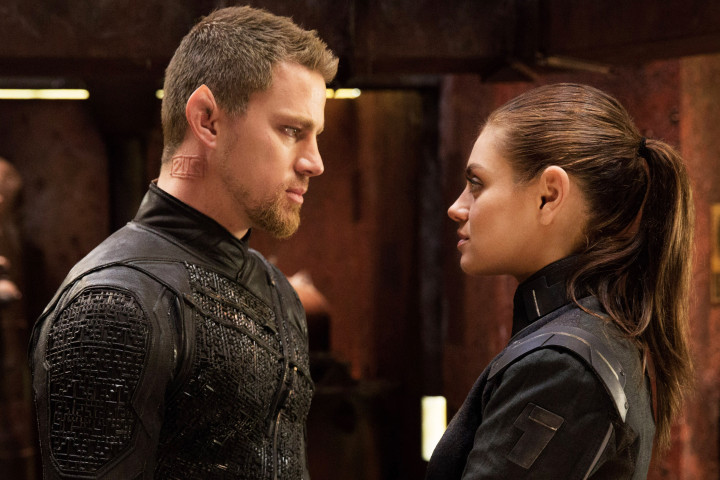
Channing Tatum and Mila Kunis star in the Wachowskis’ sci-fi/fantasy mashup JUPITER ASCENDING
JUPITER ASCENDING (Lana and Andy Wachowski, 2015)
Opens Friday, February 6 www.jupiterascending.com
Lana and Andy Wachowski have followed up their 2012 adaptation of David Mitchell’s Cloud Atlas with the sci-fi mashup Jupiter Ascending, which was initially supposed to be released last summer but instead is hitting theaters on February 6, as Earth is passing between the sun and Jupiter. The stars and planets might not quite be in alignment for the film, which is taking quite a beating from most critics, but it turns out that Jupiter Ascending is actually rather fun, even if it’s not quite as stupid as you want it to be. (Hey, any movie that delves into the “royal bowels” is fine with us.) Essentially, the Wachowskis (the Matrix trilogy, Bound) have taken just about every sci-fi/fantasy film and franchise you can think of — Star Trek, Star Wars, Men in Black, Terminator, Highlander, Lord of the Rings, the X-Men, Superman, Spider-Man, the Fantastic Four, Blade Runner, E.T., The Wizard of Oz, Logan’s Run, Gravity, Wings of Desire, Close Encounters of the Third Kind (and yes, that is Terry Gilliam himself in an homage to Brazil) — put them in a blender, and mixed them together to come up with a space opera about a toilet-scrubbing Cinderella, born Jupiter Jones (Mila Kunis), who is discovered to be the genetic queen of a powerful world that harvests planets. She finds a protector in the splice hunter Caine Wise (Channing Tatum), who seeks additional help from the grizzled Stinger Apini (Sean Bean), as Jupiter’s “children” — the evil and twisted Balem Abrasax (Eddie Redmayne), the handsome playboy Titus (Douglas Booth), and the beautiful and elegant Kalique (Tuppence Middleton) — all want to regain possession of Earth away from the “reccurence.”
JUPITER ASCENDING boasts big-time set design, often in lieu of story
Set in Chicago and the multiverse, Jupiter Ascending likes everything big, preferring special effects and production design to plot credibility as the Wachowskis attempt to tell a King Lear-like story about family and power. There are too many chase scenes that go on too long, and there are only so many dazzling sets you can see before becoming frustrated. Tatum and Kunis actually make for an engaging pair, even if so much of their relationship makes no sense. But there’s a sly grin lurking below it all, from Michael Giacchino’s bombastic score, which references horror films, to John Toll’s overblown cinematography. Oh, did we forget to mention it’s all in 3-D as well? Sure, there’s not a whole lot of originality in this popcorn muncher, but there’s still plenty of silly fun to be enjoyed. The Wachowskis had us at “royal bowels.”
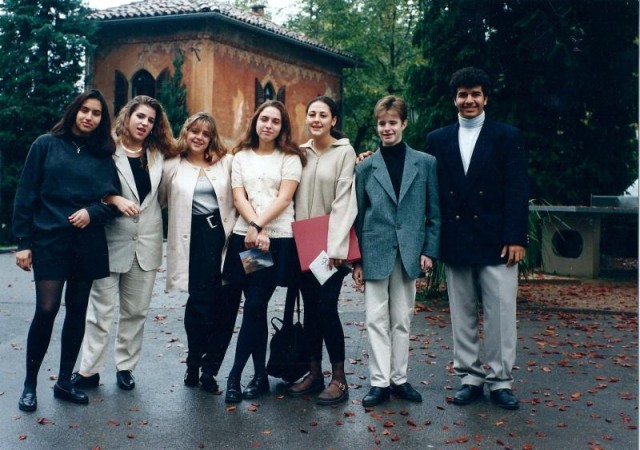
A ghost hangs over every shot of Matt Shepard Is a Friend of Mine, the spirit of a young man whose life was cut short in senseless, brutal violence. On October 6, 1998, twenty-one-year-old Matthew Wayne Shepard was mercilessly beaten by Aaron McKinney and Russell Henderson and died in the hospital less than a week later, a tragic victim of homophobia. Shepard’s beating and death became front-page news not just in his home state of Wyoming but around the world, ultimately leading to hate crimes legislation including, in 2009, the passage of the Matthew Shepard and James Byrd Jr. Hate Crimes Prevention Act. The death of Matthew Wayne Shepard sharpened focus on homophobia and crimes of hate, but in 2010 a group of his friends, led by filmmaker Michele Josue and her husband, Liam McNiff, set out to tell the story of the person they knew simply as Matt. “I miss my friend, and I’m not ready to let him go,” Josue says at the beginning of her debut feature, Matt Shepard Is a Friend of Mine. Josue meets with Shepard’s parents, Judy and Dennis, who talk about what Matt was like as a child and how they learned about his sexual preference; such school friends as Zeina Barkawi, Nikki Pearson, Tim Galles, and Kate Chill, who discuss their close bonds with Matt at schools in Wyoming and Switzerland; his teacher Cynthia Whisenant and guidance counselor Walt Boulden, who shed more light on his character; and others who knew Matt more peripherally, including the undersheriff who handled the case as well as the bartender who was working the fateful night Matt met up with McKinney and Henderson. Josue also delves into a horrific event that happened to Matt in Morocco, something that changed him drastically. The sentimental film includes never-before-seen home movies, photographs, and diary entries that paint a fascinating portrait of a small, skinny kid whose life touched so many.
As expected, the award-winning film festival favorite is overly worshipful of Shepard, even as it does get into some of his demons, especially near the end. Although it doesn’t directly address any of the Matthew Shepard conspiracies out there — in particular, The Book of Matt, in which journalist Stephen Jimenez offers a different theory of why Shepard was beaten and killed — the film feels very much like a defense against those who question the story. Many scenes are also far too personal and intimate, with friends and family members sharing thoughts and worries that are best saved for therapy sessions as they process their grief and guilt on camera. Even so, Matt Shepard Is a Friend of Mine is a powerful, important document of the care and love that emanated from Matt Shepard, both in life and in death.
Fiasco Theater strips INTO THE WOODS down to its bare bones in delightful revival (photo by Joan Marcus)
Laura Pels Theatre
Harold and Miriam Steinberg Center for Theatre
111 West 46th St. between Sixth & Seventh Aves.
Tuesday – Sunday through April 12, $109
212-719-1300 www.roundabouttheatre.org www.fiascotheater.com
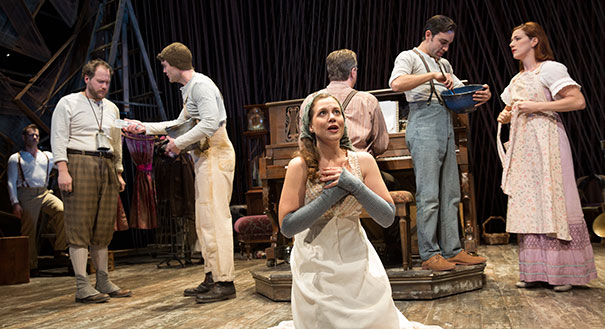
The Fiasco Theater shows that there is no such thing as too much Into the Woods in its utterly delightful, stripped-down version running at the Roundabout’s Laura Pels Theatre through April 12. In the summer of 2012, the Public Theater presented an all-star production (Amy Adams, Denis O’Hare, Donna Murphy, Jessie Mueller) as part of its Shakespeare in the Park season (redubbed Sondheim in the Park for the occasion), and Rob Marshall’s film, with a superstar cast (Meryl Streep, Johnny Depp, Emily Blunt, Chris Pine, et al.), is in theaters now and up for three Oscars. But the Manhattan-based Fiasco company, which was founded by a group of Brown graduates who “believe that it is only when artists are brave enough to risk a fiasco that the possibility exists of creating something special,” have indeed created something special, shining a new light on Stephen Sondheim and James Lapine’s fairy-tale mash-up, which earned ten Tony nominations back in 1988. There are no trees in this new version; instead, Derek McLane’s set consists of piano insides arranged along the sides and top of the stage, with thick, knotted crossed ropes in the back. Chandeliers hang over the actors and the audience as well. There is no orchestra; at the center of the stage, Matt Castle plays a movable piano, and through the course of the evening, other cast members add occasional guitar, French horn, trumpet, calliope, xylophone, bassoon, drums, miniature harp, cowbell, and triangle. All ten cast members are onstage through the whole show, several playing multiple roles; when they are not in the scene, they sit in the background, often looking as gleeful as the audience, taking joy in what is unfolding in front of them.
The Witch (Jennifer Mudge) uses help to scream at Rapunzel (Emily Young) in wonderful adaptation of Sondheim/Lapine favorite (photo by Joan Marcus)
The once-upon-a-time story is about a baker (Ben Steinfeld) and his wife (Jessie Austrian) who learn that they are childless because of a curse placed on his family by a vengeful witch (Jennifer Mudge). To end the curse and have a baby, they must head into the woods and come back with a cow as white as milk, a cape as red as blood, hair as yellow as corn, and a slipper as pure as gold. So off they go, encountering clueless Jack (Patrick Mulryan), who has been sent to market by his mother (Liz Hayes) to sell his beloved bovine (Andy Grotelueschen); Little Red Ridinghood (Emily Young), who is bringing a basket of goodies to her grandmother’s (Claire Karpen) house; Cinderella (Karpen), who wants to go to the prince’s (Noah Brody) festival but is slaving for her wicked stepmother (Hayes) and vicious stepsisters, Lucinda (Brody) and Florinda (Grotelueschen); Rapunzel (Young), who has been imprisoned in a tower by the witch; and a mysterious man (Paul L. Coffey) who knows more than he is letting on. While the first act ends happily, things don’t go nearly so well in the second act, as a giant invades the kingdom, leaving a path of death and destruction in its wake.
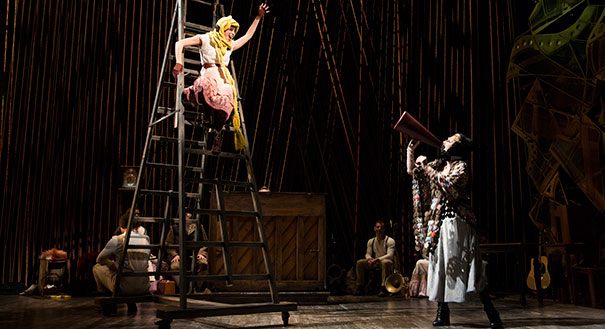
The revival, directed by Brody and Steinfeld, has a ball simplifying the diverse elements, using inventive, low-budget stagecraft to maximum effect. Brody and Grotelueschen, as Cinderella’s stepsisters, hold a curtain rod in front of them to show off their “dresses” for the festival, and as a pair of princes they gallop with little horse heads on sticks (which they hand to audience members when they come to a stop). At one point the baker’s wife sits down on the floor in the aisle and peruses a Playbill. And Rapunzel’s castle is actually a ladder that is moved about the stage — and which nearly every actor walks under, tempting fate. There are plenty of sly nods to the audience, knowing glances, and, primarily, big smiles throughout. Oh, and there’s Sondheim’s simply divine songs as well, from “Hello, Little Girl,” “Maybe They’re Magic,” and “Agony” to “Witch’s Lament,” “Any Moment,” and “Last Midnight,” all delivered with an intoxicating glee, with scrumptiously playful orchestrations by Castle and Frank Galgano. But Fiasco, which has previously tackled Twelfth Night, Measure for Measure, and Cymbeline and will be bringing The Two Gentleman of Verona in Washington, DC, this spring, never lose sight of the show’s central theme — that happily ever after comes with a heavy price. But there’s no need to get too serious, as this is one endlessly fun trip back into the woods.
Documentary looks at the mad rush to get out of Saigon at the end of the Vietnam War (photo courtesy Bettmann/Corbis)
LAST DAYS IN VIETNAM (Rory Kennedy, 2014)
Maysles Cinema
343 Malcolm X Blvd. between 127th & 128th Sts.
Sunday, February 8, 7:30
Series runs February 7-18
212-582-6050 www.maysles.org/mdc www.lastdaysinvietnam.com
To many, the fall of Saigon immediately brings to mind images of men, women, and children climbing the gate at the U.S. embassy, desperately trying to board American helicopters and escape the country as the North Vietnamese army approached. Director and producer Rory Kennedy takes viewers behind the scenes of that madness in the harrowing and revealing documentary Last Days in Vietnam. Kennedy, the youngest daughter of Bobby and Ethel Kennedy, and editor Don Kleszy have woven together remarkable footage from 1970s Vietnam as more than a dozen insiders share their compelling stories, which play out like a gripping thriller with a surprise, emotionally powerful ending. At the center of it all is the late U.S. ambassador Graham Martin, a stubborn patriot who continually refused to vacate the embassy until it was almost too late. U.S. Army captain Stuart Herrington gets personal as he talks about trying to help potential refugees. Secretary of State Henry Kissinger and White House press secretary Ron Nessen discuss President Gerald Ford’s attempts to persuade Congress to fund a major evacuation. CIA analyst Frank Snepp and Special Forces advisor Richard Armitage delve into the military’s plans, while South Vietnamese Navy captain Kiem Do, South Vietnamese Army lieutenant Dam Pham, and Vietnamese student Binh Pho tell what it was like from their vantage points. USS Kirk chief engineer Hugh Doyle, USS Kirk captain Paul Jacobs, and Marine pilot Gerald Berry reveal stunning stories of bravery and daring during the evacuation on land and sea and in the air. If you think this is old news, you’re mistaken, as the film offers a whole new perspective on this seminal moment in the history of two nations — and it’s nearly impossible to watch it without thinking that something similar might occur in Iraq and Afghanistan soon. An American Experience production and nominated for an Oscar for Best Documentary Feature, Last Days in Vietnam is screening February 8 at 7:30 as part of the Maysles Documentary Center series “Oscar Buzz Presents” and will be followed by a Q&A with Kennedy (Ethel, Ghosts of Abu Ghraib); the series includes such other Oscar-nominated and shortlisted films as Laura Poitras’s Citizenfour, Sam Cullman, Mark Becker, and Jennifer Grausman’s Art and Craft, and Al Hicks’s Keep on Keepin’ On.

 Lana and Andy Wachowski have followed up their 2012 adaptation of David Mitchell’s Cloud Atlas with the sci-fi mashup Jupiter Ascending, which was initially supposed to be released last summer but instead is hitting theaters on February 6, as Earth is passing between the sun and Jupiter. The stars and planets might not quite be in alignment for the film, which is taking quite a beating from most critics, but it turns out that Jupiter Ascending is actually rather fun, even if it’s not quite as stupid as you want it to be. (Hey, any movie that delves into the “royal bowels” is fine with us.) Essentially, the Wachowskis (the Matrix trilogy, Bound) have taken just about every sci-fi/fantasy film and franchise you can think of — Star Trek, Star Wars, Men in Black, Terminator, Highlander, Lord of the Rings, the X-Men, Superman, Spider-Man, the Fantastic Four, Blade Runner, E.T., The Wizard of Oz, Logan’s Run, Gravity, Wings of Desire, Close Encounters of the Third Kind (and yes, that is Terry Gilliam himself in an homage to Brazil) — put them in a blender, and mixed them together to come up with a space opera about a toilet-scrubbing Cinderella, born Jupiter Jones (Mila Kunis), who is discovered to be the genetic queen of a powerful world that harvests planets. She finds a protector in the splice hunter Caine Wise (Channing Tatum), who seeks additional help from the grizzled Stinger Apini (Sean Bean), as Jupiter’s “children” — the evil and twisted Balem Abrasax (Eddie Redmayne), the handsome playboy Titus (Douglas Booth), and the beautiful and elegant Kalique (Tuppence Middleton) — all want to regain possession of Earth away from the “reccurence.”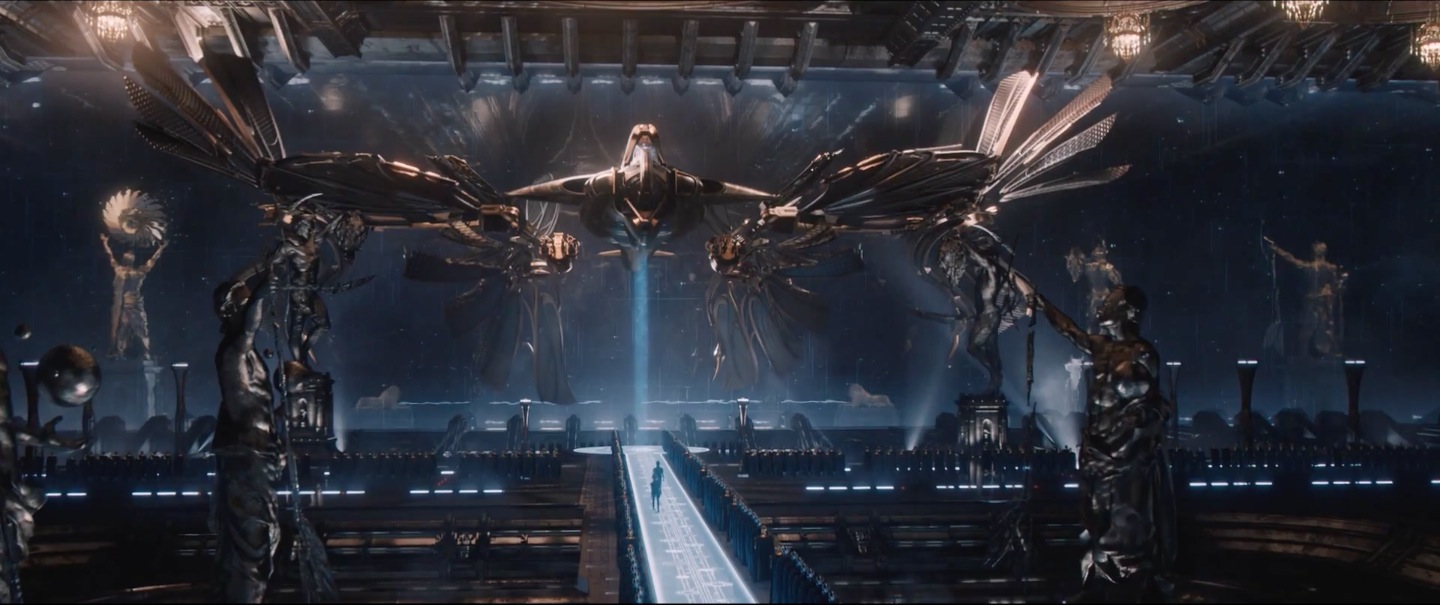
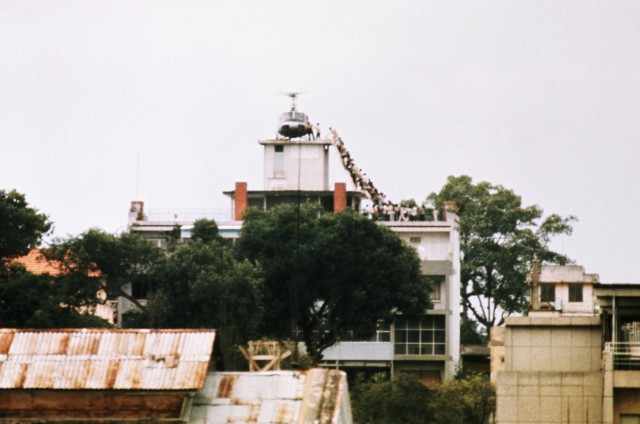
 To many, the fall of Saigon immediately brings to mind images of men, women, and children climbing the gate at the U.S. embassy, desperately trying to board American helicopters and escape the country as the North Vietnamese army approached. Director and producer Rory Kennedy takes viewers behind the scenes of that madness in the harrowing and revealing documentary Last Days in Vietnam. Kennedy, the youngest daughter of Bobby and Ethel Kennedy, and editor Don Kleszy have woven together remarkable footage from 1970s Vietnam as more than a dozen insiders share their compelling stories, which play out like a gripping thriller with a surprise, emotionally powerful ending. At the center of it all is the late U.S. ambassador Graham Martin, a stubborn patriot who continually refused to vacate the embassy until it was almost too late. U.S. Army captain Stuart Herrington gets personal as he talks about trying to help potential refugees. Secretary of State Henry Kissinger and White House press secretary Ron Nessen discuss President Gerald Ford’s attempts to persuade Congress to fund a major evacuation. CIA analyst Frank Snepp and Special Forces advisor Richard Armitage delve into the military’s plans, while South Vietnamese Navy captain Kiem Do, South Vietnamese Army lieutenant Dam Pham, and Vietnamese student Binh Pho tell what it was like from their vantage points. USS Kirk chief engineer Hugh Doyle, USS Kirk captain Paul Jacobs, and Marine pilot Gerald Berry reveal stunning stories of bravery and daring during the evacuation on land and sea and in the air. If you think this is old news, you’re mistaken, as the film offers a whole new perspective on this seminal moment in the history of two nations — and it’s nearly impossible to watch it without thinking that something similar might occur in Iraq and Afghanistan soon. An American Experience production and nominated for an Oscar for Best Documentary Feature, Last Days in Vietnam is screening February 8 at 7:30 as part of the Maysles Documentary Center series “Oscar Buzz Presents” and will be followed by a Q&A with Kennedy (Ethel, Ghosts of Abu Ghraib); the series includes such other Oscar-nominated and shortlisted films as Laura Poitras’s Citizenfour, Sam Cullman, Mark Becker, and Jennifer Grausman’s Art and Craft, and Al Hicks’s Keep on Keepin’ On.