Who: Peter Regli
What: “RH No. 320 (Snow Monsters)”
Where: Flatiron Plaza, intersection of Fifth Ave., Broadway, and 23rd St.
When: Daily through March 13
Why: It’s been a monster of a winter, so Peter Regli’s “Snow Monsters” look right at home on Flatiron Plaza, a dozen marble snowmen hanging out in the shadow of the Flatiron Building next to Madison Square Park. This 320th installment of Regli’s Reality Hacking series, realized and pending public-space interventions that began back in 1995 in Zurich, follows such other New York City projects as 1999’s “Wall Clocks,” 2000’s “Walk/Talk” and “Post No Bills,” 2002’s “Tempo,” and 2009’s “Flag.” A collaboration between the Dominique Lévy Gallery, the New York City Department of Transportation Art Program, and the Flatiron 23rd Street Partnership, “Snow Monsters” invites curiosity not only because the snowmen look real from a distance (and remain in the exact same position no matter the weather) but because they are on a median that often is home to corporate-sponsored initiatives, but these sculptures are not selling anything, instead just helping New Yorkers pay closer attention to their surroundings and, as Regli says, helping to “put question marks into the everyday world. . . . I chose the snowman because of its Buddha-like nature. They appear briefly in the world, bring joy and evoke memories of childhood, then disappear again, melting away without complaint.”
twi-ny recommended events
THE STOOP SERIES — DIGITAL CITY: GOOGLE MAP HACKERS

Artist Jennifer Maravillas, whose ongoing “71 Square Miles” project is part of “Mapping Brooklyn” exhibition, will be at BRIC for Stoop Series discussion on March 3 (photo courtesy Jennifer Maravillas)
Who: Justin Blinder, Brian House, and Jennifer Maravillas
What: “The Stoop Series”
Where: BRIC House, 647 Fulton St., 718-683-5600
When: Tuesday, March 3, free, 7:00
Why: In conjunction with the new exhibition “Mapping Brooklyn,” a joint venture between BRIC and the Brooklyn Historical Society, exhibition artists Justin Blinder and Jennifer Maravillas and media artist Brian House will discuss the use of technology in their work, with a particular focus on Google Maps, as part of “The Stoop Series.” The exhibit, which also includes contributions from Aaron Beebe, Joyce Kozloff, Nick Vaughan and Jake Margolin, and others, continues through May 3 at BRIC and September 6 at BHS. In addition, on March 14 and April 11, Chloë Bass will perform live as part of her “Mental Map” interactive installation; on March 28, Katarina Jerinic will lead “Visit to Erratic Monuments,” a walking tour between BRIC and BHS; and on April 2, BHS will host “Tales from the Vault! Wish You Were Here,” which looks at historical Brooklyn maps and tourism guides.
WIM WENDERS: PARIS, TEXAS
PARIS, TEXAS (Wim Wenders, 1984)
MoMA Film, Museum of Modern Art
11 West 53rd St. between Fifth & Sixth Aves.
Monday, March 2, 3:45, and Wednesday, March 11, 6:15
Series runs March 2-17
Tickets: $12, in person only, may be applied to museum admission within thirty days, same-day screenings free with museum admission, available at Film and Media Desk beginning at 9:30 am
212-708-9400
www.moma.org

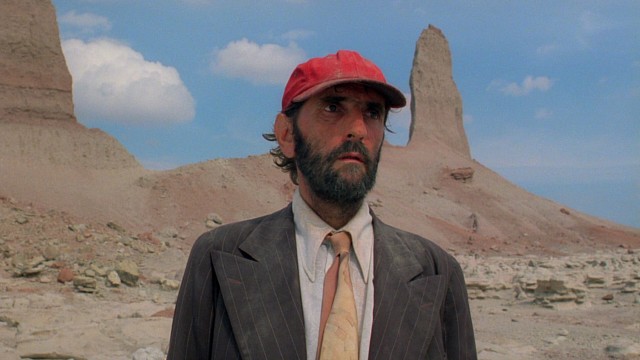
Winner of both the Palme d’Or and the Critics Prize at the 1984 Cannes Film Festival, Wim Wenders’s Paris, Texas is a stirring and provocative road movie about the dissolution of the American family and the death of the American dream. Written by Sam Shepard and adapted by L. M. Kit Carson, the two-and-a-half-hour film opens with a haggard man (Harry Dean Stanton) wandering through a vast, deserted landscape. A close-up of him in his red hat, seen against blue skies and white clouds, evokes the American flag. (Later shots show him looking up at a flag flapping in the breeze, as well as a graffiti depiction of the Statue of Liberty.) After he collapses in a bar in the middle of nowhere, he is soon discovered to be Travis Henderson, a husband and father who has been missing for four years. His brother, Walt (Dean Stockwell), a successful L.A. billboard designer, comes to take him home, but Travis, remaining silent, keeps walking away. He eventually reveals that he is trying to get to Paris, Texas, where he has purchased a plot of land in the desert, but he avoids discussing his past and why he walked out on his wife, Jane (Nastassja Kinski), and son, Hunter (Hunter Carson, the son of L. M. Kit Carson and Karen Black), who is being raised by Walt and his wife, Anne (Aurore Clément). An odd man who is afraid of flying, has a penchant for arranging shoes, and falls asleep at key moments, Travis sets out with Hunter to find Jane and make something out of his lost life.
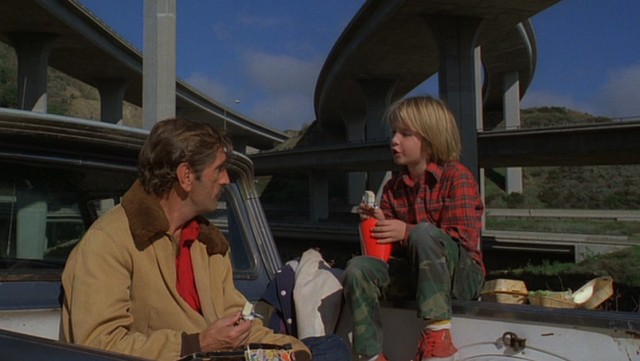
Travis (Harry Dean Stanton) and Hunter (Hunter Carson) bond while searching for Jane in Wim Wenders road movie
Longtime character actor Stanton (Repo Man, Wise Blood) is brilliant as Travis, his long, craggy face and sad, puppy-dog eyes conveying his troubled soul and buried emotions, his slow, careful gait awash in loneliness and desperation. The scenes between Travis and Jane are a master class in acting and storytelling; Stanton and Kinski (Tess, Cat People) will break your heart over and over again as they face the hardest of truths. Wenders and regular cinematographer Robby Müller use a one-way mirror to absolutely stunning effect in these scenes about what is hidden and what is revealed in a relationship. Wenders had previously made the Road Movie Trilogy of Alice in the Cities, The Wrong Move, and Kings of the Road, which also dealt with difficult family issues, but Paris, Texas takes things to another level. Ry Cooder’s gorgeous slide-guitar soundtrack is like a requiem for the American dream, now a wasteland of emptiness. (Cooder would later make Buena Vista Social Club with Wenders. Another interesting connection is that Wenders’s assistant director was Allison Anders, who would go on to write and direct the indie hit Gas Food Lodging.) A uniquely told family drama, Paris, Texas is rich with deft touches and subtle details, all encapsulated in the final shot. (Don’t miss what it says on that highway billboard.) Paris, Texas is screening in a new digital restoration at MoMA on March 2 at 3:45 and March 11 at 6:15 as part of a two-plus-week Wenders retrospective in advance of the release of his latest film, the Oscar-nominated documentary The Salt of the Earth; the director will be on hand to introduce the March 2 screening. The series continues through March 17 with such other Wenders works as The American Friend, Wings of Desire, Until the End of the World, Tokyo-Ga, The Goalie’s Anxiety at the Penalty Kick, and other well-known gems and rare early shorts, with Wenders at the museum for Q&As and introductions at all screenings through March 7.

KILL ME LIKE YOU MEAN IT

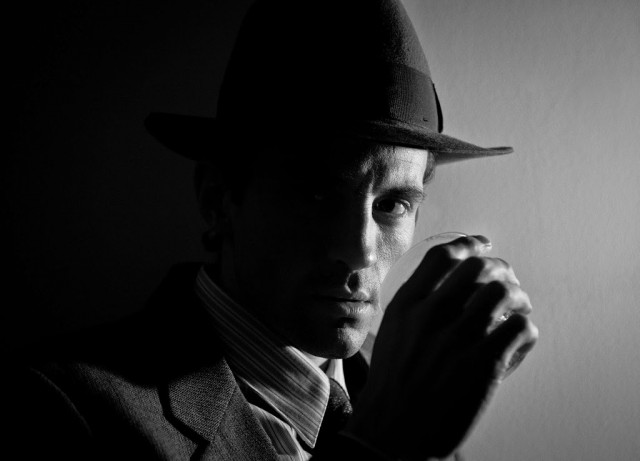
Nathan Darrow stars as private investigator Ben Farrell in Stolen Chair film noir parody (photo by Carrie Leonard)
Fourth Street Theatre
83 East Fourth St. between Bowery & Second Ave.
Wednesday – Sunday through March 8, $25-$45, 7:00 or 8:00
www.stolenchair.org
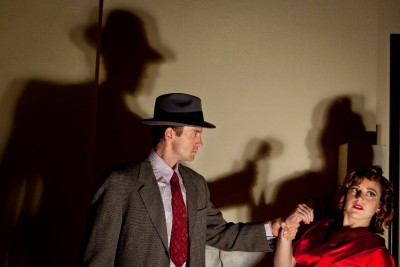
Stolen Chair, which specializes in creating unique theatrical experiences (The Man Who Laughs, Potion), does it again with the film noir parody Kill Me Like You Mean It, an existential exploration of the very nature of storytelling, keeping its existential tongue in its existential cheek as it mines through the familiar clichés of the rich American genre while also searching for the meaning of existence. Written by company co-artistic director Kiran Rikhye and directed by cofounder Jon Stancato, the show follows private investigator Ben Farrell (Nathan Darrow), a former cop who is hired by Murder Monthly magazine publisher Lydia Forsythe (Natalie Hegg) to find her star writer, Tommy Dickie (David Skeist), who is in the midst of a series of stories about private investigator Bob Darrell, whose cases predict what will happen next to Farrell in real life. However, Dickie doesn’t appear to be missing at all, as Farrell finds him at home, where his bombshell sister, Vivian Ballantine (Sarah Skeist), hires Farrell to investigate Forsythe. “Truth is stranger than fiction,” Tommy says, to which Farrell retorts, “No. Truth is fiction.” Soon Farrell is trying to prevent Forsythe and Dickie from publishing a story in which Darrell dies, thinking that will lead to his own death as well.

PI Ben Farrell (Nathan Darrow) needs to twist a few arms to get information in KILL ME LIKE YOU MEAN IT (photo by Carrie Leonard)
There’s plenty of playful pulp throughout Kill Me Like You Mean It, which features appropriately dark, moody lighting by David Bengali and a jazzy score by Sean Cronin. There are an additional two sets of seats on either side of the stage, like a jury deliberating on the action unfolding in front of them in a courtroom drama while also providing different angles that evoke noir compositions. Various props are stored underneath the higher of the two, most memorably a bathtub, used for a riotous send-up of a memorable scene from Otto Preminger’s Laura; set changes, most prominently an inventive use of moving doors, are made by a pair of mysterious men with flashlights. Darrow, who plays the Underwood bodyguard Edward Meechum on House of Cards, is wonderfully deadpan spitting out absurdist takes on noir dialogue, keeping a straight face as he gets into splendid rat-a-tat-tat conversations. Vivian: “I’d like you to feel safe. Go on and search me.” Farrell: “What do you think I’ll find?” Vivian: “What would you like to find?” Farrell: “What do you think I’d like to find?” Vivian: “I think you’d like to find whatever you’re looking for.” Farrell: “What would you like me to be looking for?” Vivian: “Why don’t you find it and find out.” Stancato adds such other fun touches as running jokes about cigarettes and lighters, face slapping, and hats. The boundaries between fiction, reality, and yet another level of fiction even extend to the program, which is a mock edition of Murder Monthly that comes complete with an installment of Tommy Dickie’s serial and some old-fashioned ads, one of which is for a whiskey that audience members are offered a sample of upon entering the theater. Also in the program is a list of suggested movies to check out, ranging from Chinatown, Dead Men Don’t Wear Plaid, and L.A. Confidential to The Maltese Falcon, Double Indemnity, and D.O.A., prime viewing indeed. Be sure to arrive a little early to be serenaded by some noir-era crooning.
SEMELE

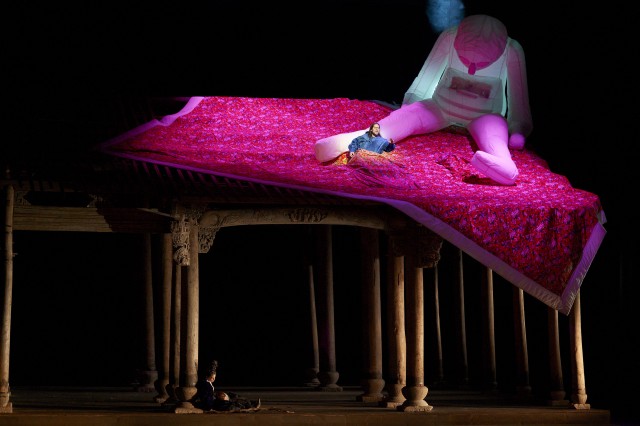
Chinese visual and performance artist makes his directorial debut with Canadian Opera Company production of SEMELE (photo by Michael Cooper)
Who: Zhang Huan and the Canadian Opera Company
What: Semele
Where: BAM Howard Gilman Opera House, Peter Jay Sharp Building, 230 Lafayette Ave., 718-636-4100
When: March 4-10, $35-$170
Why: Chinese visual and performance artist Zhang Huan brings a distinctly Chinese look and feel to the Canadian Opera Company’s multimedia production of George Frideric Handel and William Congreve’s Semele, the Greek myth about the love affair between the god Jupiter and the mortal Semele, which does not make Jupiter’s wife, Juno, very happy. In his directorial debut, Zhang, who works in Shanghai and New York City, re-creates an authentic 17-ton, 450-year-old Ming Dynasty temple as part of the set, while also incorporating a Chinese dragon and sumo wrestlers. The opera is conducted by Christopher Moulds, with costumes by fashion designer Han Feng, and lighting by Willem Laarman based on Wolfgang Göbbel’s original design; coloratura soprano Jane Archibald plays Semele, with Colin Ainsworth as Jupiter and Hilary Summers as Juni/Ino. The three-hour opera will be performed March 4, 6, 8, and 10; Neil Kutner and Paul Bartlett will lead the master class “Semele: Behind the Scenes” on March 8 at 10:00 am at BAM Fisher ($45).
MAPS TO THE STARS

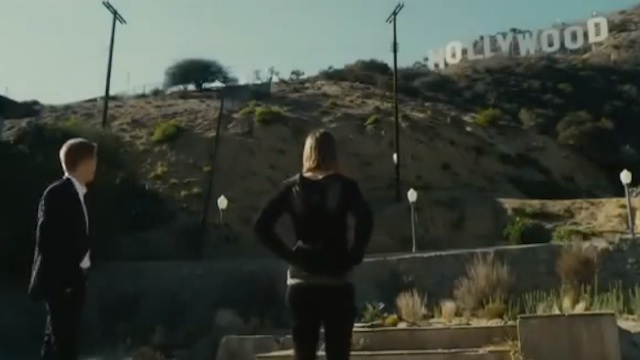
Jerome Fontana (Robert Pattinson) and Agatha Weiss (Mia Wasikowska) look to the Hollywood hills in MAPS TO THE STARS
MAPS TO THE STARS (David Cronenberg, 2014)
Opens Friday, February 27
www.focusfeatures.com

Canadian filmmaker David Cronenberg and American novelist and screenwriter Bruce Wagner, a match made in Hollywood Babylon, paint a savage portrait of celebrity culture in the absolutely incendiary and off-the-charts satire Maps to the Stars. The darkly funny comic drama centers on Agatha Weiss (Mia Wasikowska), a young woman who returns to Hollywood after having been put away for a long time for a dangerous deed, her face and body marked by burns. Befriending limo driver Jerome Fontana (Robert Pattinson), who is an aspiring actor and writer, Agatha gets a job working for disgruntled actress Havana Segrand (Julianne Moore), who is desperate to star in the remake of Stolen Moments, playing the role that made her mother, Clarice Taggart (Sarah Gadon), famous, but Havana fears that according to Hollywood she is much too old. Havana undergoes regular intense physical and psychological therapy to deal with her mommy issues with television healer Stafford Weiss (John Cusack), Agatha’s father, who has banished his daughter from ever contacting the family again. Meanwhile, Agatha’s younger brother, thirteen-year-old child star Benjie Weiss (Evan Bird), is a Bieberesque character fresh out of rehab who is negotiating the sequel to his massive hit, Bad Babysitter, with his very serious stage mom, Cristina (Olivia Williams). Slowly but surely, everyone’s lives intersect in a riot of fame and misfortune, drugs and guns, ghosts and incest.

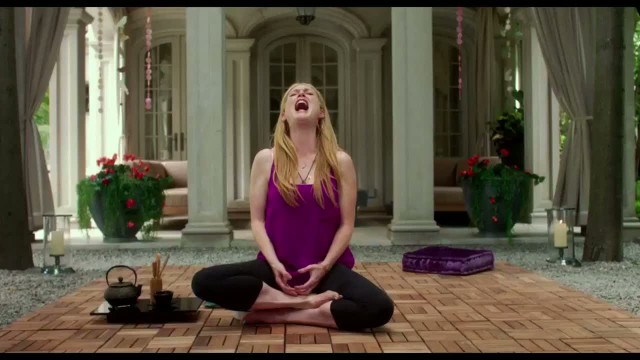
Havana Segrand (Julianne Moore) screams for success in dazzling collaboration between David Cronenberg and Bruce Wagner
Cronenberg, who has made such previous cult favorites as Scanners, The Fly, Naked Lunch, and A History of Violence, and the L.A.-based Wagner, author of such stinging novels as I’ll Let You Go, Still Holding, The Empty Chair, and I’m Losing You, which he also turned into a film, leave nothing and no one unscathed in this thoroughly brutal depiction of Hollywood as a haunted La La Land of dreams and nightmares, both literally and figuratively. Rising star Wasikowska (Alice in Wonderland, In Treatment, Jane Eyre) is superb as Agatha, her inner and outer scars revealing more and more of themselves as she reinserts herself into the life of her crazy family, with Cusack channeling a bit of Nicolas Cage as the overprotective patriarch, a self-help guru who could use a little help himself. Moore was named Best Actress at Cannes for her harrowing portrayal of an actress teetering on the edge of reality. Shooting for the first time ever in the United States, Cronenberg captures the sights and smells of Los Angeles and its environs; most of the film was shot in Canada, however, but Cronenberg kept Wagner, a former Hollywood limo driver himself, close by, trying to attain as much authenticity as possible. Twilight hunk Pattinson, who spent all of Cronenberg’s previous movie, Cosmopolis, in the back of a limo, gets in the driver’s seat here, playing an alternate, reimagined version of Wagner. The severely screwed-up Weiss family serves as a microcosm for Hollywood’s own severely screwed-up dysfunction, as Cronenberg melds the ridiculous with the sublime, the tragic with the comic, the bizarre with the, well, more bizarre, creating a modern-day fairy-tale mashup of Shakespeare and Williams, Sunset Boulevard and Less than Zero, a caustic, cautionary tale of the price you pay for getting what you wish for.
EASTERN BOYS

Marek (Paul Kirill Emelyanov), Boss (Danil Vorobyev), and Daniel (Oliver Rabourdin) get involved in a dangerous game in EASTERN BOYS
EASTERN BOYS (Robin Campillo, 2013)
Film Society of Lincoln Center, Howard Gilman Theater, Elinor Bunin Munroe Film Center
144 West 65th St. between Eighth Ave. & Broadway
February 27 – March 5
212-875-5050
www.filmlinc.com
Robin Campillo takes a genuinely compassionate look at immigration, home invasion, and sexual obsession in the compelling, always surprising Eastern Boys. Seeking out companionship, middle-aged Daniel (Olivier Rabourdin) spots young Marek (Kirill Emelyanov) and cruises him at the Gare du Nord station in Paris. They set up a paid rendezvous at Daniel’s apartment for the next day, but Marek’s arrival is preceded by that of his primarily male friends from Eastern Europe, illegal immigrants who begin taking things from Daniel’s place as they dance and drink; it’s a heartbreaking party scene, with Daniel not knowing how to react, an implicit if not overt threat to his physical well-being hovering over the thick atmosphere. But when Marek eventually does show up, Daniel is desperate for his attention, still determined to be alone with him, an attraction that has dangerous consequences.
Employing a cinéma vérité style, writer, director, and editor Campillo, whose previous, debut feature was 2004’s Les Revenants and has written several films with Laurent Cantet, including The Class and Heading South, tells the intimate story of Daniel and Marek’s complicated relationship with grace and subtlety as they both balance fear with desire, knowing that the unpredictable and violent Boss (Danil Vorobyev), the leader of the gang, is lurking around them. The opening scene has a documentary, neo-Realist quality, but it’s all fiction, the characters portrayed by actors. Campillo divides the film into four chapters based on location and thematic elements, with the home invasion set in his own apartment so he could feel like he himself was being invaded while making it. Nominated for three César Awards (Best Picture, Best Director, and Emelyanov as Most Promising Actor) Eastern Boys goes from a dark romance to a gripping thriller in the final section, but Campillo never reverts to purely good and evil characters, and he provides no straightforward answers, especially in the open-ended finale, while raising important questions about society. It’s a deeply affecting film, one that seeps into your system, an often uncomfortable experience that mirrors Daniel’s fascination with Marek; you’ll squirm in your seat, but you won’t be able to turn away.