Who: More than sixty restaurants from the metropolitan area
What: The Village Voice Choice Eats Eighth Annual Tasting Event
Where: Metropolitan Pavilion, 125 West 18th St. between Sixth & Seventh Aves.
When: Friday, March 13, 6:00 – 10:00 (21 and older only)
Why: We warned you back in January that you’d have to move fast to get tickets to this year’s Choice Eats gourmet feeding frenzy, and lo and behold, all tickets are now sold out for the March 13 event except for the $170 VIP combo that gets you early admission into the Metropolitan Pavilion on Friday and the Intrepid on May 5 for the Choice Streets food-truck festival. Music will be supplied by Q104.3 and 106.7 FM DJ Jonathan Clarke, with beer from such breweries as Sixpoint, Smuttynose, Abita, Flying Dog, Lost Nation, Stella Artois, and Asahi in addition to specialty vodka, rum, whisky, wine, and other spirits. To make sure you find your favorites, check out this map and plan your path in advance, because it gets crazy crowded pretty quickly, and the Metropolitan Pavilion can become a confusing maze, especially as you fill up on food and booze.
twi-ny recommended events
REELABILITIES: NY DISABILITIES FILM FESTIVAL
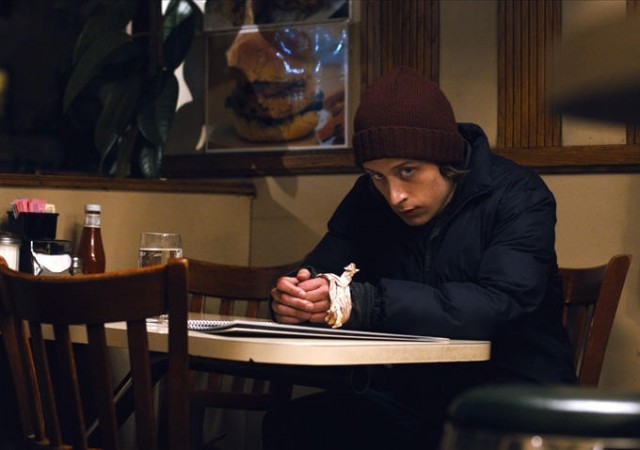
Rory Culkin will be among the special guests at the ReelAbilities film festival, discussing his starring role in GABRIEL
Multiple venues
March 12-18, free – $50 (most film screenings $12-$13)
newyork.reelabilities.org
The seventh annual ReelAbilities film festival will feature more than two dozen programs, focusing on “promoting awareness and appreciation of the lives, stories, and artistic expressions of people with different disabilities.” This year’s festival, running March 12-18, will take place at more than three dozen locations in all five boroughs in addition to Westchester and Long Island. The Finishers, Nils Tavernier’s drama about a teenager with cerebral palsy who is convinced by his father that the two should compete together in an Ironman triathlon in France, is the opening-night selection, with a gala screening at the Intrepid Sea, Air & Space Museum, while the closing-night film is Carlo Zoratti’s The Special Need, about a twenty-nine-year-old autistic man who is determined to lose his virginity, being shown March 18 at the JCC in Manhattan and followed by a reception. Among the other films are Adam Kahan’s The Case of the Three Sided Dream, a documentary about blind and paralyzed jazzman Rahsaan Roland Kirk; Troy Kotsur’s mockumentary No Ordinary Hero: The SuperDeafy Movie; Richard Kane’s Jon Imber’s Left Hand, which tells the story of the artist who had to switch the hand he paints with because of ALS; and Lou Howe’s Gabriel, which stars Rory Culkin as a teenager dealing with mental illness. (Many of the screenings will be followed by discussions and Q&As with the filmmakers, actors, protagonists, and health professionals.) There will also be such special events as “(In)Visible,” a conversation between blind Michigan Supreme Court justice Richard Bernstein and Jason’s Connections cofounder Jason Harris; a multimedia exhibit at the JCC in Manhattan by the Jack and Shirley Silver Center for Special Needs; the ReelAbilities Comedy Night at the JCC with Anita Hollander, Mary Archbold, Pat Shay, Shannon DeVido, and David Harrell; and a Shabbat Dinner celebrating the twenty-fifth anniversary of the Americans with Disabilities Act, with film screenings and a panel discussion with historian Warren Shaw, Justice Bernstein, photographer Rick Guidotti, and others, moderated by Lawrence Carter-Long.
MoMA PRESENTS: BENEDIKT ERLINGSSON’S OF HORSES AND MEN
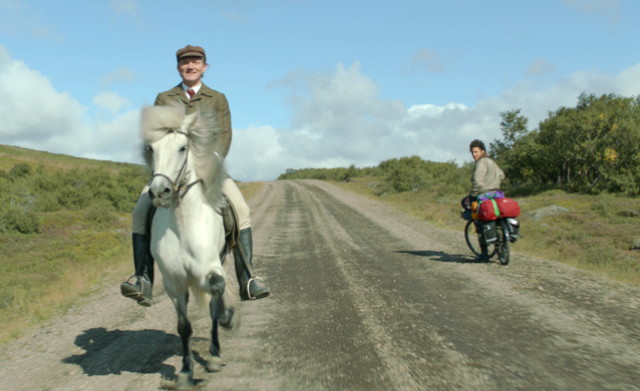
Human nature is explored through the eyes of horses in wildly entertaining Icelandic tale
OF HORSES AND MEN (HROSS Í OSS) (Benedikt Erlingsson, 2013)
MoMA Film, Museum of Modern Art
11 West 53rd St. between Fifth & Sixth Aves.
March 11-17
Tickets: $12, in person only, may be applied to museum admission within thirty days, same-day screenings free with museum admission, available at Film and Media Desk beginning at 9:30 am
212-708-9400
www.moma.org
hrosss.is/the-film
 Iceland’s entry for the 2013 Academy Awards and winner of the 2014 Nordic Council Film Prize, Benedikt Erlingsson’s black comedy, Of Horses and Men, takes an absurdist look at the relationship between humans and horses, incorporating love, sex, pain, responsibility, friendship, religion, and death in darkly comic and heart-rending ways. In a tight-knit community spread across a sweeping rural landscape in Iceland, horses are far more plentiful than people. One morning, Kolbeinn (Ingvar E. Sigurdsson) goes for a ride aboard his gorgeous white mare as men, women, and children come outside to watch him pass by like it’s a parade. But a shocking, unexpected encounter with Solveig’s (Charlotte Bøving) black stallion sets into motion a series of interconnected vignettes, each successive one featuring a minor character from a previous scene. Lust, land disputes, gender distinction, and other agreements and disagreements lead to either tragedy or joy, but, of course, this being Iceland, the former is far more prevalent, especially as more and more Brennivin (Black Death) and other drink is consumed. Writer-director Erlingsson’s debut feature is gorgeously photographed by Bergsteinn Björgúlfsson, whose camera moves lovingly over the green fields and mountainous valleys, treating the horses like Hollywood sirens, zooming in on their eyes to show the reflection of the people who seek to control them, equating the basic animal instincts of both species. The horses in the film are no mere props; Erlingsson, who grew up in a theatrical family and has directed numerous stage productions (in addition to owning a horse, whom he called his “life companion,” for thirty years until recently having to put her down), treats the animals like characters in their own right, revealing their, dare we say, humanity. Produced by Icelandic cinema legend Friðrik Þór Friðriksson (Children of Nature, Mamma Gógó), Of Horses and Men is a dark, wildly entertaining treatise on human nature among a rather quirky and unusual equestrian set. The film is being shown March 11-17 at the Museum of Modern Art as part of the ongoing MoMA Presents series.
DCTV PRESENTS STRAY DOG

Ron “Stray Dog” Hall takes his wife, and viewers, on a marvelous ride into the heart of America in Debra Granik’s charming documentary
STRAY DOG (Debra Granik, 2014)
DCTV (Downtown Community Television Center)
87 Lafayette St.
Wednesday, March 11, $10, 7:00
212-966-4510
www.dctvny.org
www.straydogthemovie.com
Shortly after meeting Ron “Stray Dog” Hall at the Biker Church in Branson, Missouri, writer-director Debra Granik (Down to the Bone) cast the Vietnam vet as Thump Milton in her second feature, the Oscar-nominated Winter’s Bone. Upon learning more about him, she soon decided that he would be a great subject for a documentary, so she took to the road, following him across the country in the engaging and revealing Stray Dog. Nearly always dressed in black, including his treasured leather jacket covered in medals and patches — when he puts it in a suitcase for a trip, it’s a ritual like he’s folding the American flag — Hall is a wonderfully grizzled old man with a fluffy white beard. At home, he is learning Spanish online so he can communicate better with his new wife, Alicia, a Mexican immigrant, and her two sons (who still live across the border). He visits with his teenage granddaughter, who is making some questionable decisions about her future. In Missouri, he owns and operates the At Ease RV Park, where he gives breaks to fellow vets who can’t always afford to pay the rent. And when he goes on the road, participating in the Run for the Wall, joining up with thousands of other bikers heading for the annual service at the Vietnam Veterans Memorial in Washington, DC, he stops along the way at other ceremonies honoring soldiers who have gone missing, are POWs, or were killed in action in Vietnam, Iraq, Afghanistan, and other wars.
Hall is a gregarious, gentle man who people instantly flock to and gather around — a scene in which two of his cats sit on each of his knees is absolutely heartwarming — but he is also haunted by some of the things he did in Vietnam, suffering from nightmares that sometimes have him screaming out loud while sleeping in bed. And he wears one of his mottoes right on his arm: “Never Forgive Never Forget.” At one point he sits comfortably on a couch and says, “Just kind of being free, don’t hurt nobody, do what you want to do — a nice thing, ain’t it? You know, I’d rather live as a free man for a year than a slave for twenty.” Granik simply follows Hall as he experiences life with his surprisingly refreshing point of view; no one ever turns to the camera to make any confessions, and no talking heads are brought on board to evaluate what we’re seeing. Granik just lets this beautiful piece of Americana unfold at its own pace while also touching on such hot-button topics as immigration reform, gun control, the economic crisis, and PTSD, making no judgments as we follow the captivating exploits of a man who is part Buddha, part Santa, and all patriot. Stray Dog, which made its New York premiere this past October at the 52nd New York Film Festival, will be screening March 11 at 7:00 at DCTV, followed by a Q&A with director Granik, editor and producer Tory Stewart, and cinematographer Eric Phillips-Horst.
PHOENIX: XU BING AT THE CATHEDRAL
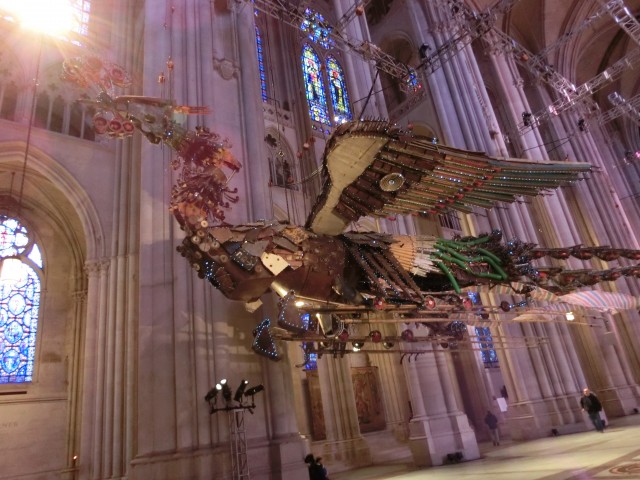
Xu Bing’s “Phoenix” will soar out of St. John the Divine on March 15 (photo by twi-ny/mdr)
The Cathedral Church of St. John the Divine
1047 Amsterdam Ave. at 112th St.
Daily through March 15, suggested donation $10
212-316-7540
www.stjohndivine.org
After more than a year spent hovering over the nave at the Cathedral Church of St. John the Divine, Huang and Feng are getting ready to take off on the next part of a journey that has seen them go from Beijing to Shanghai to Massachusetts. In January 2014, Chinese artist Xu Bing, who lives and works in Beijing and New York, installed two giant phoenixes, the ninety-foot-long male Feng and the hundred-foot-long female Huang, the two totaling more than twelve tons, at the cathedral. Originally commissioned for the World Financial Center in Beijing, “Phoenix” was ultimately rejected when Xu, a member of the ’85 New Wave Movement who went through “reeducation” as a child and whose father spent time in jail as a political prisoner, decided to use detritus from construction sites to build the two birds as a statement emphasizing the widening gap between the wealthy and the poor, capital and labor in China, where peasant communities are torn down to make way for high-end commercial ventures. It would be easy to see “Phoenix” as a metaphor for the mythological creatures rising from the ashes, especially at St. John the Divine, evoking not only the resurrection of Jesus but the cathedral’s seven-year restoration following a devastating 2001 six-alarm fire, but in Chinese legend the phoenix, known as the fenghuang, represents the combination of yin and yang, the sun and the moon, made up of elements from different animals and celestial bodies, filled with the promise of good fortune, loyalty, dignity, and compassion.
Xu, whose other recent New York projects include “The Living Word” at the Morgan, “Where Does the Dust Itself Collect?” in the Spinning Wheel Building, and “The Character of Characters” animated video at the Met, did not build Feng and Huang with random debris, instead carefully constructing each body part with specific objects; for example, the heads are made from the nose of industrial jackhammers, depicting strength and power, while feathers are built from shovelheads. Working with a team of primarily migrant workers, Xu also incorporates bamboo, girders, tools, hard hats, rebar, wheels, and other waste materials found at Beijing construction sites. “With this, there’s a kind of internal logic that produces beauty. You also produce a sense of humor,” Xu said through a translator in an artist talk he gave at MASS MoCA, where “Phoenix” made its U.S. debut in 2013. He then compared his process to Chinese folk art. “The method of Chinese folk art is to use the most inexpensive, the cheapest materials to express [people’s] hopes for the future and for their lives.” He also added LED lights to Feng and Huang, turning them into mysterious constellations in the dark. Facing away from the altar, the phoenixes are imbued with an engaging spirituality, especially when the cathedral’s church organ is being played, the music echoing throughout the vast space. The birds look very much at home inside this self-described “house of prayer for all people and a unifying center of intellectual light and leadership,” companions to Greg Wyatt’s outdoor Peace Fountain, but on March 15 they will be migrating once again, off on the next stop of their amazing journey.
THE MYSTERY OF LOVE AND SEX
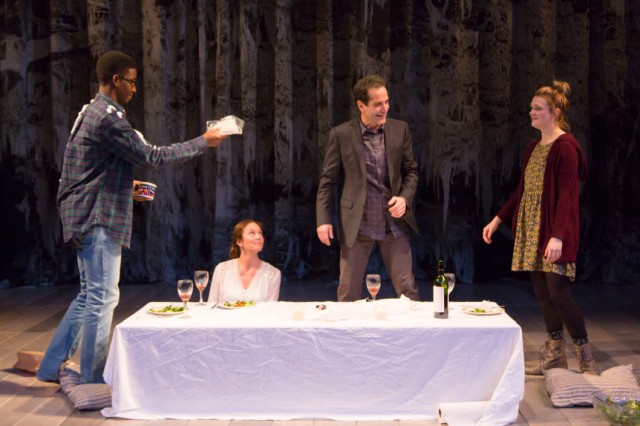
Two generations deal with love, sex, and food in Lincoln Center production (photo by T Charles Erickson)
Lincoln Center Theater at the Mitzi E. Newhouse
150 West 65th St. between Broadway & Amsterdam Ave.
Tuesday – Sunday through April 26, $87
212-362-7600
www.lct.org
Bathsheba Doran’s The Mystery of Love and Sex explores the many facets of the title concepts in light but smart ways, touching on the complicated nature of friendship and family, romance and lust. Friends since they were nine years old, Charlotte (Gayle Rankin) and Jonny (Mamoudou Athie) are now going to the same Virginia college not far from where they were raised, and they have invited her parents, Lucinda (Diane Lane) and Howard (Tony Shalhoub), to come over for what Lucinda quickly decides is a “bohemian” dinner, on a makeshift table with salad, bread, no chairs, and cheap wine. While Lucinda gets right into the spirit of things, Howard has much more trouble, beginning with attempting to sit on the floor, then trying to serve himself some food. Soon the talk turns to the relationship between Jonny, a young black man with a sick mother, and Charlotte, a young Jewish woman preparing her own way in the world. Howard, a successful writer of detective fiction, might have been treating Jonny like a member of the family for the past decade, but now that he thinks that Jonny might become an official part of the family, he is not so happy. But the kids are still teenagers with their whole lives in front of them, and their undefined relationship grows more puzzling when Jonny starts dating another woman — and Charlotte says she has the hots for a fellow coed. Things heat up even further when the four main characters start debating such issues as racism, homophobia, anti-Semitism, misogyny, religion — and food. (The show features a lot of eating, so you might want to be sure to dine beforehand.) The second act takes place five years later, as some matters have been settled, but most have not, as marriage and divorce enter the conversation.
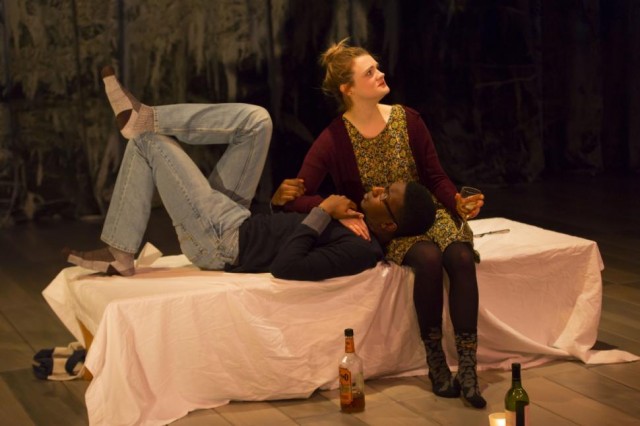
Jonny (Mamoudou Athie) and Charlotte (Gayle Rankin) contemplate their future in THE MYSTERY OF LOVE AND SEX (photo by T Charles Erickson)
Returning to New York theater for the first time since 1977, when she was twelve, the now fifty-year-old Lane (A Little Romance, Unfaithful) is resplendent as Lucinda, her smile lighting up the entire theater, along with her rich southern accent, her character’s flair for life infectious. Shalhoub (Act One, Golden Boy) is terrific as Howard, a bundle of nerves and deeply hidden prejudices who fumbles fantastically in the opening dinner scene, showing a riotous mastery of physical comedy, while standing firm later when he gets into it with Jonny. Athie and Rankin are fine as Jonny and Charlotte, the former timid and withdrawn, the latter energetic and fancy-free, but the play slows down considerably when Lane and Shalhoub are not onstage. One of the busiest directors in New York, Sam Gold, who has helmed such delights as Fun Home, The Realistic Joneses, and Seminar, makes good use of the small Newhouse stage, keeping things moving proficiently on Andrew Lieberman’s minimalist sets, which generally consist of a few pieces of furniture and long drapes in the back. Doran, who has written such other plays as Kin and Nest and for such cable series as Boardwalk Empire and Masters of Sex, has a gift for creating unpredictable situations and taking them further than expected with a smooth calm, although she is occasionally too clever for her own good. The Mystery of Love and Sex is a perfectly pleasant piece of theater, a tasty morsel if not quite the gourmet meal it attempts to be.
MADAME CÉZANNE
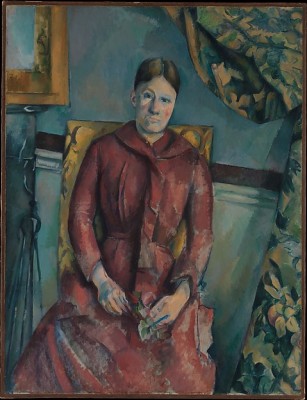
Paul Cézanne, “Madame Cézanne in a Red Dress,” oil on canvas, 1888-90 (The Mr. and Mrs. Henry Ittleson Jr. Purchase Fund, 1962)
Metropolitan Museum of Art, Galleries 955 & 961–962
1000 Fifth Ave. at 82nd St.
Daily through March 15, recommended admission $12-$25
212-535-7710
www.metmuseum.org
Not much is known about the relationship between French artist Paul Cézanne and his wife, former artist’s model Marie-Hortense Fiquet, other than that they met in 1869, had a son in 1872, were married in 1886, and, when Paul died in 1906, had long lived apart, and he left her nothing in his will. However, he did leave behind twenty-nine known portraits of her, twenty-five of which are on display at the Met in the intriguing exhibition “Madame Cézanne,” continuing through March 15. The show features paintings, drawings, and watercolors, ranging from a page of 1871-74 graphite studies to the ca. 1895-1900 oil sketch “Portrait of a Woman (Madame Cézanne).” The centerpiece of the exhibit is the quartet of portraits of Madame Cézanne in a red dress, each one very different, highlighted by the 1888-90 canvas with the most detailed surroundings. The four paintings have not been seen together for many years, and the group, now side by side, is both breathtaking and provoking in the insights it offers and questions it generates about Cezanne’s choices on the canvas. The paintings do not add insight into the couple’s love, or lack thereof, for each other, however, as Cézanne nearly always depicts his wife as dour and matronly, rarely smiling. In the unfinished 1891 oil painting “Madame Cézanne” in the Conservatory,” Hortense Fiquet sits on a chair, her hands on her lap, tree branches and fruit in the background; she gazes directly at the viewer, her eyes open, her mouth closed, appearing neither sad nor happy, just resigned to her fate. “If these quietly powerful paintings of Hortense Fiquet came to be acknowledged as a testing ground for Cézanne’s innovation and experimentation with paint on canvas, their subject and her vital partnership as model, mistress, wife, and mother have been willfully overlooked,” curator Dita Amory writes in the preface to the exhibition catalog. “Their story is a deeply compelling one, perhaps even more so for the very absence of its particulars.” What isn’t absent in this show are some very beautiful works, which add yet more mystery to this curious artistic relationship. (As a bonus, the Met is showing “Paul Cézanne: Drawings and Watercolors” in Gallery 960 in the Robert Lehman Wing, also through March 15.)