twi-ny recommended events

FLOYDADA

(photo by Dan Lane Williams)

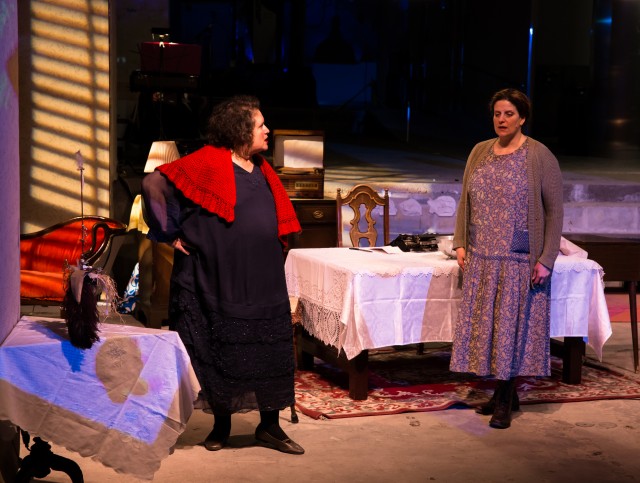
Sisters Dalia (Nomi Tichman) and Ada (Catherine Porter) reconnect in FLOYDADA (photo by Dan Lane Williams)

Peculiar Works Project
Merchants Square Building
40 Worth St. between Church St. & West Broadway
Wednesday – Saturday through April 11, $12-$18, 7:00
www.peculiarworks.org

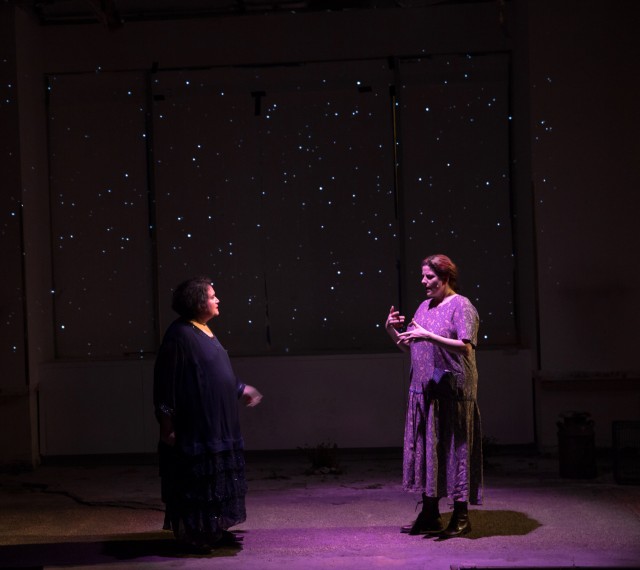
When you think of the revolutionary art movement known as Dada, West Texas is not generally one of the first things that comes to mind. But in the early 1990s, playwright Barry Rowell was driving to Lubbock when he saw a sign for the small town of Floydada, Texas, and decided right then and there that he was going to write a play that involved Dadaism. The result is Floydada, a two-character show running through April 11 in a large, empty storefront in the Merchants Square Building on Worth St. The premise is a bit thin, as well as somewhat random — which, of course, is a key element of Dada. But you don’t have to know anything about Dada — the experimental movement, based on readymade objects and chance, that developed from a disgust with the death and destruction of WWI — to understand the play; after all, “Dada does not mean anything,” Tristan Tzara wrote in his 1918 manifesto. It’s March 1927, and Dalia (Nomi Tichman) is ill, so she has returned home to be with her sister, Ada (Catherine Porter), in the small town of Floydada. Dalia has spent the last several decades primarily in New York, Berlin, and Paris — France, not Texas — writing poetry, giving performances, and hanging out with the cultural elite, including the Baroness Elsa von Freytag-Loringhoven, a close friend with whom she continues to exchange letters. Elsa has also given Dalia one of her most famous sculptures, “Portrait of Marcel Duchamp,” an avant-garde work that mystifies Ada almost as much as her sister’s activities do. Over the course of ten months, the sisters reconnect, the city girl and the country girl learning from each other and even performing together, turning the family’s dry goods store into a cabaret where they sing and recite poetry for the close-knit local community.
(photo by Dan Lane Williams)

FLOYDADA features unusual characters in an unusual space (photo by Dan Lane Williams)

When Dalia first suggests that they perform, she tells Ada, “All we need is an empty space.” The same can be said for Peculiar Works Project, the Obie-winning company, cofounded by Porter, Rowell, and Ralph Lewis in 1993, that specializes in experimental productions in unusual spaces. In 2013, they presented Rowell’s Manna-Hatta in multiple rooms upstairs in the James A. Farley Post Office. Floydada takes place on the ground floor of the Merchants Square Building, which was built in 1928, right around the time in which the play is set. One side of the long, horizontal room, which boasts large pillars, a cement floor, and an open ceiling revealing pipes, wires, and insulation, has been filled with new Dada-inspired art by Carlo Adinolfi, Michelle Beshaw, Myrel Chernick, Norman Chernick-Zeitlin, Anna Kiraly, Ray Neufeld, and Francesco Vizzini. A makeshift box-office area features a urinal tip jar and a slideshow of Dada artists. The play itself unfolds in an open area with some furniture, as the two actors wander from living room to outside road to dry goods store, using sound to indicate their coming and going. Porter and Tichman portray Ada and Dalia with an oddball eccentricity that is reminiscent of the mother and daughter Bouvier Beales from Grey Gardens, though not nearly as off the wall. “People think you’re strange, you know,” Ada says, to which Dalia replies, “I am.” Director David Vining (Cracked, The Blue Puppies Cycle) makes creative use of the space, though a lot of the movement grows repetitive; at times you’ll just wish the characters just stayed put for a few moments instead of constantly getting up and down and moving back and forth on Casey McLain’s set. Yoonmi Lee adds fine piano and percussion, while Lianne Arnold’s projections and Leila Ghaznavi’s live manipulations (and sound effects) are colorful but confusing. The overall aesthetic has a sweetly innocent DIY charm, as well as plenty of strangeness, but it’s probably about twenty minutes too long, which, in its own way, is rather Dada itself. It’s also extremely cold in the space, with no heating, so be prepared to leave your coat and hat on if the weather remains so bitter. Floydada runs Thursdays, Fridays, and Saturdays through April 11; there will be a “Dada (Re)Creation” benefit on April 6 with dance, music, art, and poetry, and the April 9-11 shows will be followed by a DadaDialogue with Pratt professor Dr. Dorothea Dietrich and other panelists.
FIRST SATURDAY: BASQUIAT

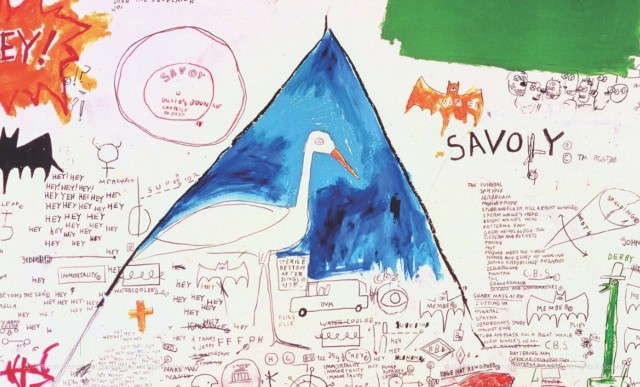
The opening of “Basquiat: The Unknown Notebooks” will be celebrated at free First Saturday program at the Brooklyn Museum

The opening of “Basquiat: The Unknown Notebooks” will be celebrated at free First Saturdays program at the Brooklyn Museum

Brooklyn Museum
200 Eastern Parkway at Washington St.
Saturday, April 4, free, 5:00 – 11:00
212-864-5400
www.brooklynmuseum.org

The April edition of the Brooklyn Museum’s First Saturdays program celebrates the opening of its latest exhibit on Jean-Michel Basquiat, “Basquiat: The Unknown Notebooks,” a collection of 160 pages from his never-before-shown notebooks, focusing on his use of text and image, along with works on paper and large-scale paintings. The free evening will feature live musical performances by the James Francies Trio and Lion Babe and a DJ set by Natasha Diggs; a curator talk by Tricia Laughlin Bloom about the new exhibition; a Basquiat crown-making workshop; a Basquiat-inspired writing workshop led by Tom La Farge and Wendy Walker; Cave Canem “Poetry Meets Art” readings from LaTasha N. Nevada Diggs and Roger Reeves; a children’s book presentation with illustrator Javaka Steptoe discussing Radiant Child: The Story of Young Artist Jean-Michel Basquiat; a screening of Tamra Davis’s 2010 documentary Jean-Michel Basquiat: The Radiant Child; a performance of Dark Swan by Urban Bush Women; and an interactive performance and dance workshop with W.A.F.F.L.E. (We Are Family for Life Entertainment). In addition, you can check out such exhibitions as “Revolution! Works from the Black Arts Movement,” “Kehinde Wiley: A New Republic,” “The Dinner Party by Judy Chicago,” and “Chitra Ganesh: Eyes of Time.”

OVERDUE: JAMES B. HARRIS

COP, starring James Woods, is part of overdue look at the career of James B. Harris

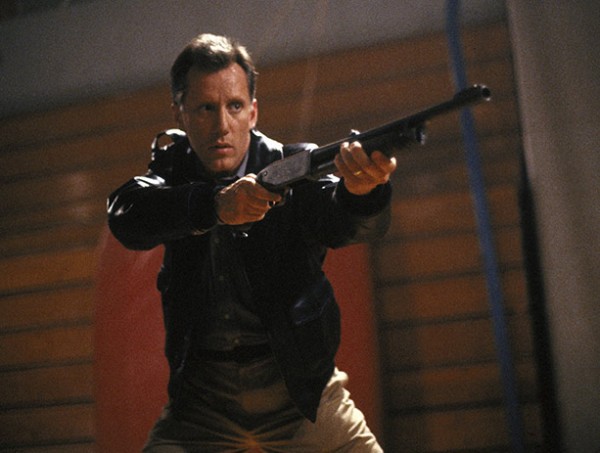
COP, starring James Woods, is part of overdue look at the career of James B. Harris

Who: James B. Harris
What: “Overdue,” critics Nick Pinkerton and Nicolas Rapold’s ongoing series that pays tribute to overlooked films and filmmakers
Where: BAMcinématek, BAM Rose Cinemas, 30 Lafayette Ave. between Ashland Pl. & St. Felix St., 718-636-4100
When: April 1-6
Why: Writer, director, and producer James B. Harris is finally given his due in this six-day series at BAM featuring eight of his nine films, including Stanley Kubrick’s The Killing, Lolita, and Paths of Glory and Don Siegel’s Telefon (starring Charles Bronson) in addition to four of his five directorial efforts, The Bedford Incident with Sidney Poitier and Richard Widmark, the Sleeping Beauty update Some Call It Loving, and Fast-Walking and Cop, both starring James Woods. The only film left out is the 1993 crime drama Boiling Point. The eighty-six-year-old Harris will be at BAM for Q&As following the April 1 screening of Some Call It Loving and the 6:30 screening of Cop on April 4 in addition to introducing the 9:30 showing of Paths of Glory on April 4, a film in which he also makes a cameo.

VIDEO OF THE DAY: “HEAVEN SENT” BY BEST COAST

Who: Best Coast
What: Northside Festival
Where: Brooklyn Live at the Inlet, 50 Kent Ave.
When: Saturday, June 13, $30, 5:00 – 10:00
Why: Singer/songwriter/guitarist Bethany Cosentino and guitarist Bobb Bruno, better known as Best Coast, are hitting the road in support of their third full-length, California Nights (Harvest, May 4). The follow-up to 2010’s Crazy for You and 2013’s The Only Place, the disc, which explores the darker sides of Los Angeles, features such tracks as “Feeling OK,” “Fine without You,” “Jealousy,” and “Wasted Time.” “It’s about a journey, accepting the things you have no control over,” Cosentino says of the record. “It’s about dealing with life like an adult, and at the end of the day, reminding yourself that there really is no reason to be sad, and you have every right to feel okay.” The California duo will be in New York City on June 13 for the Northside Festival, playing Brooklyn Live at the Inlet with Built to Spill, Alvvays, and Bully.

RUMOURS: A TRIBUTE TO FLEETWOOD MAC

rumours

Who: Karen, Katherine & Jen, Paul Bertolino, Jaime Dejesus, Sarah Factor, Samantha Feldman, Andi Rae Healy, 5j Barrow, Joanna Levine, Jeff Litman, Andrea Nardello, Abby Payne, Gerianne Pérez, Gerry Rosenthal, Jason Spiewak, Kate Steinberg, Jenn Summers, Casey Solomon, Maddy Wyatt, and others
What: The “Leave a Lasting Mark” Concert Series presents “Rumours: A Tribute to Fleetwood Mac”
Where: The Bitter End, 147 Bleecker St. between Thompson St. & La Guardia Pl., 212-673-7030
When: Tuesday, March 31, suggested donation $10, 7:00
Why: Nearly two dozen artists will be at the Bitter End on March 31 performing the songs of Fleetwood Mac, including the entire classic Rumours album, as a fundraiser for the Foundation Fighting Blindness, whose stated mission “is to drive the research that will provide preventions, treatments, and cures for people affected by retinitis pigmentosa, macular degeneration, Usher syndrome, and the entire spectrum of retinal degenerative diseases.” The organization’s annual New York City VisionWalk will take place April 18 beginning at the Central Park Bandshell.

HEBREW ILLUMINATION FOR OUR TIME: THE ART OF BARBARA WOLFF

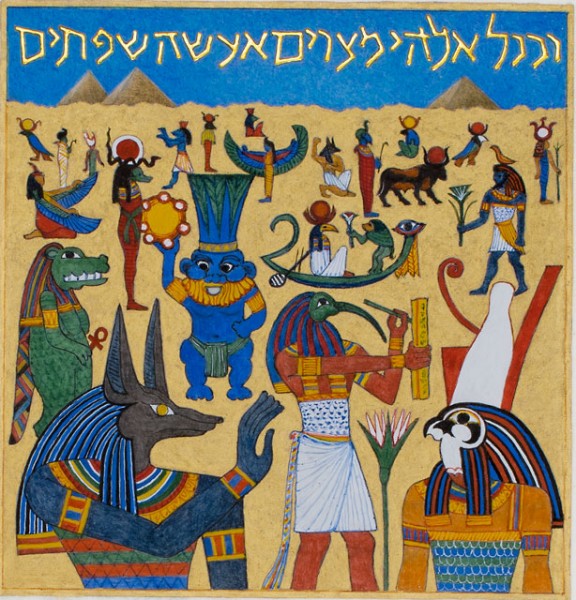
Barbara Wolff, “The Rose Haggadah,” detail, p. 19, illuminated manuscript, 2011-13 (artwork © 2014 Barbara Wolff / digital photography by Rudi Wolff)

Barbara Wolff, “The Rose Haggadah,” detail, p. 19, illuminated manuscript, 2011-13 (artwork © 2014 Barbara Wolff / digital photography by Rudi Wolff)

Morgan Library & Museum
225 Madison Ave. at 36th St.
Tuesday – Sunday through May 3, $12-$18 (free Fridays 7:00 to 9:00)
212-685-0008
www.themorgan.org
www.artofbarbarawolff.com

Passover doesn’t begin until April 3, but you can get a head start on the holiday, in which Jews around the world retell the story of the exodus from Egypt, by visiting the Morgan Library and checking out its lovely exhibition “Hebrew Illumination for Our Time: The Art of Barbara Wolff,” comprising the first two illuminated Hebrew texts to join the Morgan’s celebrated collection of illuminated manuscripts, as well as its very first Haggadah. In 2011, New York artist Barbara Wolff was commissioned by the Rose family to create an illuminated Haggadah, the book used at the Passover seder that contains prayers, hymns, historical tales, biblical scenes, and other elements that expand upon the Jews’ enslavement and their battle with the Pharaoh more than three thousand years ago. Working with her unique blend of silver, gold, and platinum foils on vellum, Wolff designed beautiful artwork to accompany Izzy Pludwinski’s Ashkenazic Hebrew calligraphy and Karen Gorst’s English captions, incorporating flora and fauna native to the Middle East along with the standard elements of the Passover seder, including such symbolic food as the Paschal lamb, matzah, and bitter herbs. Each page is exquisitely designed: A large eye oversees a pyramid in which slaves are shown hard at work, more than twenty colorful ancient Egyptian gods are gathered together in the desert, and the ten plagues are depicted above and below a lush gold area featuring silver Kiddush cups spilling drops of red wine. The Rose Haggadah is a far cry from the familiar, old-fashioned blue-and-white Maxwell House Haggadah that was so prevalent throughout much of the twentieth century. Wolff’s remarkable sixty-four-page book honors Jewish tradition in a format more associated with Christianity, bringing new life to an annual ritual that honors the past while projecting hope for the future.

Barbara Wolff, “Among the Branches They Sing” from “You Renew the Face of the Earth: Psalm 104,” illuminated manuscript, MS M.1190, fol. 3 (artwork © 2015 Barbara Wolff / photography by Rudi Wolff)

Barbara Wolff, “Among the Branches They Sing” from “You Renew the Face of the Earth: Psalm 104,” illuminated manuscript, MS M.1190, fol. 3 (artwork © 2015 Barbara Wolff / photography by Rudi Wolff)

The exhibit also includes Wolff’s illuminated version of Psalm 104, “You Renew the Face of the Earth,” ten elegant works in which she uses platinum, silver, and gold leaf on goatskin parchment. “This great hymn to the divine in nature directs our awareness to the miracle of the world,” Wolff writes in the free exhibition handout. “The sentiments expressed in this psalm have particular relevance for our own era, a time of growing consciousness of the profound effect of human enterprise on nature, and of questioning our role as steward of our planet.” The ten illuminations include the signs of the zodiac, which represent the twelve tribes of Israel; golden Hokusai-like waves above rising mountains; a silver leviathan encapsulating smaller sea creatures; and twenty-eight Israeli birds in and around a Tabor oak, with every animal specifically identified. Wolff adds commentary about each folio; for example, in “To Bring Forth Bread,” which shows grains growing, she writes, “Wild grass, ancestor of man’s most ancient cultivated crop, became the foundation of civilization. . . . Shining fields of wheat and filled granaries are symbols of security, peace, and plenty.” The exhibition is supplemented by illuminated manuscripts from the Morgan’s collection that influenced Wolff, as well as a twenty-two-minute film that highlights her intricate, intensely dedicated working process. In conjunction with the exhibition, Vassar professor Marc Michael Epstein will deliver the talk “Skies of Parchment, Seas of Ink: Barbara Wolff and her Place in the History of Jewish Manuscript Illumination” on April 1 at 6:30; on April 12 at 2:00, Wolff will lead the workshop “The Midas Touch”; on April 15 at 7:00, composer and accordionist Merima Ključo, artist Bart Woodstrup, and pianist Seth Knopp will team up for the multimedia presentation “The Sarajevo Haggadah: Music of the Book”; and on April 18 at 2:00, Stephanie Krauss will lead the workshop “My Very Own Illuminated Manuscript — Part 2: Putting It Together” for children eight and older.

A HAPPY END

(photo by Kim T. Sharp)

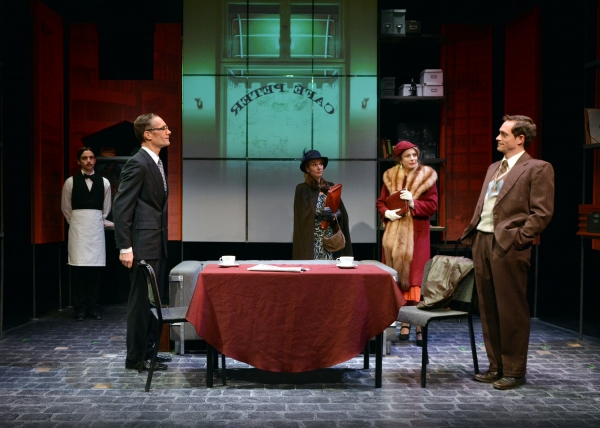
Iddo Netanyahu play looks at a family facing a crisis in Berlin during rise of the Nazis (photo by Kim T. Sharp)

June Havoc Theatre, Abingdon Theatre Company
Abingdon Theatre Arts Complex
312 West 36th St. between Eighth & Ninth Aves.
Through March 29, $65
www.ahappyend.net
www.abingdontheatre.org

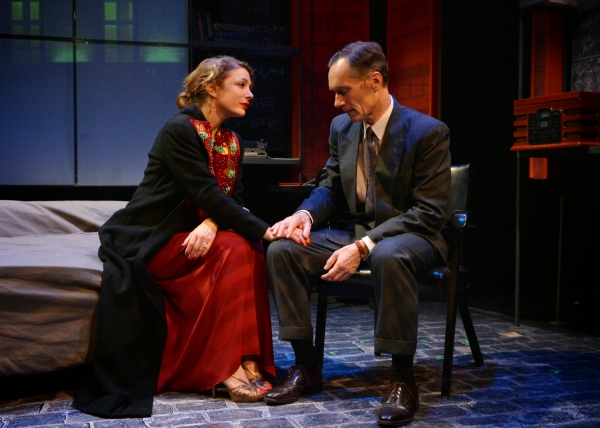
In January, in the wake of the Charlie Hebdo terrorist attack in Paris, Israeli prime minister Benjamin Netanyahu declared, “This week, a special team of ministers will convene to advance steps to increase immigration from France and other countries in Europe that are suffering from terrible anti-Semitism.” His bold and controversial proclamation couldn’t help but remind one of the decisions European Jews had to make in the 1930s, faced with the rise of Adolf Hitler and the Third Reich. To stay or to go during that unhappy time is what Bibi’s younger brother, Iddo, author and part-time radiologist, explores in A Happy End, a compelling if unsubtle play making its New York premiere by the Abingdon Theatre Company. (Iddo and Bibi’s eldest brother, Yoni, was the only Israeli soldier killed in the 1976 raid on Entebbe.) Originally commissioned in Italy in 2008 for European Holocaust Memorial Day, the play takes place over four months in 1932-33 Berlin, as Hitler is amassing power, a situation dismissed by erudite physicist Mark Erdmann (Curzon Dobell). His wife, Leah (Carmit Levité), is having an affair with his lab colleague, Dieter Kraft (Joel Ripka), a non-Jew who recognizes the increasing level of anti-Semitism in the country and tries to convince his boss that he needs to leave Germany before it is too late. But Mark and Leah, who have a talented son, Hans (Phil Gillen), refuse to abandon the only home they’ve ever known. “They’re on the decline,” Mark says about the Nazis. “Politicians can’t dictate how we should live our lives,” Leah adds. But despite the play’s title, it’s doubtful things will work out well.

(photo by Kim T. Sharp)

Leah (Carmit Levité) and Mark Erdmann (Curzon Dobell) consider leaving their home behind in A HAPPY END (photo by Kim T. Sharp)

Numerous minor set changes help move the action more than Alex Dmitriev’s rather plain direction, as there is a lot of just sitting and standing around. Levité, a South African-Israeli actress, overplays Leah at first before eventually settling into the role of a glamorous woman who wants it all, a young lover in addition to a wise, successful husband (and fabulous clothes designed by Laura Crow). Dobell is rock-solid as an intellectual who is focused more on his work than the strong emotions swirling around him; when a waiter in a café turns on the radio to listen to a Hitler speech, Mark asks him to turn it off, as if that will make the potential next chancellor just go away. Lori Gardner adds doses of humor as Anna, Mark’s assistant, although repeated borrowings of his pen get tired. (Perhaps this is a reference to the pen being mightier than the sword, or, as a real stretch, even Jean-Marie Le Pen, the longtime leader of France’s right-wing National Front, but either way, it grows old quickly.) Ripka is earnest as the sincere Dieter, wanting the Erdmanns to be safe even though their leaving would impact him both personally and professionally. A Happy End is a thought-provoking work that handles its familiar subject matter with great care, a tale that will have you wondering what you would do in a similar situation. Sadly, there are many people around the world, especially in Europe right now, faced with that very real decision.