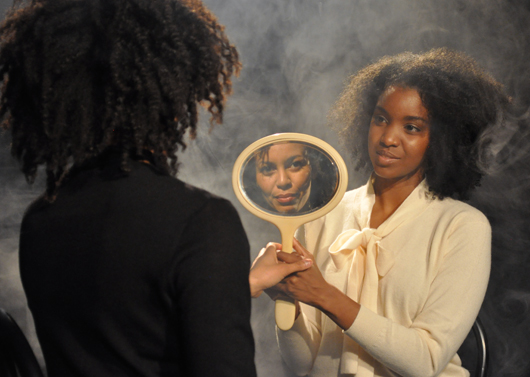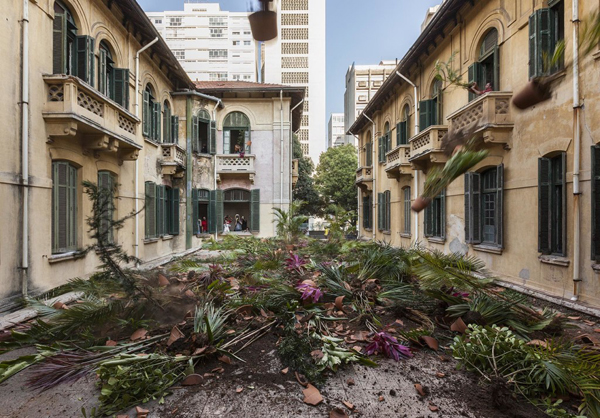
Who: Carrie Mae Weems
What: “Field of View and Other Minor Considerations”
Where: NYU Steinhardt, Einstein Auditorium, Barney Building, 34 Stuyvesant St., 212-366-5700
When: Thursday, March 26, free with advance RSVP, 6:30
Why: As part of the Performa Institute Portrait of the Artist series, Portland, Oregon–born photographer and video artist Carrie Mae Weems will deliver a lecture on her life and career, “Field of View and Other Minor Considerations,” with a focus on her artistic process and production. Weems, who had a terrific retrospective at the Guggenheim last year, “Three Decades of Photography and Video,” is a fascinating person, so this should be a very special evening. “My work has led me to investigate family relationships, gender roles, the histories of racism, sexism, class, and various political systems,” she writes in her online biography. “Despite the variety of my explorations, throughout it all it has been my contention that my responsibility as an artist is to work, to sing for my supper, to make art, beautiful and powerful, that adds and reveals; to beautify the mess of a messy world, to heal the sick and feed the helpless; to shout bravely from the roof-tops and storm barricaded doors and voice the specifics of our historic moment.”
twi-ny recommended events
CANADIAN OPERA COMPANY: SEMELE

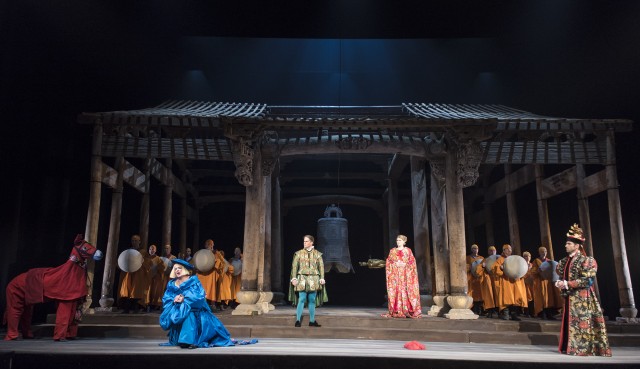
Zhang Huan has transported a 17-ton, 450-year-old Ming Dynasty temple as setting for SEMELE (photo by Jack Vartoogian / Frontrowphotos)
BAM Howard Gilman Opera House, Peter Jay Sharp Building
230 Lafayette Ave.
March 4, 6, 8, 10, $35-$170
718-636-4100
www.bam.org
www.coc.ca
When Belgium’s Théâtre Royal de la Monnaie and China’s KT Wong Foundation approached Shanghai-based visual and performance artist Zhang Huan to make his directorial debut in a production of composer George Frideric Handel and librettist William Congreve’s Semele, they were clearly seeking something different, a unique interpretation of the Baroque opera by John Eccles, based on Ovid’s Metamorphoses. And Zhang certainly delivers, bringing his complex sensibility to this mythical tale of love gone wrong. Semele takes place in and around a 17-ton, 450-year-old Ming Dynasty ancestral family temple that Zhang had previously purchased in a small village near Shanghai, then disassembled, transported, and reconstructed for the three-hour work, which is being performed by the Canadian Opera Company at BAM March 4-10. The fascinating details behind the history of the temple, including recent poverty, infidelity, and murder that relate to the Greek myth from which the opera is adapted, are communicated through a short black-and-white film that opens the program. Then Zhang dives into the tragic narrative of Semele (soprano Jane Archibald), the daughter of Cadmus, the king of Thebes (bass-baritone Kyle Ketelsen), who has been promised to Prince Athamas (countertenor Lawrence Zazzo) but is actually beloved by the god Jupiter (tenor Colin Ainsworth). That infuriates Juno, Jupiter’s wife (contralto Hilary Summers), who solicits the help of Somnus, the god of sleep (Ketelsen), and her messenger, Iris (soprano Katherine Whyte), to trick Semele and send her to her mortal doom. But not surprisingly, Zhang — who once covered his body with raw meat and walked to the Whitney Museum — brings it all together in surprising ways, using creative staging, gorgeous costumes (by fashion designer Han Feng), unusual props, and fire, breathing compelling life into this exciting production while combining Eastern and Western elements.

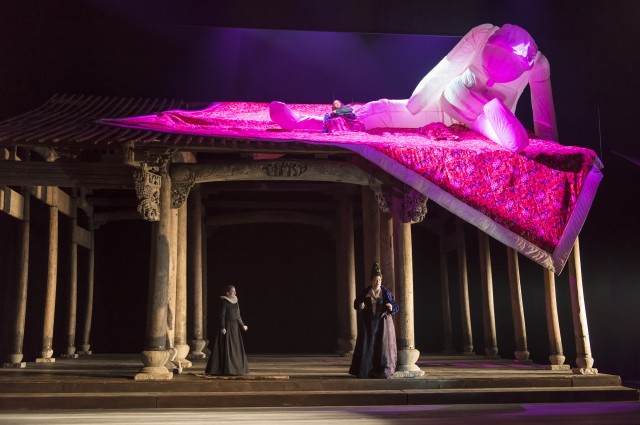
Somnus looks down from above in Zhang Huan’s visually dazzling production of SEMELE (photo by Jack Vartoogian / Frontrowphotos)
In the program notes, Zhang explains, “The fact that the roots of pain introduced in a Western opera can reappear in the East in the fate of a single peasant family in the countryside makes us continually ponder the redemptive qualities of humanity. . . . The human race has to continuously and eternally develop as it regresses.” Zhang explores that concept by incorporating into the opera a pair of sumo wrestlers (Americus Abesamis and Byamba Ulambayar), a huge blow-up god, two actors portraying a donkey showing off an enormous phallus, a twisting dragon, a chorus of men and women dressed as Buddhist monks, a Tibetan singer (Amchok Gompo Dhondup), characters that ascend and descend on wires, an orgy, nudity, and a shimmering magic mirror. (And it doesn’t take too much imagination to see the temple pillars as phallic objects either.) Handel’s score is beautifully conducted by Christopher Moulds, leading the COC Orchestra; the cast, singing in English (with English surtitles), features standout performances by Ainsorth, Whyte, and particularly Archibald in the title role, who dazzles in a late aria. In merging Eastern and Western philosophies, Zhang has infused this Greek myth with the four noble truths — aging, arising, cessation, and the path — while also relating it to modern-day China, resulting in a wholly satisfying, nontraditional, extremely entertaining multimedia experience.
FOLLIES OF GOD BOOK LAUNCH WITH JAMES GRISSOM

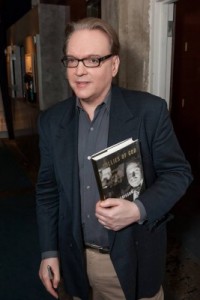
Rescheduled book launch for James Grissoms FOLLIES OF GOD will take place March 10 at the Corner Bookstore (photo by Mike Chiodo)
Who: James Grissom
What: Book launch for Follies of God: Tennessee Williams and the Women of the Fog (Knopf, March 3, 2015, $30)
Where: The Corner Bookstore, 1313 Madison Ave. at 93rd St., 212-831-3554
When: Tuesday, March 10, free, 6:00
Why: The epigraph to James Grissom’s Follies of God is a quote from Tennessee Williams: “I have been very lucky. I am a multi-souled man, because I have offered my soul to so many women, and they have filled it, repaired it, sent it back to me for use.” Later, in the first chapter, Grissom writes, “No play written by Tennessee Williams, however, got its bearings until a fog rolled across the boards, from which a female form emerged. ‘I do not know why this is,’ Tenn confessed to me, ‘but there is a premonitory moment before a woman, an important, powerful woman, enters my subconscious, and this moment is announced by the arrival of fog. Perhaps it is some detritus of my brain belching forth both waste and a woman. . . . I have not seen the fog in years.’” In the book, Grissom delves into Williams’s inspirations, his creative process, and the actresses who played the dramatic roles in his works, including Lillian Gish, Maureen Stapleton, Jessica Tandy, Geraldine Page, Julie Harris, and Katharine Hepburn, in addition to female relatives and others. The book launch was supposed to take place February 27 at the Corner Bookstore but was moved to March 5 because of the weather, so you have another chance to learn more about this fascinating tome about one of America’s greatest playwrights.
TICKET ALERT: FULL BUNNY CONTACT
FULL BUNNY CONTACT
The Clemente Soto Vélez Cultural and Educational Center
107 Suffolk St. between Rivington & Delancey Sts.
April 1-5, $10-$60
www.fullbunnycontact.com
Easter has always been a rather violent holiday. Every spring, we bite the heads off of chocolate rabbits and devour their colored eggs like candy, at least in part to attempt to get even for the punishment inflicted on the human race by giant killer bunnies in the cult classic Night of the Lepus. For the second year, Full Bunny Contact, billed as an “extreme Egg Hunt and Insane Easter Carnival,” offers a unique way to celebrate Easter while taking on the Easter Bunny himself. From April 1 to 5, the Clemente Soto Vélez Cultural and Educational Center will be home to a bizarre group of activities that you can just marvel at or get in on the hot action. General admission is $10, with individual game tickets an additional charge; for $60, you get to go hog wild, with a free drink as a bonus. But how can you pass up such games as Ride the Rabid Rabbit, Shoot the Peep, Bunny Warrior Joust, Psychotic Bunny Fortune Teller, Take a Picture with the Insult Bunny, Egg Put, ESP-ster Island, and Bunny Ball? Winners receive prizes ranging from candy to cold, hard cash. There will also be food, live music, the April Fools Day Ball, the FBC Bunny Beauty Pageant, the FBC Temper Tantrum Contest (“I wanna Easter egg! I wanna Easter egg!”) and other forms of maniacal entertainment. In our 2014 interview with FBC founder Timothy Haskell, the impresario explained, “Holidays are fantastic. I think people love celebrating them, and I think Easter in this city has lost its youthfulness. I hope this event brings some of that back.” The 2015 edition is directed by John Harlacher, who previously collaborated with Haskell on his annual Nightmare haunted house, and produced by Daniel Demello and Nathaniel Nowak. Oh, did we forget to mention the main event? In the game that gives the entire evening its name, FBC, participants are locked in a steel cage with giant Easter bunnies (again, think Night of the Lepus) from whom they must take as many eggs as they can in one minute to win yet more valuable, invaluable, or pretty much worthless prizes.
WIM WENDERS: THE SALT OF THE EARTH

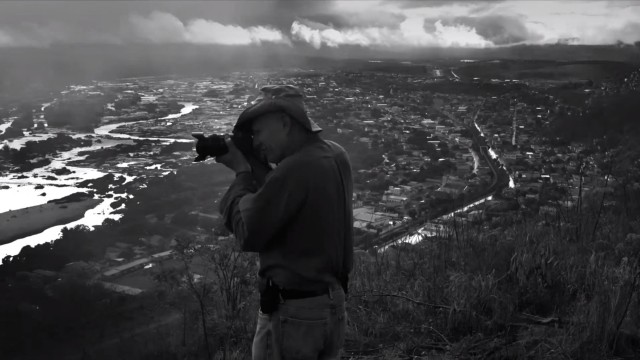
Sebastião Salgado is shown photographing the planet — and trying to save the world — in THE SALT OF THE EARTH
THE SALT OF THE EARTH (Wim Wenders & Juliano Ribero Salgado, 2014)
MoMA Film, Museum of Modern Art
11 West 53rd St. between Fifth & Sixth Aves.
Saturday, March 7, 7:45
Series runs March 2-17
Tickets: $12, in person only, may be applied to museum admission within thirty days, same-day screenings free with museum admission, available at Film and Media Desk beginning at 9:30 am
212-708-9400
www.sonyclassics.com
www.moma.org
Over the course of his storied five-decade career, German-born auteur and photographer Wim Wenders has alternated between making documentaries, primarily about other artists (Pina Bausch, Yasujirō Ozu, the Buena Vista Social Club) and fiction films, often unique takes on the road movie in which photographs play a key role (Paris, Texas; Alice in the Cities, Kings of the Road). In his latest work, Wenders has found one subject that combines his many interests, as he follows the remarkable adventures of Brazilian photographer and environmentalist Sebastião Salgado, who has traveled the world taking stunning pictures of the land and native peoples. In The Salt of the Earth, which was nominated for a Best Documentary Feature Oscar and won the Un Certain Regard special jury prize at the Cannes Film Festival and the César at France’s national film awards, Wenders teams up with Salgado’s son, filmmaker Juliano Ribero Salgado (Suzana; Nauru, an Island Adrift), as they accompany Salgado on his journeys and talk about his work, which consists predominantly of black-and-white photographs in such social justice series as “Workers” and “Migrations” and his most recent, the nature-themed“Genesis,” which was just shown at ICP. In the documentary, Salgado is shown rolling around on a shore to get a picture of a polar bear in the Arctic Circle, heading down into the mines of Brazil, meeting the Yali in Papua New Guinea, and sitting on a mountain, contemplating the future of the planet.

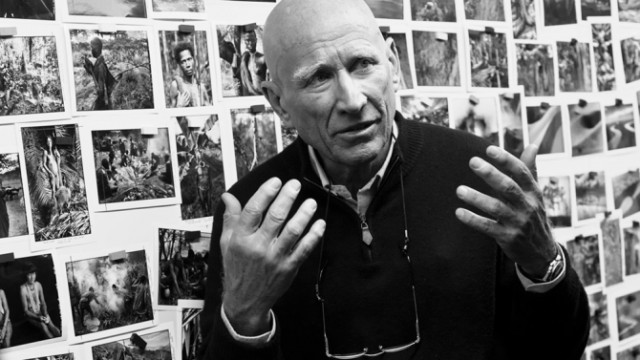
Sebastião Salgado talks about his life and work in Oscar-nominated documentary directed by his son and Wim Wenders
Salgado is not only photographing parts of the world devoid of technological modernity but is also involved, with his wife and curator, Lélia Wanick Salgado, in returning to nature, having planted more than two million trees to rebuild part of the Atlantic Forest on his family’s land in Brazil and starting Instituto Terra, a nonprofit community organization dedicated to restoring the ecosystem. “A photographer is literally somebody drawing with light, a man writing and rewriting the world with light and shadows,” Wenders narrates in the film. “Little did I know that I was going to discover much more than just a photographer.” Using a semitransparent mirror, Wenders also conducts interviews with Salgado, who is seen in front of a screen, looking at his photographs while discussing them. Other times the only thing on camera is Salgado’s bald head against a black background, as he peers into the camera to share his tale, including his relationship with his wife and children. “If you put many photographers in one place, they’ll all take very different pictures,” Salgado says. “Each one forms their way of seeing according to their history.” As The Salt of the Earth ably displays, Salgado has a fascinating history. The Salt of the Earth is being shown at MoMA on March 7 at 7:45 as part of a two-plus-week Wenders retrospective in advance of the film’s March 27 theatrical release; Wenders, who just received the Golden Bear for lifetime achievement at the Berlin Film Festival, and Juliano Ribero Salgado, whose next film will be a psychological thriller, will introduce the work and participate in a postscreening discussion. The series continues through March 17 with such other Wenders films as The American Friend, Wings of Desire, Until the End of the World, Tokyo-Ga, The Goalie’s Anxiety at the Penalty Kick, and other well-known gems and rare early shorts, with Wenders at the museum for Q&As and introductions at all screenings through March 7.
SEE IT BIG! HIGH AND WIDE: HIGH AND LOW
HIGH AND LOW (TENGOKU TO JIGOKU) (Akira Kurosawa, 1963)
Museum of the Moving Image
35th Ave. at 36th St., Astoria
Saturday, March 7, $12, 4:30
Series runs March 6-13
718-777-6800
www.movingimage.us
www.reverseshot.org
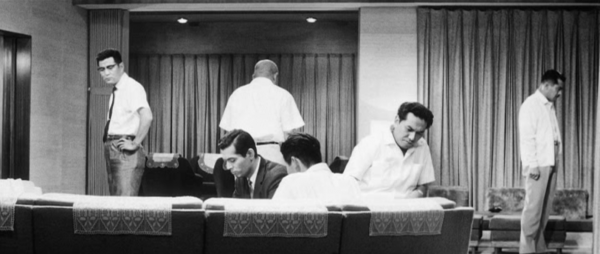
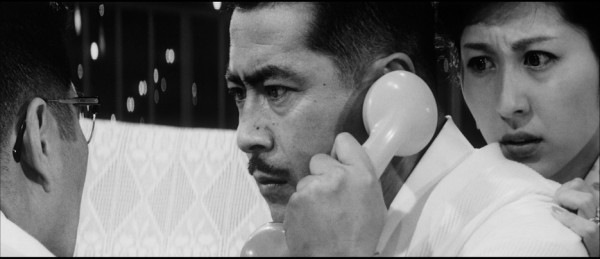
On the verge of being forced out of the company he has dedicated his life to, National Shoes executive Kingo Gondo’s (Toshirō Mifune) life is thrown into further disarray when kidnappers claim to have taken his son, Jun (Toshio Egi), and are demanding a huge ransom for his safe return. But when Gondo discovers that they have mistakenly grabbed Shinichi (Masahiko Shimazu), the son of his chauffeur, Aoki (Yutaka Sada), he at first refuses to pay. But at the insistence of his wife (Kyogo Kagawa), the begging of Aoki, and the advice of police inspector Taguchi (Kenjiro Ishiyama), he reconsiders his decision, setting in motion a riveting police procedural that is filled with tense emotion. Loosely based on Ed McBain’s 87th Precinct novel King’s Ransom, Akira Kurosawa’s High and Low, photographed by longtime Kurosawa cinematographer Asakazu Nakai, is divided into two primary sections: The first half takes place in Gondo’s luxury home, orchestrated like a stage play as the characters are developed and the plan takes hold. The second part of the film follows the police, under the leadership of Chief Detective Tokura (Tatsuya Nakadai), as they hit the streets of the seedier side of Yokohama in search of the kidnappers. Known in Japan as Tengoku to Jigoku, which translates as Heaven and Hell, High and Low is an expert noir, a subtle masterpiece that tackles numerous socioeconomic and cultural issues as Gondo weighs the fate of his business against the fate of a small child; it all manages to feel as fresh and relevant today as it probably did back in the ’60s.
High and Low is screening March 7 at 4:30 as part of the Museum of the Moving Image series “See It Big! High and Wide,” which runs March 6-13 in conjunction with the Reverse Shot online symposium “Take Five: Reverse Shot in Space.” “High and Low is a particularly emphatic example of Kurosawa’s attention to spatial continuity over the course of an entire film,” Ben Parker writes on Reverse Shot. “The title announces one spatial organization, the vertical juxtaposition of prosperous legality — symbolized by the hilltop estate of shoe executive Kingo Gondo — and the miasmic squalor and slinking resentment of the urban lower depths. But the very look of the film tells a different story. High and Low was shot using the TohoScope process, drastically widening the frame for an aspect ratio of 2.35:1. However much the social and moral themes of the film are posed along the vertical axis . . . the images and compositions are constrained to the horizontal. Ultimately, Kurosawa is attempting to undo the vertical binary of postwar Japanese society. This ‘leveling,’ however, is not as simple as filming in wide screen. Rather, the visual theme of the film culminates in its hard-won conclusion. In the last scene, Kurosawa arrives at a very different leveling of social space than that imagined by the diseased resentment of his villain.” The eight-day festival also includes such films as Jacques Tati’s Playtime, Michael Powell and Emeric Pressburger’s A Matter of Life and Death, George Stevens’s Shane, and Elem Klimo’s Come and See.
NEW YORK ART FAIR WEEK 2015: FREE FAIRS

Héctor Zamora’s O ABUSO DA HISTÓRIA will be shown at Moving Image art fair (courtesy Luciana Brito Galeria)
This year’s March edition of New York Art Fair Week — the city will be overrun with fairs again in May — features no fewer than a dozen shows, including Volta, Scope, Art on Paper, the Independent, Pulse, Spring/Break, and the granddaddy of them all, the Armory Show. If you want to see each one of them, it’s gonna cost a pretty penny, upwards of two hundred bucks total. But there are five fairs that offer free admission and a respite from the craziness that goes on at the ticketed shows.
Who: Nearly three dozen video artists, including Charlie Ahearn, Peggy Ahwesh, Oliver Bevan, Raphael Couto, Tuomas A. Laitinen, Pink Twins, and Héctor Zamora
What: Moving Image
Where: Waterfront Tunnel, 269 Eleventh Ave. between 27th & 28th Sts.
When: March 5-8, free
Why: Moving Image is a video art fan’s dream, lining the passageway in the Waterfront Tunnel in Chelsea with a multitude of innovative short works. On Saturday at noon, Sean Elwood will moderate the panel discussion and networking session “How Do Artists Secure Funding for Film and Video Artwork?” with Chris Doyle, Guy Richards Smit, Patrik Söderlund, and Eve Sussman, followed at 2:00 by “Moving Image: Instant Upload” with Alex McQuilkin, Alice Gray Stites, Amy Taubin, Rachael Rakes, and Zoë Salditch, moderated by Andrea Monti and Elle Burchill.
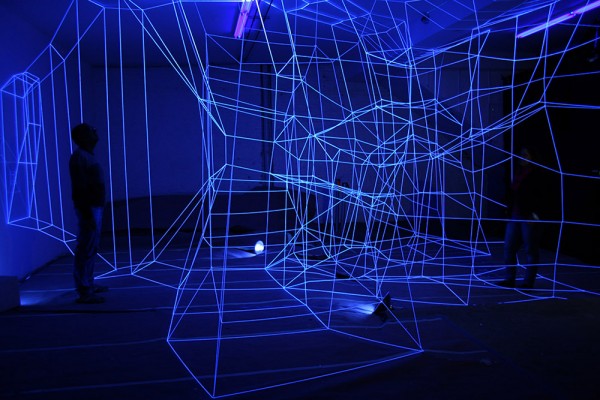
Who: More than eighty visual, tech, and performance artists, including Carlos Betancourt, Sabrina Barrios, Will Kurtz, Chris Ofili, Matt Lombard, Eunjin Kim, Carolee Schneeman, Frederico Uribe, Monika Weiss, Matthew Silver, and Kelly McLaughlin
What: The (un)Scene Art Show
Where: 549 West 52nd St. between Tenth & Eleventh Aves.
When: March 4-8, free
Why: Renamed from last year’s (Un)Fair designation, the (un)Scene Art Show seeks to “celebrate passion rather than fashion.” This year’s edition features numerous “Happenings,” including such live performances as Moon Ribas’s Waiting for Earthquakes, Jade Fusco’s Talking Tapestry, TunanuT’s Group Love, Nicole Woolcott’s Paper Pieces, Kate Brehm’s The Proofs, and Danielle Russo Dance Company’s Since thou was precious in my sight. There will also be an art and dance party hosted by Brock Enright, such panel discussions as “The Radical Eye: Why Artists Must Curate” with Anne Harris, “The (un)TALK” with Raoul Middleman, and “The Art Pollution Crisis (Three-Step Detox Program)” with Alex Melamid, and other events.
Who: Artists who are not represented by a New York City gallery
What: Clio Art Fair: The Anti-Fair for Independent Artists
Where: 508 West 26th St. between Tenth & Eleventh Aves.
When: March 5-8, free
Why: The Clio Art Fair lets their artists run wild without worrying about art market constraints and rules; there was a charming freshness to last year’s inaugural edition that the others lack, caring about the art and the artists ahead of the sale and actually enjoying itself, which rubs off on visitors.
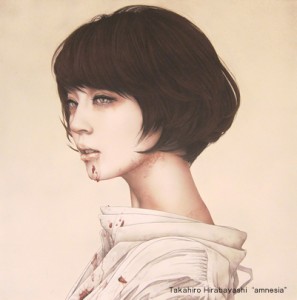
Who: Nearly three dozen artists from eight Japanese galleries
What: New City Art Fair
Where: hpgrp Gallery New York, 529 West 20th St. between Tenth & Eleventh Aves.
When: March 5-8, free
Why: Now in its fourth year, New City concentrates on Japanese contemporary art. Programs include studio visits with Spoon & Tamago and a presentation by Pola Museum Annex.
Who: Polly Apfelbaum, BTHY, Fransje Killaars, Pushpamala N., Dona Nelson, Diana Shpungin, and Sarah Tritz
What: Salon Zürcher
Where: Salon Zürcher New York, 33 Bleecker St. between Lafayette & Bowery
When: March 5-12, free
Why: In its third edition, Salon Zürcher will highlight work by seven women artists shown by seven international galleries, including India, the United States, France, and the Netherlands.