“I like individuality,” self-described “geriatric starlet” and nonagenarian fashion doyenne Iris Apfel says at the beginning of octogenarian Albert Maysles’s penultimate film, Iris. “It’s so lost these days. There’s so much sameness. Everything is homogenized. I hate it. Whatever.” Iris celebrates that individuality, not only Apfel’s, who at ninety-three is still active in the fashion world, but Maysles’s, who passed away in March at the age of eighty-eight, leaving behind a legendary legacy that changed the face of documentary cinema, including such classics as Salesman, Grey Gardens, and Gimme Shelter. Throughout the film, Apfel speaks directly to Maysles, who ends up on camera several times, breaking that once-impenetrable fourth wall that he, his brother, David, and their partner, Charlotte Zwerin, helped tear down years ago. Maysles spent four years filming the Queens-born Apfel as she shared her lovely story, growing from an interior designer and textile-business owner to a world-renowned fashion collector, tastemaker, and rule breaker, accompanied all along the way by her husband of more than sixty-six years, Carl. Maysles shows Iris, in her trademark enormous circular-framed glasses and unique, colorful ensembles that mix designer clothing with a healthy dose of inexpensive accessories, as she bargains at a cheap local store, advises women at a special Loehmann’s event, prepares for her 2005 show at the Metropolitan Museum of Art’s Costume Institute, hawks her jewelry line on the Home Shopping Network, works on a window display at Bergdorf Goodman, and talks fashion with Martha Stewart, Tavi Gevinson, and others. Maysles interviews such designers as Alexis Bittar, Duro Olowu, Naeem Khan, and Dries van Noten, Met curator Harold Koda, Architectural Digest editor in chief Margaret Russell, and J. Crew head Jenna Lyons, who have only the most kind and generous things to say about the always positive Apfel, who has a genuine love of life. “It’s better to be happy than well dressed,” she tells friend and photographer Bruce Weber.
Nonagenarian Iris Apfel and octogenarian Albert Maysles display a love of life in IRIS (photo courtesy of Magnolia Pictures)
Maysles also explores the Apfels’ inspiring relationship, filled with humor, a love of collecting knickknacks and tchotchkes (strewn about their cluttered apartment), and an infectious yen for trying anything and everything that life has to offer. The film concludes with Carl’s one-hundredth birthday party. Early on, Iris tells a story about one of her first jobs, toiling for Frieda Loehmann in Brooklyn. “One day she called me over and she said, ‘Young lady, I’ve been watching you.’ She said, ‘You’re not pretty, and you’ll never be pretty, but it doesn’t matter. You have something much better. You have style.’” Iris indeed has style, as this wonderful documentary extols, a marvelous tribute both to her and Carl as well as Albert Maysles. Who needs pretty when something this beautiful is what emerges? Iris opens April 29 at Lincoln Plaza and Film Forum, where it will be preceded by Vivian Ostrovsky’s fashion short, Losing the Thread. Producers Laura Coxson and Rebekah Maysles, one of Albert’s children, will be at Film Forum for the 6:20 show on April 29, while Iris herself will participate in a Q&A following the 6:20 screening on May 1 and will then introduce the 8:20 show.
Brooklyn Museum
200 Eastern Parkway at Washington St.
Saturday, April 4, free, 5:00 – 11:00
212-864-5400 www.brooklynmuseum.org
You know L.A.-born, New York–based artist Kehinde Wiley has made it, since one of his works is featured in the hit show Empire. Wiley’s new show at the Brooklyn Museum, “Kehinde Wiley: A New Republic,” is the centerpiece for the May edition of the institution’s free First Saturday program. The free evening will feature live musical performances by Chargaux and Zebra Katz and DJ sets by Juliana Huxtable and Total Freedom; a curator talk by Eugenie Tsai about the Wiley show; a Wiley-inspired three-dimensional frame-making workshop; pop-up gallery talks; an interactive space curated by Browntourage combining entertainment and activism; a screening of Jeffrey Dupre’s short 2014 documentary Kehinde Wiley: An Economy of Grace; and a Wiley-inspired dance performance of Leaders of the New School by Art of Legohn. In addition, you can check out such exhibitions as “Revolution! Works from the Black Arts Movement,” “Basquiat: The Unknown Notebooks,” “Diverse Works: Director’s Choice, 1997–2015,” “The Dinner Party by Judy Chicago,” and “Chitra Ganesh: Eyes of Time.”
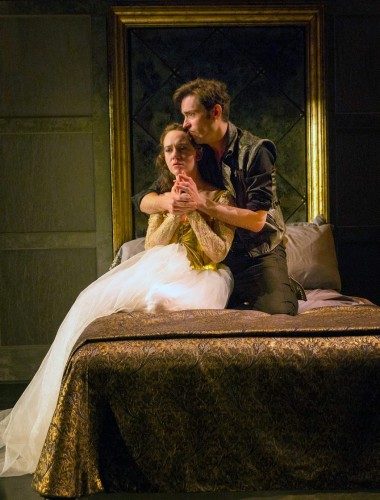
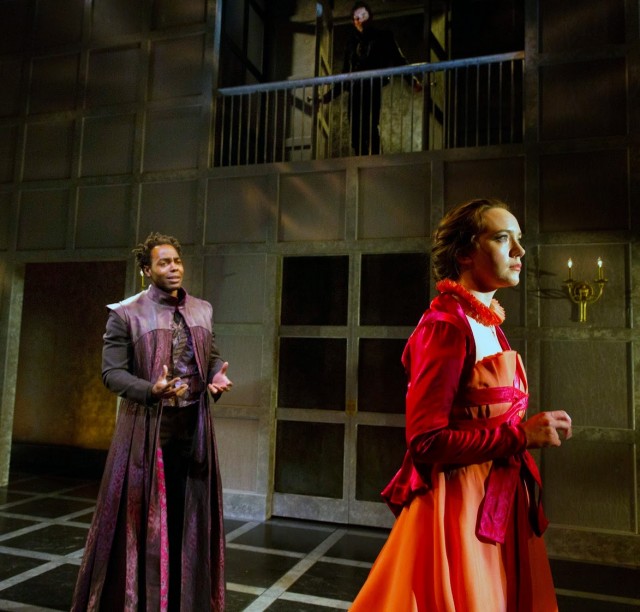
John Ford doesn’t beat around the bush in his seldom-performed 1630s classic, ‘Tis Pity She’s a Whore, currently being revived by the Red Bull Theater in a glorious new production at the Duke on 42nd Street. The Jacobean drama is a bold, brash, violent, and very funny riff on Romeo and Juliet, but in this case the young lovers just happen to be extremely close siblings. “Shall a peevish sound, / A customary form, from man to man, / Of brother and of sister, be a bar / ’Twixt my perpetual happiness and me?” Giovanni (Matthew Amendt) confesses to Friar Bonaventura (Christopher Innvar), continuing, “Say that we had one father, say one womb / (Curse to my joys!) gave both us life and birth: / Are we not therefore each to other bound / So much the more by nature, by the links / Of blood, of reason (nay, if you will have it, / Even of religion), to be ever one, / One soul, one flesh, one love, one heart, one all?” Prepared to die for his unholy desire, Giovanni is surprised, and delighted, to find out that his sister, Annabella (Amelia Pedlow), feels the same way about him. Meanwhile, a trio of suitors battles for her hand: the nobleman Lord Soranzo (Clifton Duncan), the soldier Grimaldi (Tramell Tillmann), and the over-the-top dandy Bergetto (Ryan Garbayo). Annabella’s trusted and rather bawdy tutoress, Putana (Franchelle Stewart Dorn), thinks the best choice for her lady is Soranzo, explaining, “Commend a man for his qualities, but take a husband as he is a plain, sufficient, naked man: such a one is for your bed, and such a one is Signior Soranzo, my life for’t.” But the scheming, venomous Hippolita (Kelley Curran), Soranzo’s former mistress, is not about to let him go without a fight. Also getting in on all the fun is the Cardinal (Rocco Sisto), who arrives for the wedding feast; Vasques (Derek Smith), Soranzo’s crafty and cunning Spanish servant; and Florio (Philip Goodwin), Annabella and Giovanni’s father, who explains early on, “I would not for my wealth my daughter’s love / Should cause the spilling of one drop of blood.” But alas, there will be blood spilled, and lots o’ it.
Red Bull revival features fab costumes and an elegantly austere set (photo by Richard Termine)
In late 2012, the Red Bull Theater did a splendid job reviving Ben Jonson’s 1606 Renaissance comedy, Volpone, helmed by company artistic director Jesse Berger. Berger is equally adept holding the reins for ‘Tis Pity She’s a Whore, balancing love and lust, humor and tragedy with a sweetly chaotic grace. David M. Barber’s elegant set features a balcony from which various characters watch the proceedings, in addition to a bed that magically, and ominously, appears through a center doorway. Sara Jean Tosetti’s costumes are an absolute riot, melding early sixteenth-century style with a steampunk sensibility and stiletto heels. The cast is uniformly excellent, having a ball with Ford’s sparkling language, with particular kudos due Pedlow (The Heir Apparent, You Never Can Tell) as the sexy Annabella, Tony nominee Smith (The Green Bird, Sylvia) as the conniving yet realistic Vasques, Garbayo (Loot, Final Analysis) as the flitting Bergetto, and Curran (Angels in America, Henry V) as the “lusty widow,” who proclaims, “How foolishly this beast condemns his fate, / And shuns his former love! But let him go: / My vengeance shall give comfort to his woe.” In this Red Bull revival at the Duke on 42nd Street, there is plenty of lovely vengeance and woe to go around. (The May 3 & 10 matinees will be followed by a discussion with Columbia professors James Shapiro and Jean E. Howard and members of the company. And on May 4 at 7:30 at Playwrights Horizon, the Red Bull Theater will be staging a “Revelation Reading” of Ford’s Love’s Sacrifice with live music.)
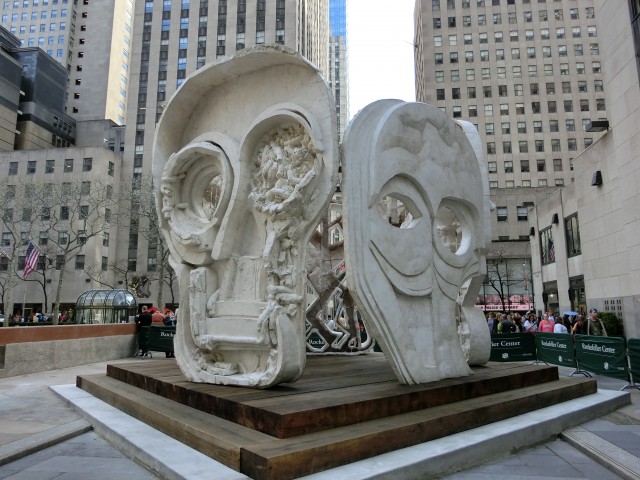
Thomas Houseago will discuss new Rock Center work, “Masks (Pentagon),” at New School talk April 29 (photo by twi-ny/mdr)
Who: Thomas Houseago What:Public Art Fund Talks Where:The New School, 12th Street Auditorium, Alvin Johnson / J. M. Kaplan Hall, 66 West 12th St. between Fifth & Sixth Aves. When: Wednesday, April 29, $10, 6:30 Why: British-born, L.A.-based artist Thomas Houseago will discuss public works and his latest project, “Masks (Pentagon),” which is on view through June 12 in Rockefeller Plaza. The site-responsive installation consists of five large-scale white masks, cast from clay in industrial-strength synthetic plaster, arranged in a pentagram so visitors can enter and look out at the surrounding Rockefeller Center area, as well as witness the revealing insides of the masks. “In this piece I wanted to bring the activity and the feel of the studio into public space as an experience,” Houseago explains in a statement. “The public gets to ‘see’ the work both from the outside as an image but then also from the inside as an insight into its construction. It becomes a kind of retreat from the city but also a porous viewing space. The public becomes part of the experience of looking and also an integral part of the work.”
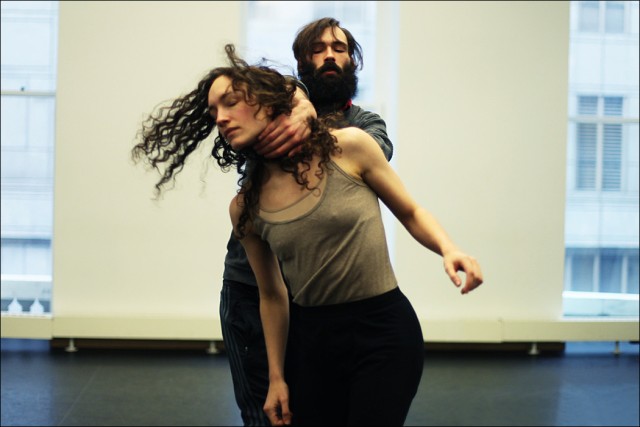
SLEEP NO MORE’s Macbeth and Lady Macbeth, Nick Bruder and Troy Ogilvie, are together again in REPLACEMENT PLACE (photo by Aeric Merideth-Goujon)
REPLACEMENT PLACE
Patricia Noworol Dance Theater
New York Live Arts
219 West 19th St. between Sixth & Seventh Aves.
April 30 – May 2, $20-$30
212-924-0077 newyorklivearts.org pndance.com
Numerous memorable pairs have portrayed Macbeth and Lady Macbeth onstage and onscreen over the years, in various interpretations, including Laurence Olivier and Vivien Leigh, Ian McKellen and Judi Dench, Orson Welles and Jeanette Nolan, Nicol Williamson and Helen Mirren, Patrick Stewart and Kate Fleetwood, Toshiro Mifune and Isuzu Yamada, Kenneth Branagh and Alex Kingston, and Liev Schreiber and Jennifer Ehle. Nick Bruder and Troy Ogilvie might not be quite the same household names, but they appeared as the ill-fated king and his devious wife in one of the most memorable and certainly unusual versions of Macbeth you’re ever likely to see, Sleep No More, in which the action unfolds throughout the McKittrick Hotel in Chelsea. The two are back together again in Replacement Place, being presented by Patricia Noworol Dance Theater at New York Live Arts April 30 to May 2. Bruder, who won the 2011 Falstaff Award for Best Principal Performance in Sleep No More, and Ogilvie, a Juilliard graduate, New Jersey native, and Dance magazine “25 to Watch” pick in 2011, recently discussed working together and their personal and professional ideas of “place.”
twi-ny: Sleep No More has been quite a phenomenon. What was it like being part of that experience? Had you been involved in any type of interactive, participatory performances before?
Troy Ogilvie: Performing in Sleep No More was a gritty, fun, sexy ride. It was an ego trip as well as an exercise in vigilant attention. No, I had never been involved in a performance that was as immersive as SNM. My other nontraditional performance experiences were more “site specific,” as in an installation in a gallery or work done in the outdoors.
Nick Bruder: I cannot express how much I’ve learned from working with punchdrunk and Sleep No More. Mainly, I’m always going to know more about the character and the work than the audience will. And that’s okay. It’s my job to know more. If I have a clear perspective and perform with the understanding that I developed this weird alchemical-like process that actually opens up room and context for the audience to engage with — that’s imperative in Sleep No More, since it’s more likely that an audience member will catch a character’s story from unordered snippets. But this still holds true to a linear performance as well. As for other work, I’ve done a bunch of other immersive or audience-integrated work. In Los Angeles I worked with visual artist Brody Condon on two of his durational performance pieces consisting of wearing a full suit of armor and slowly falling into the floor à la a video game character’s death. Whew.
twi-ny: You played Lady Macbeth and Macbeth in Sleep No More, although you never did so at the same time. Now that you’re both in Replacement Place, do you wonder what it would have been like to have played the devious husband and wife together in Chelsea?
TO: Actually, we did fight, plot, conspire, tease, and descend into madness together for over a year as “husband” and “wife.”
twi-ny: Oops. Sorry about that.
NB: Hah. We actually ended both of our runs with Sleep No More as each other’s Macbeths. And I couldn’t think of anything better.
TO: Our bond that developed at SNM spilled over into our life outside the McKittrick Hotel, and we are always dreaming up ways to continue to work with one another.
twi-ny: Troy, you’ve worked with such choreographers as Sidra Bell, Andrea Miller, Idan Sharabi, Austin McCormick, and Margie Gillis. Do you find yourself working any differently with different choreographers, and specifically with Patricia Noworol? Do the different choreographers test you in different ways, both physically and mentally?
TO: Yes. Every choreographer has their boundary that they are — to use your word — testing. There’s something that has to stretch in the dancer in order to accommodate the weakened border, something that has to stretch but not break. The stretch is a pleasure, the skill is knowing when the boundary can be re-formed and its new shape celebrated. That moment has to do with the specific chemistry between choreographer and dancer. Patricia has a lot of openness in her process, which can be frustrating but in the end is absolutely freeing and brilliant. Anything is an option, which is a relief and a stress, but it’s exactly where I want to be right now. Pat has a great sense of timing, texture, and emotional build that we can’t wait to share with audiences.
twi-ny: Nick, you’ve appeared in opera at the Met, in a dance piece at BAC, in a mobile production at the McKittrick Hotel, in Shakespeare at the Harman Center, and now you will be at NYLA for Replacement Place. How does the concept of place inform how you approach a performance?
NB: Logistically, each site where performance is presented has its benefits: audience capacity, how close they are to the performers, size of the space, etc. Even the type of audience they attract. When one is performing in so many venues, it can begin to get exhausting adapting a changing performance approach. So I have to be confident that my understanding of character and all the tools I have collected, and some that I’ve thrown away throughout the years, can aid in helping the piece I’m in to be applicable to the venue. This may sound too heady, but I think a formula of audience + performers + space = something that happened in a place. Thinking about that, I hope, relieves the pressure of me having to adapt properly to the site and let the space and work influence the type of place it is to become.
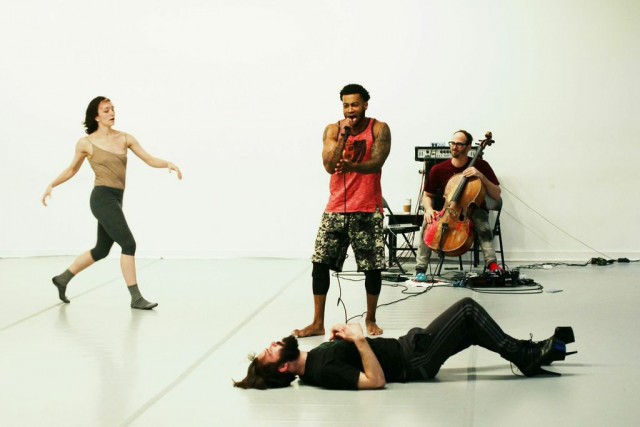
Patricia Noworol’s REPLACEMENT PLACE is a collaboration between Troy Ogilvie, Nick Bruder, AJ “the Animal” Jonez, and Chris Lancaster (photo by Aeric Merideth-Goujon)
twi-ny: Troy, in September 2012 you wrote in Dance magazine, “I dance because it is fun. I dance because I love to perform. I dance because I always have. These clichés were all accurate at one point, but none apply today.” Do you still feel the same way?
TO: Yes, but wow, so dramatic! I mean, yes, “fun,” “love,” and “always” are not the words I would use to describe my relationship to dance, but not because it is not-fun, not-love, and not-always. I have less confusion about it now, so there’s more room to actually work and less time spent on proving myself.
twi-ny: Replacement Place features quite an eccentric collection of collaborators, from the two of you to AJ “the Animal” Jonez to electro-cellist Chris Lancaster and designer Vita Tzykun. What have the rehearsals been like? The online videos have been rather tantalizing.
TO: Rehearsals have been a blast. AJ, Chris, and Vita are experts in their fields and are also so generous with their information. We all trust each other and have fun trying on each others’ shoes — sometimes literally. I am really so pleased to be working with this group; kudos for Pat for throwing us all in a room together!
NB: They’ve been like a super-condensed story of the universe. A big bang of inspiration happens which sets ideas in motion which then leads to cool and amazing organisms to exist and grow and diversify with sunshine feeding and warming all the beautiful animals and plants when all of a sudden a little dark rain cloud comes overhead and starts spilling out its watery guts until you notice that it’s actually a black hole that is sucking you and everything you know into its gullet while you lose hope by the minute only to spit you out on the other side with a new big bang and then you’re like hmm . . . must have been a wormhole. Pretty typical artistic process. It’s awesome.
twi-ny: Whew is right. In regard to place, do each of you have somewhere you go in order to get away from it all?
Dance and food take center stage at annual Danspace Project benefit (photo by Judy Hussie-Taylor)
Who: Curators Jeanine Durning, David Thomson, and Iréne Hultman and dancers and choreographers Ivy Baldwin, Whitney Hunter, Sam Kim, Joanna Kotze, Stanley Love, Juliette Mapp, Mina Nishimura, Ni’Ja Whitson Adebanjo, Daria Faïn, Christine Bonansea Saulut, Massimiliano Balduzzi, Alex Escalante, Niall Jones, and Dai Jian What:Food for Thought Where:Danspace Project, 131 East Tenth St., 212-674-8112 When: April 30 – May 2, $5 with cans of food, $10 without, 8:00 Why: Danspace Project’s annual Food for Thought presentation comprises three programs of dance and process, benefiting St. Mark’s Church-in-the-Bowery food pantry. On April 30, “This is not the end: an evening with the 2013-2015 Movement Research Artists-in-Residence” brings together curator Jeanine Durning with fellow artists-in-residence Ivy Baldwin, Whitney Hunter, Sam Kim, Joanna Kotze, Stanley Love, Juliette Mapp, Mina Nishimura, and Ni’Ja Whitson Adebanjo for a look at their current practice. On May 1, for “Charged Space,” curator David Thomson will host solo performances by Daria Faïn, Christine Bonansea Saulut, and Massimiliano Balduzzi. And on May 2, curator Iréne Hultman’s “A.N.D Yes!” features dance makers Alex Escalante, Niall Jones, and Dai Jian.
Solomon R. Guggenheim Museum
1071 Fifth Ave. at 89th St.
Friday – Wednesday through May 3, $18-$25 (pay-what-you-wish Saturday 5:45-7:45)
212-423-3587 guggenheim.org
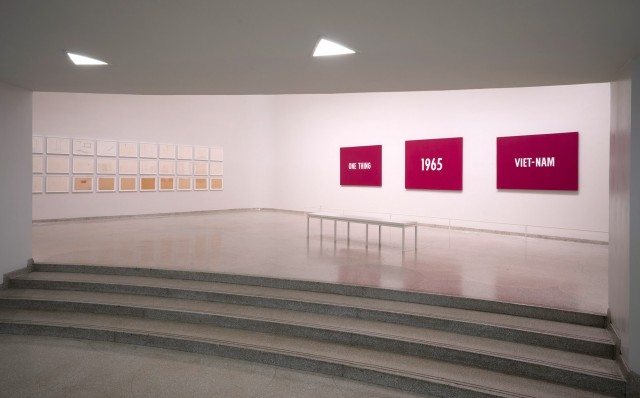
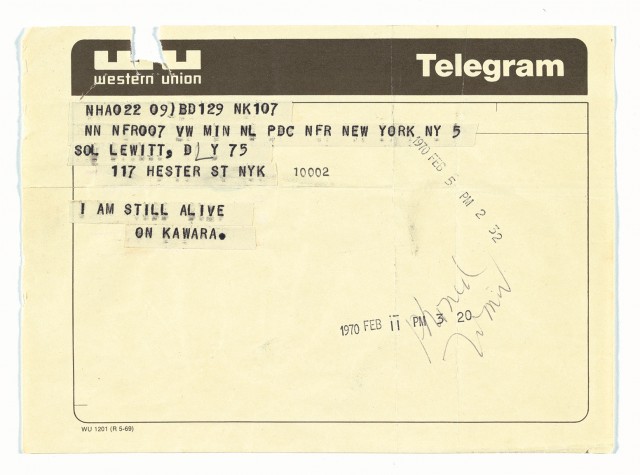
In many ways, Japanese Conceptual artist On Kawara was the first blogger, sharing details of his life via his own social-media platforms long before the internet, but never actually revealing much about his true self. As the splendid Guggenheim exhibition “On Kawara — Silence” discloses, Kawara, who was born in Japan in 1933 and spent most of his life in New York City, where he died last July while the installation was being put together (with his participation), took a rather objective view of existence. His oeuvre comprises postcards he sent to friends and colleagues telling them what time he woke up that morning, extensive notebooks listing who he came into contact with that day, maps of where he went, telegrams to friends and colleagues confirming he was alive, and paintings of the date, accompanied by often random newspaper clippings from the same day. These elements tell us everything about Kawara, and nothing. “How can we avoid misrepresenting the art of On Kawara?” senior curator Jeffrey Weiss asks in his catalog essay, “Bounded Infinity.” “Perhaps misrepresentation of Kawara’s work is not only inevitable but useful. To be sure, regarding the work of any artist, the things we choose to say are always haunted by the things we leave out. With Kawara, however, this aspect of interpretation is specifically, even strategically compounded by the work’s evasive status.” This evasiveness extends into the Guggenheim’s online bio of Kawara, which merely states, “29,771 days,” the exact length of time he was on this planet.
Such series as “I Got Up,” “Today,” “I Met,” “I Am Still Alive,” and “One Hundred Years” engage viewers and encourage exploration despite their obvious repetitiveness, as they lead you to ponder the days of your own past, the people you’ve met, the places you’ve been, and the things that happened on specific dates, which hold different memories for different people, eliciting unique emotional responses. Every Sunday, Wednesday, and Friday from 11:00 am to 5:00 pm on the rotunda, there are continuous live readings of “One Million Years,” Kawara’s lists of dates going back and forward one million years, the annums echoing through the Guggenheim. But mostly Kawara’s output is centered on the here and now, where we are at this precise time and place. “He tells us: ‘It is today!’” artist Daniel Buren writes in his catalog essay, “A Moment’s Footprint.” “On Kawara — Silence” is also a natural fit for the Guggenheim; the show is arranged primarily chronologically by series, so as visitors rise up the museum’s spiraling walkway, they circle through intriguing aspects of Kawara’s daily existence. “It had always been his dream to have a show at the Guggenheim because of the cyclical nature of time and the way that the building represents that,” assistant curator Anne Wheeler points out in an online video. “On Kawara — Silence” speaks volumes, about both him and us. (On April 28 at 6:30, “Duologues on Kawara: Alfredo Jaar and Tom McDonough” will examine Kawara’s work in relation to world events and sociocultural critique.)
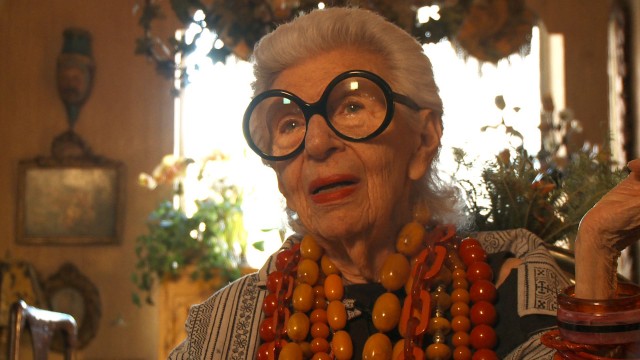
 “I like individuality,” self-described “geriatric starlet” and nonagenarian fashion doyenne Iris Apfel says at the beginning of octogenarian Albert Maysles’s penultimate film, Iris. “It’s so lost these days. There’s so much sameness. Everything is homogenized. I hate it. Whatever.” Iris celebrates that individuality, not only Apfel’s, who at ninety-three is still active in the fashion world, but Maysles’s, who passed away in March at the age of eighty-eight, leaving behind a legendary legacy that changed the face of documentary cinema, including such classics as Salesman, Grey Gardens, and Gimme Shelter. Throughout the film, Apfel speaks directly to Maysles, who ends up on camera several times, breaking that once-impenetrable fourth wall that he, his brother, David, and their partner, Charlotte Zwerin, helped tear down years ago. Maysles spent four years filming the Queens-born Apfel as she shared her lovely story, growing from an interior designer and textile-business owner to a world-renowned fashion collector, tastemaker, and rule breaker, accompanied all along the way by her husband of more than sixty-six years, Carl. Maysles shows Iris, in her trademark enormous circular-framed glasses and unique, colorful ensembles that mix designer clothing with a healthy dose of inexpensive accessories, as she bargains at a cheap local store, advises women at a special Loehmann’s event, prepares for her 2005 show at the Metropolitan Museum of Art’s Costume Institute, hawks her jewelry line on the Home Shopping Network, works on a window display at Bergdorf Goodman, and talks fashion with Martha Stewart, Tavi Gevinson, and others. Maysles interviews such designers as Alexis Bittar, Duro Olowu, Naeem Khan, and Dries van Noten, Met curator Harold Koda, Architectural Digest editor in chief Margaret Russell, and J. Crew head Jenna Lyons, who have only the most kind and generous things to say about the always positive Apfel, who has a genuine love of life. “It’s better to be happy than well dressed,” she tells friend and photographer Bruce Weber.