twi-ny recommended events

PORTRAYING THE HUMAN CONDITION: THE FILMS OF MASAKI KOBAYASHI AND TATSUYA NAKADAI

Kaji (Tatsuya Nakadai) has to search hard to find the humanity in the world (photo © Shochiku Co., Ltd.)

Kaji (Tatsuya Nakadai) has to search hard to find the humanity in the world in Masaki Kobayashi three-part masterpiece (photo © Shochiku Co., Ltd.)

THE HUMAN CONDITION (Masaki Kobayashi, 1959-61)
Museum of the Moving Image
35th Ave. at 36th St., Astoria
Part I: Saturday, May 16, $15, 1:00
Part II: Saturday, May 16, $12, 6:00
Part III: Sunday, May 17, $12, 1:00
Series runs May 15-24
718-777-6800
www.movingimage.us

Masako Kobayashi’s ten-hour epic, The Human Condition, based on a popular novel by Jumpei Gomikawa, is one of the most stunning achievements ever captured on film, and you can catch it all this weekend at the Museum of the Moving Image. Shot over the course of three years, the film follows one man’s harrowing struggle to never give up his humanity as he is dragged deeper and deeper into the morass of WWII. Tatsuya Nakadai is remarkable as Kaji, a man who believes in common decency, personal discipline, and, above all else, that humanity will always triumph. In the first part, No Greater Love, the steadfastly practical Kaji is hesitant to marry his sweetheart, Michiko (Michiyo Aratama), for fear that he will be called to serve in the Japanese army and might not come back to her alive. But when his detailed plan to treat workers fairly is accepted by the government, he is made labor supervisor of a mine in far-off Southern Manchuria, where hundreds of Chinese prisoners are brought in as well — and regularly starved, beaten, and, on occasion, brutally killed in cold blood. Kaji’s methods, which have close ties to communism, leading many to refer to him as a “Red,” anger both sides — the Japanese want to treat the workers like animals, and the Chinese prisoners don’t trust that he has their welfare in mind. A series of escape attempts threatens the stability of the labor camp and comes between Kaji and Michiko, whose undying love is echoed in the yearning, unfulfilled desire between a Korean prisoner and a Japanese prostitute. Broken promises, lies, and betrayal reach a tense conclusion that sets the stage for the second part of Kobayashi’s masterpiece.
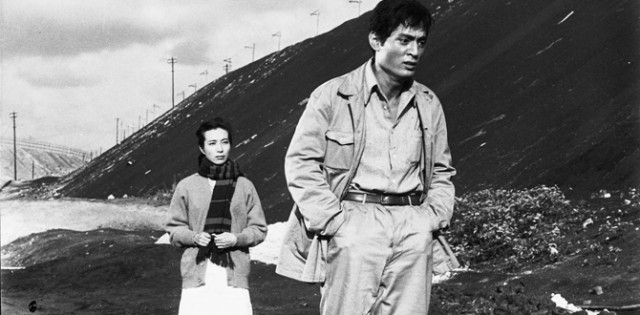
Michiyo Aratama and Tatsuya Nakadai hope that love trumps all in antiwar epic (photo © Shochiku Co., Ltd.)

Michiyo Aratama and Tatsuya Nakadai hope that love trumps all in antiwar epic (photo © Shochiku Co., Ltd.)

SPOILER ALERT: Skip the next paragraph if you don’t want to know what happens in parts II & III!

In Road to Eternity, Kaji has been drafted into the Kwantung Army, going through basic training in preparation for battle. Kaji hopes to find some semblance of humanity in the army, but the superiors are constantly slapping and hitting the recruits, punishing them in brutal ways. When Michiko suddenly shows up, Kaji suffers harassment as it is being decided whether he will be allowed to spend the night with her. With the Soviets on the march, a firefight beckons, but the Japanese troops are woefully short on weapons and ammunition — and confidence, with rumors of Japan’s demise rampant. The epic concludes with the powerful, emotional A Soldier’s Prayer. Kaji is determined to make it back to Michiko, even if it means desertion, but a long, treacherous trip awaits him and he is dangerously low on supplies. He is trying desperately to hang on to his dignity and humanity, but it becomes more and more difficult as the weather worsens, hopelessly lost people join him through the forest, and food is nowhere in sight.

The Human Condition, which has had a profound influence on such filmmakers as Stanley Kubrick, Steven Spielberg, Andrei Tarkovsky, and so many others, might take place during WWII, with Japan fighting for the Axis powers while also immersed in the Second Sino-Japanese War, but its story about man’s inhumanity to man is timeless. At its core, it’s not about Fascism, socialism, democracy, and ethnocentricity but humankind’s need for love and truth. Kaji and Michiko represent everyman and everywoman, separated by a cruel, cold world. Kobayashi provides no answers — the future he envisions is bleak indeed. At Film Forum a few years back for a tribute to his career, Nakadai talked about how brutal the making of The Human Condition was — it is also brutal to sit through, but it is a landmark work that must be seen. All three parts of the film are being shown May 16-17 at the Museum of the Moving Image in “Portraying the Human Condition: The Films of Masaki Kobayashi and Tatsuya Nakadai,” a ten-day series of nine works the pair made together, including Black River, The Inheritance, Kwaidan, Samurai Rebellion, Strike a Life for Nothing, and Harakiri. Nakadai will be at the museum to discuss his work at the May 16 screening of No Greater Love and the May 24 showing of Harakiri.
A SECRET AFFAIR: SELECTIONS FROM THE FUHRMAN FAMILY COLLECTION

(photo by twi-ny/mdr)

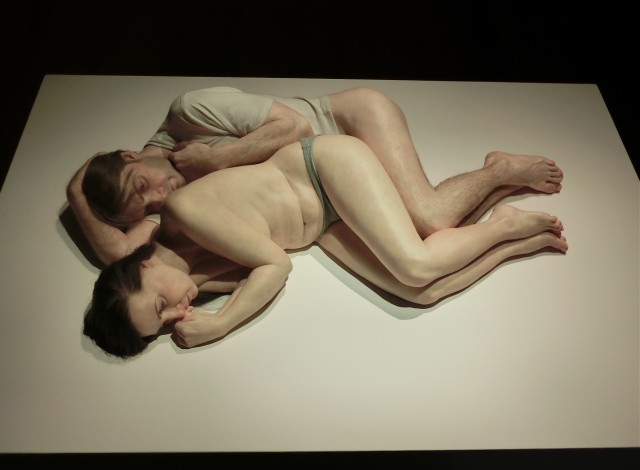
Ron Mueck’s ultra-realistic “Spooning Couple” is part of “A Secret Affair” at FLAG (photo by twi-ny/mdr)

The FLAG Art Foundation
545 West 25th St. between Ninth & Tenth Aves.
Wednesday through Saturday through May 16, free, 11:00 am – 5:00 pm
212-206-0220
flagartfoundation.org

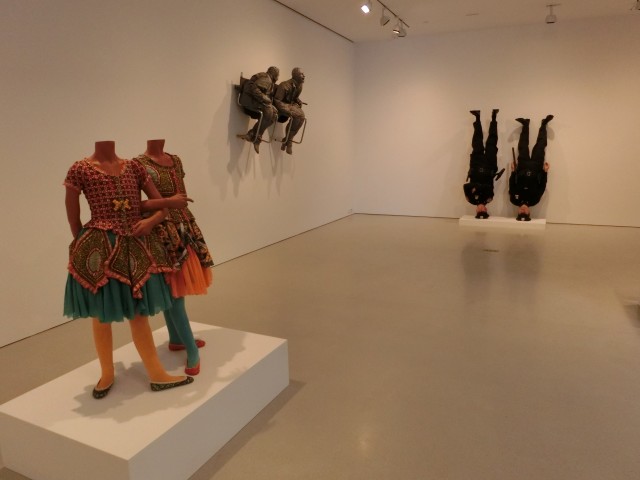
The name of the current exhibit at the FLAG Art Foundation, “A Secret Affair,” conjures thoughts of clandestine coupling. Indeed, the show, which continues through May 16, features works that explore, both as physical objects and conceptual ideas, the notion of pairs, of the double, built around what senior curator Heather Pesanti refers to in her catalog essay, “The Subversive Body,” as “meditations on the most primal and basic emotional need in life: that of human connection.” Spread across two floors of the Chelsea gallery, “A Secret Affair: Selections from the Fuhrman Family Collection” consists primarily of sculptures, along with several C-prints, that are either partnered within themselves or with another piece, by the same or a different artist. The subjects in Ron Mueck’s ultra-realistic but miniature “Two Women,” a pair of older women in heavy coats standing together but looking away, might recall fondly, or jealously, the nearby “Spooning Couple,” in which a partially naked man and woman spoon each other on a hard surface representing a bed. Meanwhile, not far away, Subodh Gupta offers a counterpart, “Spooning,” a sculpture of two large-scale stainless-steel spoons one on top of the other. In Juan Muñoz’s “Two Laughing at Each Other,” a pair of men sit in chairs halfway up a wall, not far from Maurizio Cattelan’s “Frank and Jamie,” two life-size wax figures of New York City policemen standing on their heads. In Louise Bourgeois’s “Couple,” a naked and armless man and woman, in pink fabric, face each other in a vitrine, belly to belly, while Yinka Shonibare’s “Girl Girl Ballerina” depicts a pair of headless female figures wearing colorfully patterned fabrics, hiding guns behind their backs. Gillian Wearing’s lifelike “Olia,” a topless model in jeans, finds its counterpoint in Marc Quinn’s “Sphinx (Fortuna),” a painted bronze sculpture of Kate Moss in a seemingly impossible pose. And Thomas Schütte’s patinated bronze and steel busts, “Wicht (4)” and “Wicht (7),” are on plinths next to each other, a pair of mysterious, already fading figures.

(photo by twi-ny/mdr)

Fuhrman Family Collection exhibition focuses on doubling and human connection (photo by twi-ny/mdr)

Even the single pieces in the exhibition, curated by Louis Grachos, deal with pairs. “I decided that the exhibition would focus on interrelated themes concerning the body and the figure, as well as coupling and conversation,” Grachos explains in his catalog foreword. In Charles Ray’s “Light from the Left,” the artist offers flowers to a woman, trying to make a connection. In Katharana Fritsch’s “Oktopus,” an orange cephalopod mollusc holds aloft a faceless human figure in black in one of its tentacles. Felix Gonzalez-Torres’s 1995 untitled work comprises two silver-plated brass rings flat against a wall, touching each other, evoking the magician’s trick as well as the prize one can win on a merry-go-round. Anish Kapoor’s “Blood Solid,” a red balloon-like sculpture that resembles a huge drop of blood, invites viewers to see their reflection in it, their own double. There are also works by Matthew Barney, Kiki Smith, Robert Gober, Jim Lambie, David Hammons, and Jim Hodges that provide yet more insight on the theme. In conjunction with Frieze week’s Chelsea Night, Hodges, whose “picturing: my heart” dual skulls and “First Light (Beginning of the End)” mirrored glass pieces are on display at FLAG, will be at the gallery on May 16 at 5:00 for a special closing conversation with FLAG founder Glenn Fuhrman, who owns the collection with his wife, Amanda.

SOUNDS LIKE MUSIC — THE FILMS OF MARTIN REJTMAN: TWO SHOTS FIRED

TWO SHOTS FIRED

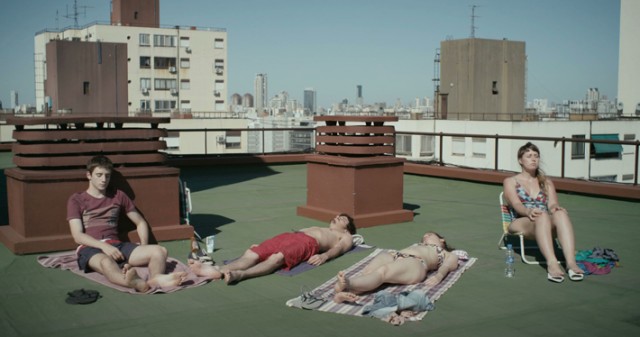
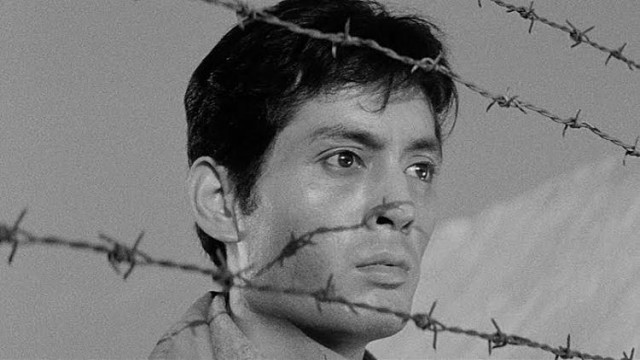
Life goes on after a bizarre shooting event in Martín Rejtman’s absurdist TWO SHOTS FIRED

TWO SHOTS FIRED (DOS DISPAROS) (Martín Rejtman, 2014)
Film Society of Lincoln Center, Elinor Bunin Munroe Film Center
Howard Gilman Theater / Francesca Beale Theater
144 West 65th St. between Broadway & Amsterdam Aves.
May 13-19
212-875-5601
www.filmlinc.com
www.cinematropical.com

Last year, award-winning Argentine writer-director Martín Rejtman returned with his first film in eight years (and only his fourth feature in his nearly thirty-year career), the absurdist black comedy Two Shots Fired. The calmly paced story begins as sixteen-year-old Mariano (Rafael Federman), after a night of dancing, goes about his daily chores, swimming laps in his family’s backyard pool (as the dog runs alongside him) and mowing the lawn. He shows no emotion when he accidentally runs over the mower’s electric cord; instead he simply goes into the house for tools to fix it. There he also finds a box with a gun, so he goes into his room, puts the gun against his head, and pulls the trigger, like it’s a perfectly normal thing to do. He then places the barrel against his stomach and shoots himself a second time. The first shot merely grazes his temple, while the second shot seems to have left a bullet lodged in his body. Mariano evenhandedly claims that he is not depressed and was not trying to kill himself, and his friends and family essentially act as if nothing has happened, going on with their simple, ordinary lives. The only ones who appear to be even the slightest bit concerned are his mother (Susana Pampin), who secretly hides all the scissors and kitchen knives, and the dog, who runs away.

When Mariano attempts to go anywhere with his brother (Benjamín Coelho) that involves passing through a metal detector, the system beeps at him; when his brother tries to explain that it must be because there is a bullet in him, Mariano doesn’t care, opting not to enter, instead waiting outside without complaining, explaining, or making a scene. When he practices with his woodwind quartet, his recorder releases a second note every time he plays, presumably the result of the lodged bullet, but he continues on, like it’s no big deal. And when his cell phone incessantly goes off, he doesn’t get mad or embarrassed; he simply tries to find a place to put it where it won’t disturb him or anyone else. He, and everyone around him, including a potential girlfriend (Manuela Martelli) and his music teacher (Laura Paredes), just keep on keeping on, going about their business, virtually emotionless. They’re not trying to forget what happened; instead, it’s like it is just another part of daily existence in this Buenos Aires suburb. A minimalist, Rejtman first focuses his camera on a place, then doesn’t move it as characters walk in and some kind of “action,” however critical or monotonous, takes place; then the people leave the frame as the camera lingers, like Ozu on Valium. What happens is just as important, or unimportant, as what doesn’t happen. Every scene is treated the same, a meditation on the mundanity of life (with perhaps more than a passing reference to how Argentina has dealt with los desaparecidos and its long-running volatile political climate). And just like life, parts of the film are boring, parts are wildly funny, parts are unpredictable, and parts are, well, just parts of life. A selection of the 52nd New York Film Festival, Two Shots Fired is having its official U.S. theatrical release May 13-19 at Lincoln Center in conjunction with “Sounds Like Music: The Films of Martín Rejtman,” with Rejtman on hand for Q&As following the 6:30 screenings on May 13 and 15. The one-week festival also includes Rejtman’s Elementary Training for Actors, The Magic Gloves, Rapado, and Silvia Prieto.

ONE CUT, ONE LIFE

Lucia Small and Ed Pincus in ONE CUT, ONE LIFE

Lucia Small and Ed Pincus team up to film the end of his time on Earth in ONE CUT, ONE LIFE (photo by Danielle Morgan)

ONE CUT, ONE LIFE (Lucia Small & Ed Pincus, 2014)
IFC Center
323 Sixth Ave. at West Third St.
Opens Wednesday, May 13
212-924-7771
www.ifccenter.com
onecutonelife.com

When documentarian and flower farmer Ed Pincus, considered the father of first-person film, was diagnosed with a terminal illness, he did what he had done previously in his life: turn the camera on himself. Teaming up with Lucia Small (My Father, the Genius), with whom he had made the post-Katrina nonfiction film The Axe in the Attic in 2007, Pincus (Black Natchez, Diaries [1971–1976]) shared the intimate details of his story as they compiled what would become One Cut, One Life, named for a Japanese Aikido philosophy that means “Everything could be the last time,” “Everything counts,” “Everything has meaning.” Not everyone was thrilled with Pincus’s decision; in particular, Jane, his wife of fifty years, had severe reservations about his making a film with death on the horizon. But in her director’s statement, Small explains, “Rather than slowing us down, Ed’s illness created a flurry of creative work, as well as the impetus to delve into difficult emotional territory. We wrote [in a grant application], ‘When he is filming, he easily immerses himself into something productive, something that extends his creative life. Making another film offers a much-needed crucial distance from his potential fate.’” Pincus died in November 2013, but One Cut, One Life lives on, to show how he faced the end. The film opens Wednesday, May 13, at the IFC Center, and the first week will feature a series of special discussions at select shows. On May 13 at 7:15, “Celebrating Ed Pincus’s Life and Legacy: Pushing Boundaries — Up Close and Personal” brings together Small, Michel Negroponte, Marco Williams, and moderator Tom Roston. On May 14 at 7:15, Small, Nina Davenport, and Judith Helfand will delve into “Female Voice and First Person Non-Fiction.” On May 15 at 7:50, Liz Giamatti will talk about “The Art of Collaboration: Trauma, Loss, and Creative Partnership.” The 7:50 screening on May 18 will be followed by a Q&A with Small. And on May 19 at 7:50, Judith Schwarz explores “The Reality of Being Mortal: End of Life, Quality of Life, and Navigating Options.”

TICKET ALERT: NEW YORK COMIC CON 2015

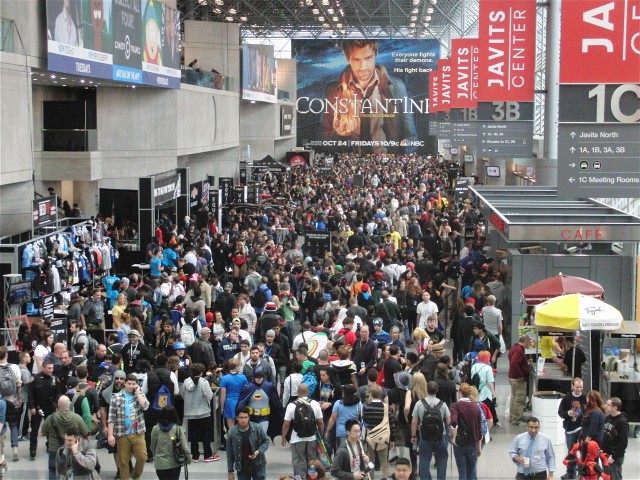
The mad rush for New York Comic Con begins on May 13, when tickets go on sale for the October event (photo by twi-ny/mdr)

The mad rush for New York Comic Con begins on May 13, when tickets go on sale for the October event (photo by twi-ny/mdr)

Who: Spotlight Guests Jewel Staite, John Rhys-Davies, Adam Hughes, Chris Claremont, Greg Capullo, Masashi Kishimoto, Scott Snyder, Todd McFarlane, and John Rhys-Davies, Featured Guests Allison Sohn, Amy Reeder, Charles Soule, Terry Dodson, and many, many more to be announced
What: New York Comic Con
Where: Javits Center, 655 W 34th St. at 12th Ave.
When: October 8-11, single day $40-$50, three-day pass $75, four-day pass $105, tickets go on sale Wednesday, May 13, at 12 noon
Why: New York Comic Con continues its exponential growth as it reaches its tenth anniversary, making it harder and harder to get tickets, so there’s no time to waste if you want to go to the annual celebration of pop culture, with particular focuses on gaming, science fiction and fantasy books and films, anime, and all things comic-book-related. The four days, part of New York Super Week, are chock full of panel discussions, sneak-peek screenings, photo and autograph opportunities, book signings, and tons and tons of costumed fans. It’s getting so that those who come dressed in regular clothes are the minority. Tickets will go very quickly, so get yours now; don’t wait around until the big-time celebrity attendees are announced, as there will be plenty of major stars there to promote their latest work and smile for the camera with you.

THE PAINTED ROCKS AT REVOLVER CREEK

(photo by Joan Marcus)

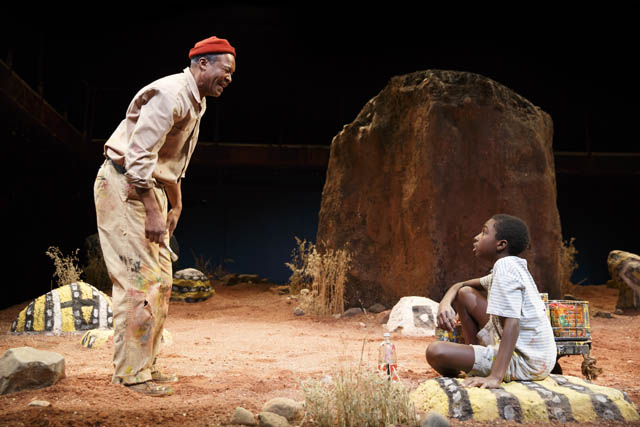
Leon Addison Brown and Caleb McLaughlin star in what might be Athol Fugard’s final play (photo by Joan Marcus)

The Pershing Square Signature Center
The Romulus Linney Courtyard Theatre
480 West 42nd St. between Tenth & Eleventh Aves.
Tuesday – Sunday through June 7, $25-$65
212-244-7529
www.signaturetheatre.org

In 2011, South African writer-director Athol Fugard won a Tony Award for lifetime achievement the day after his seventy-ninth birthday, but that hasn’t slowed down the now-eighty-three-year-old man responsible for such important plays as Sizwe Bansi Is Dead and “Master Harold” . . . and the Boys. The next year he was the Signature Theatre’s playwright-in-residence, presenting stirring revivals of Blood Knot and My Children! My Africa! as well as the New York debut of The Train Driver. He is now back at the Signature with the world premiere of The Painted Rocks at Revolver Creek, a potent tale of apartheid and its effects on three people that distills right to the core the policy of racial segregation that dominated South Africa for nearly fifty years, and its legacy today. Inspired by real-life outsider artist Nukain Mabusa, who painted flowers on rocks in a stone garden in Revolver Creek for more than a decade, the play takes place in 1981, as an elderly farm laborer (Leon Addison Brown) and his young helper (Caleb McLaughlin) prepare to paint the Big One, an enormous rock on a hill on land owned by Elmarie Kleynhans (Bianca Amato) and her husband, an Afrikaner couple who employ the man, called Tata (“father”) by the boy, known as Bokkie (“small buck”), and Outa (“old father”) by Elmarie, who uses the generic, derisive Afrikaaner terms for them rather than their names. Bokkie is eager for Tata to paint the Big One, but Outa is hesitant. “He is bigger than me. And I know that he is my last one . . . so I am frightened,” Tata says of the inanimate object. “But he is only a rock,” Bokkie explains. “I have got no more flowers in me, Bokkie,” Tata replies. However, soon Bokkie and Tata are painting the rock together, the old man sharing the story of his hard life, passing it on for future generations. “What do you see standing here? Old Man? Just another old kaffer?” he says to the rock, asserting himself for maybe the first time ever. “No, Big One, I am not old man. I am not kaffer. I am MAN.” When the religious Elmarie arrives, she doesn’t understand what Outa has painted and wants him to replace it with something much prettier. “Next Sunday, why don’t you wipe that all away and make it a big flower, your biggest flower . . . to thank the Lord for all his blessings,” she says. The old man is faced with a choice, a decision that will have great impact not only on himself but on his young friend as well.

(photo by Joan Marcus)

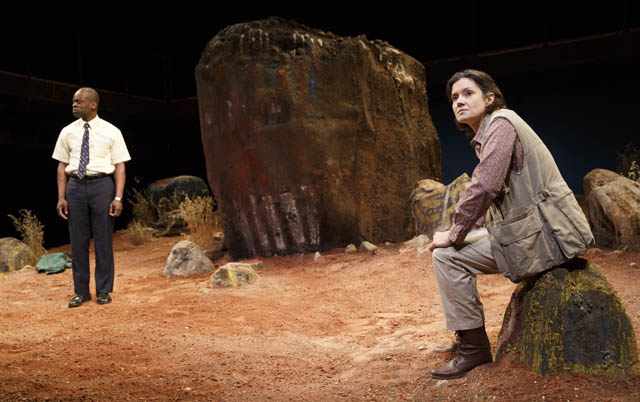
Jonathan Sejake (Sahr Ngaujah) and Elmarie Kleynhans (Bianca Amato) argue over the new South Africa in THE PAINTED ROCKS AT REVOLVER CREEK (photo by Joan Marcus)

In the second act, it’s twenty-two years later, and the boy, now a grown teacher (Sahr Ngaujah), returns to Revolver Creek, in a South Africa that has ended apartheid and has a new constitution giving equal rights to blacks. He is met by Elmarie, who does not recognize him at first, holding a gun on him until he explains who he is and tells her why he is there. “So what gives you the right to come here and paint that rock without permission? Let me remind you, this is private property, Bokkie,” she says. “Nobody calls me that anymore, Mrs. Kleynhans. My real name is Jonathan Sejake,” he responds with pride and determination. He also explains that Tata/Outa had a name as well, Nukain Mabusa. Jonathan and Elmarie then engage in a heated verbal battle over the current state of the nation, the way things used to be, and what the future promises, arguing about land ownership, violence, and personal identity. As in the first act, Fugard, who also directed the production, includes long, sharply written monologues that both expand on the characters and serve as a microcosm for the arguments that have plagued South Africa since even before apartheid officially began in 1948. The absorbing dialogue is expertly performed by the outstanding cast, who lend nuance and believability to roles that could have been clichéd and predictable. Christopher H. Barreca’s set features an array of rocks covered in fading painted flowers, centered by the Big One, which embodies the seemingly impenetrable gap that exists between blacks and Afrikaners. Just as Tata and Bokkie gave eyes to the rock, Fugard invites the audience to see the vast intricacies of apartheid rule. He imbues The Painted Rocks at Revolver Creek with a captivating sensitivity, avoiding becoming overly treacly or didactic as the well-drawn, multidimensional characters make their cases. And although the play is specifically about South Africa, it also relates to the racial tensions that have gripped America in Baltimore, Ferguson, and elsewhere. The play is part of the Signature’s Legacy Program, and Fugard has stated that it might be his “farewell to the stage.” If that is indeed true, he has left behind quite a legacy himself, concluding with one of his most softly intelligent, illuminating works.

FIASCO THEATER’S THE TWO GENTLEMEN OF VERONA

(photo by Gerry Goodstein)

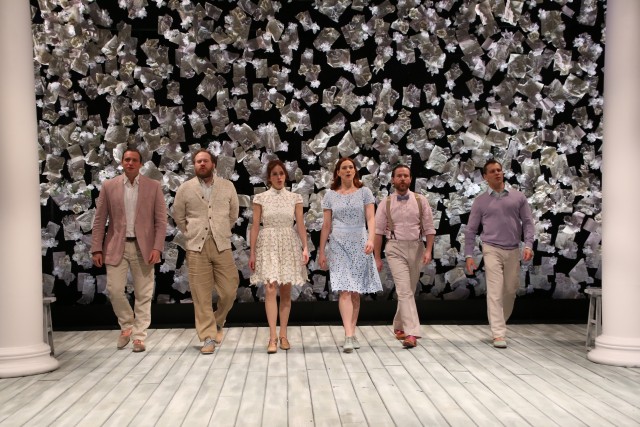
Fiasco Theater’s affectionate production of THE TWO GENTLEMEN OF VERONA has been extended at Theatre for a New Audience’s Polonsky Shakespeare Center (photo by Gerry Goodstein)

Theatre for a New Audience, Polonsky Shakespeare Center
262 Ashland Pl. between Lafayette Ave. & Fulton St.
Tuesday – Sunday through June 7, $20-$100
866-811-4111
www.tfana.org
www.fiascotheater.com

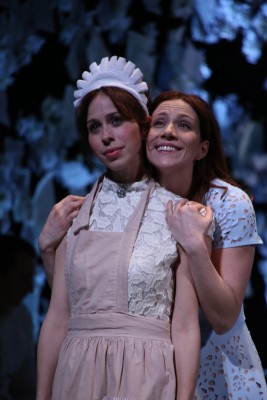
The Fiasco Theater continues its mission “to offer dynamic, joyful, actor-driven productions of classic and new plays” with a dynamic, joyful, actor-driven production of what is believed to be Shakespeare’s first play, The Two Gentlemen of Verona. The New York City–based company of Brown graduates, which has previously staged Twelfth Night, Cymbeline, Measure for Measure, and this past season’s utterly delightful, Drama Desk–nominated Into the Woods, has stripped down Shakespeare’s early comedy of letters and loyalty, mistaken identity and misplaced love, many elements of which would be explored more deeply in his future works, to its bare essentials. “Upon delving into it we quickly discovered that Two Gents is not merely a ‘shallow story,’ like those that Valentine mocks in the first scene, but a human and layered play that reveals questions and ideas of surprising depth,” a directors note in the program explains. While that might be a bit of a stretch, Fiasco does reveal Two Gents to be a fun-filled frolic through romantic folly. As the play opens, Valentine (Zachary Fine) is telling his compatriot Proteus (Noah Brody) that he is leaving Verona to court a fair lady. “To Milan let me hear from thee by letters / Of thy success in love, and what news else / Betideth here in absence of thy friend. / And I likewise will visit thee with mine,” Valentine declares. Proteus wishes him well, but because of a mix-up with Valentine’s servant, Speed (Paul L. Coffey), Proteus soon turns away from his true love, Julia (codirector Jessie Austrian), and decides instead to woo Valentine’s intended, Sylvia (Emily Young). But Sylvia’s father, the Duke of Milan (Andy Grotelueschen), favors her wealthy suitor Thurio (Coffey), setting off a three-way fight for her hand. “Sir, if you spend word for word with me, I shall make your wit bankrupt,” Thurio says, to which Valentine retorts, “I know it well, sir. You have an exchequer of words and, I think, no other treasure.” But as Speed has previously told Valentine, “Love is blind,” leading to a frantic conclusion.

(photo by Gerry Goodstein)

Lucetta (Emily Young) and Julia (Jessie Austrian) dream about love in early Shakespeare comedy (photo by Gerry Goodstein)

Set designer Derek McLane (Into the Woods, The Heiress) has covered the ceiling, walls, and backdrop with hundreds of crumpled-up handwritten letters; the stage at the Polonsky Shakespeare Center also features two white columns that serve as trees, in addition to benches on either side where the actors sit when not involved in the action (and seem to enjoy everything onstage as much as the crowd does). Regular Fiasco costume designer Whitney Locher has dressed the performers in springtime pastels,1950s-prepster style, the men sporting color-coded saddle-shoe bucks, the women in lacy cap-sleeves. Codirectors Austrian and Ben Steinfeld have the cast speak Shakespeare’s lines in contemporary rhythm, not iambic pentameter, giving it a more intimate feel and quickening the pace. The company is uniformly excellent — a particular treat is Launce’s (Grotelueschen) two monologues with his dog, Crab, played with great humor by Fine wearing a fake nose — singing a few songs and, before the first act and during intermission, mingling with the audience, giving out smiles and hugs. As is Fiasco’s style, the whole production is filled with an intoxicating affection, which works extremely well with one of Shakespeare’s lesser, though plenty charming, comedies. (The May 16 matinee will be followed by a free TFANA Talk with Re-Dressing the Canon: Essays on Theater and Gender author Alisa Solomon and members of the company. And after the May 17 matinee, food historian Francine Segan will host “Shakespeare Primavera,” a Talk & Taste inspired by Shakespeare’s Italian plays, catered by Danny Meyer’s Union Square Events; tickets are $45, or $35 if you attended the show or have a season package.)