twi-ny recommended events

WIM WENDERS — PORTRAITS ALONG THE ROAD: A TRICK OF THE LIGHT

A TRICK OF THE LIGHT

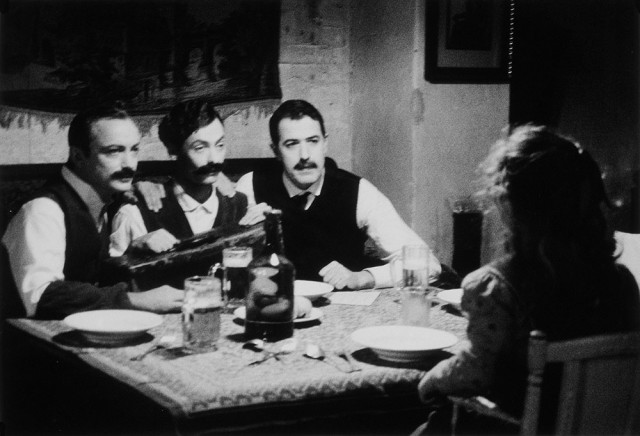
The Skladanowsky brothers attempt to please the demanding Gertrud in Wim Wenders’s affectionate early-cinema tribute, A TRICK OF THE LIGHT

A TRICK OF THE LIGHT (DIE GEBRÜDER SKLADANOWSKY) (Wim Wenders, 1995)
IFC Center
323 Sixth Ave. at Third St.
Through September 24
212-924-7771
www.ifccenter.com
www.wim-wenders.com

German director Wim Wenders pays tribute to the invention of cinema in the charming, delightful, yet bittersweet 1995 film A Trick of the Light, finally getting its long-overdue U.S. theatrical premiere engagement at the IFC Center. Using a vintage 1920s hand-crank camera for the old-fashioned black-and-white silent flashback scenes (shot at eighteen frames per second) that make up the bulk of the film, Wenders and cinematographer Jürgen Jürges iris in and out to tell the story of the real-life Skladanowsky brothers, who were inventing a mechanism to project moving pictures in the late nineteenth century, only to have their work, the bioskop, overshadowed by the Lumière brothers’ cinématographe. The technical genius is Max Skladanowsky (Udo Kier), who films the comic exploits of his brother, Eugen (Christoph Merg), while sibling and ladies’ man Emil (Otto Kuhnle) does the editing and runs the projector. Cheering them on is Max’s demanding young daughter, Gertrud (Nadine Büttner), who wants her father and uncles to capture a more precise depiction of reality. Meanwhile, a spy (Alfred Szczot) keeps a close eye on what they are doing. Working with students from his University of Television and Film Munich class, Wenders occasionally intercuts scenes in almost garish full color in which he interviews Max’s last surviving daughter, ninety-one-year-old Lucie Hürtgen-Skladanowsky, in the same house the family has owned since 1907.
A TRICK OF THE LIGHT

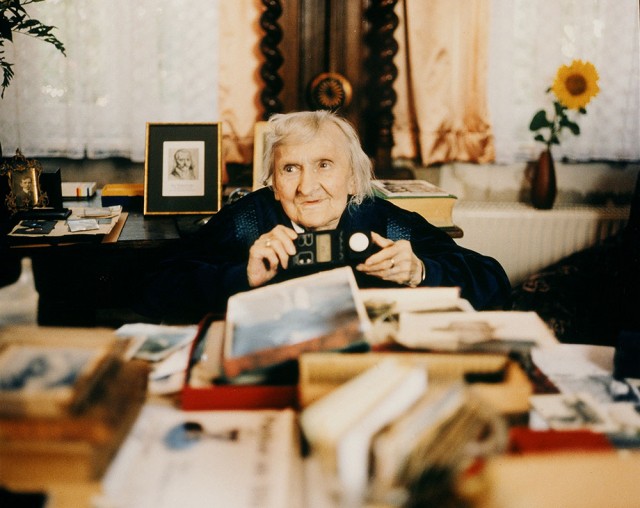
Lucie Hürtgen-Skladanowsky shares fond memories of her father and uncles in A TRICK OF THE LIGHT

Hürtgen-Skladanowsky shares fond memories while examining old photo albums, hand-colored glass plates, and other artifacts from her father’s and uncles’ heyday; she also shares her thoughts on the flashback scenes with Wenders and his small crew. Wenders, Jürges, camera assistant German Kral, soundwoman Barbara Rohm, and sound assistant Florian Gallenberger are shown sitting across the table from Lucie, who entertains them with her comments and recollections. Wenders adds a nostalgic touch by having Gertrud and Eugen occasionally enter the modern-day scenes, turning the film back into black-and-white. Also deserving of praise is Peter Przygodda’s editing and Laurent Petitgand’s lovely carnivalesque score, which help beautifully capture the look, feel, and sound of early cinema. The main film is only about an hour long, but fifteen minutes of credits include fun bonuses. A Trick of the Light, which is “dedicated to the many forgotten pioneers of film,” is part of the IFC Center’s “Wim Wenders: Portraits Along the Road” tribute to the iconoclastic director, playwright, and photographer on the occasion of his seventieth birthday; the series continues through September 24 with such other works as Buena Vista Social Club, Nick’s Film: Lightning over Water, The Soul of a Man, Tokyo-Ga, Pina, and a sneak preview of Every Thing Will Be Fine in 3D.
UNTITLED STANZAS: STAFF/UN/SITE

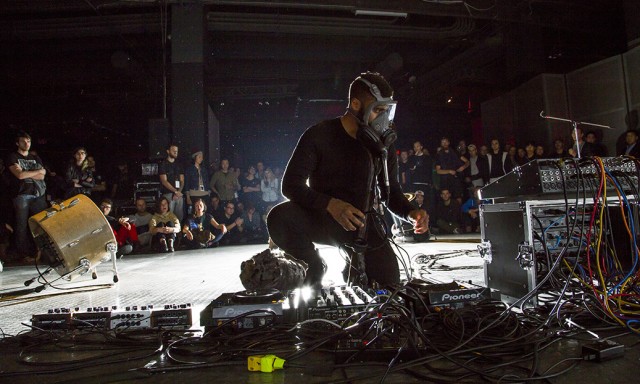
Kevin Beasley will perform new composition on the High Line this week (photo by Jean Vong, courtesy the artist and Casey Kaplan, New York)

Kevin Beasley will perform new composition on the High Line this week (photo by Jean Vong, courtesy the artist and Casey Kaplan, New York)

Who: Kevin Beasley
What: Untitled Stanzas: Staff/Un/Site
Where: High Line at the Rail Yards, on the High Line at West 30th St. & 12th Ave.
When: September 22-24, free, 6:00
Why: Virginia-born, New York-based artist Kevin Beasley has been roaming the High Line for months, recording sounds of traffic, insects, construction, and other aural vibrations. On September 22, 23, and 24 at 6:00, Beasley, who staged I Want My Spot Back at MoMA in 2012, will perform a composition based on these found sounds, taking place at the open-air Twelfth Avenue Overlook on the High Line at Thirtieth St. In addition to layering his prerecorded sounds, he will add a recording of each show to the next performance.

WAYNE McGREGOR, OLAFUR ELIASSON, AND JAMIE xx: TREE OF CODES

(photo by Stephanie Berger)

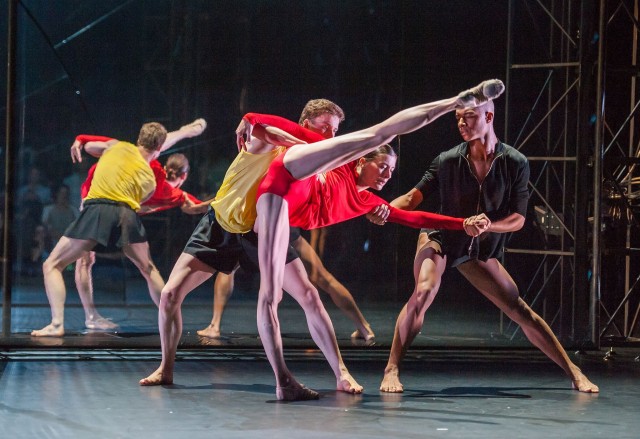
Wayne McGregor’s movement, Jamie xx’s music, and Olafur Eliasson’s visual concept come together to reimagine Jonathan Safran Foer’s TREE OF CODES, which reimagines Bruno Schulz’s STREET OF CROCODILES (photo by Stephanie Berger)

Park Ave. Armory
643 Park Ave. between 66th & 67th Sts.
Through September 21, $30-$90
212-933-5812
armoryonpark.org

Choreographer Wayne McGregor, composer Jamie xx, and artist Olafur Eliasson have created quite an audiovisual spectacle with Tree of Codes, their sparkling adaptation of Jonathan Safran Foer’s 2010 book of the same name, which used die cuts to repurpose Bruno Schulz’s Street of Crocodiles. As ticket holders enter the vast Wade Thompson Drill Hall, they encounter large screens to the north and south on which their elongated silhouettes are projected in different colors, reminiscent of Nam June Paik’s “Three Camera Participation / Participation TV,” welcoming them to the show while letting them know they are part of it. The performance itself takes place in the center of the vast Wade Thompson Drill Hall, the audience sitting in rising rows on the east side. Over the course of seventy-five dazzling minutes, various mirrored, translucent, and transparent walls descend from above, altering the perception of the highly athletic dancers, who move about virtually nonstop in an impressive array of solos, duets, and trios, set to a multilayered score that ranges from choral singing to soul, from pulsating dance beats to indie pop, sometimes all at the same time. Just as Safran Foer cut into Schulz’s story, Eliasson’s props cut into themselves, altering space and time, with refracted sections, orbiting circles, and spotlights that wander over the audience, and Jamie xx’s diverse score does the same to itself, coming up with new sounds as the music forms a kind of aural palimpsest. The dancers, meanwhile — consisting of Jérémie Bélingard, Julien Meyzindi, Sébastien Bertaud, Lydie Vareilhes, Lucie Fenwick, and the extraordinary Marie-Agnès Gillot from the Paris Opera Ballet and Louis McMiller, Daniela Neugebauer, Anna Nowak, James Pett, Fukiko Takase, and Jessica Wright from Company Wayne McGregor — are reflected multiple times in the mirrors, or fade away in ghostly images. At times, dancers in front of a see-through partition interact with dancers on the other side as if they are physically together; at other times, they appear to be dancing with multiple versions of themselves. The experience changes depending on where you sit, as the reflections and colors shift based on your angle of vision — and you might even get to see yourself in the background mirror as the spotlight hits you. It never gets very deep, but you can’t stop immersing yourself in its splendor. The performance actually begins with some cool but gimmicky Pilobolus-like moments, but don’t let that worry you. It quickly evolves into a beautifully rendered treat.

QUEER/ART/FILM: HUSH . . . HUSH, SWEET CHARLOTTE

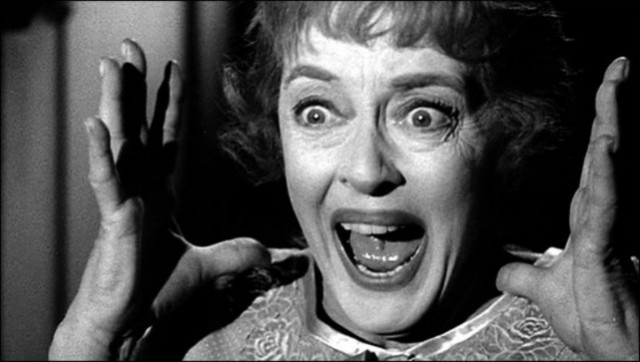
Bette Davis is a scream in cult classic HUSH . . .  HUSH, SWEET CHARLOTTE

Bette Davis is a scream in cult classic HUSH . . . HUSH, SWEET CHARLOTTE

HUSH . . . HUSH, SWEET CHARLOTTE (Robert Aldrich, 1964)
IFC Center
323 Sixth Ave. at Third St.
Monday, September 21, 8:00
212-924-7771
www.ifccenter.com

Hot on the heels of their success with What Ever Happened to Baby Jane?, director Robert Aldrich and star Bette Davis sought to make a kind of thematic sequel again with Joan Crawford, another campy psychological thriller about jealousy, family, and the wounds of time. Crawford pulled out of the production, but she was replaced by one of Davis’s good friends, Olivia de Havilland, which added a terrific edge to what became another hit, Hush . . . Hush, Sweet Charlotte. The film is screening September 21 at 8:00 as part of the monthly IFC Center series “Queer/Art/Film,” curated by Adam Baran and Ira Sachs, consisting of influential works selected by gay artists. Hush . . . Hush, Sweet Charlotte was chosen by self-described “actor, playwright, novelist, screenwriter, director, and drag legend” Charles Busch (The Tale of the Allergist’s Wife, Die Mommie Die!), who will be on hand for a postfilm discussion. “I had my father take me to the opening day,” Busch says on the IFC Center website. “The stars were there, promoting the film. I was transfixed, studying how a legendary actress behaves.” The film is set on a Louisiana plantation where Charlotte Hollis (Davis) lives as a recluse with her devoted housekeeper, the batty Velma Cruther (Agnes Moorehead). It is 1964, thirty-seven years after Charlotte’s lover, the married John Mayhew (Bruce Dern), was brutally behanded and beheaded at a party thrown by Charlotte’s father, the controlling Big Sam (Victor Buono, who also appeared in Baby Jane). The Hollis mansion must be torn down to make way for a bridge, but Charlotte refuses to leave, causing major headaches for the sheriff (Wesley Addy) and the construction foreman (George Kennedy). Charlotte’s poor cousin, Miriam Deering (de Havilland), arrives to help the deeply tortured Charlotte, but Miriam and family doctor Drew Bayliss (Joseph Cotten) seem to have other plans. Meanwhile, kindly old reporter Harry Willis (Cecil Kellaway) starts poking around, trying to get to the truth behind all the mystery and madness.

Hush . . . Hush, Sweet Charlotte is a grisly southern gothic centered on the relationship between the crazed Charlotte and the calm, collected Miriam, allowing Davis and de Havilland to play off each other beautifully, the former chewing up huge swaths of scenery, the latter cleaning it all up neatly with a spritz of cold menace. The supporting cast, which features numerous Twilight Zone veterans and a cameo by Mary Astor in her final role, provides able support as Aldrich (The Dirty Dozen, Kiss Me Deadly) wishes a fond farewell to the Old South in striking black-and-white, courtesy of cinematographer Joseph F. Biroc, who also worked with Aldrich on such diverse films as The Flight of the Phoenix, The Killing of Sister George, and The Longest Yard. Composer Frank De Vol is responsible for the chilling soundtrack. It’s all great fun, with legitimate scares, helping it earn seven Oscar nominations, including for Moorehead, Biroc, and De Vol (as well as for art direction, costume design, editing, and song). It should be quite a blast getting Busch’s take on this cult classic. “Queer/Art/Film” continues October 9 with Agnès Varda’s Vagabond (with K8 Hardy) and November 23 with Alan Parker’s Fame (with Kia LaBeija).

REVOLUTION OF THE EYE: MODERN ART AND THE BIRTH OF AMERICAN TELEVISION

(photo by David Heald)

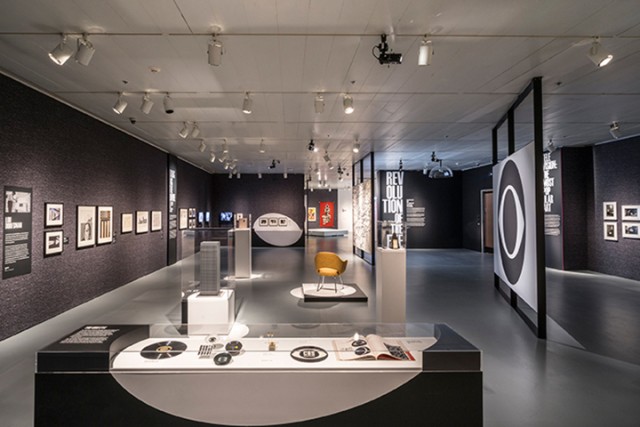
Jewish Museum show explores relationship between early television and modern art (photo by David Heald)

The Jewish Museum
1109 Fifth Ave. at 92nd St.
Thursday – Tuesday through September 27, $7.50-$15 (children eighteen and under free; free admission Saturday 11:00 am – 5:45 pm, pay-what-you-wish Thursday 5:00 – 8:00)
212-423-3200
thejewishmuseum.org

I am a proud TV baby, born into the first generation that treated television like a cherished member of the family. I actually took great offense that my bonus sibling — it was much more than a mere babysitter to me — was referred to as the boob tube and that many people claimed that watching too much of what I even as a kid considered a legitimate art form was bad for your physical and mental well-being. In Annie Hall, Alvy Singer (Woody Allen) famously explains to his actor pal, Rob (Tony Roberts), and girlfriend, Annie (Diane Keaton), why it’s so clean in California: “They don’t throw their garbage away. They make it into television shows.” Which leads me to the Jewish Museum’s fun and fascinating new look at the medium, the informative and entertaining exhibition “Revolution of the Eye: Modern Art and the Birth of American Television,” continuing through September 27. “Rarely is TV discussed in terms of art — and when it is, critics have usually focused on the ways television has influenced high art, or been critiqued and ridiculed by it,” UMBC Center for Art, Design, and Visual Culture executive director Symmes Gardner writes in his foreword to the catalog. “Yet as network television now shares the stage with other forms of broadcasting and video dissemination, we can see the ways in which this popular, commercial mechanism aided art, responded to art — and was, many times, itself art.”

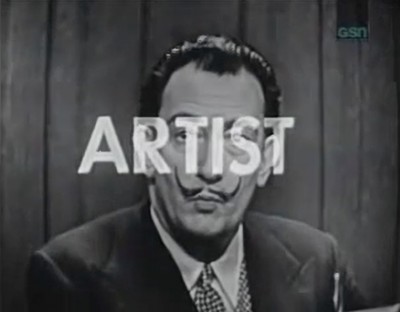
Exhibition includes clip of Salvador Dali appearance on WHATS MY LINE? (© Fremantle Media)

Exhibition includes clip of Salvador Dali appearance on WHAT’S MY LINE? (© Fremantle Media)

The multimedia show follows the development of television from the 1940s through the 1970s, tracing the impact that modern art had on the telly, which in turn influenced contemporary American society. Lovingly curated by Maurice Berger — although a bit noisy, with too many of the sounds bouncing off one another — the exhibition explores links between Rod Serling’s anthology series The Twilight Zone and surrealism (including a startling comparison of the opening title sequence to clips of short films by Marcel Duchamp, Fernand Léger, and René Clair), and Ernie Kovacs and Dada (and how the comic master was among the first to exploit the technology of the medium itself while playfully attacking the corporations that sponsored it). The development of television logos, advertising, and title sequences turns out to be quite a tale, involving such cutting-edge graphic designers as Saul Bass and established artists as Ben Shahn. Rowan and Martin’s Laugh-In is seen in conjunction with Pop, Op, and psychedelic art, while the tongue-in-cheek Batman series is compared to the comic-book Pop art of Roy Lichtenstein. Even Dinah Shore and Ed Sullivan make the cut, the latter’s mod sets matched with sculptures by Sol Lewitt, Donald Judd, and Robert Morris. The exhibit also has rare clips of artists on television, including Salvador Dali, Andy Warhol, Alexander Calder, Willem de Kooning, John Cage, Duchamp, Shahn, and Lichtenstein, although they are all far too short, but a segment of Aline Saarinen’s Sunday Show with Alberto Giacometti is a real treat. There are also works by Lee Friedlander (mocking the medium), Georgia O’Keeffe, Man Ray, Robert Motherwell, Eero Saarinen (Aline’s husband), Agnes Martin, and others, in addition to sections devoted to Winky Dink and You, which invited kids to be artists using the television screen, and the Museum of Modern Art’s Television Project, which sought to place the medium in a higher art form, something that the Jewish Museum has ably accomplished in this splendid exhibit that justifies my longtime love affair with the boob tube.

THEATER & CINEMA: VENUS IN FUR

VENUS IN FUR

The relationship between actor and director becomes an intense psychosexual battle in Roman Polanski’s VENUS IN FUR

CINÉSALON: VENUS IN FUR (LA VÉNUS À LA FOURRURE) (Roman Polanski, 2013)
French Institute Alliance Française, Florence Gould Hall
55 East 59th St. between Madison & Park Aves.
Tuesday, September 22, $14, 4:00 & 7:30 (later screening with David Ives Q&A)
212-355-6100
www.fiaf.org
www.ifcfilms.com

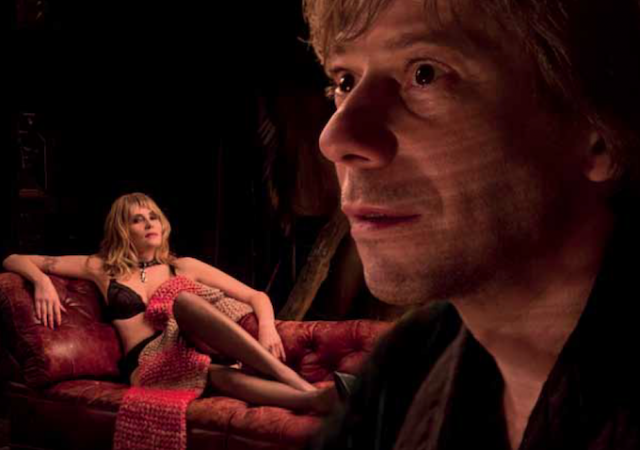
For his third stage adaptation in ten years, following 1994’s Death and the Maiden and 2011’s Carnage, Roman Polanski created a marvelous, multilayered examination of the intricate nature of storytelling, consumed with aspects of doubling. David Ives’s Tony-nominated play, Venus in Fur, is about a cynical theater director, Thomas Novachek, who is auditioning actresses for the lead in his next production, a theatrical version of Leopold von Sacher-Masoch’s psychosexual novella Venus in Furs (which led to the term “sado-masochism”), itself a man’s retelling of his enslavement by a woman. In the film, as he is packing up and about to head home, Thomas (Matthieu Amalric) is interrupted by Vanda (Emmanuelle Seigner), a tall blond who at first appears ditzy and unprepared, practically begging him to let her audition even though she isn’t on the casting sheet, then slowly taking charge as she reveals an intimate knowledge not only of his script but of stagecraft as well. An at-first flummoxed Thomas becomes more and more intrigued as Vanda performs the role of Wanda von Dunayev and he reads the part of Severin von Kushemski, their actor-director relationship intertwining with that of the characters’ dangerous and erotic attraction.
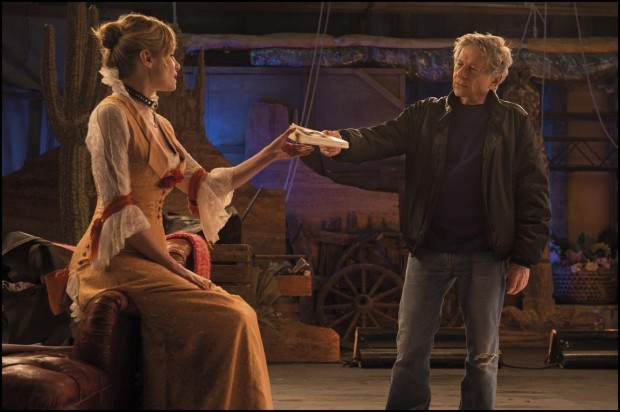
Roman Polanski directs wife Emmanuelle Seigner in thrilling stage adaptation of Tony-winning play

Roman Polanski directs wife Emmanuelle Seigner in thrilling stage adaptation of Tony-nominated play

Ives’s English-language play, which earned Nina Arianda a Tony for Best Actress, was set in an office, but Polanski, who cowrote the screenplay with Ives, has moved this French version to an old theater (the Théâtre Récamier in Paris, rebuilt by designer Jean Rabasse) where a musical production of John Ford’s Stagecoach has recently taken place, with some of the props still onstage, including a rather phallic (and prickly) cactus. Polanski has masterfully used the machinations of cinema to expand on the play while also remaining true to its single setting. One of the world’s finest actors, Amalric, who looks more than a little like a younger Polanski, is spectacular as the pretentious Thomas, his expression-filled eyes and herky-jerky motion defining the evolution of his character’s fascination with Vanda, while Seigner, who is Polanski’s wife, is a dynamo of breathless erotic power and energy, seamlessly weaving in and out of different aspects of Vanda. Venus in Fur was shot in chronological order with one camera by cinematographer Paweł Edelman, who photographed Polanski’s previous five feature films, making it feel like the viewer is onstage, experiencing the events in real time. Alexandre Desplat’s complex, gorgeous score is a character unto itself, beginning with the outdoor establishing shot of the theater. The film also contains elements that recall such previous Polanski works as The Tenant, Bitter Moon, Tess, and The Fearless Vampire Killers, placing it firmly within his impressive canon. Polanski was handed Ives’s script at Cannes in 2012, and this screen version was then shown at Cannes for the 2013 festival, a whirlwind production that is echoed in Seigner’s performance. Venus in Fur kicks off the CinéSalon series “Theater & Cinema” on September 22, with Ives on hand for a Q&A moderated by Nicholas Elliott following the 7:30 screening. The Tuesday festival continues through October 27 with such other stage-related dramas as Jacques Rivette’s Va Savoir, Olivier Assayas’s Clouds of Sils Maria, Arnaud Desplechin’s Esther Kahn, Abdellatif Kechiche’s Games of Love and Chance, and François Truffaut’s The Last Metro. But FIAF is only getting started with Amalric, who will be the subject of a six-week retrospective in November and December; he’ll be in Florence Gould Hall for a Q&A with costar Stéphanie Cléau following the 7:30 screening of The Blue Room on November 3, then will perform in writer-director Cléau’s stage production of Le Moral des Ménages with Anne-Laure Tondu at FIAF on November 4-5.

ISOLDE

(photo by Gerry Goodstein)

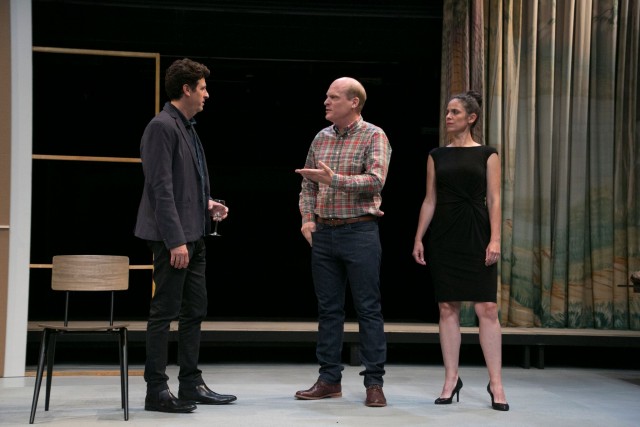
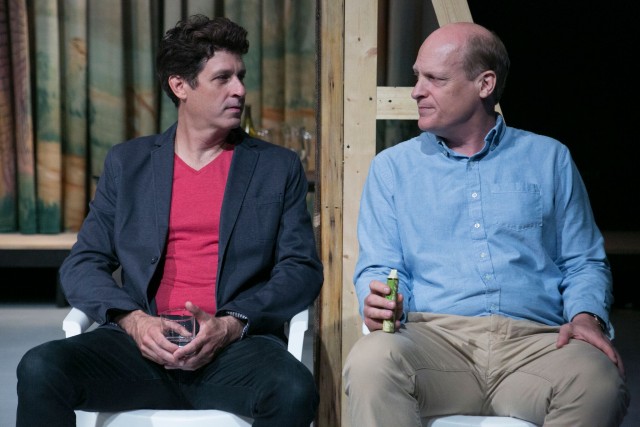
Massimo (Gary Wilmes), Patrick (Jim Fletcher), and Isolde (Tory Vazquez) discuss function and beauty, love and memory in splendidly constructed Richard Maxwell play (photo by Gerry Goodstein)

Theatre for a New Audience, Polonsky Shakespeare Center
262 Ashland Pl. between Lafayette Ave. & Fulton St.
Tuesday – Sunday through September 27, $55-$100
866-811-4111
www.tfana.org

Writer-director Richard Maxwell uses the construction of a Jungian dream house as a sharp metaphor for the building of a play in his latest experimental work, Isolde. Hyperrealism, surrealism, psychobabble, inside jokes, and the occasional cliché combine to form a grounded though existential narrative that has a lot to say about life, love, and the theater. As the play begins, Isolde (Tory Vazquez), a popular actress, is running lines with her husband, Patrick (Jim Fletcher), a successful contractor. She is rehearsing for a role in a play based on the legend of Tristan and Isolde, but she gets frustrated when she keeps losing her place. “Should we start from the top?” Patrick says? “No, no! I can get it,” she replies. “OK. . . . Um. Isolde. To get the line . . . Did you ever just try saying what you feel?” Patrick asks. He’s worried about her mental health, but she’s concerned about a lot more than that. “It’s getting worse!” she declares. Her career might be in jeopardy, but she is energized by Massimo (Gary Wilmes), the “artist architect” she has hired to design their latest vacation house. Massimo’s method involves getting to know his clients very well before deciding what to build, which in this case includes growing a little too close to Isolde. They discuss function and beauty, home and memory, while Patrick, a practical realist, becomes more and more concerned that Massimo, a poetic fantasist, isn’t really doing anything, so he brings in his friend Uncle Jerry (Brian Mendes), a gruff construction worker, for his opinion. Massimo and Uncle Jerry lock horns almost instantly, their differing styles at odds. As the three men watch football and bicker among themselves, Isolde gets right to the point. “Imagine knowing something is missing and not knowing what that is. That dresser, that doorway. That tree, that face. That thought. The panic of it not being there,” she tells Massimo with Shakespearean grace. “Wait till you see it gone and the terror of one day not even knowing that it’s gone — how do you mourn that which you cannot recall? You’re only left with the ghost of some longing, a deadened sensation of the void. How subtle is the gift of memory? How precious?”

(photo by Gerry Goodstein)

Massimo (Gary Wilmes) and Patrick (Jim Fletcher) both have their hands full in ISOLDE (photo by Gerry Goodstein)

Isolde takes place on Sacha Van Riel’s somewhat spare set, with exposed, movable plywood walls and a far-off image of the lake they are building near, as if the play’s setting is as unfinished as Massimo’s design. There are numerous bits of dialogue that refer to the making of theater as much as the construction of a house. “Where is the flow? Should you have two stories?” Massimo asks. “This is my cue?” Patrick says, adding, “Can we see a budget?” Maxwell also takes a wry stab at how he perhaps has been perceived as an avant-garde theater director, as Massimo explains: “People often get the wrong impression about me. They think I’m this laid back guy and I am but that doesn’t mean I don’t know what I’m doing. The truth is some of my ideas are not always embraced. And I’ll be the first to tell you I come across as arrogant, but I see my peers bumble through the orthodoxy of architecture and I want to be impressed with their work but I’m not impressed.” Fletcher (House of Dance, And That’s How the Rent Gets Paid), Vazquez (People without History, Wrestling Ladies), and Wilmes (Chinglish, Straight White Men) are joys to watch, so at ease with one another; veterans of Maxwell’s New York City Players company, they also portrayed characters immersed in a love triangle in Gatz, Elevator Repair Service’s eight-hour adaptation of Fitzgerald’s The Great Gatsby. To further the various meta surrounding the multilayered show, Maxwell is married to Vazquez and went to high school with Wilmes. As with nearly all of Maxwell’s productions (Neutral Hero, House, The Evening), the terrific actors — including Mendes, who offers a refreshing honesty and bluntness as Uncle Jerry — recite their often abstruse, disconnected dialogue plainly and directly, without overt emotion, almost robotic at times, although their performances are filled with passion. Artists of many disciplines are often compared to architects, and, of course, vice versa; in the eighty-five-minute Isolde, at Theatre for a New Audience’s Polonsky Shakespeare Center in Fort Greene through September 27, Maxwell lifts the concept to a whole new level, or should we say story. “Function is beauty; it takes us out of the past, answers the future,” Isolde says to Massimo early on. “Don’t erect a monument just to hold on to something.” In Maxwell’s world, function is indeed beauty, and he builds works that are much more than mere monuments.