twi-ny recommended events

AXIS: TWELFTH NIGHT

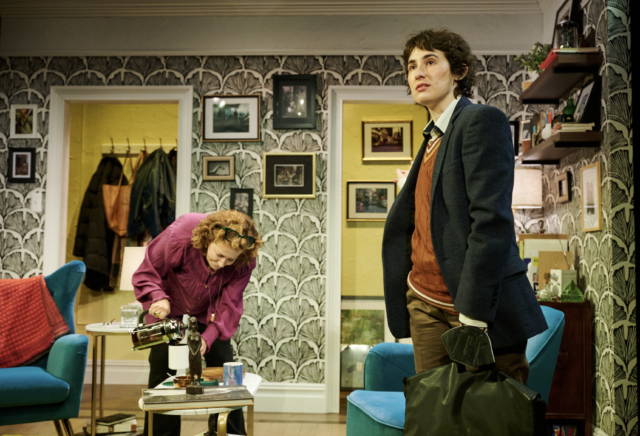
Axis puts a dark spin on Shakespeare’s Twelfth Night (photo by Pavel Antonov)

TWELFTH NIGHT
Axis Theatre Company
One Sheridan Sq. between West Fourth & Washington Sts.
Wednesday – Saturday through May 25, $11-$44, 8:00
866-811-4111
www.axiscompany.org

I described the last two productions I saw of William Shakespeare’s 1601–02 Twelfth Night as “light and lively,” “ecstatic,” “a joy to behold,” and “a pure delight.” I would not use any of those words to describe Axis Theatre Company’s streamlined new production, but that won’t stop me from heartily recommending it.

Shakespeare professor Marc Palmieri’s adaptation focuses on the darker side of this mistaken-identity romantic comedy about unrequited love, which has been trimmed to a fast-paced ninety minutes. David Zeffren’s lighting remains dim throughout on director Randall Sharp’s haunting stage, where actors are surrounded by large rectangular blocks and shadowy entrances; in one corner, guitarist and sound designer Paul Carbonara and pianist Yonatan Gutfeld (the keyboards are embedded in one of the blocks) perform Carbonara’s subtle Baroque-like score. Karl Ruckdeschel’s costumes — men’s suits and long coats, women’s gowns — are muted grays, lavenders, and earth tones; even Malvolio’s socks are a subdued yellow, not as garishly ridiculous as usual.

“If music be the food of love, play on / Give me excess of it,” Duke Orsino (Jon McCormick) declares as the show begins. The story is familiar to Shakespeare aficionados: In faraway Illyria, the wealthy countess Olivia (Katy Frame) rejects all suitors, including Orsino, who is in love with her. Her loyal steward, Malvolio (Axis producing director Brian Barnhart), also harbors a secret passion for the noblewoman. Twins Viola (Britt Genelin) and Sebastian (Eli Bridges) survive a shipwreck and wash up onshore, each ignorant that the other is still alive. One of the duke’s gentlemen, Curio (Robert Ierardi), explains to Viola, who has now disguised herself as a man named Cesario, that Olivia keeps repulsing Orsino’s advances. Viola quickly decides that she will convince Olivia to see Orsino in order to secure a place for herself in the duke’s employ.

Sebastian was rescued by Antonio (Jim Sterling), a sea captain who requests to be his servant. Believing his sister to be dead, Sebastian disguises himself as Roderigo and heads to the court of Orsino, where Antonio is not welcome.

Meanwhile, a group of conniving drunks hover around Olivia: her uncle, the raunchy Sir Toby Belch (George Demas); Sir Toby’s friend, the faux-elegant squire Sir Andrew Aguecheek (Andrew Dawson), who Sir Toby presents to Olivia as a potential suitor; Olivia’s chambermaid, Maria (Dee Pelletier); Olivia’s fool, Feste (Spencer Aste); and her servant Fabian (Brian Parks). “You must confine yourself within the modest limits of order,” Maria warns Sir Toby, who replies, “Confine! I’ll confine myself no finer than I am: these clothes are good enough to drink in; and so be these boots too.”

Axis Theatre Company’s Bard adaptation continues through May 25 (photo by Pavel Antonov)

After Malvolio chastises them for their ill behavior, Sir Toby, Sir Andrew, Feste, and Fabian, under Maria’s lead, concoct a plan to embarrass Malvolio in front of everyone. Maria explains, “Marry, sir, sometimes he is a kind and affectioned ass / the best persuaded of himself, so crammed, as he thinks / with excellencies, that it is his grounds of faith / that all that look on him love him / and on that vice in him will my revenge find / notable cause to work.”

It all comes to a head in a grand finale that, while not as boisterous as in other iterations, is as satisfying in its exactitude.

Axis refers to Twelfth Night as “Shakespeare’s most painful comedy,” and that’s just what Sharp, Palmieri, and the superb cast deliver. The company’s dungeonlike space on Sheridan Square is tailor-made for eerie, chimeric stories bathed in gloom, doom, and gothic and apocalyptic humor. In such previous works as High Noon, Dead End, Last Man Club, and Worlds Fair Inn, Axis founding artistic director Sharp has presented stark, compelling productions heavy in dark atmosphere but not without comic moments.

In this Twelfth Night, Olivia is fretful, often edgy with anxiety. She has no friends, only those who want her wealth or favor. Many of the characters, from Malvolio and Olivia to Feste and Sir Toby Belch, have a slightly pathetic bent to them. When Sir Andrew proclaims, “Shall we set about some revels?” and Sir Toby replies, “What shall we do else?,” the revelries that follow are not exactly a fanciful, fun frolic. Feste sings “O Mistress mine where are you roaming?” and “When that I was and a little tiny boy (With hey, ho, the wind and the rain)” and Carbonara and Yonatan Gutfeld’s music ramps up, accompanied by Lynn Mancinelli’s period choreography, but it’s not quite a royal ball. A subtle cloud of desperation hangs over the festivities. In fact, sometimes it feels like a night on the Bowery. Even the revelation scenes are kept relatively low key.

Twelfth Night demonstrates precisely what Sharp and Axis do best, whether offering an original play or a fresh take on an old chestnut. As always, they also include a related window display at the bottom of the theater entry stairs, this time providing added ambience and some shipwreck Easter eggs but no cakes and ale.

[Mark Rifkin is a Brooklyn-born, Manhattan-based writer and editor; you can follow him on Substack here.]

STAFF MEAL

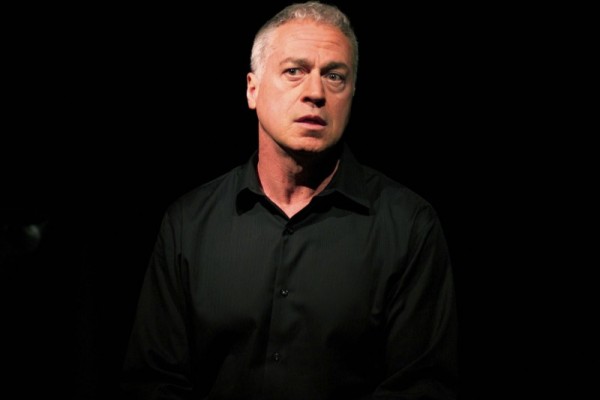
Mina (Susannah Flood) and Ben (Greg Keller) explore a possible relationship as doomsday approaches in Staff Meal (photo by Chelcie Parry)

STAFF MEAL
Playwrights Horizons, Peter Jay Sharp Theater
416 West 42nd St. between Ninth & Tenth Aves.
Tuesday – Sunday through May 24, $71-$91
www.playwrightshorizons.org

Abe Koogler’s Staff Meal kicks off with a tasty amuse bouche, continues with a delicious appetizer, then serves up a tantalizing main course before getting off track with a few awkward sides and an erratic dessert. But that doesn’t mean it ultimately isn’t a meal worth savoring.

Written between January and April 2020, just as the pandemic was starting to take hold of the world, Staff Meal is set in an absurdist time and place where lonely people are desperate for connection. Mina (Susannah Flood) and Ben (Greg Keller) meet-cute in a coffee shop, where they slowly begin speaking with each other while working on their laptops. The first day, Ben says, “Hey,” and Mina answers, “Hey.” The second day, Ben says, “Hey!” and Mina answers, “Hey!” The third day, Ben says, “Hey,” and Mina answers, “Oh hey!,” adding, “All’s well?”

Their less-than-scintillating conversation — Ben: “We had a dog who I used to throw the ball to a lot.” Mina: “Hey, I had a dog too! We used to throw the ball to him too.” — gets a little longer each day until Ben doesn’t show up, which worries Mina. On a trip to the bathroom, she asks an audience member to keep an eye on her computer. A nattily dressed vagrant (Erin Markey) appears from the theater aisle and tries to snatch the laptop just as Mina returns and stops her, shooting the audience member/guard a nasty look. The fourth wall has been broken — and will be again and again — in a nontraditional play overstuffed with convention-defying moments that range from brilliant and hilarious to baffling and confusing.

Ben and Mina decide to grab a bite and wander into a strange restaurant where no one comes to take their order as they delve deeper into who they are. Discussing past lives, Ben says he believes he was a passenger on a ship like the Titanic, but definitely not the Titanic, that sunk around the same time, while Mina thinks she was the rat in the animated film Ratatouille. The waiter (Hampton Fluker) eventually shows up, but only to deliver a monologue to the audience about the restaurant’s mysterious owner, Gary Robinson, and the expansive wine cellar, which is far away in a kind of hellish basement dungeon.

The action then shifts into the past, to the waiter’s first day, when he sat down with two other servers (Jess Barbagallo and Carmen M. Herlihy) to have a staff meal made specially by the chef, Christina (Markey). They rave poetically about the fabulous spread, even though it is clearly only green grapes.

The servers give the waiter advice on how to do his job, including not offending Christina — oops, too late — while the waiter wants to know why everything takes so long to happen in the restaurant, especially the journey to the wine cellar. The servers explain that the establishment is based on Flights of Fancy followed by Acts of Service dedicated to making connections, clear metaphors for life itself with indirect references to the Bible. Gary Robinson is referred to as a “legend” no one ever sees, like a supreme being, with Christina — it’s unlikely the first six letters of her name are mere coincidence — as the earthbound figure precisely following the recipes in his books.

In fact, the servers call out iterations of “Oh god” four times while partaking of the duck, which is actually grapes, the biblical fruit about which Jeremiah said, “But every one shall die for his own iniquity; every man who eats the sour grapes, his teeth shall be set on edge.” It also evokes how the public can lift a chef to godlike status and their restaurant to a kind of holy space, complete with scallop shell wallpaper, the emblem of St. James that relates to the physical and spiritual aspects of the human condition.

In case you’re getting lost at this point, Rita (Stephanie Berry) declares, “I’m sorry, WHAT IS THIS PLAY ABOUT???????!?!?!?!?!”

Things only get more bizarre and existential as the characters seek “sweet relief” in a city endangered by e-commerce, empty streets, and the breakdown of the social contract as everything literally falls apart around them.

Chef Christina (Erin Markey) serves up a meal of biblical proportions in Playwrights Horizons production (photo by Chelcie Parry)

Early on, Ben asks Mina if she eats out a lot. She responds in a way that captures how so many people feel all the time about going out anywhere — to a restaurant or even the theater itself — and not just during a pandemic: “I do!” she says. “I mean, no not really; it’s often hard to hear, and the food is often overpriced, and I often feel disappointed, and a big part of me honestly wishes we were just at someone’s house being hosted warmly by someone who was making us all different kinds of food and there was sort of a fire and wine was passed around to the sound of laughter and I was sort of sandwiched on the couch after dinner between two close friends and there was a third kneeling in front of me who I could rustle their hair.”

Jian Jung’s set morphs from the spare coffee shop to the fancy restaurant to an apocalyptic scenario as Masha Tsimring’s lighting grows ever darker and Tei Blow’s sound becomes more ominous, with illusions by Steve Cuiffo. Kaye Voyce’s costumes include everyday casual wear, restaurant uniforms, and the vagrant’s ratty clothing.

Koogler (Deep Blue Sound, Fulfillment Center) and director Morgan Green (School Pictures, Minor Character) keep the audience on its proverbial toes for most of the hundred-minute show before going haywire in the end, overfilling the plate with an abundance of effluvia. When Rita asks, “Do you ever get this feeling with young writers, or early writers, writers who are developing . . . do you ever wonder: When will they develop?” Koogler is an established playwright, but Staff Meal could benefit from some further development.

Keller (The Thanksgiving Play, Shhhh) and Flood (Make Believe, The Comeuppance) are adorable as the young couple who may be falling in love, while Barbagallo (The Trees, Help) and Herlihy (The Apiary, Scene Partners) are cryptic and charming as the servers, Markey (Dr. Ride’s American Beach House, A Ride on the Irish Cream) chews up the scenery in her two roles, Berry (On Sugarland, Sugar in Our Wounds) devours her soliloquy, and Fluker (All My Sons, Esai’s Table) is cool and calm as the waiter, who is a stand-in for the audience’s psyche.

Although dealing with issues that were exacerbated during the coronavirus crisis, Staff Meal is not a pandemic play. It’s a funny and frightening satire about attempting to make connection and build community even when the planet might be in a doom-spiral, about humans needing nourishment by being with others, in coffee shops, restaurants, or a theater. Like life, it’s not perfect, with its ups and downs, but it provides fine fare that may not go down easy but feeds the soul in these harried times.

[Mark Rifkin is a Brooklyn-born, Manhattan-based writer and editor; you can follow him on Substack here.]

THIRD LAW: AN INTERACTIVE THEATRICAL GAME

Nothing happens in Third Law without audience participation (photo by Paris Marcel)

THIRD LAW
Culture Lab LIC
5-25 46th Ave.
Thursday – Sunday through May 26, $28.52
www.culturelablic.org
www.wwtns.org

Investigative theater company What Will the Neighbors Say? goes back to the beginning of time in the world premiere of Third Law, but its unique take on the story of Adam and Eve in the Garden of Eden needs the audience to help it progress. Continuing at Culture Lab LIC through May 26, the forty-five-minute experience is part escape room, part choose-your-own-adventure in which the audience must band together in order to keep the narrative going.

Approximately twenty people remove their shoes and enter a small installation where six actors in sackcloth are lined up on a platform along a wall. Projections on the floor, wall, and two benches lead to how the play will unfold, involving sound, light, and movement. The more the audience learns about the prompts, the more it can influence what happens; thus, each performance is unique, leading up to three possible endings. As Isaac Newton’s third law of motion states, as interpreted by NASA, “for every action (force) in nature there is an equal and opposite reaction. If object A exerts a force on object B, object B also exerts an equal and opposite force on object A. In other words, forces result from interactions.”

The show was devised by Shani Matoaka Bekt, Sam Hood Adrain, Megan Mariko Boggs, Pablo Calderón-Santiago, James Clements, and Melannie Vásquez Lara, who play Adam and Eve as they discuss the Creator, eating fruit, and loneliness. Much of the dialogue relates to the audience and the world outside the play as well.

Six actors portray Adam and Eve in the Garden of Eden in interactive production at Culture Lab LIC (photo by Paris Marcel)

“I can’t imagine being apart. What was it like when you were alone?” Eve asks. Adam replies, “It’s hard to toil by yourself.” Third Law is activated only when everyone toils in harmony.

“Would you like to be Creator?” Eve asks Adam, who responds, “To be Creator? Is that allowed?” Eve answers, “Why not?” The Creator is not only the mysterious supreme being but the cast, director Coral Cohen, lighting designer Jacqueline Scaletta, sound and video designer Cosette Pin, set designer Miles Giordani, costume designer Elizabeth Shevelev, and the audience, which wanders around the space, figuring out how and how much it can guide the action while staying out of the way of the actors.

At its heart, Third Law, a melding of art and technology inspired by gameplay, is all about the choices humans make, individually and as a group. “We should be able to choose for ourselves,” Eve says. But as we know from real life, every choice comes with consequences.

[Mark Rifkin is a Brooklyn-born, Manhattan-based writer and editor; you can follow him on Substack here.]
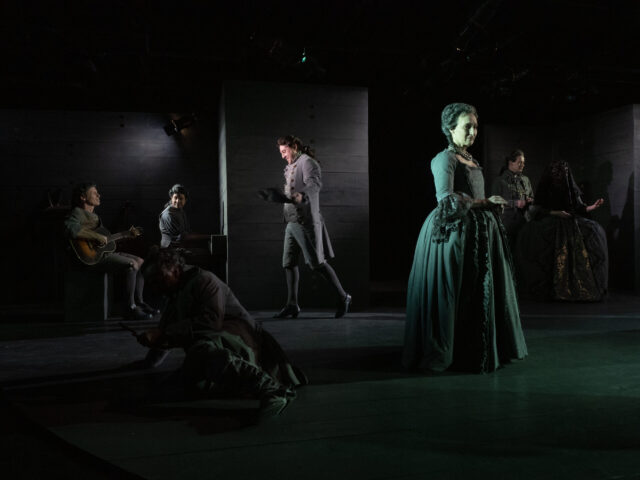
STILL

Mark (Tim Daly) and Helen (Jayne Atkinson) go over old times in Lia Romeo’s Still (photo by Joey Moro)

STILL
DR2 Theatre
103 East 15th St. at 20 Union Sq. East
Extended through May 23, $36.50-$90
www.coltcoeur.org/still

During the pandemic, I watched Lia Romeo’s lovely Zoom play Sitting & Talking, in which a pair of septuagenarians, a gruff divorcé and an elegant widow, portrayed by TV favorites Dan Lauria and Wendie Malick, respectively, try to make a connection online. Romeo’s latest, Still, is a lovely in-person play in which a pair of sexagenarians, a gentle divorcé and a never-married writer, portrayed by TV favorites Tim Daly and Jayne Atkinson, spend one night sitting and talking, trying to reconnect and, perhaps, rekindle an old relationship.

Continuing at the intimate DR2 Theatre through May 23, the seventy-five-minute Colt Coeur production takes place in a hotel, where Mark (Daly) and Helen (Atkinson) meet for the first time in decades. Mark is a sixty-seven-year-old bank lawyer who has just gotten divorced after twenty-nine years of marriage; Helen is a sixty-five-year-old bestselling novelist. He has two daughters; she has no children.

Their conversation in the lounge ranges from past memories to current dreams to aging and ailments. “You know what I’ve heard?” Helen begins. “The cells in your body completely renew themselves every seven years. I mean they’re all renewing themselves all the time, obviously, but after seven years you’re a completely different person. On a cellular level.” It’s a potent comment about how people change over time, no matter how much they might think they are the same, shortly followed by this poignant exchange:

Mark: You haven’t changed much.
Helen: You don’t think so? I was scared, getting dressed, that you’d think I looked so —
Mark: No, no, you look great.
Helen: Great for my age, maybe, but I look terrible for forty. How old are you in your head?
Mark: What do you —
Helen: Like when you picture your face — and then you see your real face — do you get surprised?
Mark: I think maybe I’m fifty.
Helen: I think I’m even younger than that. I think I’m probably around the age when you last saw me.
Mark: You don’t look that different.
Helen: You didn’t know me.
Mark: What?
Helen: When you first came in — I was sitting here, you walked right past the table. I had to say “Mark!” —
Mark: It was dark!
Helen: You thought — who’s that shriveled-up woman. That little old woman — that can’t be Helen —
Mark: That’s not what I thought!
Helen: It’s okay. I thought you looked old, too.
Mark: You did?
Helen: Not in a bad way. Men age better than women.
Mark: That’s bullshit.
Helen: I know! I know it is, but I still feel it.

They discuss dating, Tinder, poetry, being sick, happiness, who broke up with whom all those years ago, and why they hadn’t stayed in touch. He says, “Sometimes I feel like everything could have been different. I mean — if you and I — I know we wanted different things —” She replies lightly, “Yeah, I wanted you, and you wanted someone else.”

But after Mark asks Helen to come upstairs to his hotel room, a disagreement — about the immediate future and the book Helen is currently writing — places a potential roadblock in their relationship.

Tim Daly and Jayne Atkinson excel in moving play about love, loneliness, and aging (photo by Joey Moro)

Romeo (Connected, Green Whales) has crafted a tender, insightful work that explores what was, what is, and what still might be, directed by Adrienne Campbell-Holt (Dodi & Diana, Eureka Day) with a graceful delicacy even as things heat up. Alexander Woodward’s sets are cozy, with soft lighting by Reza Behjat and warm sound by Hidenori Nakajo, inviting the audience into the caring story; Barbara A. Bell’s costumes are naturalistic at first but then grow bold in the second half.

Mark and Helen are believable, well-developed characters in relatable situations. They’ve been through good times and bad, now wondering if they might be able to have the future they once considered so long ago. Emmy nominee Daly (Coastal Disturbances, Downstairs) and two-time Tony nominee Atkinson (The Rainmaker, Enchanted April) give beautifully nuanced performances as two proud individuals taking stock of their lives, wondering what comes next and whether they are still prepared to take chances and make changes to their relatively comfortable existence as senior citizens.

“It’s all kind of a crapshoot, at our age,” Mark says.

But Still wisely shows us that it doesn’t have to be.

[Mark Rifkin is a Brooklyn-born, Manhattan-based writer and editor; you can follow him on Substack here.]
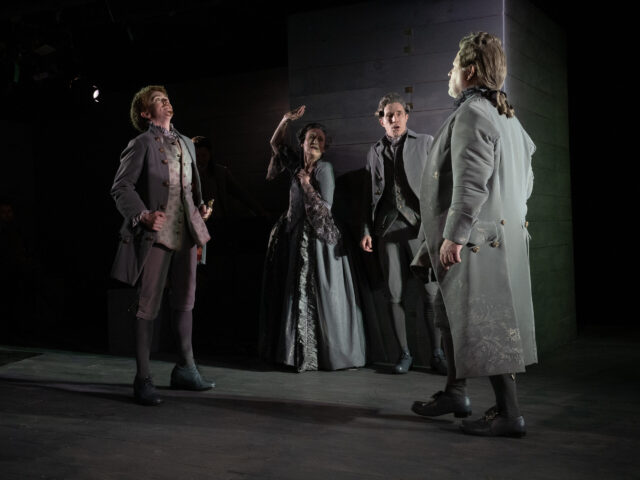
AMEI WALLACH: TALKING TAKING VENICE

Taking Venice examines 1964 biennale art scandal involving Robert Rauschenberg and the State Department

Who: Amei Wallach, Robert Storr
What: Postscreening Q&As for Taking Venice
Where: IFC Center, 323 Sixth Ave. at West Third St.
When: Friday, May 17, 7:15, and Saturday, May 18, 7:15
Why: “I grew up during the Cold War when the world seemed as dangerous as it does today. But it also seemed to be filled with possibility, with the actions of people who dreamed big and took big chances,” Amei Wallach says in the director’s statement for her latest documentary, Taking Venice. “This was especially true of artists, always looking to build something new. I became an art critic, then an author, and now a filmmaker. My goal is to make films about art that leap out of the art world and into a reckoning with what’s relevant in our lives through the stories that they tell. . . . Taking Venice builds on a tradition of telling the story of America then through the eyes of now because I want it to reflect how much the world and art have changed. I want there to be moments that sting with what we have lost, and moments that encapsulate what we have gained.”

In 2008, Wallach and codirector Marion Cajori made Louise Bourgeois: The Spider, the Mistress and the Tangerine, a fascinating exploration of the extraordinary French artist. Five years later, Wallach gave us Ilya and Emilia Kabakov: Enter Here, a compelling look at the renowned Russian art couple.

Wallach is now back with her third film, Taking Venice, which invites viewers inside the controversy surrounding the 1964 Venice Biennale, where several forces might have teamed up in order to ensure that American artist Robert Rauschenberg would win the Golden Lion. The scandal involved art curators Alice Denney and Alan Solomon, art dealer Leo Castelli, and, perhaps, the US government, which saw Rauschenberg’s uniquely American pop art as a way to help fight communism. Among the people Wallach speaks with are artists Christo, Simone Leigh, Mark Bradford, Shirin Neshat, and Carolee Schneeman; authors Louis Menand and Calvin Tompkins; museum directors Valerie Hillings and Philip Rylands; 2007 Venice Biennale director Robert Storr; and Denney, who died this past November at the age of 101. Even Rauschenberg chimes in: “I had moments where I thought everything would be much better if I hadn’t been so lucky,” he says in an archival clip.

Taking Venice opens May 17 at IFC Center; Wallach will be on hand for Q&As following the 7:15 screenings on May 17 and 18, the latter joined by Storr.

[Mark Rifkin is a Brooklyn-born, Manhattan-based writer and editor; you can follow him on Substack here.]
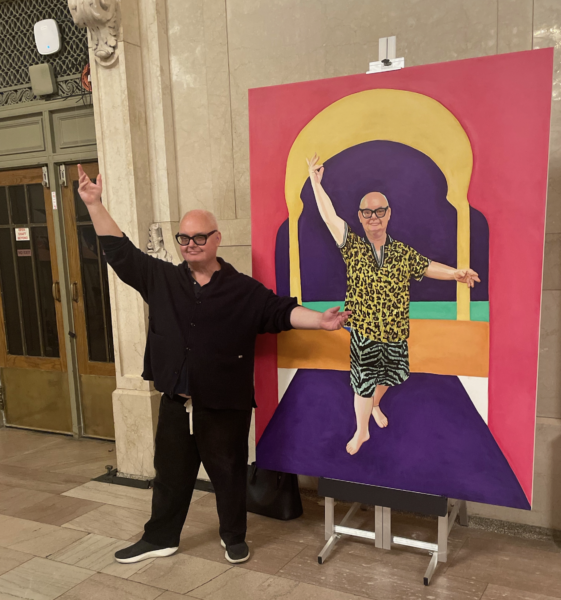
ALL OF ME

Lucy (Madison Ferris) and Alfonso (Danny J. Gomez) explore a possible relationship in All of Me (photo by Monique Carboni)

ALL OF ME
The New Group at the Pershing Square Signature Center
The Alice Griffin Jewel Box Theatre
480 West 42nd St. between Ninth & Tenth Aves.
Tuesday – Saturday through June 16, $31-$89
thenewgroup.org

Laura Winters’s All of Me is an endearing and moving romantic comedy about two young people who meet-cute at a hospital in Schenectady and explore a potential relationship that is impacted by family and financial issues.

Lucy (Madison Ferris) was a teenage jazz singer who is now considering going to college. Alfonso (Danny J. Gomez) works in data science and modeling and has just relocated from Manhattan to Schenectady. She has a dark sense of humor, always ready with a no-holds-barred joke, while he is a more serious and straightforward person. Lucy lives in a house that is slowly falling apart, with her overprotective, conservative mother, Connie (Kyra Sedgwick); her older sister, Jackie (Lily Mae Harrington); and Jackie’s fiancé, Moose (Brian Morabito), a slacker trying to earn money by playing online poker and via other random methods. Alfonso lives with his overprotective mother, Elena (Florencia Lozano), a defense lawyer, and his unseen father, an investment banker, in a fancy home with a maid and driver.

It’s not quite Romeo and Juliet, West Side Story, or The Notebook, but it has an innate charm; it’s impossible not to root for these two attractive twentysomethings, despite all the impediments in their way.

Oh, and it just so happens that they both are in wheelchairs, communicating via text-to-speech technology that may be light-years beyond Stephen Hawking’s but still is perceptibly machine-created.

“What’s your favorite pre-set on your device?” Alfonso asks. The unpredictable Lucy replies, “‘Polly want a cracker!’ When I want to be disarming. And if some stranger is staring at me I use — ‘Hey dipshit, take a picture, it will last longer, and lasting longer is something your girlfriend told me you should work on.’ What’s yours?” The practical Alfonso answers, “It seems a bit lame now but — ‘To infinity and beyond.’”

Connie (Kyra Sedgwick) has a rare smile for Lucy (Madison Ferris) in New Group show (photo by Monique Carboni)

Lucy had a potential career as a jazz singer cut short when she was diagnosed with muscular dystrophy six years earlier, at sixteen. She is unable to stand on her own and is losing her ability to speak and use her hands as the disease progresses. Alfonso was injured in an accident when he was six months old, is paralyzed from the waist down, and has limited use of his right hand. In real life, Ferris has muscular dystrophy, and Gomez was partially paralyzed in a mountain biking accident in 2016 that almost killed him.

While Alfonso has a support structure in place because of his parents’ wealth — they have a ritzy home specially outfitted for his needs, along with expensive art and furniture — daily existence for Lucy is more problematic. The wooden plank that allows her to get from one side of the house to the other is undependable, the dishwasher is broken, and Connie is working multiple jobs to make ends meet, doing nails at a salon and selling knives to housewives, receiving no help from her ex-husband, an opioid addict. Connie’s jobs fit her personality; she pretties up other women, then pulls out sharp weapons.

As older sister Jackie’s wedding approaches, the conflicts grow, including arguments about Lucy’s text-to-speech program. Connie is not happy with it, complaining, “Excuse me for missing the sound of my daughter’s actual, non-weird-robot voice.” Jackie is hoping that Lucy might be able to sing at the wedding. But Lucy, always quick with a joke, explains, “But I enjoy sounding like futuristic AI that waits until the end of the movie to lock you out of the spaceship.”

Winters (Coronation, Gonzo) is a young, energetic writer who documented the process of making All of Me on TikTok with an infectious enthusiasm that comes through in director Ashley Brooke Monroe’s (Julius Caesar, Tommy’s Girls) spirited production. Ferris (The Glass Menagerie,) is hilarious as Lucy, who refuses to wallow in self-pity but understands her situation all too well, while Gomez, in his theatrical debut, is tender and affable as Alfonso, who is at first shocked by Lucy’s boldness and pointed joking but comes to care for her.

@laurawinters12

Sedgwick (Twelfth Night, Ah, Wilderness!) makes a potent return to theater after an absence of more than two decades as the wine-drinking, cigarette-smoking mother whose life has not turned out as planned as she struggles to get by every day. Although she wants the best for her children, it has to be on her terms, not theirs. In her off-Broadway debut, Harrington sparkles as Jackie, sensitively portraying a sibling in a family dynamic that often makes her second fiddle to her sister, while Morabito (The Panic of ’29, Othello) is appropriately bedraggled as the ne’er-do-well, well-named Moose. Lozano (Brooklyn Laundry, One Wet Brain) is graceful as the fashionable Elena.

All of Me, a New Group production at the Pershing Square Signature Center through June 16, is a classic opposites attract rom-com and dysfunctional family drama, although the class difference gets overdone, emphasized by Brett Banakis and Edward T. Morris’s sets and Sarah LeFeber’s costumes. The show is reminiscent of Cost of Living, Martyna Majok’s 2022 Broadway transfer about a wealthy Harvard-Princeton man with cerebral palsy and a divorced quadriplegic woman, but that successful play bordered on becoming trauma porn, concentrating on the dangers of being disabled and feeling helpless. All of Me is much more focused on characters aiming to be independent.

The 1931 title song, written by Gerald Marks and Seymour Simons and performed by such jazz legends as Paul Whiteman and His Orchestra, Ella Fitzgerald, Louis Armstrong, and Billie Holiday, contains the following lines: “All of me / Why not take all of me / Can’t you see / I’m no good without you / Take my lips / I want to lose them / Take my arms / I’ll never use them.” Those lyrics have never had such resonance as in Winters’s poignant and powerful play.

[Mark Rifkin is a Brooklyn-born, Manhattan-based writer and editor; you can follow him on Substack here.]
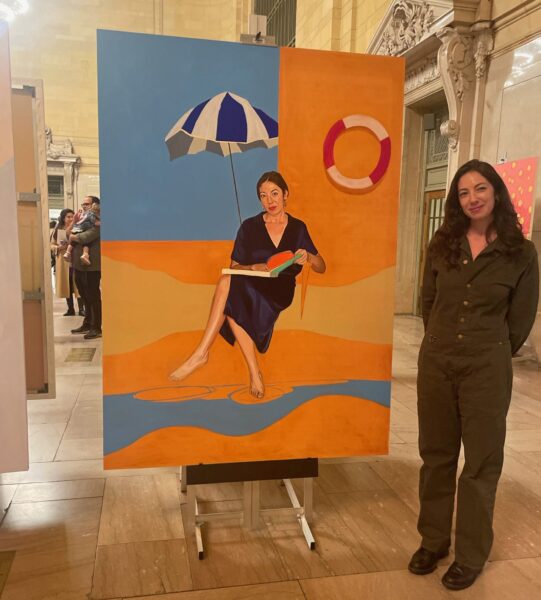
STELLA PRINCE LIVE AT CAFE WHA?

Stella Prince will play Cafe Wha? with special guests May 17 (photo by Lynn Goldsmith)

Who: Stella Prince ft Maidin and Susie McCollum
What: Live concert
Where: Cafe Wha?, 115 MacDougal St.
When: Friday, May 17, $17.99 – $29.15 (plus two-item minimum), 6:30
Why: Self-described “Gen Z Folk” artist Stella Prince knew she wanted to become a singer when she was three, started performing when she was five, and wrote her first song when she was ten. Now nineteen, Prince, who was born and raised in Woodstock and lives in Nashville, has been performing around the country and the UK, including becoming the youngest performer ever to play Nashville’s Tin Pan South music festival.

On such tunes as “Crying on a Saturday Night,” “Closing Doors,” and “Two Faced,” she reveals a maturity well beyond her years. On “Dear Future Me,” she asks, “Why do I keep begging for love / Is it because it’s never enough / Why do I always punish myself / If things don’t go the way I planned them to be / You never truly recover / When you always compare yourself to another / Childhood insecurities hover / Making it hard to relate to each other / When will I fill this empty void that’s buried deep inside of me? / Maybe not until I get over past insecurities / Standing tall like trees / Reaching new heights of maturity / I wish my younger self could see / dear future me.”

On May 17, Prince, who recently announced that her all-female folk showcase, Change the Conversation’s “Stella Prince and Friends,” will visit Connecticut, Maine, and California this summer, brings her talents to the legendary Cafe Wha? in Greenwich Village, joined by Maidin and Susie McCollum. Tickets are $17.99 for general admission and $29.15 for premier seating, plus a two-item minimum.

[Mark Rifkin is a Brooklyn-born, Manhattan-based writer and editor; you can follow him on Substack here.]