The film career of French artist Daniel Pommereulle is being celebrated at Metrograph this month
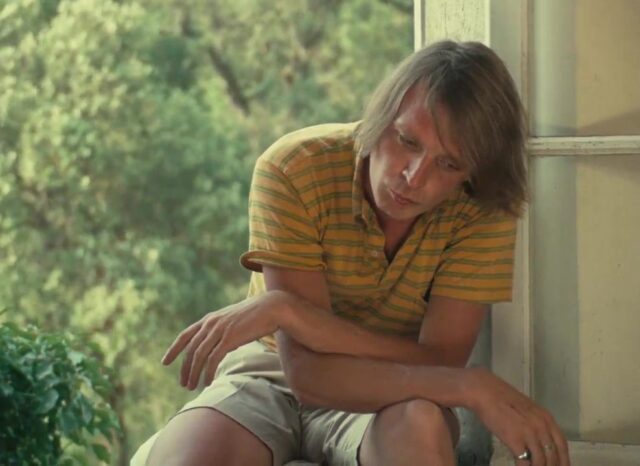
SIX MORAL TALES: LA COLLECTIONNEUSE (Eric Rohmer, 1967)
Metrograph
7 Ludlow St. between Canal & Hester Sts.
Saturday, September 14, 2:30
Sunday, September 15, 11:00 am
Series runs September 13-29
212-660-0312 metrograph.com
On September 12, the exhibit “Daniel Pommereulle: Premonition Objects” opens at Ramiken on Grand St. On September 13, Metrograph kicks off the two-week series “One More Time: The Cinema of Daniel Pommereulle,” consisting of seven programs featuring the French painter, sculptor, filmmaker, performer, and poet who died in 2003 at the age of sixty-six. First up is “Daniel Pommereulle X3,” bringing together Pommereulle’s shorts One More Time and Vite and Anton Bialas and Ferdinand Gouzon’s 2021 Monuments aux vivants, which documents the artist’s sculptural work; curators Boris Bergmann and Armance Léger will take part in a postscreening Q&A moderated by filmmaker Kathy Brew. “Pommereulle was one of those people who could stand firm against the all-consuming metropolis: someone who never compromised, who never sold his soul — even to America. We joyously return Pommereulle to New York: a necessary encounter, a poetic reward,” Léger and Bergmann said in a statement. The festival also includes Jean-Luc Godard’s Weekend, Jean Eustache’s The Mother and the Whore, Marc’O’s Les Idoles, Jackie Raynal’s Deux Fois, serge Bard and Olivier Mosset’s Ici et maintenant and Fun and Games for Everyone, and Eric Rohmer’s La Collectionneuse.
“Razor blades are words,” art critic Alain Jouffroy tells painter Daniel Pommereulle (Daniel Pommereulle) in one of the prologues at the start of La Collectionneuse, the fourth film in French master Eric Rohmer’s Six Moral Tales (falling between My Night at Maud’s and Claire’s Knee). Words might have the ability to cut, but they don’t seem to have much impact on the three people at the center of the film, which offers a sort of alternate take on François Truffaut’s Jules et Jim. Needing a break from his supposedly strenuous life, gallerist Adrien (Patrick Bauchau, who also appeared in La Carrière de Suzanne, Rohmer’s second morality tale) decides to vacation at the isolated St. Tropez summer home of the never-seen Rodolphe. Daniel is also at the house, along with Haydée (Haydée Politoff), a beautiful young woman who spends much of the film in a bikini and being taken out by a different guy nearly every night. Adrien decides that she is a “collector” of men, and the three needle one another as they discuss life and love, sex and morality, beauty and ugliness. Adrien might claim to want to have nothing to do with Haydée, but he keeps spending more and more time with her, even though he never stops criticizing her lifestyle. He even uses her as a pawn when trying to get an art collector named Sam (played by former New York Times film critic Eugene Archer under the pseudonym Seymour Hertzberg) to invest in his gallery.
While everybody else in the film pretty much knows what they want, Adrien, who purports to understand life better than all of them, is a sad, lost soul, unable to get past his high-and-mighty attitude. Rohmer crafted the roles of Daniel and Haydée specifically for Pommereulle and Politoff, who improvised much of their dialogue; Bauchau opted not to take that route, making for a fascinating relationship among the three very different people. La Collectionneuse is beautifully shot in 35mm by Néstor Almendros, the bright colors of the characters’ clothing mixing splendidly with the countryside and ocean while offering a striking visual counterpoint to the constant ennui dripping off the screen. His camera especially loves Politoff, regularly exploring her body inch by inch. The film is both Rohmer’s and Almendros’s first color feature; Almendros would go on to make more films with the director, as well as with Truffaut, even after coming to Hollywood and shooting such films as Days of Heaven, Kramer vs. Kramer, and Sophie’s Choice. Winner of a Silver Bear Extraordinary Jury Prize at the 1967 Berlinale, La Collectionneuse is screening September 14 and 15 at Metrograph.
[Mark Rifkin is a Brooklyn-born, Manhattan-based writer and editor; you can follow him on Substack here.]
Barbara Loden wrote, directed, produced, and stars in Wanda
WANDA (Barbara Loden, 1970)
Metrograph
7 Ludlow St. between Canal & Hester Sts.
Friday, September 13, 8:20 (with introduction)
Sunday, September 15, 2:50
Thursday, September 19, 3:00
212-660-0312 metrograph.com
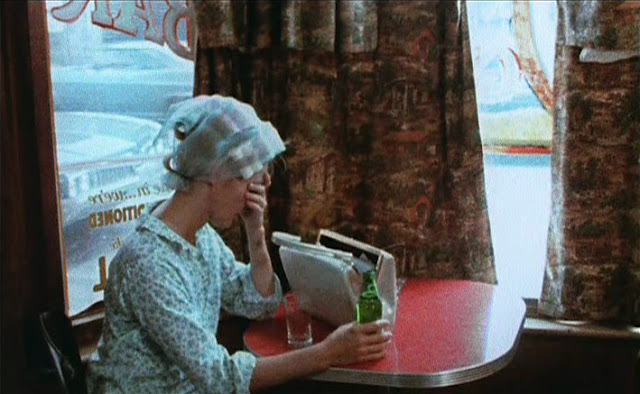
“If you don’t want anything, you won’t have anything, and if you don’t have anything, then you’re as good as dead,” Mr. Dennis (Michael Higgins) tells Wanda Goronski (Barbara Loden) in Wanda, which is screening September 13, 15, and 19 in the continuing Metrograph series “One-Timers.” The first theatrical feature written, directed, produced by, and starring an American woman, Wanda is a raw, naturalistic road-trip movie about an emotionally vacant woman who walks through life in a kind of stupor, wandering into situations to avoid being alone yet still trapped in an unrelenting alienation. Loden, who won a 1964 Tony for her portrayal of Maggie in Arthur Miller’s After the Fall — the play was directed on Broadway by Elia Kazan, whom she would marry four years later and remain with through her tragic death in 1980 — doesn’t try to turn Wanda into a feminist antihero, but she does take all the power away from her, making her completely dependent on other people, primarily men, an excellent counterpoint to Loden herself, who has all the power. Staying on her sister’s (Dorothy Shupenes) couch in the middle of Pennsylvania coal country, Wanda is almost zombielike as she slowly heads to court in curlers and a housecoat and lets the judge award custody of her two children to her soon-to-be-ex-husband (Jerome Thier). “I’m just no good,” she mumbles. Broke and apparently with no faith or hope in her future, she proceeds to get involved with some sketchy losers, including Mr. Dennis, who takes her on a minor crime spree that is a far cry from Bonnie and Clyde. All along the way, she rarely has anything of any interest to say to anyone; the only time she speaks clearly and definitively is when she explains that she likes onions on her hamburgers.
Mr. Dennis (Michael Higgins) takes Wanda Goronski (Barbara Loden) for quite a ride in Wanda
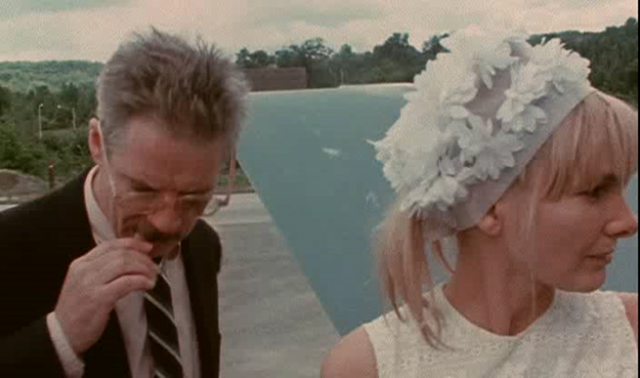
Shot in a cinéma vérité style by documentary cinematographer Nicholas T. Proferes, Wanda — named Best Foreign Film at the Venice International Film Festival — is a riveting and infuriating exploration of the death of the American dream as the 1960s come to an end and the country reexamines itself, not necessarily liking what it sees. Apathy competes with melancholy as Wanda is unable and unwilling to take control of her life, dressed in the same white outfit and carrying the same white pocketbook throughout nearly the entire film, but she is more disconsolate than angelic. Much of the film is improvised and most of the characters are portrayed by nonprofessional actors or people who just happened to be in the area, like the scene in which Mr. Dennis and Wanda encounter a family flying a remote-control model airplane. (Higgins would go on to make more than fifty films, including The Conversation, The Stepford Wives, and The Seduction of Joe Tynan.) Coming on the cusp of the women’s liberation movement, Wanda is about a pouty sad-sack who barely ever changes emotion, always wearing the same blank stare. It’s not that she’s promiscuous, adventurous, or even unpredictable; she just is. You desperately want her to take action, to care about something or someone, but it’s just not going to happen. It’s almost as if Loden is setting the groundwork for such future films as Martin Scorsese’s Alice Doesn’t Live Here Anymore and Taxi Driver, which feature such strong, decisive female characters as Alice (Ellen Burstyn) in the former and Iris (Jodie Foster) in the latter, who at least attempt to take matters into their own hands; elements of Wanda can also be found in Aki Kaurismäki’s Match Factory Girl and Chantal Akerman’s Jeanne Dielman, 23, Quai du Commerce, 1080 Bruxelles.Wanda would end up being Loden’s only film as writer and director; she died in 1980 of cancer at the age of forty-eight. The September 13 screening will be introduced by Caryn Coleman, founder of the Future of Film Is Female.
[Mark Rifkin is a Brooklyn-born, Manhattan-based writer and editor; you can follow him on Substack here.]
John Wayne looks better than ever in new 4K restoration of The Searchers
THE SEARCHERS (John Ford, 1956)
Film Forum
209 West Houston St.
September 13-19
212-727-8110 filmforum.org
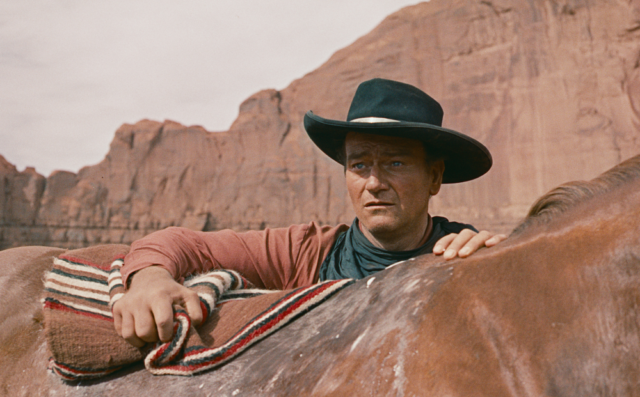
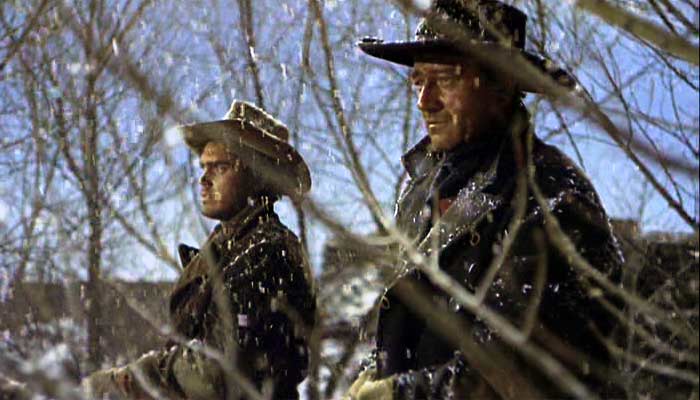
That’ll be the day when someone tries to claim there’s a better Western than John Ford’s ethnocentric look at the dying of the Old West and the birth of the modern era — and not it looks better than ever, in a 4K restoration opening at Film Forum September 13. Essentially about a gunfighter’s attempt to find and kill his young niece, who has been kidnapped and, ostensibly, ruined by Indians, The Searchers — based on the 1954 novel by Alan Le May — is laden with iconic imagery, inside messages, and not-so-subtle metaphors. Hence, it is no accident that John Wayne’s son, Patrick, plays an ambitious yet inept officer named Greenhill. The elder Wayne stars as Ethan Edwards, a tough-as-nails Confederate veteran seeking revenge for the murder of his brother’s family; he’s also out to save Debbie (Natalie Wood) from the Comanches, led by a chief known as Scar (Henry Brandon), by ending her life, because in his world view, it’s better to be dead than red.
In iconic Western, Jeffrey Hunter and Ethan Edwards search for Natalie Wood, with very different motives
Joining him on his trek is Debbie’s adopted brother, Martin Pawley (Jeffrey Hunter), who wants to save her from Edwards. The magnificent film balances its serious center with a large dose of humor, particularly in the relationships between Ethan and Martin and Ethan with his Indian companion, Look (Beulah Archuletta). And keep your eye on that blanket in front of the house. Born in Maine in 1894, Ford made some of the most dazzling Westerns and literary adaptations ever put on celluloid; he passed away in 1973 at the age of seventy-nine, having won four Best Director Oscars among his nearly 140 pictures.
[Mark Rifkin is a Brooklyn-born, Manhattan-based writer and editor; you can follow him on Substack here.]
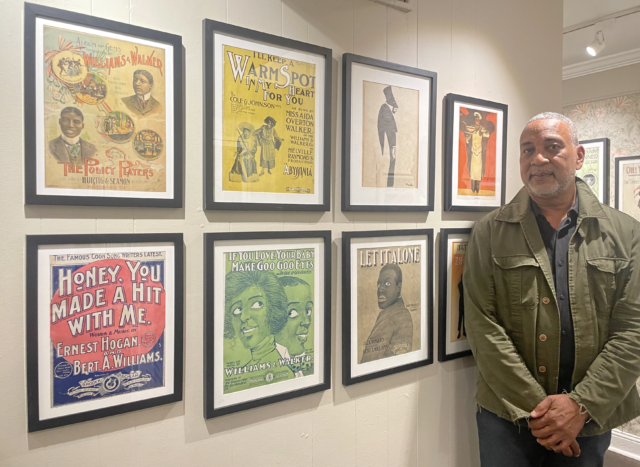
Curator and cultural historian John T. Reddick will give a talk on Tin Pan Alley on September 11 at the Society of Illustrators (photo by twi-ny/mdr)
ILLUSTRATING TIN PAN ALLEY: FROM RAGTIME TO JAZZ
Society of Illustrators
128 East Sixty-Third St. between Park & Lexington Aves.
Wednesday – Saturday through October 12, $10-$15
Tin Pan Alley Talk & Reception: Wednesday, September 11, $10-$15. 6:30
212-838-2560 societyillustrators.org
Longtime Harlem resident and Yale University School of Architecture graduate John T. Reddick is into bridge building — but in this case, the bridges aren’t physical structures but those that involve the lesser-known history of Tin Pan Alley. The birthplace of American popular music, Tin Pan Alley flourished in the late nineteenth and early twentieth centuries, when dozens of music publishers and businesses lined the streets of what is now Chelsea, in the West Twenties.
Born and raised in the integrated Philadelphia neighborhood of Mount Airy, Reddick got involved in trying to save Tin Pan Alley when five buildings on West Twenty-Eighth St. were in danger of being demolished by their owner/developer. In 2019, the Landmarks Preservation Commission designated them historic landmarks.
A founding member of Harlem Pride and the director of community engagement projects for the Central Park Conservancy, Reddick has been an avid collector of sheet music art, focusing on songs composed and/or performed by Black and Jewish entertainers. What began as a curiosity and hobby has blossomed into a dazzling exhibition at the Society of Illustrators, “Illustrating Tin Pan Alley: From Ragtime to Jazz,” on view through October 12.
“I felt like these artists were groundbreakers. I see in them many parallels to hip hop, in that ragtime’s innovation for its time was as jarring as hip hop’s,” he said of the composers and performers of the era during a tour of the show. “My journey began after I went to a talk on the Lower East Side given by Jeffery Gurock, who lectured on the period when Harlem was Jewish. That was a revelation to me, that Harlem had once been the second largest Jewish community in New York City. From that point I went to the library, did research, and started buying items on eBay. It was just shocking; as I bought sheet music or got to see the names, I realized they all lived in Harlem during the same time period.”
Arranged chronologically, the exhibit focuses on sheet music and its accompanying art, which reveals the developing connections between American Black and white music, beginning with the cakewalk, a Black dance that originated in America but became a craze when introduced in Europe, advancing its popularity as a hit in the United States. Several photographs and illustrations depict the cakewalk being performed, including two works by French artist Georges-Bertin Scott, sheet music covers for the songs “Darktown Is Out To-Night” and “Cake Walk Neath the Dixie Moon,” and a drawing in which Uncle Sam relaxes while watching dancers’ cakewalk around a tree.
On a nearby wall is the sheet music for “All Coons Look Alike to Me,” a popular 1898 song composed by Ernest Hogan that sold more than a million copies. Hogan, a prominent Black composer and performer, appeared in shows with the leading African American performers of the day. However, the song’s sheet music art, which featured unflattering caricatures of Black men and women, became such a crippling definer of Hogan as an artist that it led to his demise.
Reddick noted, “All of a sudden, this ragtime music is popular, and you want to show and sell us more. What do you use to image that music?” Reddick grouped together the sheet music covers for “Who Dat Say Chicken in Dis Crowd” by Paul Laurence Dunbar and Will Marion [Cook], “Cotton: A Southern Breakdown” by Albert Von Tilzer, and “Watermelon Am Good Enough for Mine” by G. Barker Richardson and Von Tilzer. “I have three things in there: cotton, chicken, and watermelon. They’re in the lyrics; they’re in the titles,” Reddick said. “A lot of the signifying, I feel, is coming out of music publishers just trying to meet the commercial market where its mind is at. You don’t cartoon something unless its understanding is pervasive. For me it’s the beginning of bridge building to some identity that’s beyond that becomes an American music.”
Other excellent groupings juxtapose two different sheet music covers for Lew Pollack’s “Vamping Sal the Sheba of Georgia” and three for Shelton Brooks’s “Darktown Strutters’ Ball.”
Pointing out that a lot of sheet music was dedicated to songwriter and journalist Monroe Rosenfeld because the performers knew he could talk them up in the newspaper, Reddick zeroed in on the team of Bert Williams and George Walker.
“Rosenfeld has this bridge relationship, so you see a lot of people pandering to him, even Williams and Walker, who coined themselves ‘the two real coons.’ They claimed the tag and the stage to establish their own authenticity and artistry. I realized in many ways it’s just like hip hop. You could have been the greatest hip-hop singer in the world, but if you went to amateur night at the Apollo and started singing in a tuxedo, you would be booed. You wouldn’t even get your mouth open because there’s a certain kind of drag they expect you to be in to perform. Williams and Walker knew they were good, but they realized that more whites were blacking-up and playing Blacks onstage than actual Black performers. It was so much more sophisticated. They could show that there’s parody and all this irony in lot of stuff they did.”
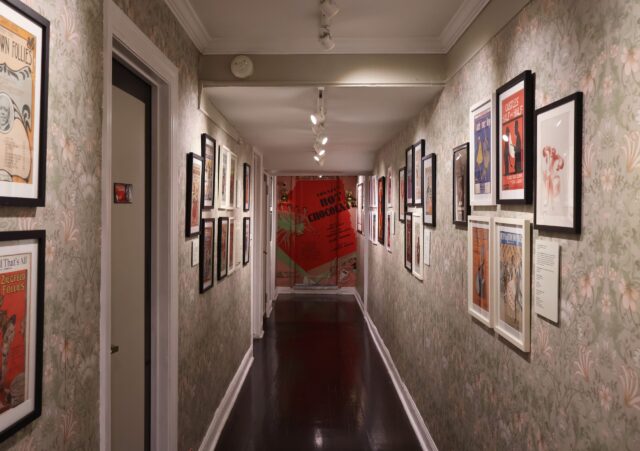
Every element, even the way the show is hung, carries some kind of weight. Reddick explained that for most of the works, a black frame indicates the song was written by a Black composer, a white frame by a white composer.
Perhaps not accidentally, the cover sheet for Jean Schwartz’s 1908 “The Whitewash Man,” depicting a smiling Black man carrying a paint bucket and a broom, is placed over a water fountain, evoking the “Whites Only” signs of the Jim Crow era.
Among the other composers and performers Reddick discussed were James Reese Europe and Ford T. Dabney, Noble Sissle and Eubie Blake, Irene and Vernon Castle, Irving Berlin, George Gershwin, Ethel Waters, Cab Calloway, Duke Ellington, Miss Aida Overton Walker, drummer Buddy Gilmore, Fats Waller, Sophie Tucker, Josephine Baker, and W. C. Handy as well as the Clef Club, the Ziegfeld Follies, the Cotton Club, Connie’s Inn, and Al Hirschfeld and Sydney Leff, two Jewish artists who attended the Vocational High School for the Arts on 138th Street in Harlem.
“Think of the names of Motown groups,” Reddick said. “The Supremes, the Marvelettes, the Temptations. Nobody’s a gangster. They’re claiming we deserve to be on the other side. Now we have a credential. . . . When the Central Park jogger case happened [in 1989], the term ‘wilding,’ it was just a term for young people being in nature and the park, not being there in the park to victimize people. But that was the first time it crossed over as a term from the Black community to the broader public. . . . So, I always think, what if bling had crossed over, associated with a jewelry store robbery as opposed to the fashions of hip-hop artists. Again, the word already had that meaning in my culture. Bling and jewelry. You got bling on, but at a certain point it crossed over, right? Maybe a hip-hop person, whatever. What was the bridge that made it happen?”
Tin Pan Alley exhibition winds down narrow hallway (photo courtesy of Society of Illustrators)
One of the most striking works is E. Simms Campbell’s gorgeously detailed 1932 “Night-Club-Map of Harlem,” which locates such hot spots as Smalls Paradise, Club Hot-Cha (“where nothing happens before 2 a.m.”), “the nice new police station,” Gladys’ Clam House, the Lafayette Theatre, the Radium Club, and the Savoy Ballroom, with cartoon vignettes of people dancing the lindy hop and the snakehips, men purchasing “marijuana cigarettes,” Bill “Bojangles” Robinson tapping away, and Tillie’s offering “specialties in fried chicken — and it’s really good.”
Reddick, who will give a lecture at the Society of Illustrators on September 11 at 6:30, followed by a reception with pianist/preservationist Adrian Untermyer, then told a story about American composer and violinist Will Marion Cook, who had studied with and influenced Antonín Dvořák’s take on America’s “Negro Music.”
“He performed and got a review that said he was one of the nation’s best colored violinists. And he took his violin to the critic and broke it and said, ‘I’m the best violinist.’ He wanted to start writing for Black shows and other Black players. He wrote with [poet and novelist] Paul Laurence Dunbar. But his family was so embarrassed for writing that ‘n—er’ music that in his first productions, he didn’t use his last name. However, Cook-associated shows such as 1898’s Clorindy and 1903’s In Dahomey served to bring a more diverse African American identity to the stage. What does that mean politically? If people are liking you, then they are seeing you in another light. What’s that going to mean on the political landscape?”
He added, “Now they could be voters. Picking cotton, you weren’t a voter. They’re playing at Madison Square Garden, so they’re at this elevated level. They’re having a life that was unimaginable for most Blacks.”
Above “All Coons Look Alike to Me” is a quote by W. E. B. Du Bois from his 1903 book The Souls of Black Folk: “It is a peculiar sensation, this double-consciousness, this sense of always looking at one’s self through the eyes of others . . . one ever feels his two-ness, an American, a Negro; two souls, two thoughts, two un-reconciled strivings.”
In “Illustrating Tin Pan Alley: From Ragtime to Jazz,” Reddick is reconciling those strivings and more, building bridges across race and class through a unique moment in New York City musical history.
[On September 19, the Society of Illustrators will host a happy hour from 5:00 to 9:00, with free admission, drink specials, and live music by Charlie Judkins, Miss Maybell, and Robert Lamont. Mark Rifkin is a Brooklyn-born, Manhattan-based writer and editor; you can follow him on Substack here.]
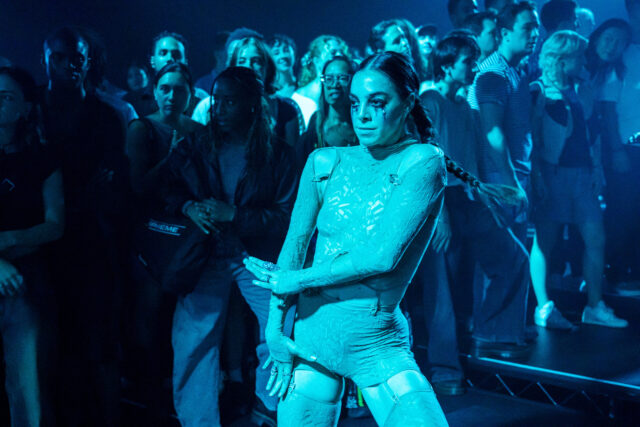
Park Ave. Armory has been transformed into a rave club for R.O.S.E. (photo by Stephanie Berger)
R.O.S.E.
Park Ave. Armory, Wade Thompson Drill Hall
643 Park Ave. at Sixty-Seventh St.
September 5-12, $65 www.armoryonpark.org
Sharon Eyal’s exhilarating R.O.S.E., which opened September 5 for a too-brief seven-show run in Wade Thompson Drill Hall in Park Ave. Armory, ebbs and flows as a participatory dance experience that pulses with a series of slow fuses that explode about half a dozen times over the course of three hot hours.
An armory commission that debuted last year at New Century Hall in Manchester, R.O.S.E. starts off calmer than one might expect. The hall is divided into front and back sections by a floor-to-ceiling side-to-side black fabric wall. As the audience arrived in the first section of the hall, about a half hour before showtime, a DJ spun droning tunes in the space, mostly empty save for a few couches and benches; a projection of a large white rose glowed on the wall behind the DJ.
On opening night, one man moved slowly back and forth to the music as a handful of others relaxed, talked, and checked their phones. Little was going on; excitement was nonexistent. At 7:30, the crowd began entering the main space; staff wearing glow sticks placed a sticker over each person’s phone camera lens, as absolutely no photo or video is allowed inside.
The truncated area lacks the breathtaking awe of the hall’s usual vastness, with walls and curtains on all sides and lights and speakers hanging down, blocking the view of the impressive ceiling. There are four step-platforms, with bars in two corners, the tech crew in a third, and DJ Ben UFO in the fourth. (The set design is by Daphnée Lanternier, who is also credited with creative direction.)
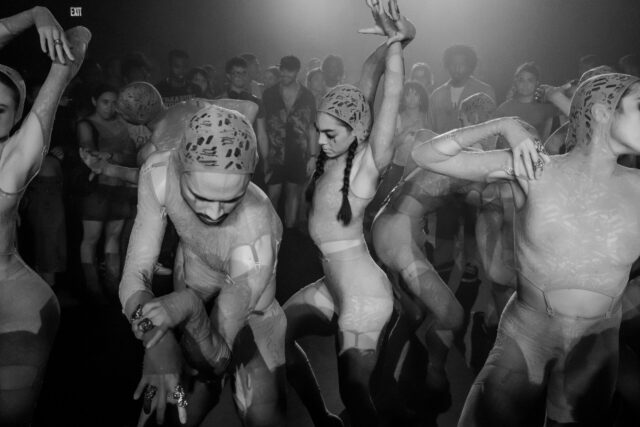
Dancers weave in, through, and around the crowd in Sharon Eyal’s immersive R.O.S.E. (photo by Stephanie Berger)
It was not clear what to do at first as attendees considered where to stand. (I recommend hanging around wherever you see white tape on the floor.) The crowd consisted of people from all age groups (except children), in all types of dress and hairstyles, including small groups that appeared to come straight out of SNL’s old “Sprockets” skits; some swayed to the music, others chattered away, and a few scanned their phones. After about fifteen curious minutes, one gentleman stepped into a spotlight in the middle of the room and clapped his hands over his head several times; that was all it took to get more people to start dancing.
Shortly after eight o’clock, as the packed dance floor was heating up, nine performers (Darren Devaney, Guido Dutilh, Juan Gil, Alice Godfrey, Héloïse Jocqueviel, Johnny McMillan, Keren Lurie Pardes, and Nitzan Ressler) entered the space, making their way through the audience, which parted to let them pass. Wearing postapocalyptic beige costumes by Maria Grazia Chiuri of Christian Dior Couture (that occasionally included cowls and cinch sacks), metal jewelry and makeup by Noa Eyal Behar (that featured streaked black eyeliner, teardrops, and piercings), they moved through the crowd with insectlike precision, their arms and legs forming awkward angles.
Eyal cut her teeth as a member and choreographer of Batsheva Dance Company, and her exciting movement language contains elements of former Batsheva artistic director Ohad Naharin’s Gaga system. The work is codirected by Eyal’s longtime collaborator Gai Behar, whom Eyal met in a club in the late 1990s, and Caius Pawsom of the Young art collective.
While some audience members hung back on the platform risers, others followed the nine dancers around the room as the music thumped, haze wafted over everyone, and Alon Cohen’s propulsive lighting shifted between darkness and light. And then the dancers disappeared.
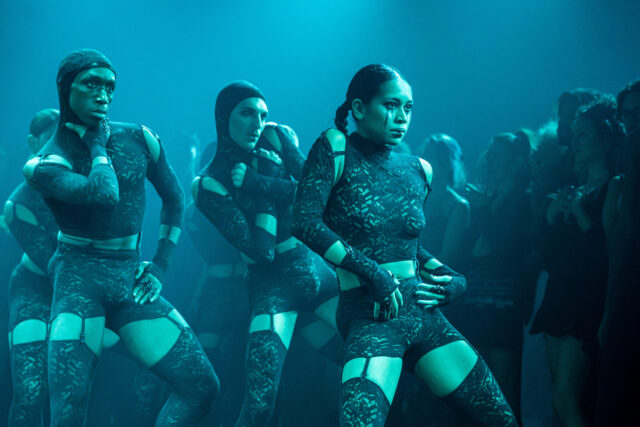
A team of twelve dancers in black join the fray at Park Ave. Armory (photo by Stephanie Berger)
This pattern happened five or six times during the evening. The dancers would sneak into the area, starting from different corners, and groove for between five and fifteen minutes, sometimes breaking off into stunning solos. If you decide to remain close to them, you have to stay vigilant, as they unpredictably turn, twist, and reach out; you might be touched — one woman stood her ground, so a dancer made contact with her, while another dancer gently put a hand on a man’s shoulder — and you might even be given a black rose.
For one exquisitely choreographed scene, the nine dancers faced off against twelve dancers in black lace (New York–based Julia Ciesielka, Blu Furutate, Antonia Gillette, Michaella Ho, Destinee Jimenez, Nick LaMaina, Natalie Wong, Nina Longid, Julian Sanchez, Luc Simpson, Kailei Sin, and Jeremy Villas) in an epic battle that evoked both West Side Story and The Warriors (as well as a smidgen of Beneath the Planet of the Apes).
It’s a long night, so if you need a break, you can wander back to the first section or even out into the armory’s various period rooms with chairs and couches, and you can get a breath of fresh air outside, but the time between dances gets shorter and shorter as the evening continues, and you don’t want to miss any of them. Part of the fun is anticipating where the dancers will next emerge from and when and where they will exit. Near the end, there are longer solos and, ultimately, a stirring finale where everyone comes together in a rousing celebration bursting with electricity.
The more you put into R.O.S.E., the more you will get out of it. Don’t take off the phone sticker and try to steal a picture or video, which I saw at least two people doing, and don’t obsessively scroll through your cell in between dances. Get into the groove. Bask in the freedom. Join the party and rave on!
[Mark Rifkin is a Brooklyn-born, Manhattan-based writer and editor; you can follow him on Substack here.]
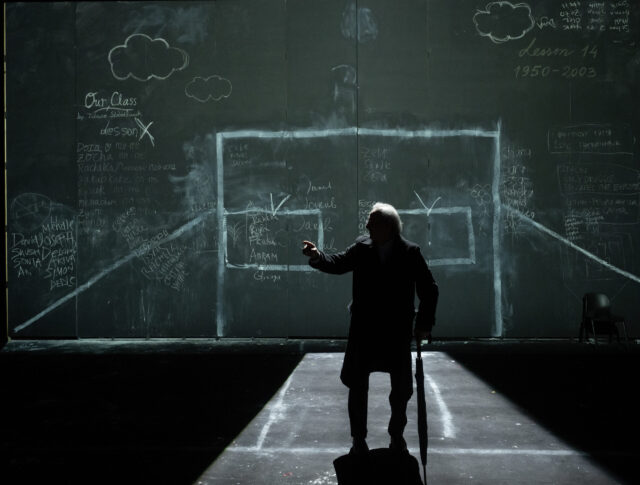
Rich Topol first played Abram Baker in Our Class at BAM this past January (photo by Pavel Antonov)
OUR CLASS / THE MERCHANT OF VENICE
Classic Stage Company, Lynn F. Angelson Theater
136 East Thirteenth St. between Third & Fourth Aves. Our Class: Tuesday – Sunday, September 12 – November 3, $89-$139 The Merchant of Venice: Tuesday – Sunday, November 22 – December 22, $59-$129 www.classicstage.org www.arlekinplayers.com
Earlier this year, Arlekin Players Theatre and MART Foundation’s timely new adaptation of Polish playwright Tadeusz Słobodzianek’s 2008 drama, Our Class, sold out a three-week run at the BAM Fisher as part of the Under the Radar festival. Inspired by actual events that occurred in the small village of Jedwabne, Poland, the three-hour play, directed by the endlessly inventive Igor Golyak, focuses on antisemitism among a group of ten Polish students, five Jewish, five Catholic, all born in 1919–20, from childhood to young adulthood to old age, although several don’t make it through a horrific 1941 pogrom.
In my January 30 review, I wrote, “The cast and crew, who hail from Russia, Ukraine, Poland, Israel, Germany, and the US, are superb. . . . Perhaps the best thing about Our Class is that it doesn’t preach at the audience; it has a message and a point of view but is not teaching us about good and evil.”
The show, which was nominated for Drama League, Outer Critics Circle, and Drama Desk Awards, is back for a return engagement September 12 – November 3 at Classic Stage, with the same cast and crew. One thing that will be at least somewhat different is the staging, as Classic Stage is smaller and more intimate than the Fisher (199 seats vs. 250), and the audience sits on three sides of the action. Arlekin’s residency continues there November 22 – December 22 with the New York debut of its unique and unusual production of Shakespeare’s The most excellent historie of the Merchant of Venice with the exxtreame cruelitie of Shylocke the Jewe, featuring much of the same team as Our Class, including director Golyak and actors Richard Topol, Gus Birney, José Espinosa, Tess Goldwyn, Stephen Ochsner, and Alexandra Silber.
Topol, who has starred as Jewish characters on and off Broadway in such works as Indecent,The Chosen,Awake & Sing,Prayer for the French Republic, and King of the Jews, plays Abram Baker in Our Class, a student who leaves Poland and becomes a rabbi in America. In The Merchant of Venice, he will play Shylock, the Jewish moneylender previously portrayed by Edmund Kean, Edwin Booth, Jacob Adler, Orson Welles, Al Pacino, Laurence Olivier, John Douglas Thompson, Andrew Scott, and many others.
In my January 8 Substack post “‘class consciousness’: we are not safe. again.,” exploring Our Class and antisemitism in relation to Hamas’s brutal attack on Israel on October 7 and the aftermath, Topol explained, “Certainly the violence that is occurring in both Ukraine and Israel/Gaza is impacting my relationship and understanding of the play. And it’s making Our Class a story that feels even more important to tell. Because it’s based on true events that occurred not far from Ukraine. And because it’s about cycles of hate. And the violence that can come from that hate.”
As the company began rehearsals for the Classic Stage transfer, I asked Topol several questions about the two plays and his characters.
twi-ny: What similarities do you see between Abram and Shylock?
rt: Well, for starters, they are both Jews living through perilous times filled with antisemitism. They are both fathers who love their children deeply. They are both connected to their religion fully. And they both face moments where they struggle with how to respond to people who treat them with indignity.
twi-ny: What are their main differences?
rt: I think their main difference is how they respond to being treated with indignity. Shylock seeks revenge. He can’t see straight once he’s been broken. Abram is treated less harshly but he also is a kinder man who tries to come to terms with the world as it is in a way that allows for forgiveness or redemption or understanding. And I think that is because Abram is a rabbi who feels the blessings of his G-d around him, even as he suffers harm. Shylock is a businessman, a moneylender, and though he is connected to his Jewish faith, he isn’t as grounded in its teachings as Abram is. Abram creates this gigantic family, these generations of descendants whom he loves and cherishes. Shylock feels like he’s alone in the world, with only his one daughter as his ally. And once she’s gone he has nobody he can lean on, live for, or help him see straight.
Also, because of Abram’s inherent kindness, he sees the best in people, the hope for the world, the possibilities for the future. Maybe Shylock had some kindness in him somewhere but we certainly don’t see much if any of it during the course of the play. Maybe it was snuffed out when his wife died. But bottom line there is a hardness in Shylock’s soul as opposed to a kind of softness in Abram’s.
twi-ny: How might Abram have fared as the Venetian moneylender in Merchant, and how might Shylock have done as the rabbi in Our Class?
rt: That’s a great question and a fun thing to try to imagine. Abram seems like a pretty smart guy, so maybe he would have figured out how to make a successful go of it as a Venetian moneylender. He’s good with languages, he’s a hard worker, and he has a kind of can-do attitude that would have stood him in good stead. I like his chances.
Shylock as a rabbi . . . hmm . . . I’m thinking no way. At least not the kind of rabbi I’d like to hear at synagogue! He definitely feels strongly about his tribe, his people, his religion. But I don’t see him as having the right temperament to be a leader to his fellow Jews.
twi-ny: What would they think about the state of the world if they were alive today, with the same jobs?
rt: Shylock as a modern-day moneylender — a banker in this world of global capitalism — he might be just fine. I think most of the Jews of this time live with greater freedoms, respect, and opportunity than during Shylock’s time in Venice. He’d certainly recognize the antisemitism of our time, but if he were a banker in Venice now I think he might be thriving and might feel like a true equal to his Christian counterparts.
Abram, well, he was alive not that long ago. But I think he’d be heartbroken to see the rise of antisemitism in this country. My sense of him is of someone who loved and seized on the promise and opportunity of America, symbolized by the Statue of Liberty. An immigrant who was always thankful for the chance to make a new and full life here. And he would be as disturbed by the hate and divisiveness of our time right now as many of us are.
[Mark Rifkin is a Brooklyn-born, Manhattan-based writer and editor; you can follow him on Substack here.]
In January, The Voices in Your Head offered a unique view of grief counseling, taking place at St. Lydia’s Dinner Church in Brooklyn. The sixty-minute play sold out quickly, extending its run and adding seats. It’s now back for a return engagement September 9 – October 11, and some nights are already fully booked. For other nights, there are either $39.72 or $55.20 Pay It Forward tickets available, but not both. Christian Caro, Marcia DeBonis, Tom Mezger, Daphne Overbeck, Erin Treadway, and Jehan O. Young reprise their roles in this Egg & Spoon remount, with Alex Gibson, Jamila Sabares–Klemm, and Molly Samson joining the cast.
Below is my original review of the January 2024 edition of this thoroughly involving and entertaining experience.
————————————
Lately I’ve been thinking more than ever about grief and death. I’m not a support group kinda guy, but when I heard about The Voices in Your Head, I knew I had to go.
I found solace — and nearly nonstop laughter — in Those Guilty Creatures’ immersive, site-specific group therapy black comedy, which continues at St. Lydia’s storefront dinner church in Brooklyn through January 29.
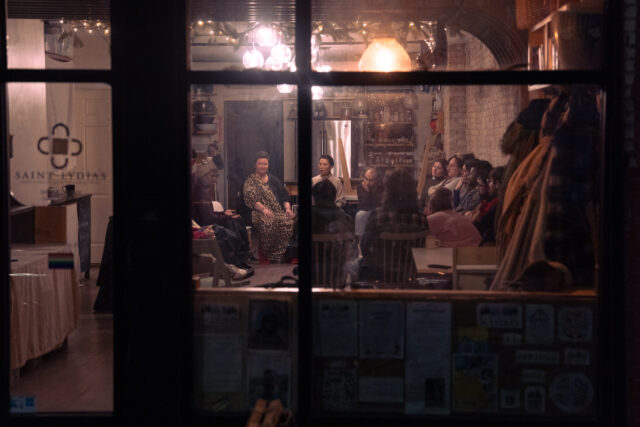
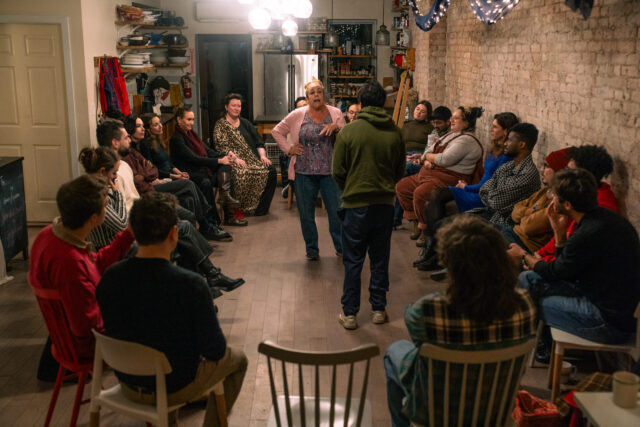
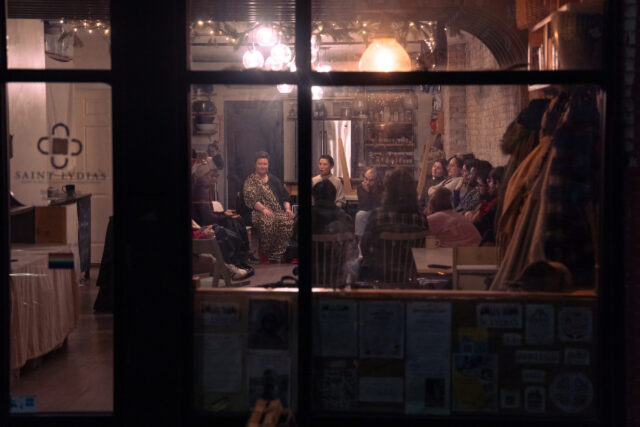
The space has been renamed St. Lidwina’s, after the Dutch patron saint of chronic pain and ice skating. The church has a large front window and door, looking more like a cozy shop than a place of worship. When you arrive, you are asked to check off your name on a sign-in sheet; to protect your anonymity, there are no last names, although people passing by outside can peek in and see you.
In the center of the room are more than two dozen unmatched chairs arranged in a large oval. In the back is a working kitchen where the facilitator, Gwen (Vanessa Kai), greets everyone while making tea and cookies. Several attendees engage in friendly conversation and chitchat. Shortly after Gwen calls the meeting to order, it becomes apparent that a handful of the participants are in the cast.
“It’s funny, when I was at my lowest, I was going to all these different meetings; it felt like dating, trying to find the right match, and they were all so . . . maudlin? I thought, there has to be another way. So, I started this group,” Gwen says. “Evidently, there was a need. So, we’re all here, we’ve met the criteria, but, broadly, I like to think of this as a place to share a sensibility. Laughter comes easier for me in here than out there. Everyone has their own relationship to grief; I’ve been considering mine, but what about anti-grief? We seek that through shared stories, activities, and discussions. . . . We aim to hear three stories each week, which, hopefully, helps us exchange some weird-ass joy.”
The audience becomes immersed in the grief of others in The Voices in Your Head (photo by HanJie Chow)
Sharing their sensibilities are the vivacious and outgoing Regina (Daphne Overbeck); Vivian (Marcia DeBonis), who believes in “Death, Embarrassment, Trauma”; Caleb (Christian Caro), who doesn’t want to be sad in college and can’t stop texting; the ultraserious Sandra (Erin Treadway); and the practical Hadiya (Jehan O. Young), who loves “the morbid stuff.”
They are eventually joined by first-timer Blake (Patrick Foley), who is determined to turn his story of loss into a Netflix special, and Ted (Tom Mezger), who actually attends the church and saw a flier.
Over the course of sixty fun, lively minutes, the group discusses Kelly Clarkson, hot cater waiters, self-care, vacuuming, exfoliating, sand, and other items and issues as they explore their personal misfortunes. A role-playing session that puts some of the group members in specific social situations doesn’t go quite as expected. During a break, the characters gossip, revealing more about who they are.
At the center of it all is the arbitrariness of death and Gwen’s assertion that we should “just approach the nature of the loss with a sense of humor. It helps us hold a certain space.”
The Voices in Your Head takes place in the storefront of a Brooklyn dinner church (photo by HanJie Chow)
The cast is uniformly excellent, led by Kai (The Pain of My Belligerence,KPOP) as the not-necessarily-so-stable Gwen, the always terrific DeBonis (Mary Page Marlowe,Small Mouth Sounds) as the chatty but caring Vivian, Treadway (Spaceman,War Dreamer) as the dour Sandra, Young (Speech,The Johnsons) as the purposeful Hadiya, Overbeck (Typed Out: A Princess Cabaret,Nightgowns) as the wonderfully over-the-top Regina, and Caro making his off-Broadway debut as the inattentive Caleb, but Foley (Circle Jerk,The Seagull/Woodstock, NY) nearly steals the show with his unforgettable Christmas story.
Created by Grier Mathiot and Billy McEntee and gleefully directed by Ryan Dobrin, The Voices in Your Head is as smart as it is hilarious. It’s not so much about how we deal with death than how we deal with life. Everyone reacts differently to tragedy and loss, but, as Gwen points out, “We need to hear each other’s laughter.”
The Voices in Your Head is not interactive — the audience should leave the talking to the actors — but feel free to mingle afterward and share your own thoughts about this engaging and involving experience.
[Mark Rifkin is a Brooklyn-born, Manhattan-based writer and editor; you can follow him on Substack here.]