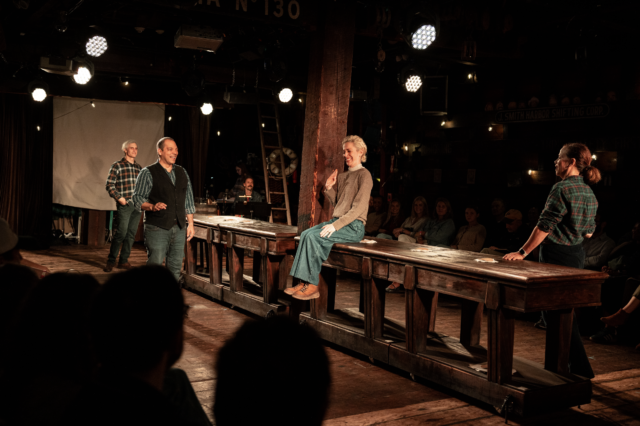
At the beginning of writer Sarah Gancher and director Jared Mezzocchi’s wonderful site-specific play The Wind and the Rain: A story about Sunny’s Bar, actor Paco Tolson asks if anyone is new to Red Hook. The night I was there, only a few hands went up. “You made it! Welcome!” he says.
There was a time not long ago when nearly everyone in the audience would have raised their hands. Red Hook has changed, and the show provides an entertaining and innovative look at that metamorphosis through the slightly warped lens of Sunny’s Bar.
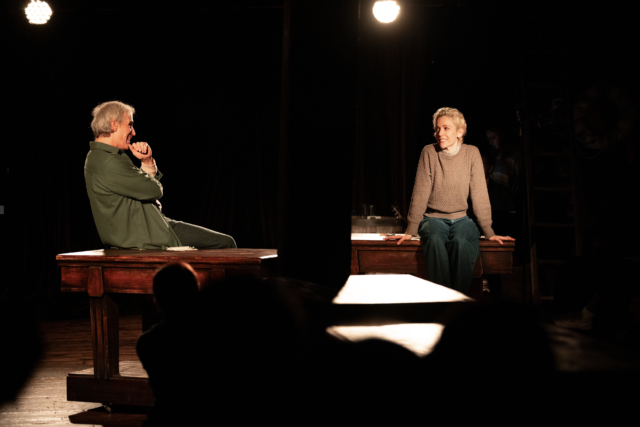
The multimedia production starts on board the historic 1914 Lehigh Valley No. 79 wooden railroad barge, which is docked on Conover St. in Red Hook and houses the Waterfront Museum, which is run by barge owner David Sharps. The audience sits in two rows on three sides of the staging area, where Tolson, Jennifer Regan, Pete Simpson, and Jen Tullock share the history of the neighborhood and, specifically, Sunny’s Bar, which is across the street. Simpson points out early on, “Some of what you see tonight is based on interviews. Some is based on research. Some is fictionalized. Some is totally made up.” He adds, “It’s a big story. It covers hundreds of years and thousands of people. And there’s just four of us, so we do need your help. We need you to be our voices of the past.”
The Wind and the Rain is an immersive, participatory show; members of the audience read text projected on a front screen and the walls, and some are asked to stand up and play a role for a minute or two. Although it’s made clear that no one will be forced to do anything they don’t want to do, the play works best when the audience is fully engaged. (Be sure to be ready when the shoe comes to you.)
Gancher takes us back through desolate periods with wild dogs roaming the grounds, police corruption and protection rackets, gambling and brothels, and Prohibition as well as when Red Hook was a busy port, an English fishing village, a Dutch community, Lenape territory, and part of a massive glacier. “How do you write a story about time?” Regan asks. In this case, they focus on the last hundred years, featuring a wide range of intriguing characters centered around the impact Hurricane Sandy had on the bar and the relationship between Sunny (Simpson) and his partner, Tone Johansen (Tullock), pronounced “tuna.”
Sunny was raised in Red Hook, traveled to India to study with a guru, tried his hand at acting, then became an abstract painter before opening the bar in 1997. Tone was born on a remote Norwegian island, where her family had little and she was not exposed to the outside world. When they discuss their past, flashback scenes introduce us to Sunny’s grandparents Antonio and Angelina Balzano, who bought the bar in 1907, his parents Ralph and Josephine, his brother Frank, his cousin Gina Fazzabini, hipster bartender Francis, Barzano delivery boy Romeo and his brother Dominic, the hardworking Teresa, and others, splendidly portrayed by the four-person cast through quick changes as they shift four rolling tables around. (Marcelo Martínez Garcia’s set also includes family photos hung on the walls; the costumes are by Mika Eubanks, with stark lighting by Amith Chandrashaker, immersive sound by Jane Shaw, and superb video and projections by Paul Deziel.)
Battling family money squabbles, natural disasters, and Sunny’s health issues and wandering eye, Tone does everything she can to keep the bar running against improbable odds.
Sunny (Pete Simpson) and Tone (Jen Tullock) take stock of their lives in multimedia participatory site-specific play (photo by Maria Baranova)
Obie winners Gancher (The Place We Built, The Lucky Ones) and Mezzocchi (On the Beauty of Loss) previously collaborated on Russian Troll Farm: A Workplace Comedy, which was a streaming hit during the pandemic before being performed IRL at the Vineyard, which teamed up with Anne Hamburger’s site-specific specialists En Garde Arts on The Wind and the Rain. Gancher and Mezzocci make terrific use of the dark, intimate space, keeping the strong ensemble — which has an infectious improvisatory feel, like a jazz band — on the move and the audience involved, never getting bogged down in staid exposition.
Obie winner Simpson (Is This a Room,Infinite Life) does an uncanny job capturing the essence of Sunny, a magnetic figure who helped revivify Red Hook. Tullock (On the Head of a Pin,You Shall Inherit the Earth!) is powerful as the serious Tone, an unstoppable force who is on a mission. Regan (Born Yesterday,How I Learned to Drive) and Tolson (Vietgone,The Knight of the Burning Pestle) are excellent switching between multiple roles and addressing the audience directly, breaking the fourth wall regularly.
Throughout the show, an Americana roots band led by multi-instrumentalist Pete Lanctot plays such traditional tunes as “I Saw the Light” and “Where the Soul of Man Never Dies” with a rotating roster of musicians from Sunny’s; the night I attended, Lanctot was joined by Adam Winski on banjo, Sarah Klein on ukulele, and Alex Deane on fiddle.
The two-hour play (plus intermission) concludes with a group walk to Sunny’s Bar, accompanied by further narrative delivered over headphones and spectacular projections, resulting in a grand finale, with VIP ticket holders congregating at outside tables in the back to continue a memorable experience that can only happen in Red Hook.
[Mark Rifkin is a Brooklyn-born, Manhattan-based writer and editor; you can follow him on Substack here.]
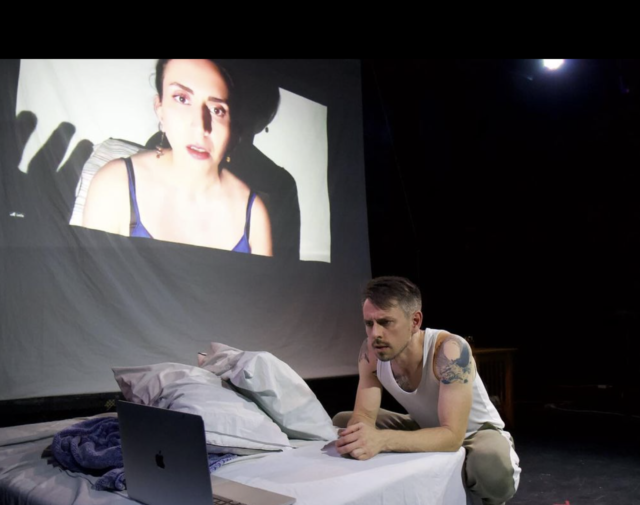
Leila (Deniz Khateri) and Jake (Addy Marsh) try to maintain a long-distance relationship despite Muslim travel ban (photo by Mari Eimas-Dietrich)
SUNSET, ECLIPSED BY SEAGULLS
The Tank
312 West Thirty-Sixth St. between Eighth & Ninth Aves.
Through October 13, $25-$50 (use code TANKFRIEND to save $5) thetanknyc.org
Iranian American actor, writer, and director Deniz Khateri explores a complicated long-distance relationship in Sunset, Eclipsed by Seagulls, a fact-based drama continuing at the Tank through October 13. Codirected by Siobhán Carroll, the eighty-minute play begins shortly before President Donald Trump’s January 2017 Muslim travel ban, Executive Orders 13769 and 13780: Protecting the Nation from Foreign Terrorist Entry into the United States, and concludes in April 2023, when discussions about the US-Iran nuclear deal resume after five years.
Leila (Khateri), who is Iranian, and Jake (Addy Marsh), who is American, meet in Paris and begai a passionate three-month romance, but now she is stuck in her home country while he is in the States. The two thirtysomethings communicate over the internet, commiserating that they cannot be physically together; Marsh is onstage, in Jake’s apartment, carrying his laptop from a desk to the mattress, while Khateri is seen in a large projection on a white sheet on the back wall. The audience of about fifty people sit on three sides of the stage. (The set was designed in consultation with Sadra Tehrani, with moody lighting by Zoe Griffith and sound and music by Bahar Royaee.)
By the time the ban ends and they can be in each other’s arms again, their situations have changed and they have to reevaluate who they are and what they want.
Each scene begins with projected text updating the status of the travel ban and the tenuous relations between Iran and the United States, which Carroll and Khateri try to connect with what is happening between Jake and Leila — but it can be a bit of a stretch as it reaches back to the 1970s — and concludes with poetic dream monologues by Jake accompanied by the sounds of water, from drips to ocean waves, emphasizing the separation between the lovers.
“Let no one know I’m doomed to distance. / I live by the endless ocean. / The sun burns my eyes. / I can smell the seagulls screaming. But I can’t hold them,” he says. “I’m imprisoned by the woods. / I put the woods around me to feel safe, to sleep deeply
in the shade. / Safe from the sun, safe from the seagulls. / But the sun is always there. Even at night. / It calls me from the end of the ocean, a flame . . . finds its way through the woods.”
The play gets bogged down in the second half, when the couple reunites and the characters make questionable choices. The interplay of distant longing followed by present reality recalls how people were apart during the pandemic, forced to meet over Zoom, then sometimes experiencing difficulty readjusting to being out in the world again.
Khateri (Automated Response,We All Used to Be Sane) is lovely as Leila, sexy and self-assured, her big eyes filled with emotion, but Marsh (Mi Abuela, Queen of Nightmares) can’t quite keep up with her as his character becomes more and more unlikable and obtuse and the plot devolves into hard-to-fathom melodrama. But Sunset, Eclipsed by Seagulls has its tender, thoughtful moments as it explores the need for humans to be together, sometimes regardless of the consequences.
[Mark Rifkin is a Brooklyn-born, Manhattan-based writer and editor; you can follow him on Substack here.]
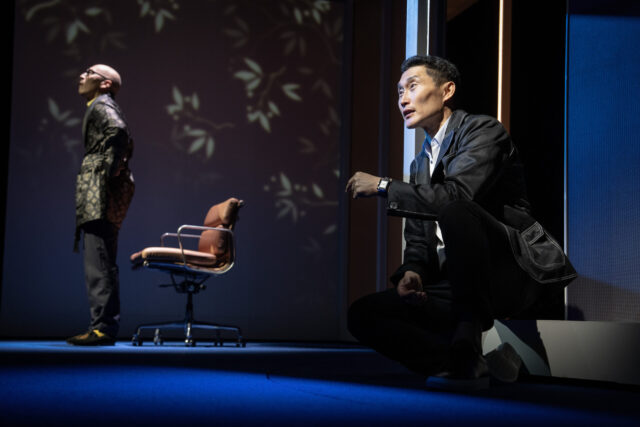
Francis Jue and Daniel Dae Kim play father and son in Yellow Face (photo by Joan Marcus)
YELLOW FACE
Todd Haimes Theatre
227 West Forty-Second St. between Broadway & Eighth Ave.
Tuesday – Sunday through November 24, $70-$348
212-539-8500 www.roundabouttheatre.org
Three recently opened shows on Broadway feature television and movie stars either making their Great White Way debut or returning after a long absence, but, was we learn, success on the big and/or small screen does not always guarantee onstage triumph.
In an April 2021 interview in Vulture, actor and anti-Asian-hate activist Daniel Dae Kim said, “I take a great deal of pride in being Korean American. I know that not every representation is 100 percent something we can stand behind all the time, but I choose to look at things as whether they’re moving the needle of progress on a larger scale.” Talking about his and Grace Park’s departure from the successful Hawaii Five-O reboot in 2017 after the seventh season following a contract dispute — the two Asian Americans wanted equal pay with their Caucasian costars — Kim explained, “I had hopes that Hawaii Five-0 would be different because it was a show set in Hawaii, where the majority of people are not white. I thought it was going to be more of an ensemble show, and if you look at the early marketing and promotion for the show, where Grace Park and I were featured equally as prominently as anyone else, it led me to believe that it could be. I was proven to be wrong.”
In the article, he also discusses initially wanting to cast an Asian lead in the American version of the Korean television drama The Good Doctor, which his 3AD company produced, but eventually agreeing with showrunner David Shore and hiring white English actor Freddie Highmore.
Kim, who was born in South Korea, is now back on Broadway in the Great White Way debut of David Henry Hwang’s semiautobiographical 2007 Obie-winning Pulitzer finalist, Yellow Face, at the Todd Haimes Theatre through November 24. Kim plays a version of Hwang, known as DHH, a first-generation Chinese American playwright and activist who gets involved in a series of casting controversies. DHH makes a public stand against producer Cameron Mackintosh’s insistence on casting English actor Jonathan Pryce as a French-Vietnamese pimp known as the Engineer, altering his eyes and skin color to make him look more Asian; Pryce went on to win a Tony for his performance.
DHH, who won a Tony for his 1988 play, M. Butterfly, decides to write about “yellow face” in his next play, Face Value, choosing unknown actor Marcus G. Dahlman (Ryan Eggold) as the lead, believing he is at least part Asian. But when it turns out that the renamed Marcus Gee probably has no Asian blood in him at all, DHH convinces the actor that he must have had a Siberian Jewish ancestor, and things go haywire from there.
Yellow Face is told in flashback, with DHH often directly addressing the audience, guiding the tale while freely admitting the many mistakes he made. It starts with various public figures commenting on the Marcus Gee situation.
“Wow. That is one of the strangest stories I’ve ever heard,” Vice President Al Gore (Marinda Anderson) says.
“David Henry Hwang is a white racist asshole,” playwright Frank Chin (Kevin Del Aguila) declares.
“This is a tempest in an Oriental teapot,” Mackintosh (Shannon Tyo) insists.
DHH (Daniel Dae Kim) and Marcus Gee (Ryan Eggold) have different ideas of ethnic representation at Todd Haimes Theatre (photo by Joan Marcus)
Among the other real-life famous and not-so-famous people chiming in at one point or another are casting director Vinnie Liff, author Gish Jen, theater critics Frank Rich and Michael Riedel, New York City mayor Ed Koch, columnist George F. Will, talk show host Dick Cavett, Taiwanese American computer scientist Wen Ho Lee, actors B. D. Wong, Mark Linn-Baker, Lily Tomlin, Gina Torres, Jane Krakowski, and Margaret Cho, politicians Fred Thompson, Sam Brownback, Tom Delay, and Richard Shelby, and theater luminaries Bernard Jacobs, Joe Papp, and Jerry Zaks, all played by Anderson, Del Aguila, Tyo, and Francis Jue; Jue also portrays DHH’s father, HYH, an immigrant immensely proud of his success in the financial sector but whose bank finds itself in a bit of hot water with a congressional committee as the opening of Face Value approaches.
Kim is most well known for playing Jin-Soo Kwon on the seven seasons of Lost and Chin Ho Kelly for seven years on the Hawaii Five-O reboot; he has also appeared onstage in New York City, Los Angeles, and London since 1991, including Romeo and Juliet,A Doll’s House,The Tempest,The King and I, and Hwang’s Golden Child. He is amiable and confident as DHH, instantly gaining the audience’s faith as he balances the sublime and the ridiculous with acute self-awareness and self-deprecation; he’s particularly strong as DHH digs himself into a deeper and deeper hole. His casting in and of itself is fascinating; there’s been a recent movement for people of Asian descent not to be called “Asian” but to be identified by the specific country they or their ancestors come from; in this case, the South Korean Kim is playing the Chinese American Hwang.
Eggold (Dead End,All My Sons) is hilarious as Marcus, a regional actor who can’t believe how his stature has changed once he agreed to pretend to be Asian, getting hooked on the hoopla. Keller (Dig,Shhhh) excels as the announcer and a reporter identified as “Name withheld on advice of counsel,” Jue, who originated the role of HYH at the Public and played an alternate version of DHH in Hwang’s autobiographical soft power, is gleeful as the father, and Tyo (The Comeuppance,The Chinese Lady), del Aguila (Some Like It Hot,Frozen), and Anderson (Merry Me,Sandblasted) shift seamlessly from role to role.
Arnulfo Maldonado’s changing sets and Yee Eun Nam’s projections keep the audience fully engaged under the smooth-flowing direction of Leigh Silverman, who helmed the original production of Yellow Face as well as Hwang’s Chinglish,Kung Fu, and Golden Child, her familiarity with the material delivering a fun experience while making its important points.
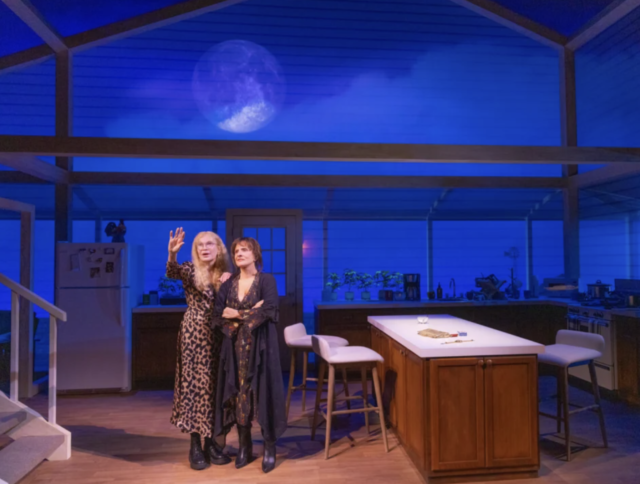
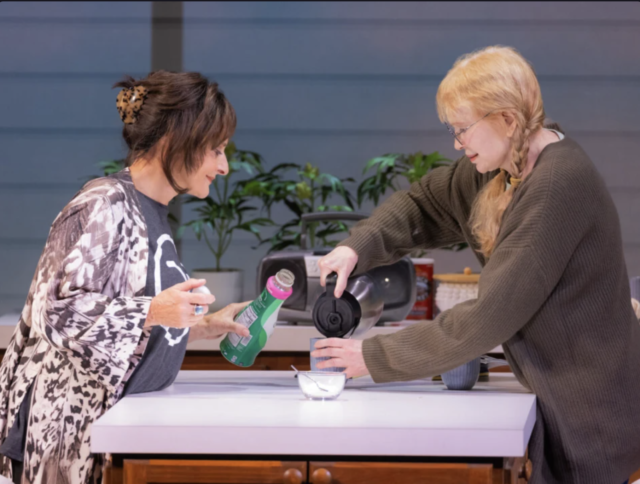
Mia Farrow and Patti LuPone return to Broadway in Jen Silverman’s The Roommate (photo by Matthew Murphy)
THE ROOMMATE
Booth Theatre
222 West 45th St. between Broadway & Eighth Ave.
Tuesday – Sunday through December 15, $48 – $321 theroommatebway.com
The Broadway premiere of Jen Silverman’s 2015 play, The Roommate, dooms itself from the very start. Longtime friends Mia Farrow and Patti LuPone take the stage together, their names projected across the top of the set, and they bask in the uproarious applause of the audience. They exit, then return seconds later in character. While the laudatory moment removes the need for applause at the beginning of the actual narrative, it also makes sure we never forget we are watching a pair of superstar performers, even though the success of the play — any play — depends on our believing in the fiction that is about to unfold before us.
Two years ago, LuPone, who has won two Grammys and three Tonys, announced she was retiring from the Great White Way because of Actors’ Equity’s lack of support of its union members, writing on Twitter, “Quite a week on Broadway, seeing my name being bandied about. Gave up my Equity card; no longer part of that circus. Figure it out.” She later told People magazine, “I just didn’t want to give them any more money. . . . And I don’t know when I’m going to be back on stage.”
Meanwhile, Farrow, who has never been nominated for an Oscar or Tony, last appeared on Broadway in 2014 in Love Letters, sitting at a table with Brian Dennehy and reading A. R. Gurney’s epistolary play. Here only other Broadway appearance was costarring with Anthony Perkins in Bernard Slade’s 1980 Romantic Comedy. (She made her off-Broadway debut as Cecily Cardew in The Importance of Being Earnest in 1963.)
So there was a lot of buzz surrounding LuPone and Farrow teaming up at the Booth Theatre for a play about an odd couple living together in rural Iowa. Unfortunately, they lack any kind of chemistry, and three-time Tony-winning director Jack O’Brien (Shucked,The Invention of Love) can’t get around Jen Silverman’s inconsequential, clichéd script.
Farrow is Sharon, a divorced mother from Illinois who has made a peaceful life for herself in a large home in Iowa City. She likes things as they are, simple, without complications, but she seeks out a roommate, both for financial reasons and, perhaps, friendship.
LuPone is Robyn, a divorced mother from the Bronx who is ready for a major change. She is not exactly what Sharon expected: a tough-talking vegan lesbian whose black leather provides a sharp contrast to Sharon’s loose-fitting sun dresses. (The costumes are by Bob Crowley, who also designed the set, a skeletal house with a kitchen and a small staircase leading up.)
After learning these facts about Robyn, Sharon declares, “I mean. A roommate! I’ve never had a roommate. I’m sixty-five years old. A roommate!”
While there is no reason an actor can’t play well above or below their age, the line gets a curious stare from the audience, who know Farrow cannot be sixty-five. (In actuality, Farrow is seventy-nine and LuPone is seventy-five). In a script note, Silverman suggests, “In terms of age, you should feel free to adjust the character’s age to fit the actor.” Because the production made such a big deal of Farrow and LuPone’s star power when they first took the stage, the number sticks out as false.
Robyn (Patti LuPone) and Sharon (Mia Farrow) form an odd couple in The Roommate (photo by Matthew Murphy)
As the play continues, we learn more about both women, their prejudices, their pasts, and their futures. Each is dealing with not being on the closest of terms with their children. While Robyn knows about what’s going on around the world, Sharon seems to be happily stuck in an old-fashioned bubble straight out of a Norman Rockwell painting, oblivious to what is happening right outside her door, although that changes as she grows more and more intrigued with what she at least initially considers Robyn’s vices.
The Roommate is in part a riff on The Odd Couple, with Sharon a fuddy-duddy like Felix Ungar, Robyn a more coarse figure like Oscar Madison. (At the 2017 Williamstown Theater Festival, S. Epatha Merkerson was Sharon, and Jane Kaczmarek was Robyn.)
But the effects they have on each other are difficult to believe, not fully formed. Silverman (Collective Rage: A Play in 5 Betties,Spain) might have a lot to say about human vulnerability and morality and female friendship, but she goes too far off the rails in the play’s slow-moving ninety minutes.
Farrow is lovely as Sharon, every line delivered with a touch of wonder, going especially high and squeaky when something Robyn reveals surprises her. She handles Sharon’s absurd shifts in right and wrong with aplomb, just going with the flow, but LuPone (Company,Shows for Days) looks like she’d rather be just about anywhere else, as if she knows she made a mistake choosing this play as her return to the stage. Hopefully Farrow and LuPone will join forces again, only next time in a better piece of theater.
“There’s a great liberty in being bad,” Robyn tells Sharon, who repeats the line later on.
It’s a catchy phrase that never comes to fruition in The Roommate.
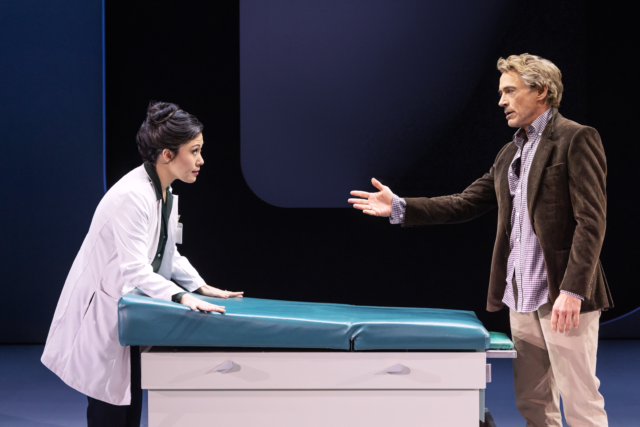
Jacob McNeal (Robert Downey Jr.) gets good and bad news from his doctor (Ruthie Ann Miles) in McNeal (photo by Matthew Murphy and Evan Zimmerman)
McNEAL
Vivian Beaumont Theater at Lincoln Center Theater
150 West 65th St. between Broadway & Amsterdam Ave.
Tuesday – Saturday through November 24, $195.50-$371
212-362-7600 www.lct.org
The night before I saw Ayad Akhtar’s McNeal at the Vivian Beaumont Theater at Lincoln Center, I watched Dario Argento’s 1982 giallo cult classic, Tenebrae, starring Tony and Oscar nominee and New York City native Anthony Franciosa as Peter Neal, a popular American novelist on a book tour in Italy, accompanied by his agent, Bullmer (John Saxon), and his assistant, Anne (Daria Nicolodi). One critical scene involves Neal sitting down for a television interview with superfan Christiano Berti (John Steiner). Fact and fiction start weaving in and out of the plot as violent scenes from his books come to life in a series of murders.
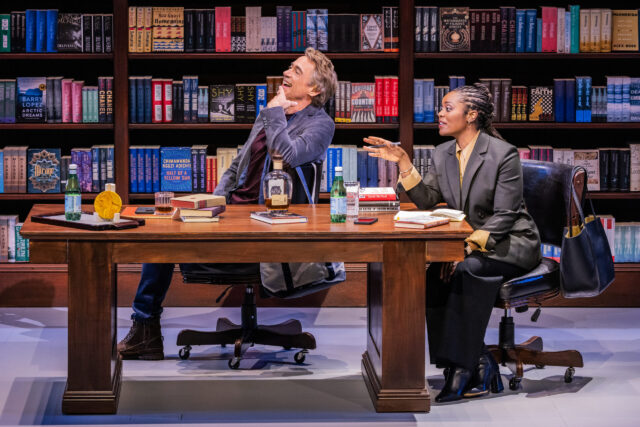
In McNeal, Oscar and Emmy winner and New York City native Robert Downey Jr. is the title character, Jacob McNeal, a popular American novelist who, while being examined by his doctor, Sahra Grewal (Ruthie Ann Miles), gets notified that he has won the Nobel Prize in Literature, an award he feels he deserved many years ago. His agent, Stephie Banic (Andrea Martin), immediately contacts his publisher to negotiate a new contract, and the Times finally agrees to do a front-page magazine profile of him, sending over New York Times journalist Natasha Brathwaite (Brittany Bellizeare), who is not planning on doing a puff piece. “Were you a diversity hire?” he asks her, kicking off an awkward interview. McNeal flirts with using AI for his Nobel acceptance speech, but soon he is counting on AI for much more as fact and fiction intermingle.
I prefer Tenebrae.
Jacob McNeal (Robert Downey Jr.) says way too much in interview with journalist Natasha Brathwaite (Brittany Bellizeare) (photo by Matthew Murphy and Evan Zimmerman)
In his Broadway debut, Downey, who first acted on the stage in Alms for the Middle Class in Rochester in 1983, delivers a solid performance as the self-destructive McNeal, who has a serious kidney issue but can’t stop going back to the bottle. (Downey himself has had problems with drugs and alcohol and has been drug-free for more than twenty years.) He looks completely comfortable in McNeal’s skin, playing a character who is adorable and unlikable at the same time, as it’s difficult to dismiss his misogyny as just exemplary of the way things used to be. The sets by Michael Yeargan and Jake Barton rise and lower from above and below as Barton’s projections beam out visual stimuli, from texts and close-ups to the spewing of words and letters.
In such previous works as Junk,The Invisible Hand,Corruption, and the Pulitzer Prize–winning Disgraced, Akhtar has proved to be a master of complex plots, tackling such issues as politics, race, religion, the financial industry, capitalism, and personal ambition. In McNeal, however, he takes on too much, straying from the central focus on the future of AI and its impact on literature and humanity itself to include scenes that feel like they’re from another play; even director Bartlett Sher (The King and I,Oslo), who has been nominated for eight Tonys and won one, is unable to weave together subplots involving McNeal’s son, Harlan (Rafi Gavron), with its bizarre revelation; McNeal’s flirtations with Banic’s assistant, Dipti (Saisha Talwar), and fondness for Harvey Weinstein, as his agent’s actions confound believability; his liberal use of the lives of his friends and relatives in his plots; and his relationship with journalist Francine Blake (Melora Hardin).
The 105-minute show does have a magical finale, but it’s not enough to save it. Near the end, a typing prompt acknowledges that the audience is “confused by what is real and what isn’t.”
There was no such problem in Tenebrae.
[Mark Rifkin is a Brooklyn-born, Manhattan-based writer and editor; you can follow him on Substack here.]
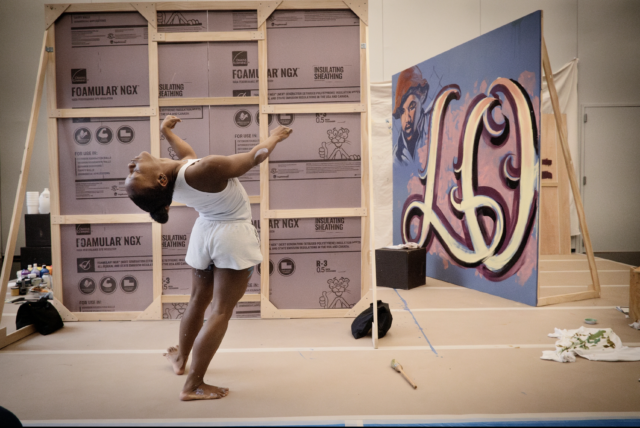
Imani Gaudin and Jakob Vitale will premiere site-specific work October 3 in Bella Abzug Park
jakob & imani
Bella Abzug Park, Hudson Yards
Enter between West Thirty-Fourth & Thirty-Fifth Sts. along Hudson Blvd. East
Thursday, October 3, free, noon-3:00 and 4:00-7:00
646-731-3200 baryshnikovarts.org
Baryshnikov Arts takes it outside with the world premiere of jakob & imani, a site-specific piece conceived by choreographer Imani Gaudin and visual artist Jakob Vitale for Bella Abzug Park at Hudson Yards. Commissioned with the Hudson Yards Hell’s Kitchen Alliance, the durational work explores the symbiotic relationship between graffiti and dance. It will be performed by Gaudin, Vitale, and Marcus Sarjeant, with a set by Gaudin, Vitale, and Louis James Woodworks and photography by Sinematic Studios; Gaudin and Vitale, both graduates of Purchase, also created the sound score and the costumes.
Gaudin, who was born and raised in New Orleans and is artistic director of the Brooklyn-based Gaudanse Inc., seeks “to create a collaborative space for all artists alike while exploring what it means to delve deep into how movement languages bring forth new ideas and translates into what we call dance.” The company has presented such previous pieces as nanibu,二時二分(2:02), and mamihlapinatapai. The Bronx-born Vitale, who is based in New York and Los Angeles, states that “art can reach in any direction, but in its most basic form it can either steer an observer into fantastical distractions or it can build off of life and evoke a thought/reaction to the prevalence of the real. . . . It comes down to the viewer to determine the significance of the art and evoking its effectiveness towards making the world fair and peaceful.”
Admission to jakob & imani, which takes place October 3 from noon to seven with a one-hour break at three, is free. Baryshnikov Arts’ fall season continues with such other programs as Oliver Tompkins Ray’s Woolgathering, featuring Patti Smith, with choreography by John Heginbotham; PRISMA’s Origins, with ARKAI and SPIDERHORSE; and the Charles Overton Group in a salon-style concert.
[Mark Rifkin is a Brooklyn-born, Manhattan-based writer and editor; you can follow him on Substack here.]
Meredith Monk’s Indra’s Net at Park Ave. Armory is a multimedia marvel (photo by Stephanie Berger)
INDRA’S NET
Park Avenue Armory, Wade Thompson Drill Hall
643 Park Ave. at 67th St.
Through October 6, $45-$185
212-933-5812 www.armoryonpark.org
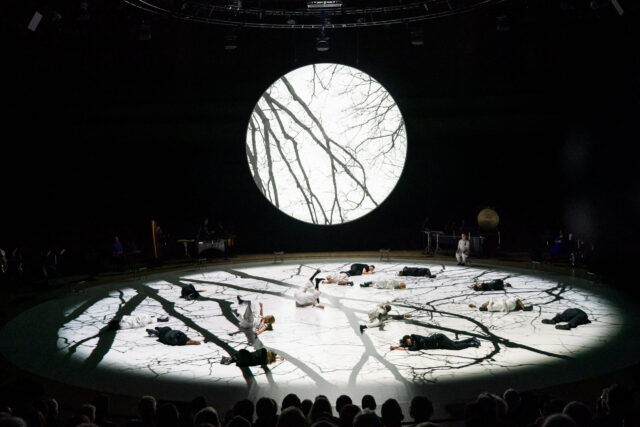
Meredith Monk, the grand doyenne of experimental music, theater, film, and dance, completes her trilogy exploring the interconnectedness of humanity and the natural environment and the universe with the gorgeous Indra’s Net, making its North American premiere at Park Ave. Armory through October 6. The eighty-one-year-old MacArthur Fellow and National Medal of Arts honoree began the three-part work with 2013’s On Behalf of Nature, followed by 2017’s Cellular Songs. Conceived for the armory’s massive Wade Thompson Drill Hall, The piece starts with a preamble; as the audience enters the space, they are greeted by “Rotation Shrine,” projections of Monk and members of her vocal ensemble in silhouette, their bodies floating across the screen. Meanwhile, four dancers to the right and four to the left pose in spotlights as droning music plays.
The audience is then seated in rafters around a large circle on the floor with eight small chairs lined horizontally in a row; at the east end of the hall is a moonlike flat screen hovering above the performance space, facing the audience, its curved upper limit mimicking the arched ceiling. The eight dancers (Tomas Cruz, Jodi Gilbert, Toussaint Jeanlouis, Anaïs Maviel, Luisa Muhr, Paul Pinto, Sarah Rossy, Chanan Ben Simon), known as the mirror chorus, take seats on cushions along the outer edge of the circle, then Monk and the vocal ensemble (Paul Chwe MinChul An, Theo Bleckmann, Gideon Crevoshay, Allison Easter, Ellen Fisher, Katie Geissinger, music supervisor Allison Sniffin) sit on the chairs. They move their arms and legs in synchronized motion to begin the piece as the sixteen-piece orchestra, eight on each side and dressed in shades of blue, perform the lovely score, led by Fifi Zhango on piano, Laura Sherman on harp, Ethan Cohn on double bass, Michael Raia on clarinet, and Karl Ronneburg and John Hollenbeck on percussion.
It’s no mere coincidence that the cast is made up of groups of eight, a number that, in various mathematical, religious, mystical, and numerological meanings, represents regeneration, prosperity, and the search for balance between the spiritual and material worlds.
Soon the vocal ensemble is wandering the stage, breaking off into duets and trios as if they are having conversations, although no actual words are spoken, instead creating their own language. Occasionally, a live overhead camera projects the movement on the screen, providing breathtaking visuals. At one point, the vocal ensemble, in all white, and the mirror chorus, in all black, interact as projections of tree branches evoking arteries appear on the floor and screen, interweaving humans with nature. The costumes and set are by Yoshio Yabara, with whispery, echoing immersive sound by Daniel Neumann, evocative, sometimes spooky lighting by Joe Levasseur, mesmerizing cinematography by Ben Stechschulte, and engaging projections by Jorge Morales Picó.
Meredith Monk completes eleven-year trilogy with dazzling Indra’s Net (photo by Stephanie Berger)
In the program, Monk explains that the title of the eighty-minute piece, Indra’s Net, comes from an “ancient Buddhist/Hindu legend [in which] an enlightened king, Indra, stretches an immense, boundless net across the universe with an infinitely faceted jewel at every intersection. Each jewel is unique yet reflects all the others, illuminating the principle of interdependence among all living things.”
Metaphorically, the net and jewels refer to the interdependence between the performers and the audience, celebrating each individual, but on the way out after the show it morphs into a poetic reality as the audience encounters “Offering Shrine,” a video of sixteen people, including many of the vocalists and dancers, opening their hands to reveal such objects as a baseball, keys, a toy car, Scrabble letters, and animal sculptures, representations of which are arranged on a long table below the screen. It’s a compelling way to pay tribute to the little things that, together, help shape an existence that encircles us all.
[Mark Rifkin is a Brooklyn-born, Manhattan-based writer and editor; you can follow him on Substack here.]
Table 17 goes back and forth in time as a couple looks at their past, present, and future (photo by Daniel J. Vasquez)
TABLE 17
Susan & Ronald Frankel Theater
Robert W. Wilson MCC Theater Space
511 West Fifty-Second St. between Tenth & Eleventh Aves.
Through September 29, $60-$150 mcctheater.org
Writer Douglas Lyons and director Zhailon Levingston have followed up their sweet and savory 2021 Broadway debut, Chicken & Biscuits, with another culinary collaboration, MCC Theater’s Table 17, although this one is more appetizer and dessert, skipping the main course.
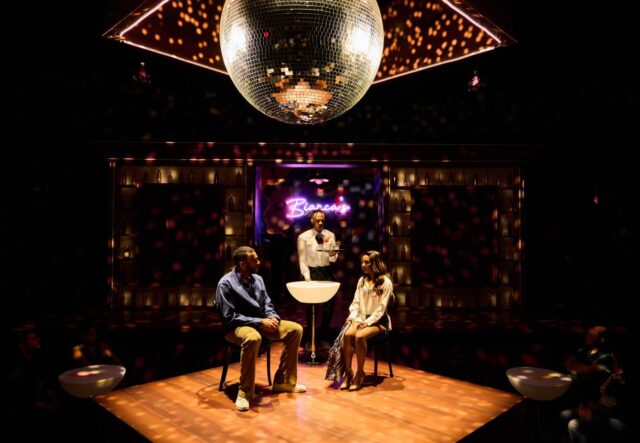
The eighty-five-minute play was inspired by Lyons’s admiration of Black rom-coms, including Love & Basketball,How Stella Got Her Groove Back,Poetic Justice, and Love Jones; posters of various films line the hallway lobby. Each audience member gets a pseudo menu for a restaurant called Bianca’s, which has information about the show and “Today’s Special,” a message from Lyons that asks everyone to “unbutton your top button, the pants too, and let yourself be. When the characters ask you for advice, don’t be shy, talk to ’em.”
Jason Sherwood’s set features sixteen glowing white tables surrounding a round platform where another table sits under a disco ball; at the back of the stage is a long wall with compartments that can open, changing from windows to plush cushions to bars with glasses and bottles, with embedded LED and neon lighting by Ben Stanton.
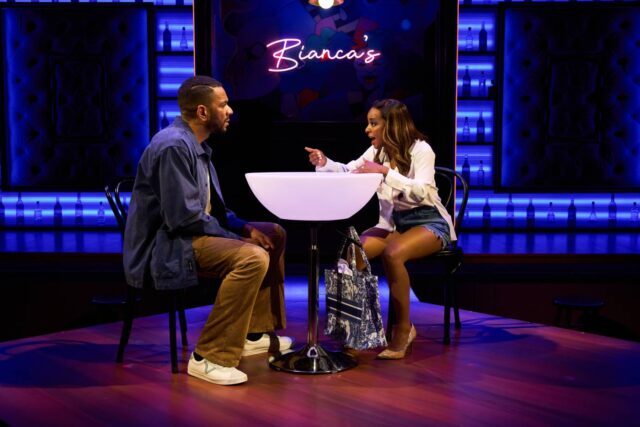
The incomparable Kara Young, who has been nominated for three Tonys in successive years, 2022, 2023, and 2024, as Best Featured Actress for Clyde’s,Cost of Living, and Purlie Victorious: A Non-Confederate Romp Through the Cotton Patch, winning for the last one, stars as Jada Cory, a frantically harried young woman who enters to Chaka Khan’s “I’m Every Woman” and asks the audience whether she should change her outfit as she gets ready to meet her ex-fiancé for the first time in two years. “Him calling outta the blue caught me off guard,” she explains. “But, I know Dallas. His pride would not allow him to reach out to me unless he missed me. And I mean, why wouldn’t he?”
Playwright, filmmaker, and actor Biko Eisen-Martin (soft,3rd and Palou) is Dallas Thompson, a would-be smooth operator who thinks he looks great in corduroy and enters to Usher’s “Nice & Slow.” “Do I miss her? I can’t say I don’t,” he says. “But, if I was saying I did, I’d wanna know she missed me first, before I admitted it. Though, this ain’t me admittin’ it — so, chill out.”
Dallas Thompson (Biko Eisen-Martin) and Jada Cory (Kara Young) rehash old times in MCC world premiere (photo by Daniel J. Vasquez)
And Michael Rishawn, who originated roles in Handjob and Ain’t No Mo’, takes on multiple roles, from snarky restaurant host River Wilks to a cocky bartender who brags about his success with women to Eric, a flight attendant colleague of Jada’s.
As Jada and Dallas play a kind of cat-and-mouse game in the present over whether they are still attracted to each other, the narrative is interrupted by flashbacks to their meet cute, blossoming romance, and eventual breakup. It’s also interrupted by River, who has to be their server as well that evening, offering such pearls of wisdom as “Life sucks, don’t it?” and, when Jada asks him to recommend a dish, “No, I work here. I don’t eat here.”
Young is a delight to watch, even when she goes over the top; she is a master of physical comedy and hilarious facial expressions. Eisen-Martin is steadfast as Dallas, who thinks he’s a lot more cool, calm, and collected than he really is. And Rishawn is a barrel of energy switching among his parts, although he too often takes things too far, the comic relief becoming too absurd.
Like so many rom-coms, Table 17 is light fare that goes down easy, a tasty eighty-five-minute morsel that doesn’t have a lot of meat on its bones but is still yummy.
[Mark Rifkin is a Brooklyn-born, Manhattan-based writer and editor; you can follow him on Substack here.]
Ivan (Mark Eydelshteyn) and Ani (Mikey Madison) set off on a frenetic romance in Anora
MAIN SLATE: ANORA (Sean Baker, 2024)
Film at Lincoln Center
Saturday, September 28, 6:15
Sunday, September 29, noon www.filmlinc.org
The sixty-second edition of the New York Film Festival is under way, and the first standout is Sean Baker’s Anora.
Winner of the Palme d’Or at Cannes, Anora is a nonstop wild ride through the frenetic, unpredictable relationship between a stripper and the scion of a Russian oligarch. It starts out luridly but quickly morphs into a touching and surprisingly human tale.
Mikey Madison, who starred in the 2022 Scream sequel, shows off her mighty pipes in the film, making a career breakthrough as Ani, a stripper living in a Brighton Beach railroad apartment who catches the eye of Ivan Zakharov (Mark Eydelshteyn), who buys her for a week, lighting up the nights in a cavalcade of sex and drugs while developing what appears to be turning into a real relationship. But when his parents, Nikolai (Aleksei Serebryakov) and Galina (Darya Ekamasova), find out about it, they sic their guard dogs, Igor (Yura Borisov), Toros (Karren Karagulian), and Garnick (Vache Tovmasyan), on them, leading to hilariously violent scenes as Ani sets out to prove that she is not a hooker and is not ashamed of being a sex worker.
Written, edited, and directed by Baker, whose previous work includes Take Out,Tangerine,The Florida Project, and Red Rocket,Anora is an aggressive, in-your-face trip that races from Coney Island to Las Vegas, with lush cinematography by Drew Daniels, a pulsating score by Matthew Hearon-Smith, and fanciful costumes by Jocelyn Pierce.
Madison, a regular on Better Things and Lady in the Lake, is fearless as Ani, a determined young woman who knows what she wants and is not afraid to say it out loud and fight for it. The coda is disappointing — it would have been much better if the film ended before the final moments in the car — but otherwise Anora is a thrilling cinematic experience.
Anora is screening September 28 and 29, with Baker and Madison on hand for Q&As. The ferocious film will then return to Lincoln Center for a theatrical run in mid-October, with Baker and Madison participating in Q&As October 16 and 18. Keep watching this space for more reviews from NYFF62.
Iris (Isabelle Huppert) takes notes while teaching Isong (Kim Seungyun) French in Hong Sangsoo’s A Traveler’s Needs
MAIN SLATE: A TRAVELER’S NEEDS (Hong Sangsoo, 2024)
Film at Lincoln Center
Wednesday, October 2, 9:00
Thursday, October 3, 6:15 www.filmlinc.org
Longtime New York Film Festival favorite Hong Sangsoo returns to Lincoln Center with two touching works for NYFF62. For nearly thirty years, the South Korean Hong has been making contemplative, character-driven films in which writers or directors develop different kinds of relationships with actors, fans, students, and other admirers amid a lot of drinking, eating, and smoking as they discuss art, love, human nature, and film itself.
In such gems asOki’s Movie,The Day He Arrives,Yourself and Yours,Like You Know It All, and Right Now, Wrong Then, Hong constructs slow-paced, intriguing philosophical narratives in which not much necessarily happens but nearly every minute is imbued with meaning.
In A Traveler’s Needs, Isabelle Huppert, in her third Hong film (following 2012’s In Another Country and 2017’s Claire’s Camera), stars as Iris, a mysterious Frenchwoman who seems to just appear and disappear; we know almost nothing about her or why she is in Seoul.
When we first encounter her, she is teaching French to a young pianist, Isong (Kim Seungyun), asking her questions using index cards and an old cassette recorder that looks almost like a toy. We soon find out that Iris is not a trained teacher but someone who only recently developed her unique method, which involves asking her students how they feel deep inside, and that she has no idea if it will actually work.
Iris, who dresses like she is on vacation, wearing a flowery dress, green sweater, and wide-brimmed hat, next visits Wonju (Lee Hyeyoung) and her husband, Haesoon (Kwon Haehyo), to teach them French. Wonju is suspicious of Iris and her technique, but as they partake of more of the milky rice wine known as makgeolli, everyone loosens up a bit.
Later, Iris returns home, to an apartment she shares with Inguk (Ha Seongguk), a younger man who is not quite ready to introduce her to his mother, Yeonhee (Cho Yunhee), although the relationship between Inguk and Iris is unclear.
So how does A Traveler’s Needs make you feel? Like many of Hong’s films, it’s a calm tale featuring lots of conversation and long takes, highlighted by another superb performance by Huppert. It might be best exemplified by a scene in which Iris approaches a tiny river, takes off her shoes, steps into the water, looks around while humming, and drops one of her shoes. It’s hard to tell if it was supposed to happen, but Huppert lets out an adorable sigh, picks it up, shakes it out, and carries on.
Hong also incorporates an oddly endearing repetition in the film, in dialogue, character traits, and Iris’s movement, particularly how she walks when she exits a scene. She practically floats in and out of her world, innocent and carefree, like a child. Hong’s camera loves her — he wrote, directed, photographed, produced, and edited the film in addition to composing the score — and so will you.
A Traveler’s Needs is screening October 2 at 9:00 and October 3 at 6:15, with Huppert participating in Q&As after each show; she will also return to Lincoln Center November 21 for a Q&A when the film opens at the Walter Reade Theater.
Jeonim (Kim Minhee) and her uncle, Chu Sieon (Kwon Haehyo), reunite at a university in By the Stream
MAIN SLATE: BY THE STREAM (Hong Sangsoo, 2024)
Film at Lincoln Center
Friday, October 4, 9:00
Friday, October 11, 6:45 www.filmlinc.org
“I’ll light the smallest lamp in the corner and protect it until I die,” a college student tells Chu Sieon (Kwon Haehyo) when he asks four young women what they want to do in the future in Hong Sangsoo’s By the Stream. It’s a subtle admission in a subtle film filled with small lamps in corners, literally and figuratively.
Hong wrote, edited, produced, directed, photographed, and composed the score for the film, another intimate, eloquent drama about people just going about their daily lives, eating, drinking, and talking about creativity and love. It takes place on a lovely campus at a woman’s university in Seoul, where it’s time for the annual skit contest, when the various departments put on ten-minute shows. Art professor Jeonim (Kim Minhee) is in a jam when the director in charge of the script for her department has been kicked out after sleeping with three of the students.
Jeonim makes a desperate call to her uncle, Chu, a onetime popular actor who was canceled for unstated reasons and has been running a small bookstore on a remote lake for decades. Niece and uncle have not spoken for ten years, but Sieon accepts the offer, returning to the school where he got his start forty years before. While the four art students are not exactly psyched about the script he has written for them, the head of the department, Jeong (Cho Yunhee), is instantly smitten with him, an adoring fan who wants to spend more and more time with him — and he doesn’t seem to mind all the attention.
With skit night approaching, Jeonim, Sieon, and Jeong do a lot of eating, talking, and drinking, enjoying eel and the milk rice wine known as makgeolli, as relationships grow more complicated and characters reexamine who they are and what they want.
By the Stream is Hong’s thirty-second film since his debut, 1996’s The Day a Pig Fell into the Well. It’s also the thirteenth Hong film Kim has starred in; they began an affair in 2015 — they are both separated from their spouses, with whom they have children, which caused a scandal in South Korea — and Kim, an award-winning international star, has not worked for another director since Park Chan-wook’s 2016 The Handmaiden. Hong is twenty-two years older than Kim; Kwon is seventeen years older than Cho. That is not to imply that By the Stream is autobiographical, but it appears to have personal elements that add intrigue to the gentle magic of the storytelling and characterization.
Kim won the Best Performance award at Locarno for her role as Jeonim, who spends much of her time drawing the ripples in a stream, the water ever changing and constantly moving, like life. She then re-creates the patterns on her loom, finding solace in making art. Chu is reenergized by his decision to direct the skit, interacting with people as he hasn’t since isolating himself at his bookstore. And Jeong shows a different side of herself as she becomes a fan girl forming a connection with the object of her affection.
Hong often leaves his camera fixed as the action unfolds, particularly when the three protagonists are at tables, eating, drinking, and talking, composing a kind of flowing, ever-changing portrait. Water has been a leitmotif throughout Hong’s career; several of his films have the words water,river,beach, and stream in them, and in others, water plays a part, like the beautiful scene in A Traveler’s Needs when Iris (Isabelle Huppert) steps into a small stream.
As in so many of Hong’s works, By the Stream proceeds at its own hypnotic pace, offering profound if understated treatises on the little things in life, like that small lamp in the corner.
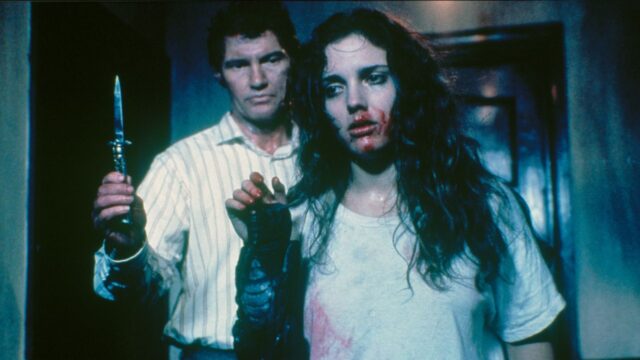
Larry Cotton (Andrew Robinson) and his daughter, Kirsty (Ashley Laurence), have their hands full in Hellraiser
REVIVALS: HELLRAISER (Clive Barker, 1987)
Saturday, October 5, 9:15
Wednesday, October 9, 1:00 www.filmlinc.org
“What’s your pleasure?” an unseen character asks at the beginning and end of Clive Barker’s Hellraiser, now screening at NYFF62 in a 4K restoration. Adapted from his novella The Hellbound Heart, the horror film made quite a splash when it was released in 1987, and its legacy as a genre classic has only grown over the years, despite, not because of, nine sequels, none of which Barker wrote or directed. The film faced bans and censorship, so Barker had to make some concessions, editing certain ultraviolent and S&M scenes, but there are still plenty in there to justify its cult status.
“We did a version which had some spanking in it and the MPAA was not very appreciative of that,” Barker said in the DVD audio commentary. “[They also] told me I was allowed two consecutive buttock thrusts from Frank but a third would be deemed obscene.”
The film begins with Frank Cotton (Sean Chapman) in Morocco acquiring a puzzle box and, upon solving it in his suburban American home, getting sent to a hell realm where pain mixes with pleasure, a decadent take on the hot nightclub scene of the 1980s. Years later, Frank’s brother, Larry (Andrew Robinson), returns to the family homestead with his second wife, Julia (Clare Higgins), who unbeknownst to him had a torrid affair with Frank. Larry’s daughter, Kirsty (Ashley Laurence), shows up to provide support, but it’s instantly clear that she and Julia are not besties.
When Larry severely cuts his hand while helping the creepy movers bring a bed upstairs, the blood oozes into the floorboards and awakens Frank, who is a skinless terrifying creature (portrayed by Oliver Smith). Frank reveals to Julia, who still has the hots for him, that he can regain his skin and they can have a life together if she feeds him other human beings, so she hits the bars, bringing men home to be devoured by her lover. Larry is completely oblivious to what is going on right under his nose, but Kirsty grows suspicious, leading to an appropriately blood-soaked, out-of-this-world climax.
Hellraiser is most remembered and revered for the Cenobites, ghoulish S&M characters known as the Chatterer (Nicholas Vince), Butterball (Simon Bamford), the unnamed female (Grace Kirby), and their leader, Pinhead (Doug Bradley), who became a breakout star. The general plot is derivative and the acting has a heavy dose of soap opera attitude, but Barker pushes it all beyond the limits of standard genre fare, toying with cliché so you won’t always know what’s coming. Christopher Young’s score, Michael Buchanan’s production design, Jocelyn James’s art direction, and Aileen Seaton’s hair stylings capture the ’80s sensibility and look better than ever in the restoration, as do the special effects and intense makeup and costumes.
All in all, this version of Hellraiser provides the answer to the question “What’s your pleasure?”
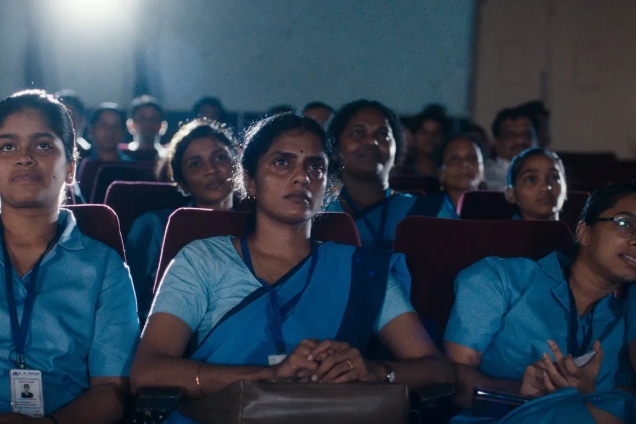
Prabha (Kani Kusruti) takes a new look at her life in All We Imagine as Light
MAIN SLATE: ALL WE IMAGINE AS LIGHT (Payal Kapadia, 2024)
Film at Lincoln Center
Monday, October 7, 6:00
Tuesday, October 8, 9:15
Free talk Wednesday, October 9, 4:00
Thursday, October 10, 3:30 www.filmlinc.org
Indian filmmaker Payal Kapadia won the Golden Eye at Cannes in 2021 for best documentary for A Night of Knowing Nothing, a film that mixes fact and fiction while telling the story of two lovers trying to stay connected via letters amid student protests in India. Kapadia mixes fact and fiction again in her follow-up, the tender and deeply poignant All We Imagine as Light, which won the Grand Prix at Cannes earlier this year.
The new work opens with gritty shots of the streets of Mumbai, as unseen people share their difficulties trying to make a new life for themselves after migrating from the country. “There’s always the feeling I’ll have to leave,” one person says. Another opines, “The city takes time away from you.” A third argues, “Why would anyone want to move back?”
Kapadia, who was born in Mumbai, then shifts to the fictional tale of two nurses and a third hospital employee fighting loneliness as they care for sick people. Prabha (a heart-wrenching Kani Kusruti) and the younger Anu (Divya Prabha) live together in an apartment in the city. Prabha, who is in an arranged marriage, has not seen her husband, who is working in Germany, for more than a year. Anu, whose family is Hindi, is in love with a Muslim man, Shiaz (Hridhu Haroon), keeping their relationship secret for fear of being discovered and shunned. And Parvaty (Chhaya Kadam) is a recent widow who is being evicted from her home of twenty-two years because her name is nowhere on the paperwork left behind by her husband.
When Prabha receives a brand-new German rice cooker in the mail, she assumes it is from her spouse, perhaps a message that he is not coming back and that she should proceed with her life. But she is tentative to start dating, even as she is pursued by the goofy but sweet Dr. Manoj (Azees Nedumangad), who writes poetry for her.
The three women decide to hit the road, taking a trip to Parvaty’s seaside Maharashtrian hometown, where they take stock of their lives, particularly after a man washes up onshore.
All We Imagine as Light is sensitively shot by cinematographer Ranabir Das, with a soft, jazzy score by Topshe as soft rain falls, trains pass by in the background, and Prabha and Parvaty throw stones at a billboard for a pending skyscraper that proclaims, “CLASS is a privilege reserved for the PRIVILEGED.”
All We Imagine as Light is an engaging and touchingly lyrical look at womanhood in contemporary Mumbai, as the city threatens three women with potential isolation and alienation until they bind together. The youngest, Anu, instills new energy into the others to reevaluate their situations and take action. “Do you ever think of the future?” Anu asks.
The film appropriately provides no firm answers in the end, but it is clear that Kapadia’s future is a bright one.
All We Imagine as Light is screening at NYFF62 on October 7, 8, and 10, with the writer-director participating in Q&As following the first two showings. She will also be at the Amphitheater at the Elinor Bunin Munroe Film Center on October 9 at 4:00 for a free talk with Portuguese director Miguel Gomes, whose Grand Tour is screening October 8, 9, and 11 at the festival.
[Mark Rifkin is a Brooklyn-born, Manhattan-based writer and editor; you can follow him on Substack here.]