twi-ny recommended events

2015 NYC FOOD FILM FEST

AMC Empire 25
234 West 42nd St. between Seventh & Eighth Aves.
October 22-25, $49-$125
thefoodfilmfestival.com

Food and film go together like, well, dinner and a movie. The annual Food Film Fest takes it to the next level, showing films about food, accompanied by special talks and tastings. The 2015 event features more than two dozen short works, including several New York City, U.S., and world premieres. Among the tasty morsels are Nina Ha’s rap music parody Baby Got Kale, Barbara Zonzin’s Choco Thriller, Barbara Tranter’s Happy Goats Happy Cheese, Derek Klingenberg’s Serenading the Cattle with My Trombone, and Natasha Subramaniam and Alisa Lapidus’s animated fridge fight, Zergut. The festival takes place at the AMC Empire in Times Square, beginning October 22 ($89 / VIP $114) with “Tender: Stories of Love and Meat, which pairs four films with Texas BBQ from Kreuz Market, Kent Black of Black’s Barbecue, and Scott Morales of Taylor Café, pork tacos by Tortilleria Nixtamal, sliders from Schnipper’s, and potent potables from Iron Station, Black Rooster, and NY Distilling Co. October 23 ($99 / VIP $124) is the ever-popular “Food Porn Party,” with nine films, an appearance by Larry Caldwell, a VIP party by Public, ramen by Yosuke Sumida with Keizo Shimamoto, a vegetarian treat from Dirt Candy’s Amanda Cohen, and sweets from Archichef and Top Pot Donuts. On October 24 at noon (kids $23, adults $32, family packages $100-$125), “Eat Your Movies!” is a family event with six children’s films, food by Night Kitchen inspired by the films, treats from Fishing Creak Creamery and Robicelli’s, and kid-friendly food activities. On Saturday night ($99 / VIP $129), “Edible Adventure #13: Hungry for Love” consists of five films, a VIP party by David Burke Kitchen, food from Uncle Boons, Manna’s, chef Karl Palma, and Liddabit Sweets, and a matcha tea tasting. The culinary festivities conclude on October 25 at noon ($49) with “Restaurant Revival: Jodie’s Diner (1985-2014),” a screening of James Boo’s Nothing with Something: The Death of a Diner, with brunch prepared by Jodie Royston of Jodie’s Restaurant, the Albany, California, favorite that closed last year but is looking for a new home. Part of the proceeds from the festival benefit the Billion Oyster Project.

HELEN LAWRENCE

(photo by David Cooper)

Stan Douglas’s HELEN LAWRENCE is quite a visual spectacle at BAM (photo by David Cooper)

BAM NEXT WAVE FESTIVAL
BAM Howard Gilman Opera House
30 Lafayette Ave. between Ashland Pl. & St. Felix St.
October 14-17, $24-$95, 7:30
718-636-4100
www.bam.org

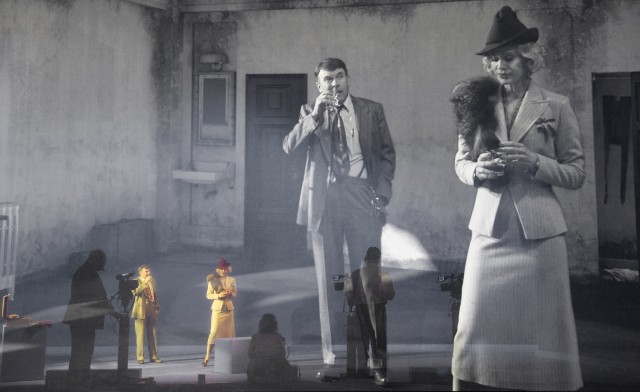
Canadian visual artist Stan Douglas creates quite a spectacle with his multimedia theatrical presentation Helen Lawrence, but after the initial wonder wears off, he’s not able to fully exploit the cutting-edge technology, some of which was invented specifically for this show, to illuminate writer Chris Haddock’s noir narrative. The Vancouver native sets the tale in his hometown shortly after World War II, as femme fatale Helen Lawrence (Lisa Ryder) arrives, having emerged from a psych ward ready to seek vengeance for a wrong done her. She gets caught up in a world of corrupt cops (Ryan Hollyman, Greg Ellwand), a clever bookie (Nicholas Lea), a creepy hotel owner (Hrothgar Mathews), a hooker looking to get out of seedy Hogan’s Alley (Emily Piggford), a tomboy hotel clerk always looking for the inside scoop (Haley McGee), and a pair of very different men battling for control of the neighborhood (Allan Louis and Sterling Jarvis). The actors perform in front of a blue screen and behind a large translucent scrim that covers the entire stage; several camera operators move around filming them live, with the results projected onto the scrim, accompanied by John Gzowski’s noir score. The characters wear colorful clothing courtesy of costume designer Nancy Bryant — no, they are not by British fashion designer Helen Lawrence — with Lawrence’s yellow outfit particularly eye-catching, but their onscreen versions are seen in black-and-white. And although the actors walk on a primarily empty stage, 3-D imaging places them on street corners and in hotel rooms as they appear to interact with objects that are not really there. It’s a fantastic effect, especially set in a noir world, a kind of live cinema that takes the audience behind the scenes as the action plays out, a separation between color and black-and-white that brings together the past, present, and future of cinematic storytelling, but it fails to delve any deeper over the course of its ninety minutes. While the beginning is ridiculously cool, it starts to feel like a lost opportunity as more of the same continues. Such multimedia works as Reid Farrington’s Tyson vs. Ali, The Return, and Gin & “It,” Tina Landau’s Old Hats (which is returning to the Signature Theatre in January), and Josie Rourke’s The Machine have been able to make more effective use of technology in relation to the narrative. The Canadian Stage production of Helen Lawrence is still quite a sight, but it’s hard not to wonder what more could have been done with it.

THE ASSASSIN

THE ASSASSIN

Shu Qi is an expertly trained killer with a conscience in Hou Hsiao-hsien’s gorgeous period drama THE ASSASSIN

THE ASSASSIN (刺客聶隱娘) (NIE YINNIANG) (Hou Hsiao-hsien, 2015)
Film Society of Lincoln Center, Walter Reade Theater, 165 Werst 65th St., 212-875-5050
IFC Center, 323 Sixth Avenue at West Third St., 212-924-7771
Opens Friday, October 16
wellgousa.com

Taiwanese master Hou Hsiao-hsien’s first film in eight years is a visually sumptuous feast, perhaps the most beautifully poetic wuxia film ever made. Inspired by a chuanqi story by Pei Xing, The Assassin is set during the ninth-century Tang dynasty, on the brink of war between Weibo and the Royal Court. Exiled from her home since she was ten, Nie Yinniang (Hou muse Shu Qi) has returned thirteen years later, now an expert assassin, trained by the nun (Fang-Yi Sheu) who raised her to be a cold-blooded killer out for revenge. After being unable to execute a hit out of sympathy for her target’s child, Yinniang is ordered to kill Tian Ji’an (Chang Chen), her cousin and the man to whom she was betrothed as a young girl, as a lesson to teach her not to let personal passions rule her. But don’t worry about the plot, which is far from clear and at times impossible to follow. Instead, glory in Hou’s virtuosity as a filmmaker; he was named Best Director at Cannes for The Assassin, a meditative journey through a fantastical medieval world. Hou and cinematographer Mark Lee Ping-Bing craft each frame like it’s a classical Chinese painting, a work of art unto itself. The camera moves slowly, if at all, as the story plays out in long shots, in both time and space, with very few close-ups and no quick cuts, even during the martial arts fights in which Yinniang displays her awesome skills. Hou often lingers on her face, which shows no outward emotion, although her soul is in turmoil. Hou evokes Andrei Tarkovsky, Akira Kurosawa, Ang Lee, and Zhang Yimou as he takes the viewer from spectacular mountains and river valleys to lush interiors (the stunning sets and gorgeous costumes, bathed in red, black, and gold, are by Hwarng Wern-ying), with silk curtains, bamboo and birch trees, columns, and other elements often in the foreground, along with mist, fog, and smoke, occasionally obscuring the proceedings, lending a surreal quality to Hou’s innate realism.

There are long passages of silence or with only quiet, barely audible music by composer Lim Giong, with very little dialogue, as rituals are performed, baths are prepared, and a bit of black magic takes place. The opening scenes, set around a breathtaking mountain abbey in Inner Mongolia, are shot in black-and-white with no soundtrack, like a silent film, harkening to cinema’s past as well as Yinniang’s; when it switches over to color, fiery reds take over as the credits begin. Throughout the film, the nun wears white and the assassin wears black, in stark contrast to the others’ exquisitely colorful attire; however, the film is not about good and evil but something in between. Shu and Cheng, who played a trio of lovers in Hou’s Three Times, seem to be barely acting in The Assassin, immersing themselves in their characters; Hou (The Puppetmaster, Flowers of Shanghai) gives all of his cast, professional and nonprofessional alike, a tremendous amount of freedom, and it results here in scenes that feel real despite our knowing better. Sure, a touch more plot explication would have been nice, but that was not what Hou was after; he wanted to create a mood, an atmosphere, to transport the actors and the audience to another time and place, and he has done that marvelously. The Assassin is a treasure chest of memorable moments that rewards multiple viewings. I’ve already watched it twice and can’t wait to see it again — and I’ve given up trying to figure out exactly what it’s about, instead reveling in its immense, contemplative beauty. Hou’s previous full-length film was 2007’s Flight of the Red Balloon; here’s hoping it’s not another eight years till his next one.

FOOL FOR LOVE

(photo © 2015 Joan Marcus)

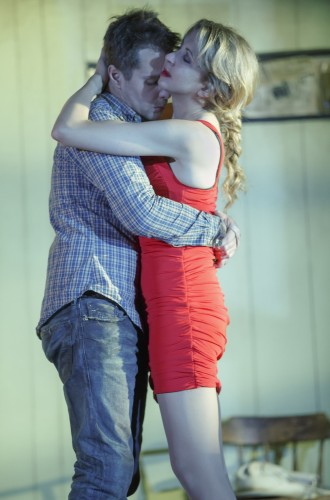
Eddie (Sam Rockwell) and May (Nina Arianda) are lovers with quite a past in FOOL FOR LOVE (photo © 2015 Joan Marcus)

Manhattan Theatre Club at the Samuel J. Friedman Theatre
261 West 47th St. between Broadway & Eighth Aves.
Tuesday – Sunday through December 13, $75-$150
foolforlovebroadway.com
www.manhattantheatreclub.com

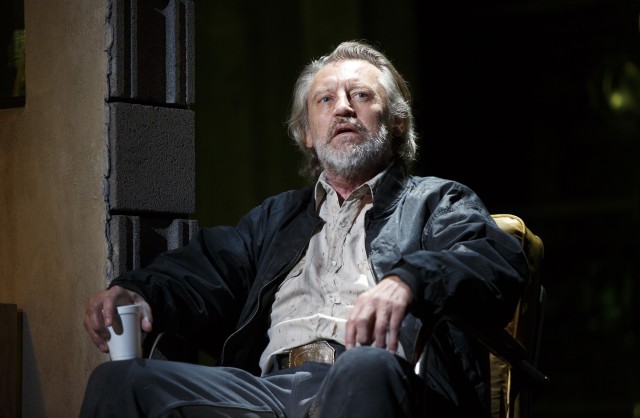
In the published script for Fool for Love, Sam Shepard explains, “This play is to be performed relentlessly, without a break.” And as with many of Shepard’s plays, it is indeed relentless. In a seedy motel room on the edge of the Mojave Desert, Eddie (Sam Rockwell), a former rodeo cowboy, reclines in a shaky chair against the back wall, while May (Nina Arianda), a tall blonde, is hunched statue-like on the end of the bed, her face covered by her long hair, looking toward the ground. At the front of the stage near the corner, an older man (Gordon Joseph Weiss) sits back in a sturdy chair, hands grasping the armrests like the slick hipster from the Maxell commercials. The Old Man and May remain stock-still as Eddie begins talking and makes his way over to May, showing a slight limp. “I’m not goin’ anywhere. See? I’m right here. I’m not gone,” he tells her, and she eventually reaches out and grabs his leg, holding on for dear life. That sequence sets the stage for this seventy-five-minute one-act play about two people who both attract and repel each other, for reasons that become more clear with a surprise revelation about halfway through. May and Eddie have known each other since high school, and they have been on-and-off lovers ever since. “You’re just guilty. Gutless and guilty,” she says shortly before promising to kill both Eddie and the Countess, a woman he might be seeing. “I’m gonna torture her first, though. Not you. I’m just gonna let you have it. Probably in the midst of a kiss. Right when you think everything’s been healed up. Right in the moment when you’re sure you’ve got me buffaloed. That’s when you’ll die.” The ever-confident Eddie is sure that May will ultimately choose to come away with him, despite May’s claims that she has started a new life, dating a normal man, Martin (Tom Pelphrey). Every once in a while, the Old Man chimes in briefly, like a Greek chorus all by himself. “I wanna show you somethin’. Somethin’ real, okay? Somethin’ actual,” he says to Eddie, referring to a nonexistent picture on the wall. A moment later, after the Old Man has settled back in his chair, once again soundless and immobile, May tells Eddie how much she can’t stand him. “No matter how much I’d like not to hate you, I hate you even more. It grows. I can’t even see you now. All I can see is a picture of you. You and her.” We only see what we want to see, remember what we want to remember, mixing fiction and reality in our memories, much like theater itself. For Eddie and May, there’s one thing they can never forget. “You know we’re connected, May,” Eddie says. “We’ll always be connected. That was decided a long time ago.” To Shepard, destiny is a bitch.
(photo © 2015 Joan Marcus)

The Old Man (Gordon Joseph Weiss) is a Greek chorus unto himself in Broadway debut of Sam Shepard’s Pulitzer-nominated FOOL FOR LOVE (photo © 2015 Joan Marcus)

Nominated for a Pulitzer Prize, Fool for Love is part of the series of plays, including the Family Trilogy, that Shepard wrote between 1978 and 1985, consisting of Curse of the Starving Class, Pulitzer winner Buried Child, Pulitzer nominee True West, and A Lie of the Mind. Partly inspired by his relationship with Jessica Lange, Fool for Love is a treat for actors; previous versions have featured such Eddie-May pairings as Ed Harris and Kathy Baker, Ian Charleson and Julie Walters, Martin Henderson and Juliette Lewis, Bruce Willis and Denise Simone, and, in the 1985 Robert Altman film, Shepard and Kim Basinger (with Harry Dean Stanton as the Old Man and Randy Quaid as Martin). The original 1983 production was directed by Shepard, who includes extremely specific stage cues in his script. For the play’s Broadway debut, Daniel Aukin (Bad Jews, 4,000 Miles) takes the reins. Tony winner Arianda (Venus in Fur, Born Yesterday) and Rockwell (A Behanding in Spokane, Moon) have a fiery energy together, but their back-and-forth rapport gets repetitive, and you can feel the hands of Shepard (and Aukin) manipulating your emotions too much, especially when Rockwell puts his lasso to interesting use, bringing a little S&M into the proceedings. The story bounces between the physical and the metaphysical, occasionally getting caught within both at the same time. Pelphrey (Guiding Light, As the World Turns) plays Martin with just the right amount of cluelessness, and Weiss is terrifically perverse as the Old Man; while the rest of the action is going on, you can’t help but cast glances over at him sitting in the darkness. Shepard is a man’s man, and Fool for Love is very much a masculine tale; May might get in her digs, but Eddie is really calling the shots as he cleans his rifle and swigs tequila straight from the bottle. Love ain’t easy, and destiny is a bitch, Shepard is telling us. Damn straight.

TICKET ALERT: AN EVENING WITH JOEL SHAPIRO

Sculptor Joel Shapiro will be at the National Academy on November 4 to discuss the evolution of his work

Sculptor Joel Shapiro will be at the National Academy on November 4 to discuss the evolution of his work

Who: Joel Shapiro
What: An Evening with Joel Shapiro
Where: Assembly Hall, National Academy Museum & School, 1083 Fifth Ave. at 5 East 89th St., 212-369-4880
When: Wednesday, November 4, free with advance RSVP, 6:00
Why: National Academician and sculptor supreme Joel Shapiro will be at the National Academy on November 4, discussing the evolution of his extensive and impressive career, “focusing on the development of form, its possible meaning, and the relationship between sculpture and drawing to the plane.” The New York native is represented in the current “On the Square Part II” group show at Pace on East Fifty-Seventh St., and his work can also be found in museums, galleries, lobbies, and public spaces around the world, including the Sony Building at 550 Madison Ave. “I was always interested in art, but I didn’t pursue it. I mean, I had this sort of idea that I was supposed to become a physician,” Shapiro told Lewis Kachur in a 1988 interview for the Archives of American Art Oral History Program. “It was tough to come to the realization that in fact what I really was good at, and what interested me, and what satisfied me, was doing art work. That came much later.” (Oral history interview with Joel Shapiro, 1988 July 15 – December 14, Archives of American Art, Smithsonian Institution.) The talk will be followed by a reception in the Sonia Gechtoff Gallery.

THE GIN GAME

(photo by Joan Marcus)

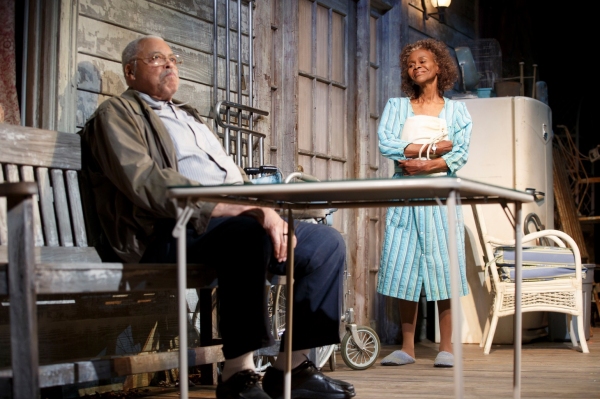
James Earl Jones and Cicely Tyson reunite onstage in lovely Broadway revival of THE GIN GAME (photo by Joan Marcus)

Golden Theatre
252 West 45th St. between Broadway & Eighth Ave.
Tuesday – Sunday through January 10, $57 – $141
thegingamebroadway.com

Life is like a game of cards in D. L. Coburn’s Pulitzer Prize-winning The Gin Game, back at its original Broadway home, the Golden Theatre, in a lovely revival starring James Earl Jones and Cicely Tyson. But it’s also a whole lot more complicated than that. Weller Martin (Jones) and Fonsia Dorsey (Tyson) have both recently moved into a nursing home to live out their final years. “Is there something wrong with you — if you don’t mind my asking,” Fonsia says. “Oh my, I should say so,” Weller replies. “I have one of the most advanced cases of old age in the history of medical science. The mortality rate’s incredible.” Over numerous games of gin on the ramshackle back porch, Weller, who fancies himself a card sharp, and Fonsia, who claims to not have played in a long time, slowly and carefully reveal details about their lives and their families, none of whom come to visit them. They are two old, lonely people brought together by circumstance; as they play gin, the other residents are inside, taking advantage of more of what the nursing home has to offer. “I don’t understand all this ‘entertainment,’” Weller says. “I’m talking about this constant need to entertain us. Sometimes I get the idea that they feel like if they don’t have a choir up there, or if they don’t have a goddamn magician up there doing tricks or something, then we’re all going to drop dead right in front of their eyes. En masse.” Weller is a big, blustery man whose cynicism and deep-seated anger seep into his card playing, especially when he continues losing games to the God-fearing, slim, and demure Fonsia, who doesn’t take kindly to his language. “You know, I never heard my father say a curse word in his life,” she explains, to which Weller responds, “Obviously you never played gin with him.”

(photo by Joan Marcus)

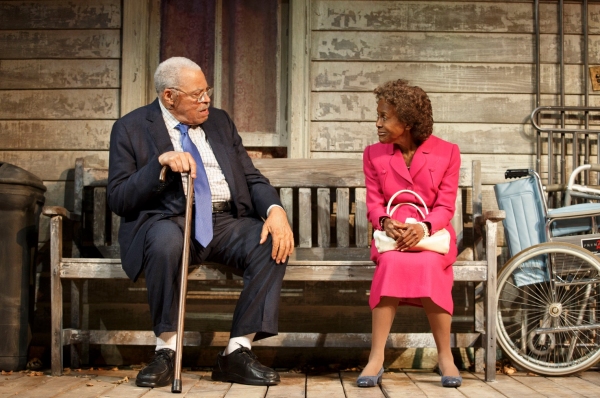
Weller Martin (James Earl Jones) and Fonsia Dorsey (Cicely Tyson) play cards as a metaphor for life in THE GIN GAME (photo by Joan Marcus)

Coburn’s first play, The Gin Game sums up the whole of two people’s lives in clever, if at times sentimental and overly metaphorical, ways, while avoiding any easy, pat answers. At one point, Weller is not willing to accept that Fonsia’s success is just beginner’s luck. “I didn’t realize there was that much strategy to it,” she says. “There most certainly is. Anyone who tells you that gin is nothing but luck doesn’t know what the game is all about,” he says, referring to life as well. Riccardo Hernandez’s set is littered with broken-down sinks and refrigerators, old walkers and wheelchairs, but Weller and Fonsia are not ready for the garbage heap quite yet. Director Leonard Foglia (On Golden Pond, Master Class) sure-handedly makes a play that is mostly made up of games of cards mesmerizing and exciting, letting his stars do their stuff. (To see the cheat sheet Coburn created so the performers can keep track of the games, go here.) The two actors, who first worked together on Broadway nearly fifty years ago, in Roscoe Lee Browne’s 1966 show A Hand Is on the Gate, are sensational. The eighty-four-year-old Jones (You Can’t Take It with You, Gore Vidal’s The Best Man), who has won two Tonys, three Emmys, a Grammy, and a lifetime achievement Oscar, adds a complex sadness to Weller’s pomposity, his deep, mellifluous voice raising and lowering like a choreographed dance, while the ninety-year-old Tyson (The Trip to Bountiful, Sounder), who has won a Tony and three Emmys along with an Oscar nomination, is utterly charming and delightful as Fonsia, who turns out to be much stronger than she first appears. Both characters, despite their age, do some growing up during the course of the two-hour play, which has been previously performed by such pairs as Hume Cronyn and Jessica Tandy, E. G. Marshall and Maureen Stapleton, and Charles Durning and Julie Harris and won Tonys in 1977 for Best Play and in 1997 for Best Revival. (There is also a 2003 television adaptation starring Dick Van Dyke and Mary Tyler Moore.) The night I saw the show, both Jones and Tyson each had a moment when they accidentally dropped something. As they bent down to pick the items up, you could feel a tension build in the audience, wondering whether the actors would be able to do so without a problem. We should have had no such fears; it appears that there’s almost nothing this dynamic duo can’t accomplish.

HANNA LIDEN: EVERYTHING

(photo by twi-ny/mdr)

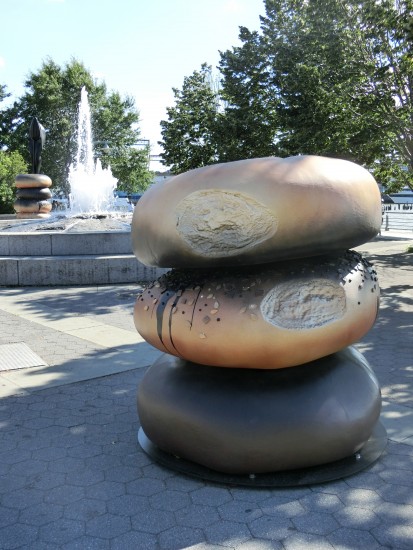
Hanna Liden’s bagel sculptures pay tribute to a New York City icon (photo by twi-ny/mdr)

Hudson River Park at Christopher St.
Through October 20
www.artproductionfund.org
everything slideshow

In The Joys of Yiddish, Leo Rosten wrote, “If you have never tasted a bagel, I feel sorry for you.” I understand that completely. I spent countless Sunday mornings as a child going out with my father to pick up lox, whitefish, sable, cream cheese, and a bag of hot, steaming bagels, their aroma lofting through the car as we drove back home, where the rest of the family awaited our arrival with great anticipation. Swedish-born, New York City-based artist Hanna Liden pays tribute to the bagel and her adopted home with the sculptural installation “Everything,” which continues in Hudson River Park through October 20. (The bagels in Ruth Wittenberg Plaza were taken down September 30.) Liden’s bagels are much bigger and harder than the standard hand-rolled, water-boiled doughy delights, which date back to early-seventeenth-century Poland, but that doesn’t make them any less visually appetizing. Carved out of styrofoam and then covered with polyurethane, the bagels are stacked three, four, and five high, except for one that sits alone under a tree, making a unique kind of bench. Some have black and brown areas where they have been toasted — “a romantic tribute to the darkness and grime, which are essential and beautiful characteristics of our city,” Liden notes — and some have poppy or sesame seeds. One of the stacks forms a giant vase, with a tulip sticking out of the top, as Liden, who has previously made vases out of such objects as a takeaway coffee cup, a boot, and a Yankees helmet, has fun with the homophone “flour-flower” while also evoking the work of Claes Oldenburg. To Liden, the bagel also represents the “eternal cycle of city life” and is something that is uniquely New York; bagels don’t taste the same anywhere else in the world.