twi-ny recommended events

CONSEQUENCES: ALPHAVILLE

ALPHAVILLE

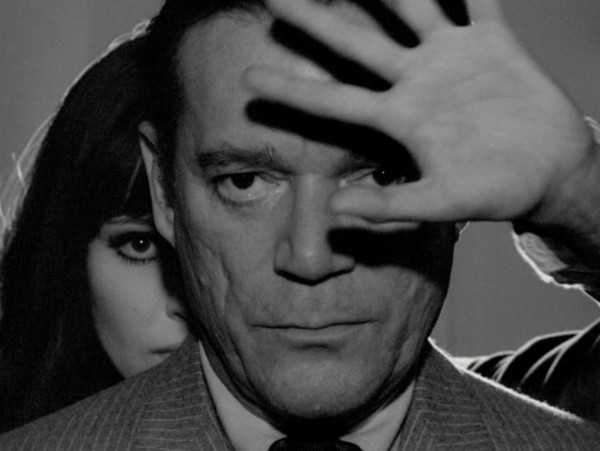
Lemmy Caution (Eddie Constantine) seeks help from Natasha Vonbraun (Anna Karina) in Jean-Luc Godard’s masterful ALPHAVILLE

ALPHAVILLE: A STRANGE ADVENTURE OF LEMMY CAUTION (ALPHAVILLE: UNE ÉTRANGE AVENTURE DE LEMMY CAUTION) (Jean-Luc Godard, 1965)
Rubin Museum of Art
150 West 17th St. at Seventh Ave.
Friday, October 16, $10, 9:30
212-620-5000
rubinmuseum.org

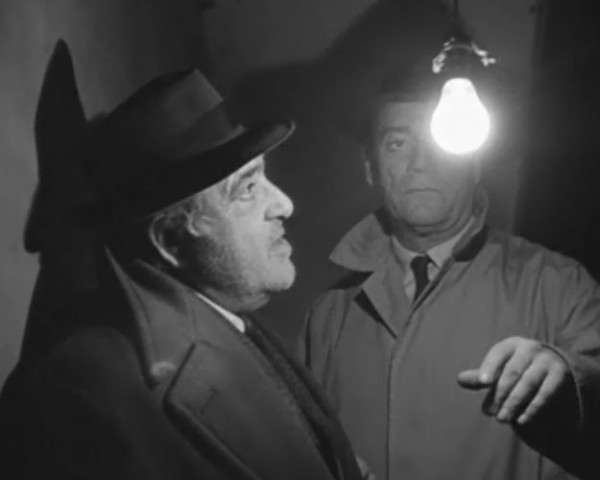
“Sometimes, reality is too complex for oral communication. But legend embodies it in a form which enables it to spread all over the world,” a growly, disembodied, mechanical-like voice says at the beginning of Jean-Luc Godard’s futuristic sci-fi noir thriller, Alphaville: Une étrange aventure de Lemmy Caution. Godard’s 1965 black-and-white masterpiece takes place in an unidentified time period in a dark, unadorned, special-effects-free Paris. A tough-as-nails man in hat and trench coat named Lemmy Caution (Eddie Constantine) has arrived in Alphaville from the Outlands, claiming to be journalist Ivan Johnson, on assignment from the Figaro-Pravda newspaper. But his real mission is to first find fellow agent Henry Dickson (Akim Tamiroff), then capture or kill Alphaville leader and death-ray inventor Professor Vonbraun (Howard Vernon), the former Leonard Nosferatu. A Guadalcanal veteran who drives a Ford Galaxie, Caution — a character Constantine played in a series of films based on the novels of Peter Cheyney, including This Man Is Dangerous, Dames Get Along, and Your Turn, Darling — is a no-nonsense guy who takes nothing for granted. “All things weird are normal in this whore of cities,” he tells a blond seductress third class, who apparently comes with his hotel room. Documenting everything he sees with an Instamatic flash camera, Caution (perhaps a stand-in for Godard himself?) is soon visited by Natasha Vonbraun (Anna Karina), the professor’s daughter, setting off on an Orwellian journey through a grim city where poetry and emotion, and such words as “love,” “why,” and “conscience,” are banned in favor of “because” and “Silence. Logic. Security. Prudence,” where the hotel Bible is actually an ever-changing dictionary and enemies of the state are killed in swimming pools and pulled out by clones of Esther Williams, all overseen by a computer known as Alpha 60 (whose text, based on writings by Jorge Luis Borges, is eerily spoken by a man without a larynx, using a mechanized voice box).
ALPHAVILLE

Henry Dickson (Akim Tamiroff) attempts to shed light on a grim situation in intellectual sci-fi film noir

Meanwhile, Caution travels everywhere with his paperback copy of Paul Éluard’s Capital of Pain, which includes such short poems as “To Be Caught in the Trap,” “In the Cylinder of Tribulations,” and “The Big Uninhabitable House.” Paul Misraki’s relentless noir score fits right in with Raoul Coutard’s bleakly beautiful cinematography, which often shows Caution through glass doors and windows and in enclosed spaces. Godard infuses Alphaville with cinematic flourishes, inside jokes, political statements, and intellectual references, directly and indirectly evoking Jean Cocteau’s Orpheus, Orson Welles’s Mr. Arkadin, Chris Marker’s La Jetée, American cartoons (a pair of white-coated professors who announce a memory problem with 183 Omega Minus are named Eckel and Jeckel, played by Cahiers du cinema’s Jean-Louis Comolli and Jean-André Fieschi), and even his own films, with Jean-Pierre Léaud making a very brief cameo as a waiter. But one of the myriad pleasures of Alphaville — which won the Golden Bear at Berlin and at one time had the working title Tarzan vs. IBM — is that it can be enjoyed on many different levels, as dystopian warning, fascist parable, cinema about cinema, individual vs. the state thriller, or, quite simply, classic French noir. Recently digitally restored with a new translation and subtitles by Lenny Borger and Cynthia Schoch, Alphaville is screening October 16 in the Rubin Museum Cabaret Cinema series “Consequences” and will be introduced by Buddhist studies professor Christopher Kelley. “All is linked, all is consequence,” a scientist tells Caution in the film. The series is being held in conjunction with “Karma: Cause, Effect and the Illusion of Fate,” which continues through December 30 with conversations (David Eagleman + Whoopi Goldberg, Noah Hutton + Jonathan Demme, Gary Indiana + Tracey Emin, Ian Somerhalder + Carol Anne Clayson) and such other karma-related films as George Romero’s Night of the Living Dead, Ken Russell’s Altered States, Josef von Sternberg’s The Blue Angel, and Sherwood Hu’s Prince of the Himalayas.
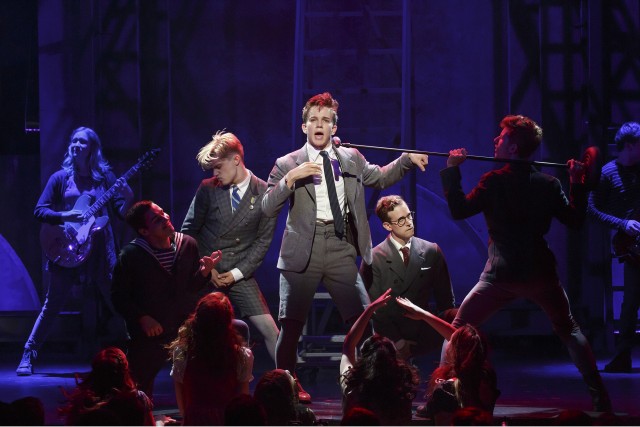
SPRING AWAKENING

(photo © 2015 Joan Marcus)

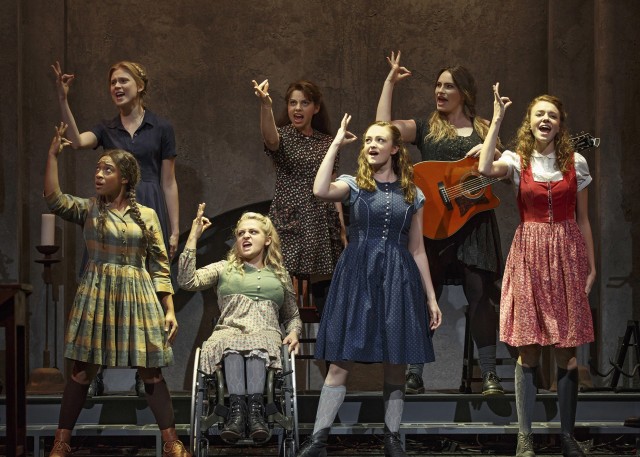
Revival of SPRING AWAKENING combines deaf and hearing actors in ingenious ways (photo © 2015 Joan Marcus)

Brooks Atkinson Theatre
256 West 47th St. between Broadway & Eighth Ave.
Tuesday – Sunday through January 24, $49-$149
877-250-2929
www.springawakeningthemusical.com
www.deafwest.org

America would be in much better shape if every member of Congress went to see Deaf West Theatre’s thrilling revival of Duncan Sheik and Steven Sater’s Spring Awakening. The musical, which won eight Tony Awards in its initial 2006 Broadway run, deals with homosexuality, guns, teen pregnancy, child abuse, suicide, premarital sex, disabilities, masturbation, education, religion, the arts, and more. At its heart, it’s a story about the eternal generation gap, focusing on the miscommunication between adults and children, which is as critical today as it was in 1891, when German author Frank Wedekind wrote the original play on which it’s based. But this time around, director Michael Arden and choreographer Spencer Liff have made the mediocre songs and Shakespeare-does-YA story secondary to a spectacular staging that will take your breath away over and over again. Arden has paired each deaf member of the cast with a hearing actor to speak or sing their lines; both performers use sign language as well, their bodies moving in a very different, very beautiful kind of dance. Sometimes the dual performers are on opposite sides of the stage, and sometimes they follow each other around, as if linked together by an invisible chain. Lines that are not vocalized or signed are projected onto a blackboard or the back wall; cues for the deaf actors consist of physical touches from their hearing doppelganger, musical vibrations, multicolored lighting, offstage closed-captioned monitors, and the use of props, such as the opening of a letter. It all works as seamlessly as in the most heavily choreographed musical, so much so you’re likely to not even realize there’s not much actual dancing in the show, which is somewhat different from Deaf West’s previous Broadway production, 2003’s Big River.

(photo © 2015 Joan Marcus)

Melchior Gabor (Austin P. McKenzie) finds himself in the midst of big trouble in SPRING AWAKENING revival (photo © 2015 Joan Marcus)

The show takes place in 1891 Germany, a time when deaf people were discriminated against and sign language was banned in classrooms. Sandra Mae Frank stars as Wendla Bergmann, an adolescent girl who asks her mother, Frau Bergmann (Camryn Manheim), how babies are made. Frau Bergmann’s fear of telling her daughter the truth sets everything in motion, as parents and teachers battle their children and students, the lack of communication between the young and old serving as the major theme of the play. The bright and charming Melchior Gabor (Austin P. McKenzie) challenges his teacher, Herr Sonnenstich (Patrick Page), over the concept of “critical commentary on textual conjecture,” Moritz Stiefel (Daniel D. Durant) has sexual dreams he doesn’t understand, the geeky Georg (Alex Wyse) has the hots for his piano teacher, and the girls don’t want what happened to the bruised and battered Ilse (Krysta Rodriguez) to happen to Martha (Treshelle Edmond) and cause her to run away too. “When I have children, I’ll let them be free. And they’ll grow strong and tall,” Anna — portrayed by Ali Stroker, the first wheelchair-bound actor to ever play a part on Broadway, even more impressive because it’s a role that doesn’t call for it — says, to which Thea (Amelia Hensley) responds, “Free? But how will we know what to do if our parents don’t tell us?” Only Frau Gabor (Marlee Matlin), Melchior’s mother, is willing to give the kids the freedom to grow. “Surely, you boys are now of an age to decide for yourselves what is good for you and what is not,” she tells her son and Moritz. But Melchior makes their dire situation clear when leading everyone in the showstopper, “Totally Fucked,” declaring, “There’s a moment you know you’re fucked / Not an inch more room to self-destruct.”

The set is like an industrial warehouse, with several metal staircases leading to a second level where the adults often look down on the children, watching them in shame and embarrassment. The impeccable casting features Emmy winner Manheim, who studied sign language in college and used the skill on The Practice; Oscar winner Matlin (Children of a Lesser God), the grand dame of deaf actors, in her Broadway debut; and Page (Casa Valentina, Cyrano de Bergerac), whose deep, booming voice echoes throughout the Brooks Atkinson Theatre, reminding everyone of the power, and bombastic nature, of vocalized speech. As the show opens, Frank, a short brunette, looks into a glassless mirror; on the other side is Katie Boeck, a tall blonde with a guitar, who will follow Frank around for the rest of the show as they portray Wendla as a team, Boeck supplying the voice of the character while also playing music. Their relationship is a beauty to behold, as if every one of us, whether we’re deaf or hearing, has two parts that form our own whole. In a later scene, a deaf actor’s voice partner becomes more than just a talking, singing shadow, making for an unforgettable, magical moment that is what live theater is all about. Wedekind’s stories work amazingly well with music; in addition to Spring Awakening, German composer Alban Berg turned his Lulu plays, Earth Spirit and Pandora’s Box, into the opera Lulu, which is being performed at the Met in November and December in a new production directed by South African multimedia artist William Kentridge. So now, how do we get Congress to see Spring Awakening?

HANK WILLIS THOMAS: THE TRUTH IS I SEE YOU

(photo by twi-ny/mdr)

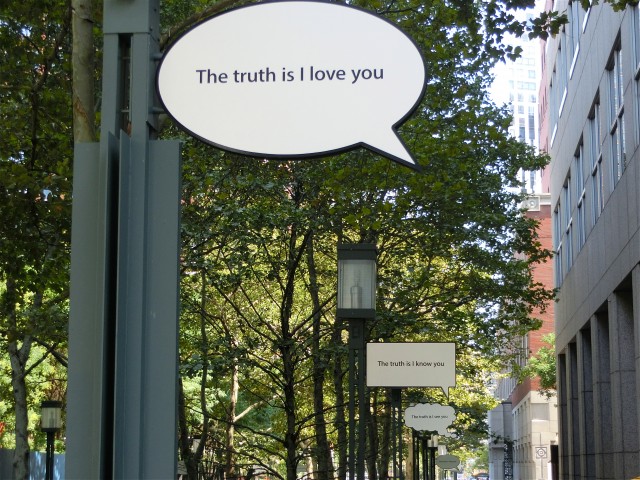
Hank Willis Thomas installation in MetroTech Commons explores different aspects of truth around the world (photo by twi-ny/mdr)

MetroTech Commons, Brooklyn
The Truth Booth: Thursday, October 15, free, 12 noon – 8:00 pm
Fall Talks: The New School, Wednesday, October 21, $10, 6:30
Installation continues through June 3, 2016
publicartfund.org
the truth is i see you slideshow

Throughout his career, Brooklyn-based visual artist Hank Willis Thomas has attempted to uncover the truth while investigating race, popular culture, gender, branding, and commodification. In works such as “B®ANDED,” “Unbranded,” “What Goes without Saying,” and “All Things Being Equal . . . ,” Thomas strips away the surface of media and advertising to get to the heart of black identity in America. For his latest work, the Public Art Fund project “The Truth Is I See You,” Thomas has filled the main walkway in MetroTech Commons with twenty-two speech bubbles of varying sizes, mounted near the tops of lampposts, each a quote about truth, in English on one side and in a foreign language spoken in Brooklyn on the other. Each bubble is accompanied by a placard that gives the translation and pronunciation of the phrase in the second language, all of which are from a poem written together by Thomas and ©ause Collective cofounder Ryan Alexiev: “The truth is I love you / The truth is I know you /The truth is I see you / The truth is I hear you / The truth is I feel you / The truth is I respect you / The truth is I follow you / The truth is I choose you / The truth is I remember you / The truth is I remind you / The truth is I liberate you / The truth is I believe you / The truth is I am you / The truth is I understand you / The truth is I need you / The truth is I miss you / The truth is I reflect you / The truth is I accept you / The truth is I trust you / The truth is I support you / The truth is I balance you / The truth is I welcome you.”

(photo by twi-ny/mdr)

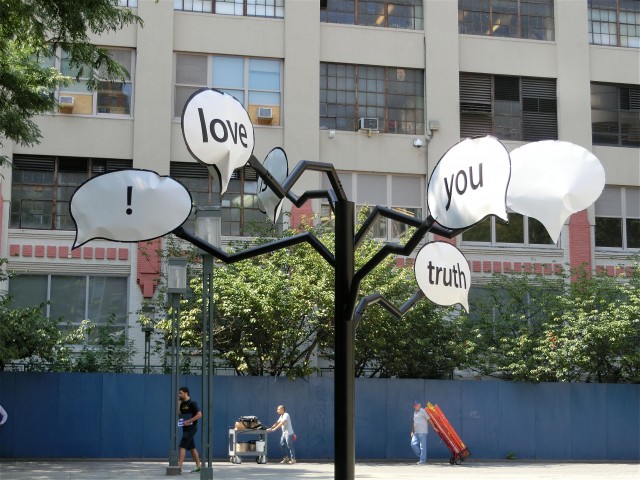
Visitors will be able to share their own thoughts on truth on October 15 in MetroTech Commons (photo by twi-ny/mdr)

Among the languages are Swahili, Italian, French, Japanese, Russian, Chinese, Yiddish, Vietnamese, and Hebrew. In the center of the path is a video monitor playing “In Search of the Truth,” consisting of clips of various people finishing the statement “The truth is . . .” that they recorded in the large, inflatable “Truth Booth,” a collaboration between Thomas, Alexiev, and Jim Ricks of the ©ause Collective that has been traveling around the world, stopping in Afghanistan, Ireland, and South Africa as well as the U.S. so far. Meanwhile, across the commons, a metal tree with bare branches holds aloft a half dozen cushiony speech bubbles that spell out “The truth is I love you,” along with question marks. “The Truth Is I See You” makes a powerful statement about inclusion, referencing America’s supposed melting pot, particularly in a borough containing so many different ethnicities. On October 15 from 12 noon to 8:00, “The Truth Booth” will be in MetroTech Commons, where visitors are invited to add their own thoughts about truth. Thomas also has contributed to the Public Art Fund group show “Image Objects” in City Hall Park (through November 20); his sculpture, “Liberty,” features a purple arm spinning a basketball atop a plinth. And on October 21, Thomas will be at the New School for a Public Art Fund Talk as part of the “Public Context, Private Meaning” series. (Thomas can also be seen in Thomas Allen Harris’s 2014 documentary, Through a Lens Darkly: Black Photographers and the Emergence of a People, based on the book Reflections in Black: A History of Black Photographers 1840 to the Present by his mother, Deborah Willis.)

BAM NEXT WAVE FESTIVAL: HELEN LAWRENCE

(photo by David Cooper)

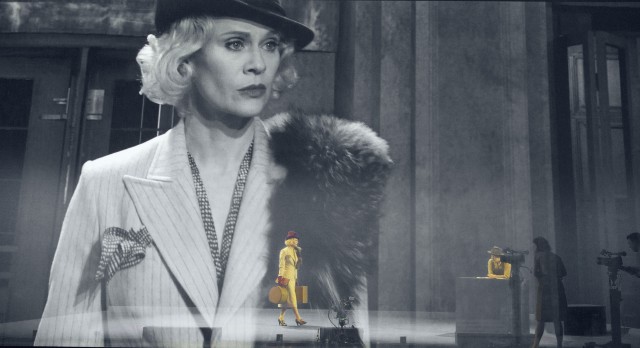
HELEN LAWRENCE tells an old-fashioned postwar noir tale using cutting-edge technology (photo by David Cooper)

BAM Howard Gilman Opera House
30 Lafayette Ave. between Ashland Pl. & St. Felix St.
October 14-17, $24-$95, 7:30
718-636-4100
www.bam.org

Photographer and film and video installation artist Stan Douglas and screenwriter Chris Haddock have teamed up for the multimedia theatrical presentation Helen Lawrence, running October 14-17 at BAM’s Howard Gilman Opera House as part of the 2015 Next Wave Festival. Douglas, who won a 2012 ICP Infinity Award for career achievement, and Haddock, the writer and creator of such Canadian television series as Da Vinci’s Inquest and Intelligence, set the post-WWII noir tale in Vancouver, where Douglas was born and is based. He directs a cast of twelve, including Lisa Ryder as the title character, Nicholas Lea as Percy Walker, Crystal Balint as Mary Jackson, and Greg Ellwand as Inspector Leonard Perkins, who interact with green screens, live camera projections, and 3-D computer imagery to give the proceedings a fantastical, surreal element. The set is by Kevin McAllister, with costumes by Nancy Bryant, lighting by Robert Sondergaard, sound by John Gzowski (who plays guitar on the recorded soundtrack), cinematography by Brian Johnson, and video programming by Peter Courtemanche.

TICKET GIVEAWAY: THE HONEYCOMB TRILOGY

THE HONEYCOMB TRILOGY
The Gym at Judson
243 Thompson St. at Washington Square South
October 13 – November 14, $25 for each of three parts
www.gideonth.com
www.judson.org

You can binge-watch a TV series, so why not a play? Mac Rogers’s (Viral, Asymmetric) sci-fi epic, the Honeycomb Trilogy, is back in New York for a return engagement, promising that “it’ll be about 20% more awesome than last time.” The original unfolded in three installments over six months in 2012, but now you can follow the Cooke family battle alien invasion and try to save the human race over the course of a week, or in one day, at the Gym at Judson. Advance Man, which won a New York Innovative Theatre Award for Outstanding Premiere Production, is being performed by itself October 13, 23, and 29 and November 3 and 13, Blast Radius on October 15, 20, and 30 and November 5 and 10, and Sovereign October 16, 22, and 27 and November 6 and 12. But on Saturdays and Sundays during the run, you can catch all three plays back-to-back-to back, at 2:00, 5:00, and 8:30.

TICKET GIVEAWAY: The Honeycomb Trilogy is running October 13 through November 14 at the Gym at Judson, and twi-ny has one pair of tickets to give away for all three shows to one lucky person. Just send your name, phone number, and favorite sci-fi binge-watching experience to contest@twi-ny.com by Wednesday, October 15, at 3:00 to be eligible. All entrants must be twenty-one years of age or older; one winner will be selected at random.

LIVE FROM THE NYPL: TA-NEHISI COATES / KHALIL GIBRAN MUHAMMAD

(photo by Nina Subin)

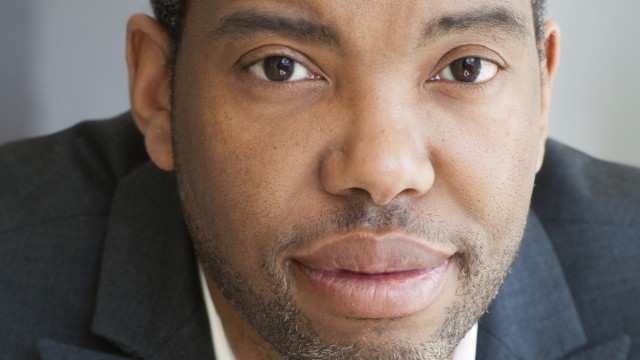
Ta-Nehisi Coates will discuss his incendiary new book at the New York Public Library on October 13 (photo by Nina Subin)

Who: Ta-Nehisi Coates and Khalil Gibran Muhammad
What: Live from the NYPL
Where: New York Public Library, Stephen A. Schwarzman Building, Celeste Bartos Forum, Fifth Ave. at 42nd St., 917-275-6975
When: Tuesday, October 13, $25-$40, 7:00
Why: With Between the World and Me (Spiegel & Grau, July 2015, $24), Atlantic national correspondent Ta-Nehisi Coates has written one of the most important books ever about the history of institutionalized racism in the United States, an intimate, angry, and eye-opening treatise in the form of a cautionary tale being told to his adolescent son. Coates, who also wrote the 2008 memoir The Beautiful Struggle: A Father, Two Sons, and an Unlikely Road to Manhood, holds nothing back in the new book, telling his son about the danger the black body is in every day in America. He writes about his childhood, the lessons he learned from his father, his experiences attending Howard University (which he calls the Mecca), and the tragedies involving Eric Garner, Michael Brown, Tamir Rice, Renisha McBride, John Crawford, and other African Americans killed by white police officers. Although the book is a mere 156 pages, it is a dense read; you’ll want to pore over passages again and again to get the full effect of what Coates is saying. And nearly every page is filled with quotes you’ll want to remember and share with others, stinging indictments of the current state of the nation. “Race is the child of racism, not the father. And the process of naming ‘the people’ has never been a matter of genealogy and physiognomy so much as one of hierarchy,” he explains early on. “Difference in hue and hair is old. But the belief in the preeminence of hue and hair, the notion that these factors can correctly organize a society and that they signify deeper attributes, which are indelible — this is the new idea at the heart of these new people who have been brought up hopelessly, tragically, deceitfully, to believe that they are white.” Between the World and Me is a book that should be required reading in every high school in America. Coates will be at the New York Public Library on October 13 to discuss the state of racism and more with Schomburg Center for Research in Black Culture director Khalil Gibran Muhammad.

DUKHTAR (DAUGHTER)

DUKHTAR

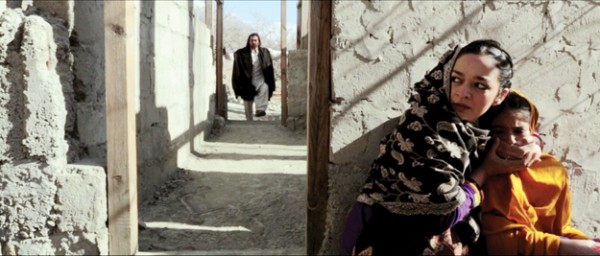
Allah Rakhi (Samiya Mumtaz) and her daughter, Zainab (Saleha Aref), go on the run in Pakistani thriller

DUKHTAR (DAUGHTER) (دختر‎) (Afia Serena Nathaniel, 2014)
Cinema Village
22 East 12th St. between University Pl. & Fifth Ave.
October 9-15
212-924-3363
www.dukhtarthefilm.com
www.cinemavillage.com

Afia Serena Nathaniel’s Dukhtar is an important film in many ways, but it’s too bad it isn’t just a little bit better. A hit at festivals around the world and Pakistan’s submission for the Academy Awards, the Pakistan-U.S. coproduction deals with the very serious topic of women’s freedom. In modern-day Pakistan, two local tribal leaders, Daulat Khan (Asif Khan) and Tor Gul (Abdullah Jaan), are trying to end a generations-old Hatfield and McCoys-like battle. The elderly Tor Gul offers peace in exchange for Daulat Khan’s ten-year-old daughter, Zainab (Saleha Aref); he’ll take her as a wife, and the feud will end. But Daulat Khan’s own wife, Allah Rakhi (Samiya Mumtaz), who herself was forced to marry at the age of fifteen, decides that she does not want her daughter to live like that, so she and Zainab head out on the run, trying to escape the young girl’s fate. They are chased by Tor Gul’s vicious enforcer, Ghorzang Khan (Adnan Shah Tipu), as well as Daulat Khan’s brother, Shehbaz Khan (Ajab Gul), who is in love with Allah Rakhi. They hitch a ride with Sohail (Mohib Mirza) in his fabulously decorated truck, but Sohail soon realizes he is in deeper than he ever wanted to be as well. Inspired by a true story, Dukhtar features beautiful cinematography by Armughan Hassan and Najaf Bilgrami, showing off the lovely vast desert and mountain landscapes of Gilgit-Baltistan in northern Pakistan, and television veteran Mumtaz is riveting as a strong yet vulnerable woman who wants to change long-held traditions, to be a person rather than a thing, but the narrative feels choppy and too direct, telegraphing its themes, and the plot makes too many jumps and has too many holes. In her feature debut, writer, director, producer, and coeditor Afia has a gripping story to tell, but its power is muted by the more melodramatic aspects of this feminist road-trip thriller, which nonetheless has very touching and powerful moments.