twi-ny recommended events

AMEI WALLACH: TALKING TAKING VENICE

Taking Venice examines 1964 biennale art scandal involving Robert Rauschenberg and the State Department

Who: Amei Wallach, Robert Storr
What: Postscreening Q&As for Taking Venice
Where: IFC Center, 323 Sixth Ave. at West Third St.
When: Friday, May 17, 7:15, and Saturday, May 18, 7:15
Why: “I grew up during the Cold War when the world seemed as dangerous as it does today. But it also seemed to be filled with possibility, with the actions of people who dreamed big and took big chances,” Amei Wallach says in the director’s statement for her latest documentary, Taking Venice. “This was especially true of artists, always looking to build something new. I became an art critic, then an author, and now a filmmaker. My goal is to make films about art that leap out of the art world and into a reckoning with what’s relevant in our lives through the stories that they tell. . . . Taking Venice builds on a tradition of telling the story of America then through the eyes of now because I want it to reflect how much the world and art have changed. I want there to be moments that sting with what we have lost, and moments that encapsulate what we have gained.”

In 2008, Wallach and codirector Marion Cajori made Louise Bourgeois: The Spider, the Mistress and the Tangerine, a fascinating exploration of the extraordinary French artist. Five years later, Wallach gave us Ilya and Emilia Kabakov: Enter Here, a compelling look at the renowned Russian art couple.

Wallach is now back with her third film, Taking Venice, which invites viewers inside the controversy surrounding the 1964 Venice Biennale, where several forces might have teamed up in order to ensure that American artist Robert Rauschenberg would win the Golden Lion. The scandal involved art curators Alice Denney and Alan Solomon, art dealer Leo Castelli, and, perhaps, the US government, which saw Rauschenberg’s uniquely American pop art as a way to help fight communism. Among the people Wallach speaks with are artists Christo, Simone Leigh, Mark Bradford, Shirin Neshat, and Carolee Schneeman; authors Louis Menand and Calvin Tompkins; museum directors Valerie Hillings and Philip Rylands; 2007 Venice Biennale director Robert Storr; and Denney, who died this past November at the age of 101. Even Rauschenberg chimes in: “I had moments where I thought everything would be much better if I hadn’t been so lucky,” he says in an archival clip.

Taking Venice opens May 17 at IFC Center; Wallach will be on hand for Q&As following the 7:15 screenings on May 17 and 18, the latter joined by Storr.

[Mark Rifkin is a Brooklyn-born, Manhattan-based writer and editor; you can follow him on Substack here.]

ALL OF ME

Lucy (Madison Ferris) and Alfonso (Danny J. Gomez) explore a possible relationship in All of Me (photo by Monique Carboni)

ALL OF ME
The New Group at the Pershing Square Signature Center
The Alice Griffin Jewel Box Theatre
480 West 42nd St. between Ninth & Tenth Aves.
Tuesday – Saturday through June 16, $31-$89
thenewgroup.org

Laura Winters’s All of Me is an endearing and moving romantic comedy about two young people who meet-cute at a hospital in Schenectady and explore a potential relationship that is impacted by family and financial issues.

Lucy (Madison Ferris) was a teenage jazz singer who is now considering going to college. Alfonso (Danny J. Gomez) works in data science and modeling and has just relocated from Manhattan to Schenectady. She has a dark sense of humor, always ready with a no-holds-barred joke, while he is a more serious and straightforward person. Lucy lives in a house that is slowly falling apart, with her overprotective, conservative mother, Connie (Kyra Sedgwick); her older sister, Jackie (Lily Mae Harrington); and Jackie’s fiancé, Moose (Brian Morabito), a slacker trying to earn money by playing online poker and via other random methods. Alfonso lives with his overprotective mother, Elena (Florencia Lozano), a defense lawyer, and his unseen father, an investment banker, in a fancy home with a maid and driver.

It’s not quite Romeo and Juliet, West Side Story, or The Notebook, but it has an innate charm; it’s impossible not to root for these two attractive twentysomethings, despite all the impediments in their way.

Oh, and it just so happens that they both are in wheelchairs, communicating via text-to-speech technology that may be light-years beyond Stephen Hawking’s but still is perceptibly machine-created.

“What’s your favorite pre-set on your device?” Alfonso asks. The unpredictable Lucy replies, “‘Polly want a cracker!’ When I want to be disarming. And if some stranger is staring at me I use — ‘Hey dipshit, take a picture, it will last longer, and lasting longer is something your girlfriend told me you should work on.’ What’s yours?” The practical Alfonso answers, “It seems a bit lame now but — ‘To infinity and beyond.’”

Connie (Kyra Sedgwick) has a rare smile for Lucy (Madison Ferris) in New Group show (photo by Monique Carboni)

Lucy had a potential career as a jazz singer cut short when she was diagnosed with muscular dystrophy six years earlier, at sixteen. She is unable to stand on her own and is losing her ability to speak and use her hands as the disease progresses. Alfonso was injured in an accident when he was six months old, is paralyzed from the waist down, and has limited use of his right hand. In real life, Ferris has muscular dystrophy, and Gomez was partially paralyzed in a mountain biking accident in 2016 that almost killed him.

While Alfonso has a support structure in place because of his parents’ wealth — they have a ritzy home specially outfitted for his needs, along with expensive art and furniture — daily existence for Lucy is more problematic. The wooden plank that allows her to get from one side of the house to the other is undependable, the dishwasher is broken, and Connie is working multiple jobs to make ends meet, doing nails at a salon and selling knives to housewives, receiving no help from her ex-husband, an opioid addict. Connie’s jobs fit her personality; she pretties up other women, then pulls out sharp weapons.

As older sister Jackie’s wedding approaches, the conflicts grow, including arguments about Lucy’s text-to-speech program. Connie is not happy with it, complaining, “Excuse me for missing the sound of my daughter’s actual, non-weird-robot voice.” Jackie is hoping that Lucy might be able to sing at the wedding. But Lucy, always quick with a joke, explains, “But I enjoy sounding like futuristic AI that waits until the end of the movie to lock you out of the spaceship.”

Winters (Coronation, Gonzo) is a young, energetic writer who documented the process of making All of Me on TikTok with an infectious enthusiasm that comes through in director Ashley Brooke Monroe’s (Julius Caesar, Tommy’s Girls) spirited production. Ferris (The Glass Menagerie,) is hilarious as Lucy, who refuses to wallow in self-pity but understands her situation all too well, while Gomez, in his theatrical debut, is tender and affable as Alfonso, who is at first shocked by Lucy’s boldness and pointed joking but comes to care for her.

@laurawinters12

Sedgwick (Twelfth Night, Ah, Wilderness!) makes a potent return to theater after an absence of more than two decades as the wine-drinking, cigarette-smoking mother whose life has not turned out as planned as she struggles to get by every day. Although she wants the best for her children, it has to be on her terms, not theirs. In her off-Broadway debut, Harrington sparkles as Jackie, sensitively portraying a sibling in a family dynamic that often makes her second fiddle to her sister, while Morabito (The Panic of ’29, Othello) is appropriately bedraggled as the ne’er-do-well, well-named Moose. Lozano (Brooklyn Laundry, One Wet Brain) is graceful as the fashionable Elena.

All of Me, a New Group production at the Pershing Square Signature Center through June 16, is a classic opposites attract rom-com and dysfunctional family drama, although the class difference gets overdone, emphasized by Brett Banakis and Edward T. Morris’s sets and Sarah LeFeber’s costumes. The show is reminiscent of Cost of Living, Martyna Majok’s 2022 Broadway transfer about a wealthy Harvard-Princeton man with cerebral palsy and a divorced quadriplegic woman, but that successful play bordered on becoming trauma porn, concentrating on the dangers of being disabled and feeling helpless. All of Me is much more focused on characters aiming to be independent.

The 1931 title song, written by Gerald Marks and Seymour Simons and performed by such jazz legends as Paul Whiteman and His Orchestra, Ella Fitzgerald, Louis Armstrong, and Billie Holiday, contains the following lines: “All of me / Why not take all of me / Can’t you see / I’m no good without you / Take my lips / I want to lose them / Take my arms / I’ll never use them.” Those lyrics have never had such resonance as in Winters’s poignant and powerful play.

[Mark Rifkin is a Brooklyn-born, Manhattan-based writer and editor; you can follow him on Substack here.]
STELLA PRINCE LIVE AT CAFE WHA?

Stella Prince will play Cafe Wha? with special guests May 17 (photo by Lynn Goldsmith)

Who: Stella Prince ft Maidin and Susie McCollum
What: Live concert
Where: Cafe Wha?, 115 MacDougal St.
When: Friday, May 17, $17.99 – $29.15 (plus two-item minimum), 6:30
Why: Self-described “Gen Z Folk” artist Stella Prince knew she wanted to become a singer when she was three, started performing when she was five, and wrote her first song when she was ten. Now nineteen, Prince, who was born and raised in Woodstock and lives in Nashville, has been performing around the country and the UK, including becoming the youngest performer ever to play Nashville’s Tin Pan South music festival.

On such tunes as “Crying on a Saturday Night,” “Closing Doors,” and “Two Faced,” she reveals a maturity well beyond her years. On “Dear Future Me,” she asks, “Why do I keep begging for love / Is it because it’s never enough / Why do I always punish myself / If things don’t go the way I planned them to be / You never truly recover / When you always compare yourself to another / Childhood insecurities hover / Making it hard to relate to each other / When will I fill this empty void that’s buried deep inside of me? / Maybe not until I get over past insecurities / Standing tall like trees / Reaching new heights of maturity / I wish my younger self could see / dear future me.”

On May 17, Prince, who recently announced that her all-female folk showcase, Change the Conversation’s “Stella Prince and Friends,” will visit Connecticut, Maine, and California this summer, brings her talents to the legendary Cafe Wha? in Greenwich Village, joined by Maidin and Susie McCollum. Tickets are $17.99 for general admission and $29.15 for premier seating, plus a two-item minimum.

[Mark Rifkin is a Brooklyn-born, Manhattan-based writer and editor; you can follow him on Substack here.]
twi-ny talk: RICHARD AYODEJI IKHIDE

Artist Richard Ayodeji Ikhide stands next to Mother’s Embrace at Candice Madey gallery (photo by Kunning Huang)

RICHARD AYODEJI IKHIDE: TIES THAT BIND WITH TIME
Candice Madey
1 Freeman Alley off Bowery
Tuesday – Saturday through June 15, free, 11:00 am – 6:00 pm
www.candicemadey.com
www.instagram.com/pandagwad

Richard Ayodeji Ikhide is having quite a week. He and his partner, Gina, had a baby on April 29 in London; Gina celebrated her birthday on May 2; Ikhide flew that day to New York City for the May 3 opening of his second solo show at Candice Madey on the Lower East Side, “Ties That Bind with Time”; and he then returned home for his newly expanded family’s first Mother’s Day together.

Born in Lagos, Nigeria, and based in London, Ikhide studied at Central Saint Martins College of Art and the Royal Drawing School. His first exhibition at Candice Madey’s 1 Rivington St. home, June 2022’s “Emiomo,” introduced the title character, a child emissary or messenger, inspired by West African spiritual beliefs and legends, who undergoes a metamorphosis with other figures in a fantastical world. He broadens that vision in the new show at Madey’s Freeman Alley space, in which Ikhide again incorporates his interests in weaving, textile design, comic books, manga, Nigerian mythology, and video games in large-scale watercolor, gouache, and collaged paintings on paper that are screwed into the walls. But this time, there’s a sharper focus on motherhood — and fatherhood — across generations. Each of the five works tells its own story, bursting with swirling colors that depict symbolic animals, ritualistic objects, and red and blue circles.

In Mother’s Embrace, a woman clutches her child, their eyes closed, their bond offering them protection from whatever they may face. In Familial Procession, a man and a woman march with several children, surrounded by floating faces; one of the kids emits a dialogue bubble with an abstract shape in it instead of recognizable words. And in Patriarch’s Principles, a family prepares for a ceremony at a table filled with artifacts.

On a recent Saturday afternoon, I bumped into Ikhide at Madey’s Rivington gallery, where he generously agreed to sit down for an impromptu interview. “Ties That Bind with Time” is up through June 15, the day before Ikhide will experience his first Father’s Day as a new dad.

twi-ny: There’s a lot of imagery with children and a mother and father in these paintings. How did that evolve? You started this series before your partner was pregnant.

Richard Ayodeji Ikhide: I think obviously it’s that thing of bringing a new life into the world. It’s kind of like you have all these ideas and associations in terms of what you might think a family might be, or what you might want for your family. And I was saying to people that I felt like this body of work was almost a bit like a visual manifesto, for myself in terms of what I might want for my family unit and how I might want things to be. And one thing I was meditating a lot on was the role of the patriarch; even the word “patriarch” itself can be this oppressive figure in the family dynamic. It was something I really wanted to push against. It’s like a narrative around the idea of the patriarch not as this oppressive figure but also a nurturer, somebody who’s also propagating the life and the vitality of the family.

twi-ny: Fathers get short shrift sometimes.

rai: Exactly. I mean, I’m going to be a Black father; there are so many narratives around Black men and their children, their family units. I don’t want to be that kind of father. I really wanted to counteract or push against some of these narratives.

twi-ny: Why is that narrative still with us? I went out with a bunch of white friends recently and we got into political discussions, and those narratives came up, with some of them arguing that that’s what’s wrong with Black society.

rai: It’s funny because Oprah did a recent study that talked about participation amongst fathers, and African American fathers were quite high. [ed. note: OWN Spotlight: Oprah and 100 Black Fathers aired in June 2021.] A lot of African American fathers are quite active in their kids’ lives, but like you said, that’s a narrative that’s still propagated today. I’m from London, but that’s something that, across the waters, still affects how people view things. It’s been interesting for me. I’ve been to every single midwife visit. I was there in the delivery room. I was there for the baby’s first change. So that’s the role I would like to play in my child’s life. This body of work was a deep meditation on what kind of dad would I like to be, and what kind of family unit would I like to have. It was really interesting to bring it all together, even the whole nine months of seeing my partner’s body change and how she’s adapting. Okay, now we’ve had the baby, she’s breastfeeding, all these things. We’re doing this together. I love her to bits. It’s been both of us, like Bonnie and Clyde. Also, I’ve got a family to feed, so on a financial level I’m thinking, Hey, look. My wife’s been on maternity leave for a while so I’m literally paying for every single bill.

twi-ny: What does she do?

rai: She’s in marketing and research and strategy, so she works with brands and agencies like Sony and Converse. She’s taking time off work, so I can’t expect to be like, You need to chip in your share. That’s all on me now. We’re also talking about all the baby responsibilities, right? And the duty you have as a father, in terms of how you need to make sure your family unit is okay. So yeah, there’s a piece with the patriarch’s principles that’s right in the middle where, you know, you have this patriarchal figure almost giving assurance and direction and almost kind of like life lessons in the sense of okay, this is how you might want to go about doing certain things. I was talking to Jake [Borndal], the director of the gallery, about one thing I got into recently, and that’s all these stats about the involvement of fathers and how the odds for children in terms of their education, career, finances, economic literacy shoot up if the father’s involved. Society needs to also incentivize men to want to play an active role. But if you have this narrative of Oh, men are just going to traumatize their families, then it’s not necessarily incentivizing us.

twi-ny: They’re going to go out for cigarettes and not come back.

rai: Exactly. I’m at a point where, I don’t know, maybe it’s a bit idealist or utopian of me, but I’m like, Hey, maybe that’s the kind of work I would like to make, put that narrative out into society.

twi-ny: And that comes across in your show without preaching at the viewer.

rai: Yeah, exactly.

Richard Ayodeji Ikhide’s “Ties That Bind with Time” is on view at Candice Madey through June 15 (photo by Kunning Huang)

twi-ny: So you’re in London, and your wife gives birth four days ago.

rai: Yeah.

twi-ny: You are there at the birth.

rai: Yeah.

twi-ny: And then you’re on a plane, and you come here to give birth to this show. And tomorrow you’re going right back home.

rai: Yeah.

twi-ny: So what have these five or six days been like for you?

rai: Intense. I’m running on empty. I mean, a couple hours ago I was changing diapers. The night before I had to fly, the baby was waking up like every hour, and I’m like, Oh my god, she needs to eat again. I don’t think I’ve cried so much as in the past four days. Yesterday, towards the end of the opening, I was getting quite emotional because we were in a hospital for about four days, just preparing for it, because our baby was late, so the doctors were like, Okay, we might need to do this, we might need to do that, we might need to do this, and I’m just there like, No, I need to make sure my partner’s okay, she doesn’t want a C-section, no, we’re not doing that. So I was in practical, logical mode. And then Monday, when we came back home, I think that’s when all the emotions started to hit me. Like, Oh my god, we have a child.

And the funny thing is, my partner’s birthday was on Thursday, the night I flew out. So her and my daughter, they’re both Tauruses now — their birthdays are three days apart — I feel really appreciative and grateful to be able to have this experience in my life: a partner’s birthday, a child being born, a show opening.

twi-ny: And now Mother’s Day.

rai: Yeah, so it’s just been absolutely mind blowing, incredible for me. All I can say is I’m grateful, you know?

twi-ny: You look deliriously happy. It’s like there’s this aura around you.

rai: It’s just been incredible to work with the gallery, with Candice and the team, with Jake. They’ve both just been absolutely amazing and incredible, they’ve treated me well, so it’s been such a lovely experience. I know I’m here for only a short time, but it’s been absolutely stellar.

twi-ny: I’m glad I just walked into this, glad you were here.

rai: It’s a synchronous moment.

[Mark Rifkin is a Brooklyn-born, Manhattan-based writer and editor; you can follow him on Substack here.]

MOTHERS DAY ON BROADWAY: MARY JANE / MOTHER PLAY

Jessica Lange is mesmerizing as a troubled matriarch in Mother Play (photo by Joan Marcus 2024)

MOTHER PLAY
Helen Hayes Theater
240 West 44th St.
Tuesday – Sunday through June 16, $108-$270
2st.com/shows

Mothers and motherhood have always taken center stage on Broadway, from Rose in Gypsy, Fantine in Les Misérables, and Heidi in Dear Evan Hansen to Mary Tyrone in Long Day’s Journey into Night, Amanda Wingfield in The Glass Menagerie, and Canteen Anna in Mother Courage and Her Children. This Mother’s Day is an ideal time to pay tribute to two extraordinary semiautobiographical plays now on Broadway, each focused on a unique mom.

At the Helen Hayes through June 16, Tony, Oscar, and Emmy winner Jessica Lange is starring as Phyllis Herman in Paula Vogel’s Mother Play — A Play in Five Evictions. As the audience enters the theater, a soundtrack is playing mother-related pop songs, from the Beatles’ “Your Mother Should Know” to the Mothers of Invention’s “Mother People,” getting everyone in the mood.

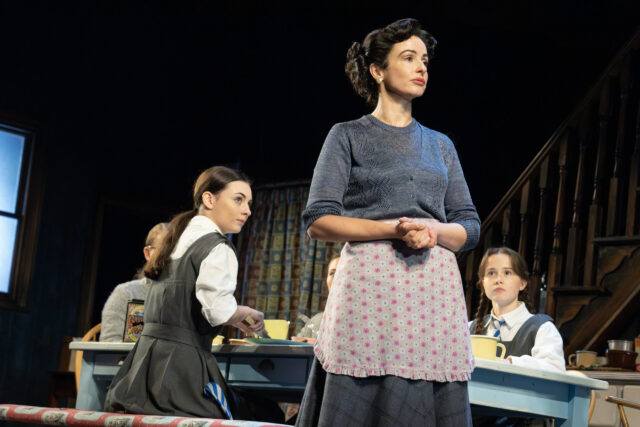
The story takes place from 1962 to the present as Phyllis and her two children, Carl (Jim Parsons) and Martha (Celia Keenan-Bolger), keep moving apartments, going up a floor each time, trying to improve their lot in life. Phyllis is a supreme diva, laying out on a fancy chair and having her kids light her cigarettes and serve her martinis. Her husband left years before and is out of the picture; Phyllis works in a typing pool but imagines herself enrobed in haute couture like Audrey Hepburn.

The memory play is narrated by Martha, who tells the audience at the beginning, “By age eleven, I had already moved seven times. My father had a habit of not paying rent. My mother, brother, and I could pack up our house in a day. A very useful skill. To know what household goods are in every box so one can also unpack in a day. Family in, family out. When I packed up my brother Carl’s apartment after he died, everything he loved fit into one medium size U-Haul box. There is a season for packing. And a season for unpacking.”

There’s a lot of packing and unpacking in the play, literally and figuratively. Whenever the family moves, they rearrange David Zinn’s set, using the same furniture, although different lighting fixtures come down from above. Phyllis insists on listening to old songs on the radio — her favorite is “Moon River,” which Hepburn sang in Breakfast at Tiffany’s — while her children attempt to listen to more modern music but are unable to get their mother out of the past.

Early on, Carl asks, “It’s over, isn’t it?” Martha replies, “What?” Carl answers, “Childhood.”

Carl and Martha have to grow up fast, catering to their mother’s needs, as opposed to her taking care of theirs. She does have a magic purse from which she can suddenly pull out a bag of McDonald’s, but she lacks almost any kind of mothering instinct. It gets worse when Carl tells her he is gay, as she angrily banishes him from their home. And she has little hope for Martha, who she calls “unremarkable,” believing the best she can do is “find an unremarkable man who doesn’t have enough imagination to cheat and drink and whore himself around town like her father does. After a year of learning how to cook, Martha will get a bun in the oven, and give me a grandchild. Because, honey, you are never a true woman until you have children.”

Phyllis might not win any Mother of the Year contests, as she admits herself, but she is not a monster. She works hard to keep a roof over their head, even if there are occasional roach problems, but she doesn’t help matters when she says she never wanted to have children, coldly explaining to Martha, “It’s a life sentence.”

The closing scenes are emotionally gut-wrenching, avoiding genre clichés as some threads are resolved and others remain packed away in boxes, perhaps never to be opened again.

Phyllis (Jessica Lange) seeks solace from her son (Jim Parsons) and daughter (Celia Keenan-Bolger) in new Paula Vogel play (photo by Joan Marcus 2024)

Pulitzer Prize winner and three-time Tony nominee Vogel (How I Learned to Drive, Indecent) based Mother Play in part on her life. Vogel, who has been married to author and professor Anne Fausto-Sterling since 2004 and does not have any children, had a brother named Carl who died of AIDS; her other brother is Mark. Their parents divorced when she was eleven, the same age as Martha in 1962, and Vogel’s mother was a secretary for the United States Postal Service, a job that Phyllis gets in the play.

But Vogel is such a potent writer that Mother Play feels intimate and personal but never overly confessional or didactic. Except for one out-of-place scene, the narrative flows with a natural sensibility that is transfixing, directed by Landau (SpongeBob SquarePants Big Love) with a powerful fluency.

Keenan-Bolger (A Parallelogram, The Glass Menagerie) and Parsons (A Man of No Importance The Boys in the Band) are exceptional as the siblings, who are caught up in a seemingly unwinnable existence but refuse to give up. As psychologically tortured as they are by their mother, they still know when to do the right thing for the family. Keenan-Bolger, Parsons, Vogel, and Lange all received well-deserved Tony nominations.

Lange is magnificent as Phyllis; she gives a grand dame performance that you can’t take your eyes off of. At seventy-five, Lange, who has three children, continues to hone her craft with grace and elegance while not being afraid to reach deep inside her. She has previously portrayed Mary Tyrone (Long Day’s Journey into Night) and Amanda Wingfield on Broadway, and Mother Play completes a kind of unofficial trilogy in style.

Rachel McAdams is sensational as the mother of a seriously ill child in Mary Jane (photo by Matthew Murphy)

MARY JANE
Samuel J. Friedman Theatre
261 West Forty-Seventh St. between Broadway & Eighth Ave.
Tuesday – Sunday through June 16, $80-$328
www.manhattantheatreclub.com

The concept of Mother’s Day goes back to before the Civil War, but it began to take shape in 1868 when Ann Reeves Jarvis started Mothers’ Friendship Day as a way to bring together Union and Confederate families, and then in 1870 when abolitionist and suffragist Julia Ward Howe, author of “The Battle Hymn of the Republic,” presented the Mother’s Day Proclamation for Peace. In 1904, Fraternal Order of Eagles Past Grand Worthy President Frank E. Hering called for a day to honor mothers everywhere; he later became known as the Father of Mother’s Day. President Woodrow Wilson, who had fought against women’s right to vote, proclaimed Mother’s Day a national holiday in May 1914.

On this Mother’s Day, Phyllis Herman may understand that she is not going to be named Mother of the Year, but Mary Jane has a much better shot at it.

In Amy Herzog’s exquisitely rendered Mary Jane, continuing at MTC’s Samuel J. Friedman Theatre through June 16, Rachel McAdams makes a sensational stage debut as the title character, a single mother raising a seriously ill child who requires round-the-clock care. Mary Jane is a kind of saint; she navigates through her complicated circumstances with a smile even as she sacrifices her career and personal life to devote nearly every minute to Alex, who is essentially being kept alive by machines.

Mary Jane does not complain about her husband’s leaving shortly after Alex’s premature birth. She refuses to report one of Alex’s nurses for falling asleep on the job and endangering him. She gives important advice to a woman (Susan Pourfar) who has just had a child like Alex. And she finds the time to listen to other people’s problems and concerns, not concentrating solely on her situation.

Mary Jane lives in a one-bedroom apartment in Queens, where she sleeps on a foldout bed in the living room/kitchen. She is friendly with her most dependable nurse, Sherry (April Matthis), as well as with her dedicated super, the tough-talking, straight-shooting Ruthie (Brenda Wehle). She encourages Sherry’s shy, neurodivergent niece, Amelia (Lily Santiago), who would like to meet Alex.

While fixing a clog in the kitchen sink, Ruthie tells Mary Jane, “You seem to be someone who’s carrying a lot of tension in her body. . . . You’re very nice, very pleasant, you’re very pleasant and with what you’re dealing with I wonder if you have an outlet for expression or if you’re absorbing that all in your body. It’s just a thought. It might not be a useful thought. . . . Because that’s how my sister got cancer.” It’s an astute observation that is all too true.

Mary Jane’s job, and health insurance, is in jeopardy when Alex is hospitalized for months after a seizure. At the hospital, Mary Jane speaks with Chaya (Pourfar), a Hasidic woman with seven kids, including one in the same situation as Alex. Chaya has a more practical point of view with more hope for the future; it’s no coincidence that her name means “life” in Hebrew and that her sick daughter’s name, Adina, means “delicate” or “gentle.” In the Bible, Adina is the mother of two of the matriarchs, Rachel and Leah.

At the hospital, Mary Jane speaks with Dr. Toros (Matthis), who strongly advises she get some rest. “I’ve seen a lot of parents come through here. It’s important to take care of yourself. Sleep in your own bed, take a bubble bath,” the doctor says, but Mary Jane insists she’s okay. Dr. Toros calls Mary Jane “mom,” perhaps because she knows Mary Jane will never hear that word from Alex. But the cracks start showing up when Kat (Santiago), the music therapist, has not shown up yet to sing to Alex.

Mary Jane (Rachel McAdams) and Chaya (Susan Pourfar) share their stories while on the pediatric floor of a Manhattan hospital (photo by Matthew Murphy)

Pulitzer finalist and three-time Tony nominee Herzog (A Doll’s House, 4000 Miles) based Mary Jane in part on her life. Herzog and her husband, Tony-winning director Sam Gold — the partners collaborated for the first time on the current Tony-nominated adaptation of Henrik Ibsen’s An Enemy of the People at Circle in the Square — had two daughters, but their eldest, Frances, died from nemaline myopathy in 2023 at the age of eleven.

In Mother Play, the set remains the same but the furniture is moved around for each scene. In Mary Jane, Lael Jellinek’s set undergoes a major change when the action shifts to the pediatric ICU of a Manhattan hospital; what happens to Mary Jane’s living room/kitchen is pure genius, adding an extra level of insight to the story.

Herzog and director Anne Kaufman (The Sign in Sidney Brustein’s Window, The Nether) premiered the play at Yale Repertory Theatre in April 2017, then brought it to 2017 at New York Theatre Workshop that September, with Carrie Coon as Mary Jane, Liza Colón-Zayas as Sherry and Dr. Toros, and Danaya Esperanza as Amelia and Kat. Pourfar (Mary Page Marlowe, Tribes) and Wehle (The Big Knife) do a fine job reprising their roles on Broadway, with Obie winner Matthis (Primary Trust, Toni Stone) excelling as Sherry and Dr. Toros, and Santiago (King Lear, Mac Beth) making a fine Broadway debut as the curious Amelia.

Making her New York City theatrical debut at forty-five, Oscar nominee McAdams (The Notebook, Mean Girls) is magnificent as Mary Jane, commanding the stage and the audience’s attention as if she were a seasoned theater pro. McAdams, who has two children, imbues her character with a positive attitude that belies, deep down, her carefully controlled anxiety. Mary Jane wants to do all the right things as a mother, but, as with Phyllis, finances get in the way, and the definition of “a life sentence” is very different. However, there is a key moment when Mary Jane wonders if what she’s doing is right for Alex himself, something that never occurs to Phyllis.

The play, which earned four Tony nods, for McAdams, Herzog, Kaufman, and sound designer Leah Gelpe, concludes with a fascinating scene that seems to unfold in its own time and space, in which Mary Jane finally opens up. It’s funny, strange, and heart-wrenching, a moving coda to a powerful, emotional experience.

[Mark Rifkin is a Brooklyn-born, Manhattan-based writer and editor; you can follow him on Substack here.]

AN AMERICAN SOLDIER

The company of An American Soldier rehearses for New York City premiere (photo by HanJie Chow)

AN AMERICAN SOLDIER
Perelman Performing Arts Center (PAC NYC)
251 Fulton St.
May 12-19, $54-$183
pacnyc.org

PAC NYC continues its wide-ranging inaugural season with the New York premiere of An American Soldier, an opera that tells the true story of what happened to Asian American army private Danny Chen in 2011 during the war in Afghanistan. The harrowing story of hate and harassment features a libretto by Tony and Grammy winner David Henry Hwang (M. Butterfly, Soft Power), with music by Huang Ruo (M. Butterfly, Book of Mountains and Seas); the two-hour work, which debuted as a one-act in 2014 and was expanded in 2018, is directed by Obie winner Chay Yew (Cambodian Rock Band, Sweatshop Overlord), with choreography by Ann Yee (Sunday in the Park with George, Caroline, or Change).

Tenor Brian Vu stars as the Chinatown-born Pvt. Chen, with mezzo-soprano Nina Yoshida Nelsen as his mother, soprano Hannah Cho as his high school friend Josephine Young, and baritone Alex DeSocio as Sgt. Aaron Marcum, his main tormentor. The cast also includes Christian Simmons, Ben Brady, Joshua Sanders, James C. Harris, Shelén Hughes, and Cierra Byrd in multiple roles. The thirty-five-piece orchestra will be conducted by Carolyn Kuan.

A coproduction with Boston Lyric Opera and American Composers Orchestra, An American Soldier features sets by Daniel Ostling, costumes by Linda Cho, lighting by Jeanette Yew, sound by David Bullard, and projections by Nicholas Hussong. There will be only five performances May 12-19, and tickets are going fast. The May 16 show will be followed by a panel discussion with Hwang, Kuan, and Ruo, moderated by Ken Smith, and the May 18 presentation will be followed by a talk with Chen family spokesperson Banny Chen, civil rights lawyer Elizabeth OuYang, Hwang, and Ruo, moderated by CeFaan Kim.

[Mark Rifkin is a Brooklyn-born, Manhattan-based writer and editor; you can follow him on Substack here.]

SHIMMER AND HERRINGBONE

Fashion takes center stage at Talking Band’s Shimmer and Herringbone (photo by Maria Baranova)

SHIMMER AND HERRINGBONE
Mabou Mines@122CC
150 1st Ave. at Ninth St.
Wednesday – Sunday through May 19, $35
talkingband.org

Amid the flurry of Broadway openings — no fewer than nineteen between March 7 and April 25, the cutoff to be eligible for the Tonys — you may have missed the celebratory event of the season, the fiftieth anniversary of Talking Band, the independent downtown company founded by Ellen Maddow, Paul Zimet, and Tina Shepard in 1974. The avant-garde troupe has staged more than sixty productions since 1975’s The Kalevala, and this year it has treated us to three exquisite new shows in a span of three months.

In February, TB presented the moving and intimate The Following Evening at PAC NYC, a collaboration with 600 Highwaymen that explored personal and professional legacy, starring real-life couples Abigail Browde and Michael Silverstone of 600 Highwaymen and Maddow and Zimet of TB. In March, Maddow, in her mid-seventies, and Zimet, in his early eighties, teamed up for the brilliant Existentialism at La MaMa, a dazzling meditation on aging.

TB concludes its unofficial trilogy with the hilariously inventive and profound Shimmer and Herringbone, which opened last night at Mabou Mines@122CC for a limited run through May 19.

In his 1905 short story “The Czar’s Soliloquy,” Mark Twain wrote, “As Teufelsdröckh suggested, what would man be — what would any man be — without his clothes? As soon as one stops and thinks over that proposition, one realizes that without his clothes a man would be nothing at all; that the clothes do not merely make the man, the clothes are the man; that without them he is a cipher, a vacancy, a nobody, a nothing.”

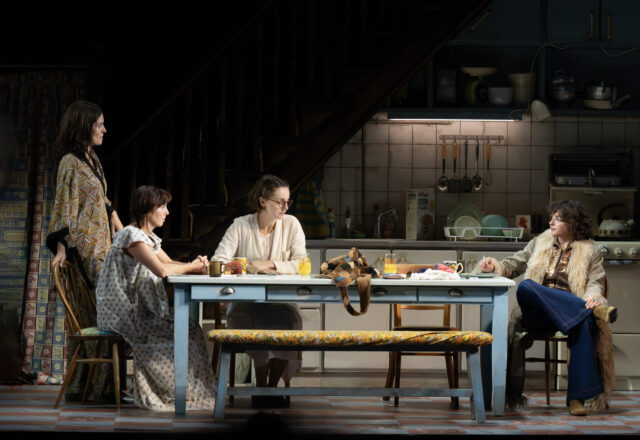
The ninety-minute Shimmer and Herringbone takes place in the titular clothing store, where a handful of oddball characters across three generations — old friends, former lovers, not-so-strangers — shop with the help of eclectic dressing room attendant Rhonda (Maddow), who shares tidbits of carefully phrased philosophy as they seek to change their clothes, their style, and, in several cases, their lives, to not be a nobody or a nothing.

When Rhonda asks one customer, “Did you find what you were looking for?,” she’s referring to more than just a new scarf or jacket.

She says to another shopper, “Where are you going, if you don’t mind my asking?,” a question that requires a bigger answer than the shoe department.

Melanie (Tina Shepard), Colin (Jack Wetherall), and Lilly (Lizzie Olesker) wonder about pigeons and life in world premiere play (photo by Maria Baranova)

At the beginning of the play, Lilly (Lizzie Olesker) and her daughter, the twentysomething Bree (Ebony Davis), find the elderly Melanie (Tina Shepard), who speaks in non sequiturs, facedown on the floor. Grace (Louise Smith) is a realtor who isn’t sure how she knows Colin (Jack Wetherall) and runs away when she sees Lilly, an ornithologist who is embarrassed that she doesn’t recognize Gus (James Tigger! Ferguson), who appears to know her very well.

As they slowly discover more about one another, the characters not only dig deep within themselves but try to understand how they are seen by others — and how they have changed over the years.

“I see this face and I wonder — could that be me?” Grace says, later adding, as only a real estate agent can, “My face is falling apart like an old house.”

Reaching out, Colin talks to Grace about the apartment where he’s lived for more than thirty years. “Suddenly, about a month ago, I woke up and everything looked drab, everything was in the wrong place. The rug that I inherited from my mother was tatty and raveled around the edges, the kitchen table was greasy, and my favorite chair looked like a toadstool with its undersides oozing toxins. It’s like I have changed, but my apartment is stubbornly, defiantly sitting in the past, and I can’t stand it,” he says. Grace responds, “That’s been happening to people a lot lately,” implicating the audience itself.

As the characters share stories from their past that often include details about what they were wearing at the time, Bree is having none of it. When Rhonda asks her, “Can I help you?,” the youngest member of the group quickly replies, “I don’t need help.” When her mother is considering whether she should return a shirt, Bree declares, “It’s just a blouse,” a phrase that sticks out like blasphemy.

Through it all, a string trio consisting of Rachel Feldhaus, Marija Kovacevic, and Agustin Uriburu performs in a far corner, sometimes adding soothing background music and sometimes playing to the characters, who sit down and watch them while having conversations.

Gus (James Tigger! Ferguson) and Rhonda (Ellen Maddow) find common ground through dress in Shimmer and Herringbone (photo by Maria Baranova)

Shimmer and Herringbone is another delightful triumph from Talking Band, reminiscent of its 2022 production Lemon Girls or Art for the Artless, which also featured Olesker, Shepard, Smith, Wetherall, and writer and composer Maddow and was directed by Zimet. The new piece is cowritten by Maddow and Zimet and directed by Zimet, in collaboration with costume designer Olivera Gajic, whose outfits nearly steal the show, from black leather and leopard print to fluffy slippers and feathery hats.

The narrative unfolds on Anna Kiraly’s cozy set, which is centered by four lighted dressing-room doors that the shoppers enter and exit and is also used for Kiraly’s projections of social media posts, images of clothing and the moon, abstract shapes, birds on a wire, and a short film. The soft lighting is by Mary Ellen Stebbins, with sweet and touching choreography by Sean Donovan. A kind of angel at a way station, Rhonda is often pushing along a mannequin or a rack of clothes that were rejected. The characters occasionally sit on concrete slabs like park benches at the front, almost touching the audience.

In addition to the classical music played by the string trio, there are pop songs and poetry, from Samuel Taylor Coleridge and Blue “Gene” Tyranny to the combo of Bruce Springsteen and Patti Smith. Gus, who fashions himself a literary junkie, references Chekhov, Dostoevsky, Woolf, Borges, Hemingway, and Kerouac as he morphs into James Joyce, who once wrote, “Mother is packing my new secondhand clothes. She prays now, she says, that I may learn in my own life and away from home and friends what the heart is and what it feels. Amen. So be it. Welcome, O life!”

The centerpiece of the show is ornithologist Lilly’s spark bird, the New York City pigeon. Also known as the Columba livia and the rock dove, the bird is not only ubiquitous — it’s believed there are about four million in the city, compared with nine million people — but it is hard for the average person to tell them apart. Human beings have the ability to choose clothing that can assist in defining who they are, both outside and inside, but pigeons don’t have that option. It’s even difficult to identify their gender, as Lilly notes, which becomes relevant late in the play.

At one point, Grace explains that part of her job is “staging” a house, evoking the staging of a play: cleaning it out from top to bottom, then painting the walls white and adding cream carpets and innocuous artworks, allowing the buyer to make it their own home. Each character entering Shimmer and Herringbone is like that plain house, ready to redecorate themselves in their own personal style.

When Bree sees Melanie dragging a large garbage bag, she asks her what’s in there. “Nothing,” Melanie answers. “Stuff that’s been clogging up my closets, burdening my soul for half a century.” How many of us would love to go through our closets and get rid of old clothes that feel like a burden?

“So you want to find something that reflects who you are,” Rhonda says to Grace, who is worried about suffering buyer’s remorse, as if a new outfit is as important as a new home.

Isn’t it?

[Mark Rifkin is a Brooklyn-born, Manhattan-based writer and editor; you can follow him on Substack here.]