John Marston’s THE MALCONTENT kicks off Reb Bull Theater Revelation Readings series at the Lucille Lortel Theater
Lucille Lortel Theater
121 Christopher St. between Bleecker & Hudson Sts.
Select Mondays, November 16 – July 25, $42-$64, 7:30
212-352-3101 www.redbulltheater.com
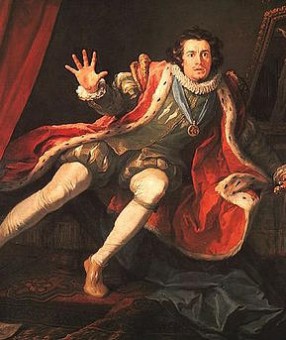
The Red Bull Theater’s Obie-winning Revelation Readings series, in which the company brings back Jacobean treasures, is up and running November 16 at the Lucille Lortel Theater with John Marston’s early-seventeenth-century satire, The Malcontent. The all-star cast features Matthew Rauch, Marsha Mason, Kelley Curran, Christopher Innvar, and Christina Rouner, directed by Derek Smith. The series continues December 7 with Cyril Tourneur’s The Atheist’s Tragedy, starring Jeremy Bobb, Miriam Hyman, Whit Leyenberger, Bhavesh Patel, Raphael Nash Thompson, Alejandra Venancio, and Lisa Wolpe, with live music by Alexander Sovronsky, direction by Ben Prusiner, and a post-show discussion with Gail Kern Paster. On December 28, Carson Elrod and Jay O. Sanders are among the cast of Ben Jonson’s Every Man in His Humour, directed by Elrod. The 2016 readings include Thomas Middleton’s A Trick to Catch the Old One (directed by Craig Baldwin and starring Steven Boyer), Philip Massinger’s The Roman Actor (with Patrick Page, directed by Louisa Proske), Shakespeare’s Coriolanus (starring Chukwudi Iwuji and directed by Michael Sexton), Frances Burney’s The Woman Hater (directed by Everett Quinton and featuring Arnie Burton, Auden Thornton, and Nick Westrate), Shakespeare’s Hamlet (directed by Tom Ridgely and featuring Arian Moayed), William Congreve’s The Way of the World, and the sixth annual Short New Play Festival.
The Blake family gathers in a Chinatown duplex for a Thanksgiving to remember in THE HUMANS (photo by Joan Marcus)
Laura Pels Theatre
Harold and Miriam Steinberg Center for Theatre
111 West 46th St. between Sixth & Seventh Aves.
Tuesday – Sunday through January 3, $99
212-719-1300 www.roundabouttheatre.org
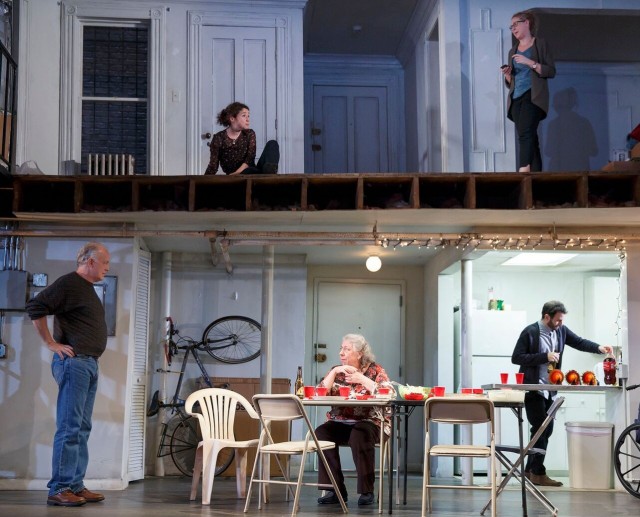
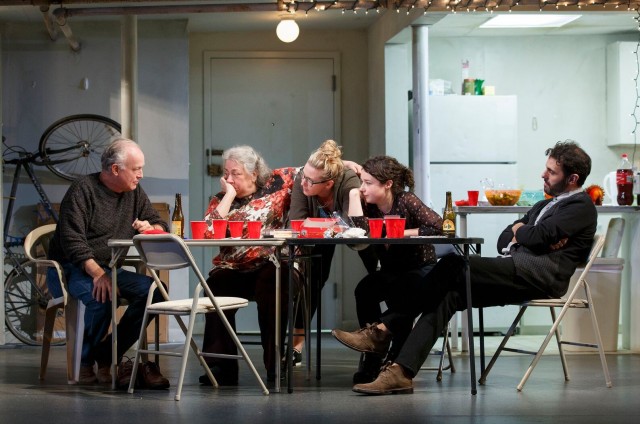
Stephen Karam, a Pulitzer finalist for his widely hailed 2011 play, Sons of the Prophet, should be up for the prestigious prize again for his follow-up, the beautifully told drama The Humans, running at the Laura Pels through January 3, after which it will be transferring to Broadway. The Roundabout commission is a gorgeous, bittersweet portrait of the fears and anxieties that ripple through the average American family in the twenty-first century. On Thanksgiving Day, the Blake clan has gathered at the duplex apartment in Chinatown just rented by Brigid Blake (Sarah Steele), a twenty-six-year-old composer and musician trying to make ends meet as a bartender, and her thirty-eight-year-old boyfriend, Richard Saad (Arian Moayed), a grad student who is preparing the holiday feast. Brigid’s parents, Erik (Reed Birney), who’s worked at the local Catholic high school for twenty-eight years, and Deirdre (Jayne Houdyshell), who has been the office manager at the same company for four decades, have driven into the city from their home in Scranton with Erik’s aged mother, Momo (Lauren Klein), who is suffering from severe dementia and is confined to a wheelchair. They are joined by Brigid’s older sister, Aimee (Cassie Beck), a Philadelphia lawyer who recently broke up with her longtime girlfriend and whose ulcerative colitis is acting up. Brigid and Richard are still in the process of moving in — the truck with most of their possessions is stuck in Queens — so there are some boxes on the floor, not much furniture, and no shades over the lone window, which looks out into a dark alley. But the members of the Blake family soldier on; they are a very close group that hide very few secrets as they talk about their lives, offer love and support, and take both playful and serious shots at one another, as one early exchange shows.
Stephen Karam’s follow-up to sonS OF THE PROPHET is a searing, and funny, portrait of the modern American family (photo by Joan Marcus)
Erik: “I hate that you moved a few blocks from where two towers got blown up and in a major flood zone. . . . I hate that.”
Brigid: “This area is safe —”
Erik: “Chinatown flooded during the last hurricane — it flooded —”
Brigid: “Yeah, that’s why I can afford to live here — it’s not like you gave me any money to help me out.”
Erik: “Wow . . .”
Brigid: “Hey, I’m — sorry, just . . . Chinatown is safe — you saw my block, Dad —”
Deirdre: “Of course it is . . .”
Brigid: “— no one’s going to steer a plane into a, a fish market on Grand Street —”
Aimee: “Brigid . . .”
Deidre: “Let it go . . .”
Erik: “I liked you livin’ in Queens, alright? I worry enough with Aimee on the top floor of the Cira Centre —”
Aimee: “Well, stop, Philly is more stable than New York —”
Brigid: “Aimee, don’t make him more —”
Aimee: “I’m just saying — it’s safer . . .”
Brigid: “Yeah, ’cause not even terrorists wanna spend time in Philly. Philly is awful —”
Aimee: “Oh, ha ha . . .”
Erik: “You think everything’s awful, you think Scranton is awful, but it’s the place that —”
Brigid: “We think it’s awful?!”
Aimee: “Dad, it is!”
Erik: “. . . yeah, well, what I think’s funny is how you guys, you move to big cities and trash Scranton, when Momo almost killed herself getting outta New York — she didn’t have a real toilet in this city, and now her granddaughter moves right back to the place she struggled to escape. . . .”
Brigid: “We know, yes . . . ‘return to the slums . . .’”
No topic is off limits as they discuss finance and economics, bowel movements, cockroaches, the correct pronunciation of Andrew Carnegie’s last name, texting, the odd noises coming from the apartment above, and general quality-of-life issues, but most of all they are searching for a sense of fairness in a world where that ideal is getting harder and harder to come by. Both men, Erik and Richard, are having trouble sleeping, experiencing weird dreams they can’t explain. Momo spits out supposed gibberish that contains such phrases as “You can never come back” and “Where do we go.” Meanwhile, Deirdre is volunteering to help Bhutanese immigrants in Scranton who are mired in poverty, having left a country that measures its success in Gross National Happiness. Scranton native Karam (Speech & Debate,Dark Sisters) is delving into the very nature of the modern-day human condition, which is not very pretty. “There’s enough going on in the real world to give me the creeps,” Deirdre says, leading Brigid to point out Richard’s obsession with a comic book called Quasar. “It’s about this species of, like, half-alien, half-demon creatures with teeth on their backs,” he explains. “On their planet, the scary stories they tell each other . . . they’re all about us. The horror stories for the monsters are all about humans.” Karam’s highly literate script was influenced by Federico García Lorca’s A Poet in New York, which deals with the city’s response to the 1929 economic crash, Sigmund Freud’s 1919 essay, “The Uncanny,” about the strangely familiar, and Napoleon Hill’s six basic fears from his 1937 book, Think and Grow Rich — fear of poverty, criticism, ill health, loss of love, old age, and death — and all six can be found in The Humans.
Two-time Tony winner Joe Mantello (Take Me Out, Assassins) seamlessly directs the real-time story, which takes place on David Zinn’s two-floor tear-away set, like a dollhouse ripped open for us to witness the actual life going on inside. The exquisite cast is just as seamless, each character authentic and believable, led by the always wonderful Houdyshell (Follies, Well) as the excitable, nervous mother, rising star Steele (Slowgirl,Speech and Debate) as the prodigal younger daughter trying to make it on her own, and, front and center at both the beginning and the end of the play, a heartfelt Birney (You Got Older, Circle Mirror Transformation) as the steadfast patriarch, desperate to hold it all together even as things threaten to fall apart, with just a touch of the supernatural hovering as well to complicate matters and to heighten the many terrors of everyday existence. As laugh-out-loud funny as it is heartbreakingly honest, The Humans offers up a Thanksgiving to remember, two spectacularly thought-provoking and entertaining hours that encapsulate the state of the American family in this tough, fearful post-9/11 world.
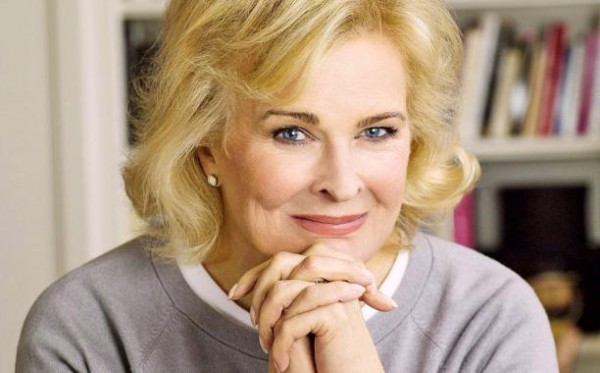
Candice Bergen will be at the JCC in Manhattan on November 10 to talk about her life and career (photo by Jonathan Becker)
Who:Abigail Pogrebin and Candice Bergen What: “What Everyone’s Talking About with Abigail Pogrebin: Candice Bergen” Where:JCC in Manhattan, 334 Amsterdam Ave. at Seventy-Sixth St., 646-505-4444 When:Wednesday, November 18, $25, 7:30 Why: Journalist and would-be actress Abigail Pogrebin, the author of Stars of David: Prominent Jews Talk about Being Jewish and One and the Same: My Life as an Identical Twin and What I’ve Learned about Everyone’s Struggle to Be Singular, has sat down at the JCC in Manhattan with such celebrities and newsmakers as Alan Cumming, Roseanne Cash, Malcolm Gladwell, Danny Meyer, and Judy Collins for her ongoing series of intimate conversations, “What Everyone’s Talking About with Abigail Pogrebin.” On November 18, she’ll be joined by Candice Bergen, the Emmy-winning, Oscar-nominated star of such television shows as Murphy Brown and Boston Legal and such films as The Group and Carnal Knowledge. Bergen, who was married to director Louis Malle for fifteen years and has now been married to real-estate developer Marshall Rose for the same amount of time, will be focusing on her recent memoir, A Fine Romance (Simon & Schuster, April 2015, $28).
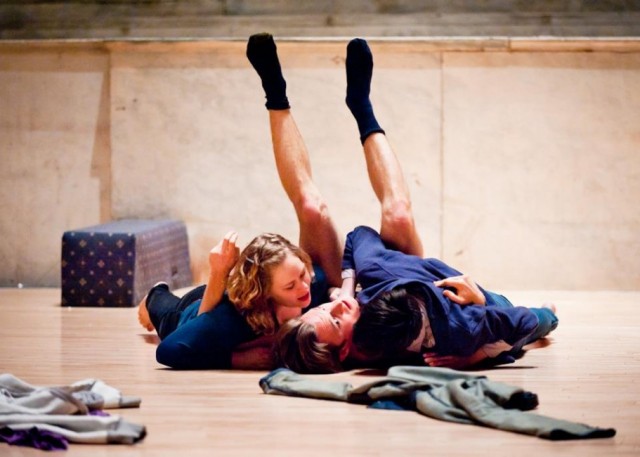
Jacob Slominski will conclude Dance under the Influence season at MAD, curated by Jack Ferver (photo courtesy of the artist)
Who: Jacob Slominski What:Dance under the Influence Where:Museum of Arts & Design, seventh floor, 2 Columbus Circle at 58th St. & Broadway, 800-838-3006 When: Friday, November 13, and Saturday, November 14, $17, 7:30 Why: The Museum of Arts & Design’s annual Dance under the Influence series, curated this year by Jack Ferver, concludes with California-born, New York City-based dancer and choreographer Jacob Slominski on November 13 & 14. Slominski has performed with such choreographers as Faye Driscoll, Ishmael Houston-Jones, and Ferver, most recently in Chambre at the New Museum. In his piece for MAD, Slominski, whose own work has been seen at such venues as Chez Bushwick and Gibney Dance, will investigate the relationship between audience and performer, particularly questioning whether the comfort level for audiences has evolved so much that the show itself is even necessary anymore. The November 13 performance will be followed by a discussion with Slominski, hosted by Ferver.
Whitney Museum of American Art
Neil Bluhm Family Galleries, fifth floor
99 Gansevoort St.
Friday, November 13, 11:00 am – 10:00 pm
Saturday, November 14, 11:00 am – finish
Free with museum admission of $18-$22
212-570-3600 whitney.org
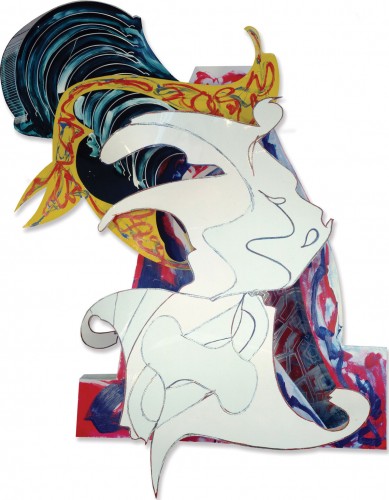
Last November’s second biennial Moby-Dick Marathon took place over the course of three days at the Ace Hotel, the South Street Seaport Museum, and the Housing Works Bookstore Cafe. This year a bonus marathon is being held November 13-14 on the fifth floor of the new Whitney, where more than 150 artists, writers, curators, editors, and others will celebrate the 164th anniversary of Herman Melville’s thousand-page 1851 epic with a two-day marathon reading in conjunction with Frank Stella’s Moby-Dick series, part of a major retrospective of the work of the Massachusetts-born, New York-based artist that continues through February 7. Stella created the works for a special 150th anniversary publication of Moby-Dick; or, The Whale, containing reproductions of sculptures, reliefs, prints, and a mural inspired by the tale of Captain Ahab’s desperate hunt for the title mammal. Among the myriad scheduled readers of the massive tome are Ben Greenman, Brian Floca, Trisha Baga, Alan Light, Morgan Parker, AK Burns, Lucky DeBellevue, Monica de la Torre, Salman Rushdie, Melissa Febos, Paul Rome, Rebecca Dinerstein, Kurt Andersen, Ben Fama, Angela Flournoy, and Rowan Ricardo-Phillips, with more to be announced.
“In 1962, while in New York to present Jules and Jim, I noticed that every journalist asked me the same question: ‘Why do the critics of Cahiers du Cinéma take Hitchcock so seriously? He’s rich and successful, but his movies have no substance,’” French Nouvelle Vague auteur François Truffaut wrote in the preface to the second edition of what he called “the hitchbook,” the seminal film bible Truffaut/Hitchcock. “In the course of an interview during which I praised Rear Window to the skies, an American critic surprised me by commenting, ‘You love Rear Window because, as a stranger to New York, you know nothing about Greenwich Village.’ To this absurd statement, I replied, ‘Rear Window is not about Greenwich Village, it is a film about cinema, and I do know cinema.’” Truffaut was determined to change the prevailing belief that British director Alfred Hitchcock was a maker of studio fluff. “In examining his films,” Truffaut continued, “it was obvious that he had given more thought to the potential of his art than any of his colleagues. It occurred to me that if he would, for the first time, agree to respond seriously to a systematic questionnaire, the resulting document might modify the American critics’ approach to Hitchcock. That is what this book is all about.” The tome compiled a weeklong series of conversations between the thirty-year-old Truffaut and the sixty-three-year-old Hitchcock — the talks began on Hitch’s birthday — in the latter’s Hollywood studio office, with Helen Scott serving as translator. Although the interviews were recorded for audio, no film was shot; instead, Philippe Halsman took still photos. The story of the unique relationship between Truffaut, who as of 1962 had made only The 400 Blows and Shoot the Piano Player (he was in the midst of finalizing Jules and Jim), and Hitchcock, who was preparing his forty-eighth film, The Birds, is told in the splendid documentary Hitchcock/Truffaut. Writer-director Kent Jones (head of the New York Film Festival), cowriter Serge Toubiana (former editor in chief of Cahiers du Cinéma) and editor Rachel Reichman lovingly combine Halsman’s pictures, audio clips from the original sessions, scenes from many of Hitchcock’s films (and a few of Truffaut’s), close-ups of dozens of pages from the book, rare archival footage, and new interviews with ten directors from around the world who weigh in on what makes Hitchcock’s work so special, so illuminating, so influential.
Sharing their praise are Martin Scorsese, Wes Anderson, David Fincher, Olivier Assayas, Peter Bogdanovich, Arnaud Desplechin, James Gray, Kiyoshi Kurosawa, Richard Linklater, and Paul Schrader, as they shed light on such classic films as Vertigo, Psycho, I Confess, The Wrong Man, Sabotage, Marnie, Rear Window, and others, with detailed shot-by-shot analysis while also praising the importance of “the hitchbook” itself. It all makes for an eye-opening crash course in cinema, and it’s likely to change the way you look and think about motion pictures. “It was a window into the world of cinema that I hadn’t had before, because it was a director simultaneously talking about his own work but doing so in a way that was utterly unpretentious and had no pomposity,” Gray (Little Odessa, Two Lovers) says about the book. “There was starting to be these kind of erudite conversations about the art form, but Truffaut was the first one where you really felt that they were talking about the craft of it,” Schrader (American Gigolo, Mishima) points out. “It’s not just that Truffaut wrote a book about Hitchcock. The book is an essential part of his body of work,” Olivier Assayas (Clouds of Sils Maria, Carlos) explains. “I think it conclusively changed people’s opinions about Hitchcock, and so Hitchcock began to be taken much more seriously,” Bogdanovich (The Last Picture Show, Paper Moon) asserts. And Scorsese (Taxi Driver, Raging Bull) sums up, “It was almost as if somebody had taken a weight off our shoulders and said yes, we can embrace this, we could go.” Of course, the book not only created a critical reassessment of Hitchcock but also helped Truffaut’s budding career. Narrated by Bob Balaban, the film places the work of the two men, who remained good friends until Hitchcock’s death in 1980 at the age of eighty (sadly, Truffaut died four years later at the age of fifty-two), in context of the history of cinema. “Why do these Hitchcock films stand up well? Well, I don’t know the answer,” Hitchcock is heard saying at the beginning of the documentary. By the end of the documentary, you will surely know the answer. Hitchcock/Truffaut is screening on November 14 at Bow Tie Chelsea Cinemas and will be followed by a Q&A with Jones and Scorsese, who collaborated on My Voyage to Italy. DOC NYC runs November 12-19, opening with the U.S. premiere of Barbara Kopple’s Miss Sharon Jones! and continuing with more than two hundred films and special events, including new and classic documentaries, master classes, panel discussions, and a keynote conversation with Jon Alpert and Sheila Nevins.
The twenty-third annual Canstruction NYC Design/Build Competition is under way at Brookfield Place, although they’re a little trickier to find this year than in the past, when they lined the Winter Garden. The architectural battle and fundraiser — visitors are asked to bring a can of high-quality, nonperishable food to donate — features more than two dozen creative structures built by teams referencing the international hunger crisis. As always, the overall construction is best viewed through a camera, but get up close and personal with the naked eye to see how ingenious many of the intricate designs are. You can vote for your favorite here. Among the impressive competitors are HOK’s “Presidential CANdidates,” Thornton Tomasetti’s “Wall Street Charging Bull,” Severud Associates’ “Spanning the Hungry Rapids,” GACE Consulting Engineers’ “The Butterfly Effect: How Far CAN Kindness Go?,” RAND Engineering & Architecture’s “Pipe Down Hunger,” and WJE Engineers & Architects’ “Yoshi’s Soup’er Mission,” although it will be mighty tough to beat out Gensler’s “What’s Up, Doc?” At the end of the competition, the structures are taken apart and the cans donated to City Harvest, so come on by, bring some nonperishable items, and help CANstruction raise upwards of 100,000 cans of food. On November 12 from 12 noon to 3:00, Jenny McCoy, a chef-instructor at the Institute of Culinary Education and author of Desserts for Every Season, will host a free presentation and tasting (of sweets made with canned food) next to Hudson Eats, right near several of the CANsculptures.
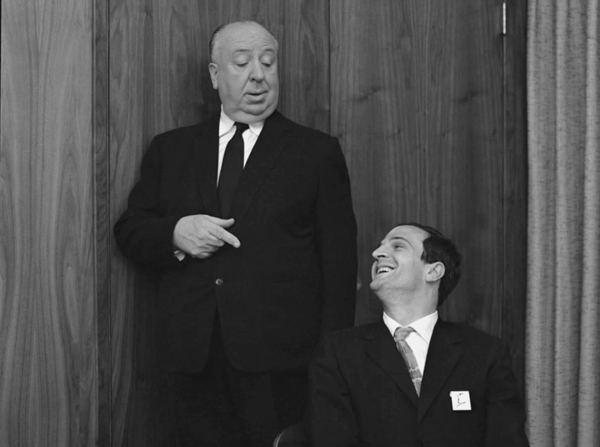
 “In 1962, while in New York to present Jules and Jim, I noticed that every journalist asked me the same question: ‘Why do the critics of Cahiers du Cinéma take Hitchcock so seriously? He’s rich and successful, but his movies have no substance,’” French Nouvelle Vague auteur François Truffaut wrote in the preface to the second edition of what he called “the hitchbook,” the seminal film bible Truffaut/Hitchcock. “In the course of an interview during which I praised Rear Window to the skies, an American critic surprised me by commenting, ‘You love Rear Window because, as a stranger to New York, you know nothing about Greenwich Village.’ To this absurd statement, I replied, ‘Rear Window is not about Greenwich Village, it is a film about cinema, and I do know cinema.’” Truffaut was determined to change the prevailing belief that British director Alfred Hitchcock was a maker of studio fluff. “In examining his films,” Truffaut continued, “it was obvious that he had given more thought to the potential of his art than any of his colleagues. It occurred to me that if he would, for the first time, agree to respond seriously to a systematic questionnaire, the resulting document might modify the American critics’ approach to Hitchcock. That is what this book is all about.” The tome compiled a weeklong series of conversations between the thirty-year-old Truffaut and the sixty-three-year-old Hitchcock — the talks began on Hitch’s birthday — in the latter’s Hollywood studio office, with Helen Scott serving as translator. Although the interviews were recorded for audio, no film was shot; instead, Philippe Halsman took still photos. The story of the unique relationship between Truffaut, who as of 1962 had made only The 400 Blows and Shoot the Piano Player (he was in the midst of finalizing Jules and Jim), and Hitchcock, who was preparing his forty-eighth film, The Birds, is told in the splendid documentary Hitchcock/Truffaut. Writer-director Kent Jones (head of the New York Film Festival), cowriter Serge Toubiana (former editor in chief of Cahiers du Cinéma) and editor Rachel Reichman lovingly combine Halsman’s pictures, audio clips from the original sessions, scenes from many of Hitchcock’s films (and a few of Truffaut’s), close-ups of dozens of pages from the book, rare archival footage, and new interviews with ten directors from around the world who weigh in on what makes Hitchcock’s work so special, so illuminating, so influential.