twi-ny recommended events

NEW YEAR’S DAY MARATHON BENEFIT READING

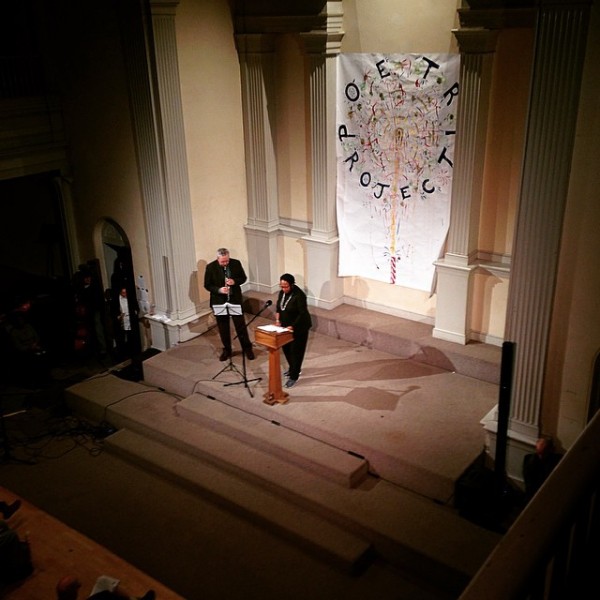
Erica Hunt and Marty Ehrlich will be back at the Poetry Project for annual New Years Day marathon

Erica Hunt and Marty Ehrlich will be back at the Poetry Project for annual January 1 marathon benefit

Who: The Poetry Project
What: Forty-second Annual New Year’s Day Marathon Benefit Reading
Where: The Poetry Project at St. Mark’s Church-in-the-Bowery, 131 East Tenth St., 212-674-0910
When: Friday, January 1, $20 in advance, $25 at the door, 2:00 pm – 12 midnight
Why: Some 150 poets will take the podium in this annual Poetry Project benefit, including Penny Arcade, Anselm Berrigan, Edmund Berrigan, Jennifer Blowdryer, Stephen Boyer, Steve Cannon, Yoshiko Chuma, CA Conrad, Maggie Dubris, Douglas Dunn, John Giorno, Philip Glass, John S. Hall, Jonas Mekas, Jennifer Miller, Jennifer Monson, Carley Moore, Thurston Moore, Eileen Myles, Elinor Nauen, Dael Orlandersmith, Church of Betty, Reno, Bob Rosenthal, Emily Skillings, Jesse Smith, Edwin Torres with David Brown, Anne Waldman with Fast Speaking Music, Ken Walker, Martha Wilson, Jenny Zhang, and more to be announced.

COLIN QUINN: THE NEW YORK STORY

(photo by Mike Lavoie)

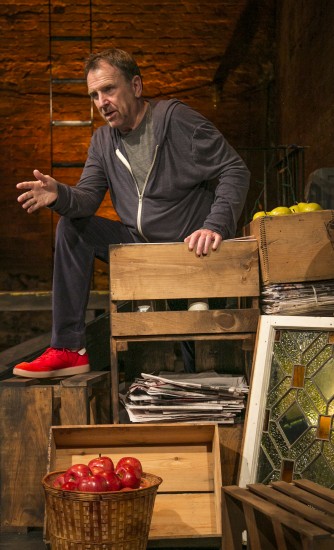
Colin Quinn explores the history and development of the New York character in one-man show (photo by Mike Lavoie)

Cherry Lane Mainstage Theatre
38 Commerce St.
Tuesday – Sunday through January 31, $25-$96
212-989-2020
www.colinquinnthenewyorkstory.com
www.cherrylanetheatre.org

Colin Quinn likes to tackle big subjects. In 2010, the actor and comedian took Broadway audiences on a journey through the history of the world in Long Story Short. In 2013 at the Barrow Street Theatre, the gruff Brooklyn-born comic explored American history in Unconstitutional. In his latest seventy-five-minute one-man show, The New York Story, based on what he claims will be his only book, The Coloring Book: A Comedian Solves Race Relations in America, Quinn examines the development (and death) of the New York persona. “Our tourist attraction is the people. Nobody else had people like this,” he says near the start of the show. “Smoking cursing rude sarcastic pushy loud fast-talking outspoken. It’s not a pleasant personality but it was entertaining and honest.” Slowly ambling across Sara C. Walsh’s old-time set, which features a classic New York City stoop, a laundry line of drying clothing, stacks of wooden crates, and small flags from many nations, Quinn discusses the Indians, the Dutch, the British, the Germans, the Irish, the Jews, the Italians, the Puerto Ricans, and the blacks, not afraid to be politically incorrect as he details what each ethnicity, religion, and race contributed to New York City. He’s no stranger to edgy material: He hosted the politically oriented comic talk show Tough Crowd, was formerly the anchor of “Weekend Update” on Saturday Night Live, has a recurring role on Girls, and played Amy Schumer’s father in Trainwreck. He can be wickedly funny about each group while respecting their individual heritages, but he’s also clearly upset about where we are today, seemingly drained of our uniqueness as New Yorkers. “First of all: positivity, inclusion, non-judgmentalism, those are all great qualities to have,” he points out. “But not in New York. This city was supposed to be the sanctuary city for the judgmental, the obnoxious, the non-positive. That’s the thing. And somewhere along the way we decided to appropriate the rest of the country’s positivity.”

The show, which begins with Odyssey’s “Native New Yorker” and concludes with Ace Frehley’s “Back in the New York Groove,” is directed by Jerry Seinfeld, who also helmed Long Story Short. It includes projections of city monuments and subway signs that are sometimes hard to make out, and Quinn often seems to be trying too hard to hit his mark instead of being more natural. But his verbal delivery is superb, speaking to the audience like he’s sharing a beer with us instead of lecturing like a professor, rambling through broken sentences as he uses his gruff Brooklyn Irish accent to expound on the state of the city he, and we, love. “The immigrants are the only ones who are still authentic,” Quinn explains. Amid all the laughs, the truth hurts. Tickets for the show are allocated geographically, from $56 for the Coney Island and Red Hook seats in the rear to, getting ever closer to the stage, $76 for Hell’s Kitchen and $96 for Washington Heights and Yonkers.

MODERN “MATINEES” — FASHIONABLY LATE: UNDERWORLD

UNDERWORLD

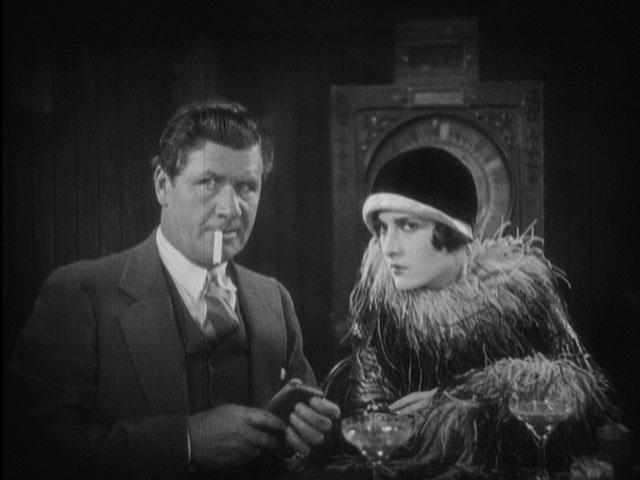
Bull Weed (George Bancroft) offers Rolls Royce (Clive Brook) a new life in Josef von Sternberg’s UNDERWORLD

UNDERWORLD (Josef von Sternberg, 1927)
MoMA Film, Museum of Modern Art
11 West 53rd St. between Fifth & Sixth Aves.
Friday, January 1, 4:00
Series runs January 1-17
Tickets: $12, may be applied to museum admission within thirty days
212-708-9400
www.moma.org

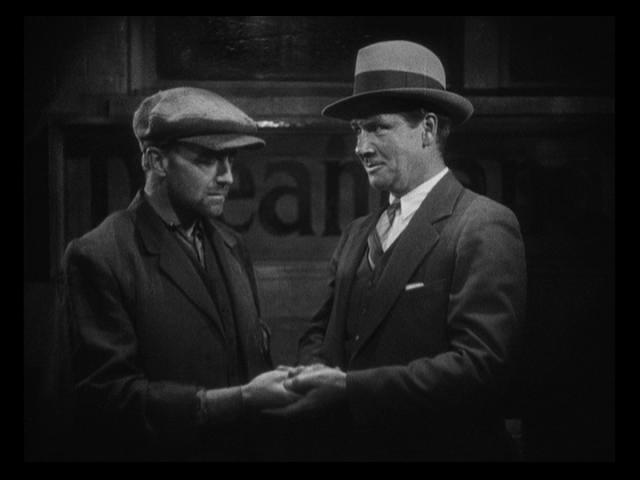
Throughout the year, MoMA shows “Modern Matinees” at 1:30 on many weekday afternoons, treating visitors with an afternoon to spare to some amazing “deep cuts” from its vast cinema library. “Modern Matinees: The Film Library Grows” is its current series, celebrating the eightieth anniversary of the Department of Film and honoring the legacy of founding curator Iris Barry. It concludes December 31 with William A. Wellman’s classic gangster picture, The Public Enemy. But as a treat for those who can’t get away for a weekday afternoon screening, MoMA is now bringing back some of its favorites in “Modern ‘Matinees’: Fashionably Late,” presenting the films at more convenient times, including on holiday and weekend afternoons and weekday evenings. “Fashionably Late” begins January 1 at 4:00 with Josef von Sternberg’s 1927 silent black-and-white Underworld, which is generally considered the first modern gangster picture and was a major influence on such films as The Public Enemy and Mervyn LeRoy’s Little Caesar, the latter scheduled for January 1 at 7:00. Sternberg’s fourth film, Underworld is set in “a great city in the dead of night. . . . streets lonely, moon-flooded. . . . buildings empty as the cliff-dwellings of a forgotten age.” The opening shot is of a superimposed clock, emphasizing that it is two o’clock in the morning, a time when most are tucked safely in their bed at home. But not Bull Weed (George Bancroft), who has just pulled off a bank heist, only to be spotted by Rolls Royce (Clive Brook), a down-on-his-luck drunken bum. At Bull’s hangout, the Dreamland Café, his girl, Feathers (Evelyn Brent), enters, and a single strand from her extravagant getup floats down, the camera following it until it is grabbed by Rolls Royce, who is sweeping the floor. Bull’s main rival, Buck Mulligan (Fred Kohler), tries to get the attention of Feathers, upsetting his own moll, Meg (Helen Lynch). Walking out of the nightclub, Bull is greeted by an electronic billboard proclaiming, “The City Is Yours.” (Howard Hawks goes one better in his seminal 1932 film, Scarface, in which the title character, Antonio “Tony” Camonte, played by Paul Muni, is encouraged by an electronic sign that tells him, “The World Is Yours.”) Laughing, Bull playfully asks Feathers, “What’ll you have?” She scoffs at him, then Rolls Royce, a former lawyer, says, “Attila, the Hun, at the gates of Rome.” To which Bull replies, “Who’s Attila? The leader of some wop gang?” The stage has been set for the rest of the film, built around jealousy and envy as both Buck and Rolls Royce, who Bull decides to rehabilitate, fall hard for Feathers, but Bull is not about to just sit back and take it.

UNDERWORLD

Bull Weed (George Bancroft) is protective of his moll, Feathers (Evelyn Brent), in classic gangster picture

Underworld is an expressionist noir melodrama that became the template for the gangster-film genre, launching many of the major tropes, from characterization to narrative development. It’s shot in shadowy glory by Bert Glennon (Lloyd’s of London, Rio Grande) from the dark streets to a glamorous annual armistice ball and a spectacular shootout finale. Journalist, novelist, and playwright Ben Hecht (Notorious, Wuthering Heights), who based Bull on real-life Chicago criminal “Terrible” Tommy O’Connor, won the Best Writing (Original Story) Academy Award at the first Oscars; Robert N. Lee wrote the screenplay, with the adaptation by Charles Furthmann and titles by George Marion Jr. Von Sternberg went on to make such classic sound films as The Blue Angel, Shanghai Express, Blonde Venus, and The Scarlett Empress with Marlene Dietrich. He directed only one full picture by himself after 1941, the 1953 Japanese war drama Anatahan; he died in Hollywood in 1969 at the age of seventy-five. “Modern ‘Matinees’: Fashionably Late” continues through January 17 with such diverse works as John Ford’s The Iron Horse, René Clair’s Un Chapeau de paille d’Italie (The Italian Straw Hat), William Dieterle’s The Life of Emile Zola, and John Huston’s The Maltese Falcon.

NOVA BY SOFTLAB

(photo by twi-ny/mdr)

SOFTlab’s “Nova” installation is winner of second annual design competition (photo by twi-ny/mdr)

North Flatiron Public Plaza
Median at intersection of Broadway, Fifth Ave., and 23rd St.
Through January 4, free
www.flatirondistrict.nyc
nova slideshow

The Flatiron/23rd Street Partnership Business Improvement District’s “23 Days of Flatiron Cheer” may be over, but the centerpiece of the holiday celebration will be delighting visitors through January 4. On North Flatiron Public Plaza, the median at the intersection of Broadway, Fifth Ave., and 23rd St., New York City design studio SOFTlab has installed “Nova,” winner of the second annual Flatiron Public Plaza Holiday Design Competition, held in conjunction with the Van Alen Institute. “Nova” is an abstract seven-starred gazebo that people can walk inside to experience colorful kaleidoscopic views of themselves and the surrounding area — Madison Square Park, the Flatiron Building, the Met Life Tower, passing traffic — reflected in cones that are angled toward various local landmarks. The outside of the pavilion consists of aluminum panels, giving it an otherworldly appearance, like an alien space ship, while the arched interior is constructed of crystalline cells composed of acrylic laminated with 3M Dichroic Film. The three-dimensional cells light up at night, giving it an extraterrestrial glow. “Nova” will remain on the plaza until January 4, after which it will beam back home.

THE HOLLYWOOD CLASSIC BEHIND WALKERS: THE LAST PICTURE SHOW

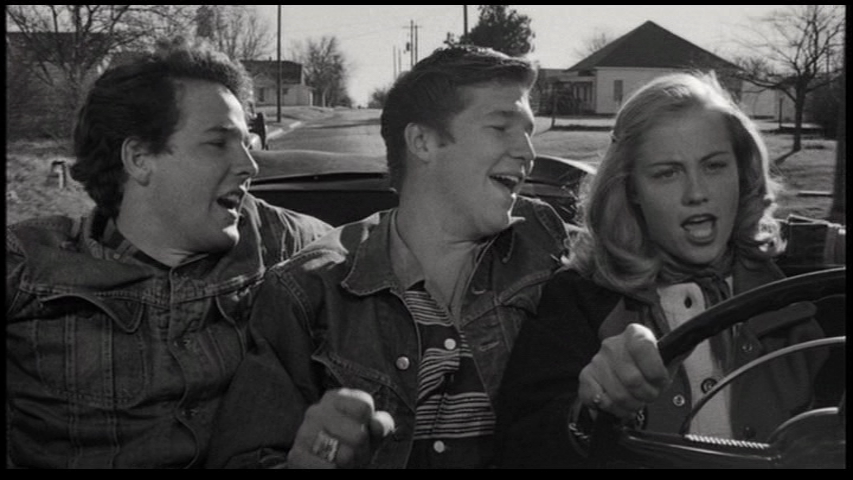
Timothy Bottoms, Jeff Bridges, and Cybill Shepherd prepare for adulthood in THE LAST PICTURE SHOW

THE LAST PICTURE SHOW (Peter Bogdanovich, 1971)
Museum of the Moving Image
35th Ave. at 36th St., Astoria
Saturday, December 26, and Sunday, December 27, $12, 7:00
Series runs through December 27
718-777-6800
www.movingimage.us

Peter Bogdanovich’s The Last Picture Show is a tender-hearted, poignant portrait of sexual awakening and coming-of-age in a sleepy Texas town. Adapted from the Larry McMurtry novel by the author and the director, the film is set in the early 1950s, focusing on Sonny Crawford (Timothy Bottoms), a teenager who works at the local pool hall with Billy (Timothy’s brother Sam), a simple-minded boy who needs special caring. Sonny’s best friend, Duane Jackson (Oscar-nominated Jeff Bridges), is dating the prettiest girl in school, Jacy Farrow (Cybill Shepherd, in her film debut), who is getting ready to test out the sexual waters, sneaking away on a date with Lester Marlow (Randy Quaid), who takes her to a naked-swimming party in a wealthier suburb of Wichita Falls. Meanwhile, Sonny breaks up with his girlfriend, Charlene Druggs (Sharon Taggart), and becomes drawn to the sad, unhappy Ruth Popper (an Oscar-winning Cloris Leachman), the wife of his football coach (Bill Thurman). The outstanding all-star cast also features Oscar-nominated Ellen Burstyn as Lois, Jacy’s mother; Eileen Brennan as a waitress in the local diner who makes cheeseburgers for Sonny; Clu Gulager as a working man who has a thing for Lois; Frank Marshall, who went on to become a big-time producer, as high school student Tommy Logan; and Oscar winner Ben Johnson as Sam the Lion, the moral center of the town and owner of the pool hall, diner, and movie theater, which shows such films as Father of the Bride and Red River. Cinematographer Robert Surtees shoots The Last Picture Show in a sentimental black-and-white that gives the film an old-fashioned feel, as if it’s a part of Americana that is fading away. Bogdanovich also chose to have no original score, instead populating the tale with country songs by Hank Williams, Bob Wills and the Texas Playboys, Lefty Frizzell, Tony Bennett, and others singing tales of woe.

In many ways the film is the flip side of George Lucas’s 1973 hit American Graffiti, which is set ten years later but looks like it’s from another century; it also has a lot in common with François Truffaut’s 1962 classic Jules and Jim. Nominated for eight Oscars including Best Picture and Best Director, The Last Picture Show is an unforgettable slice-of-life drama that will break your heart over and over again. It is screening December 26 & 27 at 7:00 in the Museum of the Moving Image series “The Hollywood Classics Behind Walkers,” which is being held in conjunction with the exhibition “Walkers: Hollywood Afterlives in Art and Artifact,” consisting of Hollywood-related photography, drawing, sculpture, print, and video by such artists as Francis Alÿs, Richard Avedon, Jim Campbell, Gregory Crewdson, Douglas Gordon, Isaac Julien, Ellen Mark, Tom Sachs, Hiroshi Sugimoto, and many others. Also screening December 26 & 27 is Sam Peckinpah’s classic Western, The Wild Bunch.

LAZARUS

(photo by Jan Versweyveld)

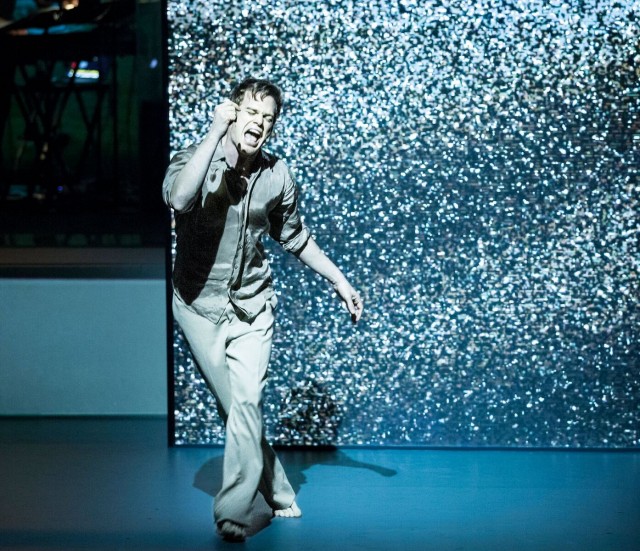
Michael C. Hall reprises David Bowie role from THE MAN WHO FELL TO EARTH in LAZARUS at NYTW (photo by Jan Versweyveld)

New York Theatre Workshop
79 East Fourth St. between Second & Third Aves.
Tuesday – Sunday through January 19, $129; Wednesday, January 20 benefit, $1,004 – $2,504
www.nytw.org

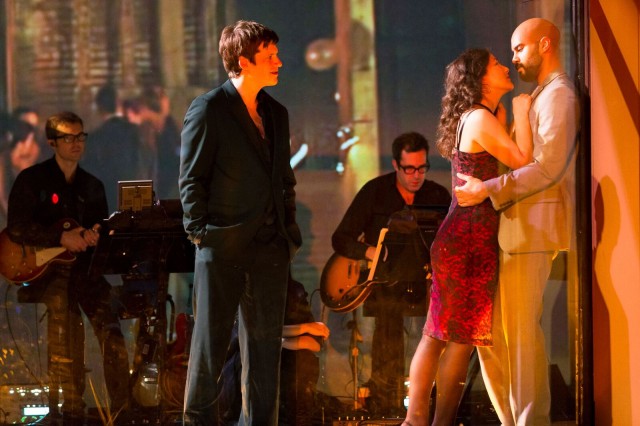
David Bowie’s resurrection after a long public absence continues with Lazarus, an intriguing, at times captivating, and often confusing musical drama at New York Theatre Workshop though January 20. A little over a decade ago, in June 2004, the iconoclastic British artist suffered a heart attack onstage and underwent emergency surgery. He stayed out of the limelight after that, making only rare appearances and not releasing a new record until 2013, The Next Day, declaring on the title track, “Here I am / Not quite dying / My body left to rot in a hollow tree / Its branches throwing shadows / On the gallows for me / And the next day / And the next / And another day.” But evidently with a renewed lust for life, Bowie has been very busy over the last few years, and he takes a fascinating look at his personal and professional past, present, and future in Lazarus, a multimedia collaboration with playwright Enda Walsh (Once, The Walworth Farce) and heavily in-demand director-of-the-moment Ivo van Hove (Scenes from a Marriage, A View from the Bridge). The show picks up some forty years after the end of The Man Who Fell to Earth, the 1976 Nicolas Roeg film in which Bowie portrayed Thomas Jerome Newton, an alien who comes to Earth to collect water to save his planet. As the audience enters the theater, Newton (Michael C. Hall) is lying flat on the stage, as if dead. He eventually rises, met by his old friend Michael (Charlie Pollock) and his new assistant, Elly (Cristin Milioti). Newton is now a retired, reclusive, wealthy former businessman who stays at home drinking gin and eating Lucky Charms and Twinkies, watching a large television screen that broadcasts things going on in his head as he agonizes over his loneliness, his wife and daughter long gone from his life. “Don’t you remember the person you were? Your life outside,” Michael asks. “That was before,” Newton answers. “And it’s all gone?” Michael says. “Of course it’s gone,” Newton responds shortly before singing “Lazarus,” one of four new songs Bowie has written for the show. “Look up here, I’m in heaven / I’ve got scars that can’t be seen / I’ve got drama, can’t be stolen / Everybody knows me now / Look up here, man, I’m in danger / I’ve got nothing left to lose,” Hall sings in a strong Bowie accent. The music is performed live by a band in a glassed-in booth across the back of the stage, behind Jan Versweyveld’s apartment set, which features a refrigerator at the right (next to a record player on the floor with a pile of Bowie LPs), a bed at the left, and a large screen at the center. Newton is soon visited by a young girl (Sophia Anne Caruso) who he knows is a figment of his imagination, there to help him find purpose in his life, as well as hers. “You’re not dying, are you?” she asks. “A little bit every day. I’m a dying man who can’t die,” he says. “That’s a joke, right?” she replies. “Yes, not being able to die is a joke. A fucking terrible joke,” he states. Newton’s life is further complicated by three teenage girls (Krystina Alabado, Krista Pioppi, and Brynn Williams) who form a kind of Greek chorus, the mysterious Valentine (Michael Esper), Elly’s jealous husband, Zach (Bobby Moreno), and a couple madly in love, Maemi (Lynn Craig) and Ben (Nicholas Christopher).
(photo by Jan Versweyveld)

Ivo van Hove’s LAZARUS uses David Bowie songs to explore love and loneliness (photo by Jan Versweyveld)

Lazarus was inspired by Walter Tevis’s 1963 science-fiction novel, The Man Who Fell to Earth, in which Newton is described thusly: “He was human; but not, properly, a man. Also, man-like, he was susceptible to love, to fear, to intense physical pain and to self-pity.” Hall (Hedwig and the Angry Inch, Cabaret) embodies the character with a tender simplicity despite the craziness that Newton is experiencing. As the girl, Caruso again shows intelligence and instincts well beyond her fourteen years, as she did earlier in 2015 in Jennifer Haley’s The Nether. The music, consisting of new arrangements of Bowie classics and deep cuts, from 1970’s The Man Who Sold the World, 1971’s Hunky Dory, 1980’s Scary Monsters, and The Next Day, in addition to the four new songs, is a treat for Bowie fans, especially the Japanese and English “It’s No Game (Part 1),” Pollock’s “The Man Who Sold the World,” Hall’s “Where Are We Now?” and “Killing a Little Time,” and Caruso’s “Life on Mars.” In a soft, gentle version of “Changes,” Tony nominee Milioti (Once) sings “Turn and face the strange,” and strangeness is just what keeps this production from soaring into the stratosphere. Too much of Lazarus, which is about love and loss and making connections, is head-scratchingly opaque, particularly the use of the video monitor; Tal Yarden’s projections are occasionally poetic and visually striking but much more often bewildering, muddying the narrative with perplexing shots that could be memories, long-gone dreams and desires, or — well, by the time Alan Cumming appears onscreen, you can forget about trying to figure out what’s going on. But if you instead concentrate on Hall’s thrilling performance, the central relationship between Newton and the girl, and the outstanding musical numbers, Lazarus will lift you up, making you thankful that Bowie has returned to Earth to share his unique, and plenty strange, world view with us mere mortals again.
MARK BRADFORD: BE STRONG BOQUAN

(photo by twi-ny/mdr)

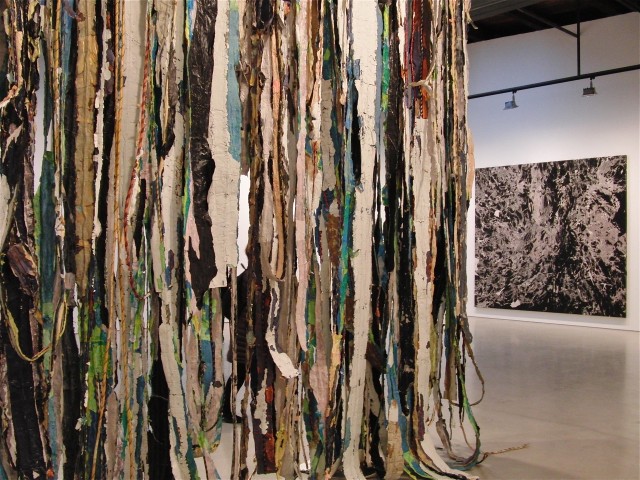
Mark Bradford, “Waterfall” (foreground), mixed media, 2015, and “Black and White” (background), mixed media on canvas, 2015 (photo by twi-ny/mdr)

Who: Mark Bradford
What: “Be Strong Boquan”
Where: Hauser & Wirth, 511 West 18th St. between Tenth & Eleventh Aves., 212-790-3900
When: Through Wednesday, December 23, free, 10:00 am – 6:00 pm
Why: Los Angeles artist Mark Bradford has had quite a 2015, highlighted by a major exhibition, “Scorched Earth,” at the Hammer Museum; setting a personal record when his painting “Smear” sold for $4.4 million at Sotheby’s in May; being named Artist of the Year by The Week magazine; completing a commission for a lobby work at Rockefeller Center; and having his first New York City solo show at his new gallery, Hauser & Wirth. The H&W exhibit, “Be Strong Boquan,” which continues through December 23, is breathtaking, consisting of nine large-scale mixed-media collages, two short films, a text-based work, and “Waterfall,” which encompasses dozens and dozens of strips of scraps from his studio, all draped over a metal bar. Bradford’s “paintings” are actually palimpsestual collages made out of billboard flyers, colored paper, posters, newsprint, and photographs layered with clear shellac on a stretched canvas; he also adds twine and other objects that he pulls to form rivulets that tear through the pieces. From a distance they look like abstract paintings, but up close you can see the depth and density of the materials, adding a mesmerizing sculptural physicality to the works, which reference urban violence, race riots, the AIDS crisis, gender identity, and other social concerns. Bradford gives the works such titles as “Hunger with Salt and Pepper Tastes Better,” “Killing the Goodbye,” and “Dead Hummingbird,” names that stand in stark contrast to the visceral beauty of the canvases. In the long, horizontal video installation “Deimos,” Bradford brings roller-skate wheels to animated stop-motion life, dancing to the soul funk of Sylvester’s “Grateful,” paying tribute to the “Queen of Disco” who died from AIDS in 1988 at the age of forty-one. (The wheels were left over from the old Roxy nightclub, which previously inhabited the H&W space on Eighteenth St.) Bradford’s “Spiderman” reimagines Eddie Murphy’s controversial 1983 “Delirious” stand-up special; a red spotlight shines on a vacant space as a black comedian can be heard on the film, which shows only the words being said, not the speaker, who discusses Michael Jackson, Eazy-E, and AIDS as an unseen audience laughs at his jokes. “Be Strong Boquan” is a breakthrough exhibit for Bradford, who at the age of fifty-four is experiencing a well-deserved surge in his career.