Restoration of Orson Welles’s CHIMES AT MIDNIGHT is playing special engagement at Film Forum
CHIMES AT MIDNIGHT (FALSTAFF) (Orson Welles, 1965)
Film Forum
209 West Houston St.
January 1-19
212-727-8110
filmforum.org
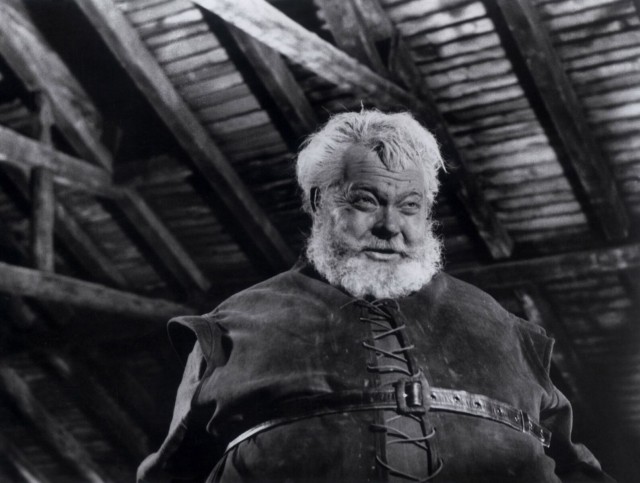
 “Jesus, the days that we have seen,” Justice Shallow (Alan Webb) says to Sir John Falstaff (Orson Welles) several times at the beginning of Chimes at Midnight, as the two old friends walk through a snowy forest. “We have heard the chimes at midnight,” Falstaff replies. Welles’s career as a writer, director, and actor in theater, television, radio, and film was fraught with conflict as budget problems, scheduling issues, and fights with producers led to a slew of unfinished projects and works edited against his wishes. Welles might have achieved his legendary status with such classic films as Citizen Kane, The Magnificent Ambersons, and Touch of Evil, but his own personal favorite was the 1965 black-and-white Chimes at Midnight (aka Falstaff). Welles spent decades working on his unique retelling of the story of the big, bawdy Sir John, attempting various stage productions before finally making the film in Spain in 1964-65. The script was adapted from Shakespeare’s Henry IV, Parts 1 and 2, Richard II, Henry V, and The Merry Wives of Windsor, with historical narration by Sir Ralph Richardson from the sixteenth-century Holinshed’s Chronicles. Welles is both boisterous and sad as Falstaff, a larger-than-life braggadocio who is both friend and father figure to Hal (Keith Baxter), the Prince of Wales, whose father, Henry IV (Sir John Gielgud), gained the throne by murdering Richard II. Hal would rather cavort with Ned Poins (Tony Beckley), Falstaff, and Falstaff’s rogue circle, which includes Pistol (Michael Aldridge), Bardolph (Patrick Bedford), and Peto, than serve the king at the castle. Meanwhile, Richard II’s supporters, led by the Earl of Worcester (Fernando Rey), Henry Percy, known as Hotspur (Norman Rodway), and the Earl of Northumberland (José Nieto), plot to take back the crown. Much of the film is set in the Boar’s Head Tavern, which is run by the elderly Mistress Quickly (Margaret Rutherford) and where Falstaff engages with prostitute Doll Tearsheet (Jeanne Moreau). Everything comes crashing together during the Battle of Shrewsbury, one of the most exciting, breathtaking battle scenes ever filmed, a nearly ten-minute spectacle of fierce fighting interlaced with Falstaff’s comic bumbling and concluding with Hal and Hotspur’s climactic face-off.
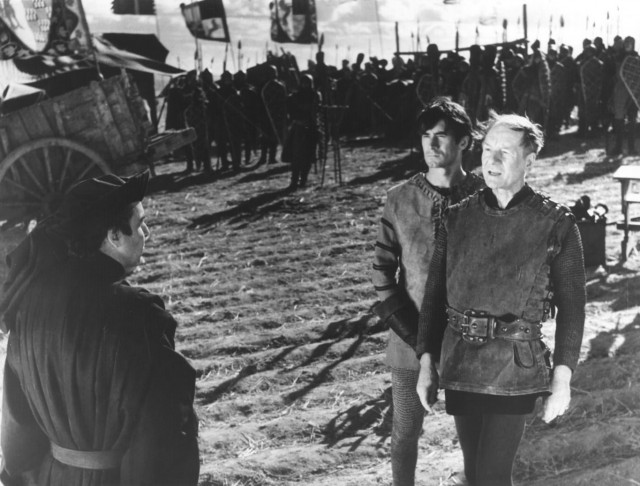
Lines are drawn for classic battle after the Earl of Northumberland (Fernando Rey) meets with Prince Hal (Keith Baxter) and King Henry IV (Sir John Gielgud) in CHIMES AT MIDNIGHT
Chimes at Midnight, which Welles called his “greatest film ever,” is one of the grandest Shakespeare adaptations ever committed to celluloid, a staggering achievement despite all of the usual roadblocks in Welles’s way, including limited time with the actors (resulting in many pick-up shots of stand-ins for Gielgud and others, seen from the back — Welles has boasted about one scene in particular in which seven actors are all played by stand-ins), continual funding dilemmas (to the point where Welles convinced one producer that he was actually making Treasure Island), location issues, and poor audio dubbing (with Welles sometimes providing the dialogue for other characters; even the great Fernando Rey’s voice is dubbed in by someone else because of the Spanish actor’s strong accent). Welles plays Falstaff with a gluttonous lust for life that is intoxicating and infectious, even as his certain fate nears, echoing Welles’s personal life and professional career. “What is difficult about Falstaff, I believe, is that he is the greatest conception of a good man, the most completely good man, in all drama,” Welles explained about the role, which he called “the most difficult part I ever played,” one he performed onstage, on film, and even on The Dean Martin Show. “He was a spokesman, you might say, for Merrie England, the old Merrie England of May mornings and midsummer eves, when even villainy was innocent,” Welles added. “The film was not intended as a lament for Falstaff, but for the death of Merrie England. . . . It is more than Falstaff who is dying. It’s the old England, dying and betrayed.” Cinematographer Edmond Richard (The Trial, The Discreet Charm of the Bourgeoisie) gets right up close to Welles, exploiting his massive face and girth, while shooting other scenes from a distance, using a depth of focus that highlights the loneliness of the king in empty, shadowy rooms as he ponders his future; Richard makes the scenes in the tavern feel almost claustrophobic, concentrating on low angles and swirling movement. Baxter, who is eerily reminiscent of Anthony Perkins (Perkins, who had previously starred in Welles’s adaptation of Kafka’s The Trial, actually wanted the role, but Welles had already promised it to Baxter, who performed it onstage as well), plays Hal with a childlike delight until things start getting serious during and after the intense, mind-blowing Battle of Shrewsbury, which directly influenced such films as Braveheart and Saving Private Ryan and is still as powerful as ever. In many ways, Chimes at Midnight is the culmination of Welles’s career as a writer, director, actor, and producer, his last fiction film to be released theatrically. “If I wanted to get into heaven on the basis of one movie, that’s the one I would offer up,” he said. “I think it’s because it is to me the least flawed; let me put it that way. It is the most successful for what I tried to do. I succeeded more completely in my view with that than with anything else.”
The film has been little seen over the decades, in part because of rights issues as well as the quality of the available prints. But in honor of its fiftieth anniversary and the centennial of Welles’s birth, a beautiful digital restoration of Chimes at Midnight, more than twenty years in the making (courtesy of Janus Films and the Criterion Collection), is now touring the country, screening January 1-12 at Film Forum. “There is no film we have waited longer for or worked harder to free up, and none we are prouder to present,” Criterion president Peter Becker recently told Wellesnet. Chimes at Midnight, in which Welles’s daughter, Beatrice, also appears, now looks better than ever, as if it’s a brand-new film, earning reconsideration as the masterpiece it truly is. And there’s more to come, as work continues on a full 4K restoration and preservation that, Becker noted, will take years to complete. The film, which won the Grand Technical Prize at Cannes and a Twentieth Anniversary Prize for Welles, takes on new meaning all these years later, knowing what became of Welles and his legacy. It’s very much a film about family, friendship, loyalty, and aging; even though Welles was only forty-nine at the time he made the film, he was already considered old and past his prime. This new restoration of Chimes at Midnight, however, shows the film to be an ageless classic, Welles firmly at the height of his estimable powers. (Baxter will be at Film Forum on January 6 to introduce the 7:30 screening and participate in a Q&A after.)

 Bernardo Bertolucci’s sexiopolitical look at Paris in the tumultuous year of 1968 focuses on three individuals: Matthew (Dawson Creek’s Michael Pitt), a shy American studying in France; Theo (French heartthrob Louis Garrel), a cigarette-smoking oh-so-French moody lad; and Isabelle (Penny Dreadful’s Eva Green), Theo’s “twin” who likes to walk around naked and flirt with both Matthew and Theo. The trio acts out scenes from films, plays dangerously erotic games, and drinks a lot of wine as the outside world comes crashing down around them. Green (Casino Royale, Kingdom of Heaven) is mesmerizing in her film debut, Pitt (Funny Games, Seven Psychopaths) reveals that he has few shortcomings, and the NC-17 rating is sure to attract an interesting crowd. And look out for a cameo appearance by Jean-Pierre Léaud playing himself. This is Bertolucci’s third film set in Paris, following


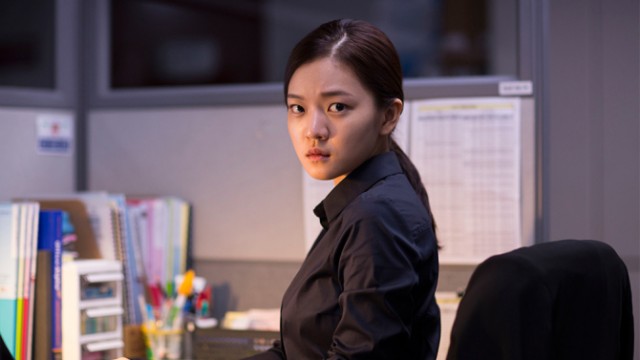
 Following its prestigious midnight film screening at Cannes this past May, Hong Won-chan’s debut feature, Office, was the opening-night selection of the 2015 New York Korean Film Festival in November at the Museum of the Moving Image. If you missed it then, you have another chance to see it in Queens on January 3, as it is one of eight films that comprise the museum’s “Curators’ Choice” series, its annual survey of some of the best films of the year. In the contemporary thriller, written by Choi Yun-jin (Steel Cold Winter), Seoul salaryman Kim Byung-Guk (Bae Seong-woo) calmly comes home from work one night and butchers his family with a hammer. The next morning, Detective Jong-hoon (Park Sung-woong) arrives at the office with plenty of questions, but no one has much to say about the killer, who was part of sales team #2 — although they are clearly hiding something. Only frazzled, insecure, wide-eyed intern Lee Mirae (Ko Ah-sung), who had a friendly relationship with Kim, wants to tell the truth, but she keeps her mouth shut, harassed by her boss (Ryu Hyun-kyung) and director Kim (Kim Eui-sung). When it is discovered that the murderer returned to the office after committing his vicious crime and may still be in the building, the tension ramps up, as does the body count.