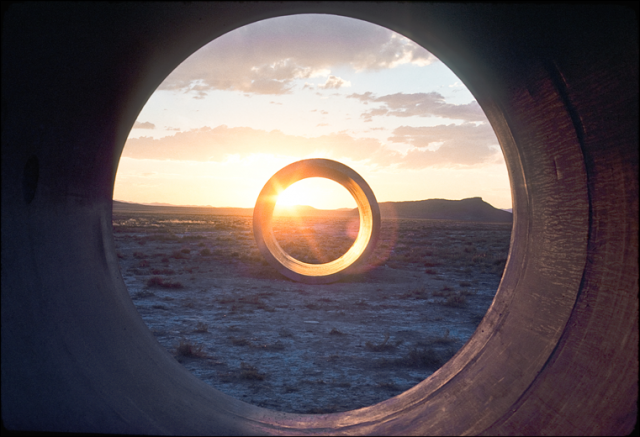
James Crump shines a light on the iconoclastic earthworks artists — and such massive projects as Nancy Holt’s “Sun Tunnels,” above — in TROUBLEMAKERS
TROUBLEMAKERS: THE STORY OF LAND ART (James Crump, 2014)
IFC Center
323 Sixth Ave. at West Third St.
Opens Friday, January 8
212-924-7771 www.ifccenter.com troublemakersthefilm.com
In the 1960s, a small group of experimental artists rejected the gallery system and the traditional art market by turning the planet into their canvas, creating monumental, often apocalyptic “earthworks” in far-off locations in the American Southwest that were nearly impossible to find. Director James Crump explores who these iconoclastic pioneers were and what they accomplished — and, in some cases, are still doing — in Troublemakers: The Story of Land Art. “The idea of land art is to relate to the idea of the globe, especially after the spaceship, the first picture of the earth, [gave] you the idea that earth is an object, so the idea for these artists after 1963 is that you can shape something, which is a sphere,” explains arte povera expert and art historian Germano Celant, who goes on to talk about the influence of airplane flight and Marcel Duchamp. “So the idea of looking from a high level is changing the perspective, your knowledge about art. And you can design it, you can draw. The area of view is a change in the history of art. It’s all this kind of convergence of information — technology, information, and history — that makes land art.” Crump (Black White + Gray) concentrates primarily on three artists, Robert Smithson, Michael Heizer, and Walter De Maria, combining rarely shown archival footage, photographs, and film clips with old and/or new interviews of artists Carl Andre, Vito Acconci, Charles Ross, Willoughby Sharp, Lawrence Weiner, and Nancy Holt (Smithson’s widow) and gallerists Paula Cooper and Virginia Dwan.
James Crump interviews Lawrence Weiner about the land-art movement in TROUBLEMAKERS
Dwan, a major supporter of the land artists, shares compelling stories about the individuals, both their personalities and their working process, while Acconci discusses the movement from a more philosophical angle, referring to the minimalist, conceptual earthworks as “an exchange with nature” that was “a new kind of religious pilgrimage.” Using bulldozers, excavators, and even earthquakes as their brushes, these artists carved, dug, and constructed massive projects in places that very few people would ever get to see, more concerned with the earth, the sun, and the vast landscape of the planet than with creating art that could be shown in galleries and museums and sold to collectors and corporations. Crump examines such remarkable projects as Smithson’s “Spiral Jetty,” Heizer’s “Double Negative,” De Maria’s “The Lightning Field,” Holt’s “Sun Tunnels,” and Ross’s forty-plus-year work-in-progress, “Star Axis,” some of which you can still see today. But earthworks, which were in part a response to the Vietnam War, were not a rejection of the city itself; Troublemakers shows many of the artists hanging out at Max’s Kansas City on Park Ave., where they ate, drank, and made professional connections. But one artist who avoided that scene was Heizer, who just had a show at Gagosian in Chelsea and did not participate in the making of the documentary. “It’s not worth anything,” he says about his art. “In fact, it’s an obligation.” A refreshing look at an utterly intriguing moment in twentieth-century art — and at a movement that takes on new meaning as the planet is in peril as a result of climate change — Troublemakers opens January 8 at the IFC Center; Crump will participate in a Q&A following the 4:25 screening on January 9.
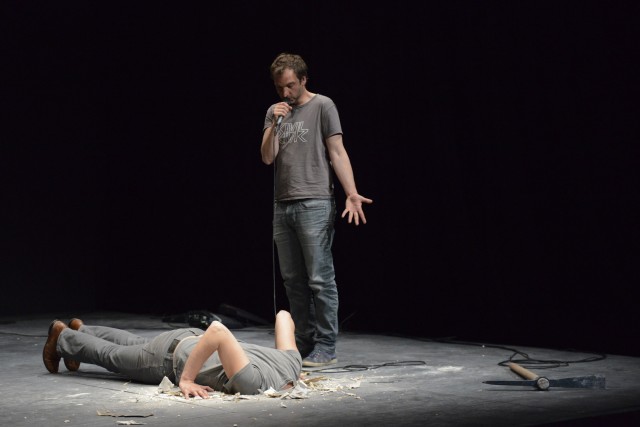
The stars were out in force on January 6 for the opening night of the Public Theater’s twelfth annual Under the Radar Festival. Among those squeezing into the sold-out Newman Theater for the New York premiere of the highly touted international hit Germinal were David Byrne, Laurie Anderson, John Leguizamo, and Denis O’Hare. The eighty-minute piece, inspired by Gustave Flaubert’s posthumously published 1899 novel Bouvard et Pécuchet, uses the magic and mechanics of stage craft to help construct a mysterious new plane of existence, as the characters create a unique theatrical experience while modeling the birth of a civilization. Conceived by Halory Goerger and Antoine Defoort of l’Amicale de Production, the vastly entertaining, highly literate, and charmingly goofy show begins with some playful lighting effects, as if the God of Theater has slowly declared, “Let there be light.” Soon Arnaud Boulogne, Sébastien Vial, Ondine Cloez, and Defoort are each using small, handheld machines to manipulate first the lights, then their thoughts, conjuring them onto the back wall. Reminiscent of babies finding their way outside their mother’s womb, the four erstwhile explorers delve into the nature of language, sound, speech, communication, identity, recognition, classification, music, architecture, archaeology, self-expression, and various philosophical conundrums that would make Roland Barthes proud, Samuel Beckett happy, and Bertolt Brecht concerned. Social interaction takes center stage as they seek out connections of all sorts in addition to reason, meaning, and, well, just plain old fun. Boulogne, Vial, Cloez, and Defoort may give the appearance that everything is low-tech and improvised, but Germinal is actually a brilliantly seamless use of modern technology choreographed to the second. As the delighted audience filed out, we couldn’t help but think that if you could put younger versions of Byrne, Anderson, Leguizamo, and O’Hare onstage together in a black-box theater with today’s technology, you just might end up with something very much like Germinal.
Machiko Kyō stars as a married woman being chased by an obsessed samurai in Teinosuke Kinugasa’s GATE OF HELL
GATE OF HELL (地獄門) (JIGOKUMON) (Teinosuke Kinugasa, 1953)
Japan Society
333 East 47th St. at First Ave.
Friday, January 8, $12, 7:00
212-715-1258 www.japansociety.org
Japan Society’s January edition of its Monthly Classics series harkens back to its past with Teinosuke Kinugasa’s lush, vibrant jidaigeki film, Gate of Hell; the society sponsored the movie’s U.S. premiere at the Guild Theatre in December 1954, the first Japanese color film ever to be shown in America. Set during the twelfth-century Heiji Rebellion, the samurai drama, based on a play by Kan Kikuchi, focuses on Morito Endo’s (Kazuo Hasegawa) dark, absurd obsession with Lady Kesa (Machiko Kyō), a married woman who is very much in love with her husband, Wataru Watanabe (Isao Yamagata). After protecting Lady Kesa and helping defend his lord, Morito is offered whatever he wants by Kiyomori the Monk (Koreya Senda). The court laughs at Morito when he asks for Lady Kesa’s hand in marriage, but when Kiyomori decides to humor him, Morito opts to pursue his goal, no matter the cost, or the humiliation.
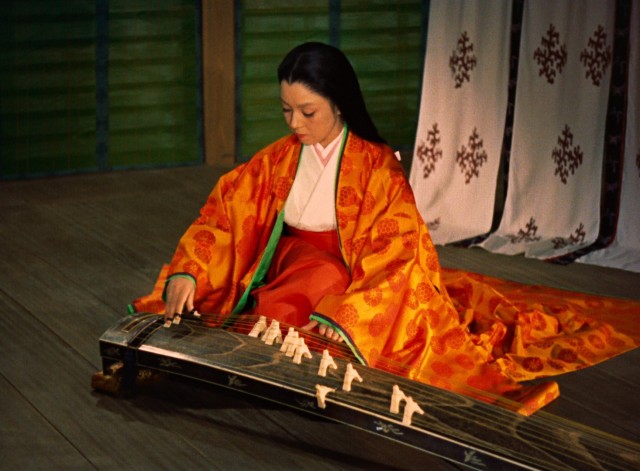
Teinosuke Kinugasa’s award-winning GATE OF HELL is filled with lush colors and beautiful cinematography
Gate of Hell, which won the Grand Prix at the 1954 Cannes Film Festival and Best Costume Design (Sanzo Wada) and a special Honorary Foreign Language Film Award at the 1955 Oscars, was beautifully restored a few years ago, its dazzling colors now jumping off the screen in a barrage of eye-catching orange, turquoise, purples, greens, and reds. Kōhei Sugiyama’s breathtaking cinematography spectacularly captures Wada’s gorgeous costumes and both the indoor and outdoor sets, the deep, detailed compositions giving the film a rousing 3D feel, from a single red flower in a green field to two rows of men lined up in a room to a battle scene in the woods. The leads will be very familiar to Japanese film fans; Hasegawa appeared in nearly three hundred movies, including Kenji Mizoguchi’s The Crucified Lovers and Kinugasa’s Jujiro and Tsukigata Hanpeita, among others, while Kyō starred in Akira Kurosawa’s Rashomon, Mizoguchi’s Ugetsu and Street of Shame, Yasujirō Ozu’s Floating Weeds, and Hiroshi Teshigahara’s The Face of Another. The Monthly Classics series continues on February 5 with Kihachi Okamoto’s The Sword of Doom.
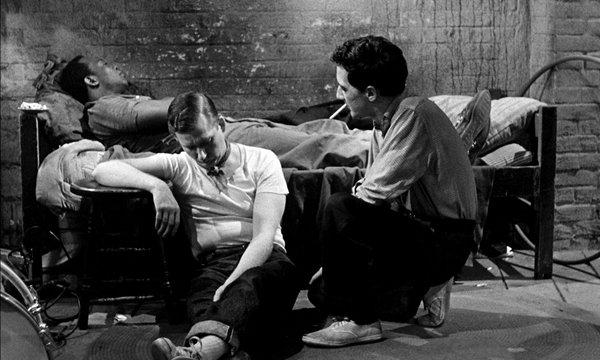
THE CONNECTION kicks off new film series at Museum of Arts & Design
THE CONNECTION (Shirley Clarke, 1962)
Museum of Arts & Design
2 Columbus Circle at 58th St. & Eighth Ave.
Friday, January 8, $10, 7:00
Series continues Friday nights through February 26
800-838-3006 madmuseum.org www.milestonefilms.com
“Now look, you cats may know more about junk, see,” square film director Jim Dunn (William Redfield) says midway through The Connection, “but let me swing with this movie, huh?” Adapted by Jack Gelber from his play and directed and edited by Shirley Clarke, The Connection is a gritty tale of drug addicts awaiting their fix that was banned for obscenity after only two matinee screenings back in October 1962. In 2013, it was released in a sharp new fiftieth-anniversary print, beautifully restored by Ross Lipman of the UCLA Film & Television Archive, which you can see January 8 as it kicks off the Museum of Arts and Design’s new “Eye of a Director” series. The inaugural program, which continues on Friday nights through February 26, focuses on the work of Clarke and her daughter, documentary filmmaker Wendy Clarke. The Connection takes place in a New York City loft, where eight men are waiting for their man: Leach (Warren Finnerty), the ringleader who has an oozing scab on his neck; Solly (Jerome Raphael), an intelligent philosopher who speaks poetically about the state of the world; Ernie (Garry Goodrow), a sad-sack complainer who has pawned his horn but still clutches tight to the mouthpiece as if it were a pacifier; Sam (Jim Anderson), a happy dude who tells rambling stories while spinning a hula hoop; and a jazz quartet consisting of real-life musicians Freddie Redd on piano, Jackie McLean on sax, Larry Richie on drums, and Michael Mattos on bass. Dunn and his cameraman, J. J. Burden (Roscoe Lee Browne), are in the apartment filming the men as Dunn tries to up the drama to make it more cinematic as well as more genuine. “Don’t be afraid, man,” Leach tells him. “It’s just your movie. It’s not real.” When Cowboy (Carl Lee) ultimately shows with the stuff, Bible-thumping Sister Salvation (Barbara Winchester) at his side, things take a decidedly more drastic turn.
Mixing elements of the French New Wave with a John Cassavetes sensibility and cinema verité style, Clarke has made an underground indie classic that moves to the beat of an addict’s craving and eventual fix. Shot in a luridly arresting black-and-white by Arthur Ornitz, The Connection is like one long be-bop jazz song, giving plenty of time for each player to take his solo, with standout performances by McLean musically and Raphael verbally. The film-within-a-film narrative allows Clarke to experiment with the mechanics of cinema and challenge the audience; when Dunn talks directly into the camera, he is speaking to Burden, yet he is also breaking the fourth wall, addressing the viewer. Cutting between Burden’s steady camera and Dunn’s handheld one, Clarke adds dizzying swirls that rush past like a speeding subway train. A New York City native, Clarke, who died in Boston in 1997 at the age of seventy-seven, made such other films as The Cool World and Portrait of Jason and won an Academy Award for her 1963 documentary, Robert Frost: A Lover’s Quarrel with the World. The new print of The Connection is part of Milestone Films’ Shirley Clarke Project, which is preserving and restoring a quartet of her best work. The MAD series includes Ornette: Made in America, Portrait of Jason, and a shorts program as well as independent video artist Wendy Clarke’s Love Tapes, One on One, L.A. Link, and other films, the first time her work will be shown with that of her mother. “From my point of view, my mother could do anything,” Wendy Clarke, who will be at MAD for Q&As following screenings on February 5 and 12, explains on the series website. “She gave me the gift of gender confidence that she had to fight for. We had a very special relationship, one that not many artists that I know experienced. She was completely supportive of my work and we had long conversations about the potential of the video, film, dance, and painting mediums. My mother wanted us to show our work together and it has taken until the MAD retrospective for this to happen.”
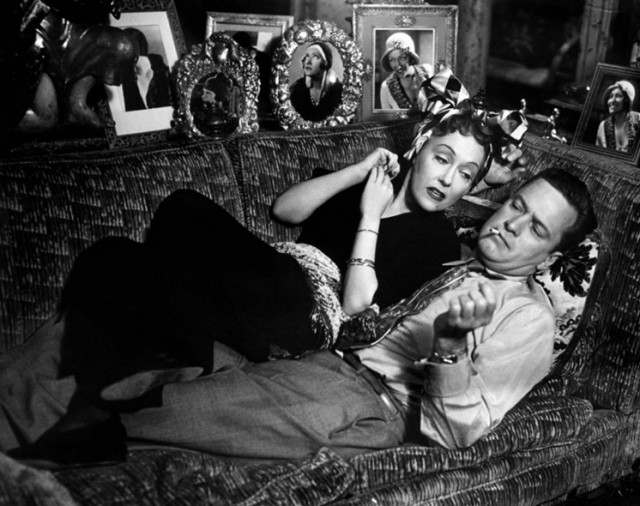
Billy Wilder takes audiences down quite a Hollywood road in SUNSET BLVD.
SUNSET BOULEVARD (Billy Wilder, 1950)
Rubin Museum of Art
150 West 17th St. at Seventh Ave.
Friday, January 8, $10, 9:30
Series continues Friday nights through February 26
212-620-5000 rubinmuseum.org
“You’re Norma Desmond. You used to be in silent pictures. You used to be big,” handsome young screenwriter Joe Gillis (William Holden) remarks to an older woman in Billy Wilder’s Sunset Boulevard. “I am big. It’s the pictures that got small,” the former star (Gloria Swanson) famously replies. It doesn’t get much bigger than Sunset Boulevard, one of the grandest Hollywood movies ever made about Hollywood. The wickedly entertaining film noir begins in a swimming pool, where Gillis is a floating corpse, seen from below. He then posthumously narrates through flashback precisely what landed him there. On the run from a couple of guys trying to repossess his car, the broke Gillis ends up at a seemingly abandoned mansion, only to find out that it is home to Desmond and her dedicated servant, Max Von Mayerling (Erich von Stroheim). They initially mistake Gillis for the undertaker who is coming to perform a funeral service and burial for Desmond’s pet monkey. (You’ve got to see it to believe it.) When Desmond discovers that Gillis is in fact a screenwriter, she lures him into working with her on her script for a new version of Salome, in which she is determined to play the lead role. “I didn’t know you were planning a comeback,” Gillis says. “I hate that word,” Desmond responds. “It’s a return, a return to the millions of people who have never forgiven me for deserting the screen.” But just as Desmond was unable to make the transition from silent black-and-white films to color and sound pictures, getting Salome off the ground is not going to be as easy as she thinks. Hollywood can be a rather vicious place, after all.
Norma Desmond (Gloria Swanson) keeps a close hold on screenwriter Joe Gillis (William Holden) in SUNSET BLVD.
Nominated for eleven Oscars and winner of three — for the sharp writing, the detailed art/set decoration, and Franz Waxman’s score, which goes from jazzy noir to melodrama — Sunset Boulevard wonderfully bites the hand that feeds it, skewering Hollywood while making references to such real stars as Rudolph Valentino, Mabel Normand, John Gilbert, Greta Garbo, Wallace Reid, and Tyrone Power and such films as Gone with the Wind and King Kong. Actual publicity stills and movie posters abound, in Paramount offices and Desmond’s spectacularly designed home, which was once owned by J. Paul Getty and would later be used for Rebel without a Cause. Cecil B. DeMille, who directed Swanson in many silent films, plays himself in the movie, seen on set making Samson and Delilah. Desmond’s fellow bridge players are portrayed by silent stars Buster Keaton, H. B. Warner, and Anna Q. Nilsson. Meanwhile, before Swanson fired him, von Stroheim directed her in the silent film Queen Kelly, which is the movie Max shows Gillis in Desmond’s screening room. (Swanson herself would go on to make only three more feature films; she passed away in 1983 at the age of eighty-four.) John F. Seitz’s black-and-white cinematography and inventive use of camera placement, from underwater to high above the action, makes the most of Hans Dreier’s sets and Swanson’s fabulous costumes and makeup. Sunset Boulevard is the thirteenth and final collaboration between writer-director Wilder and writer-producer Charles Brackett, who together previously made The Lost Weekend and A Foreign Affair. Wilder and Holden would go on to make Stalag 17, Sabrina, and Fedora together. Finally, of course, Sunset Boulevard concludes with one of the greatest quotes in Hollywood history. Sunset Boulevard is screening January 8 as part of the Rubin Museum Cabaret Cinema series “Steve McCurry Selects,” held in conjunction with the photo exhibition “Steve McCurry: India,” and will be introduced by a special guest. The series continues Friday nights through February 26 with such other classics as Jean Renoir’s The Grand Illusion, Carol Reed’s The Third Man, and Federico Fellini’s Amarcord.
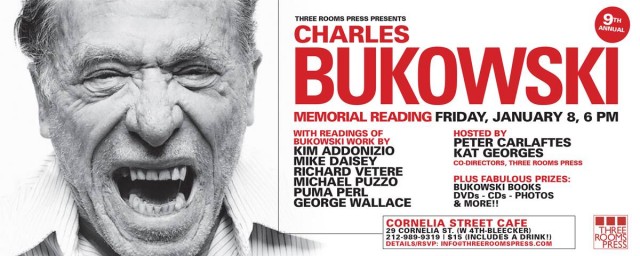
Who:Three Rooms Press Presents the Monthly @ Cornelia Street Cafe What:Ninth Annual Charles Bukowski Memorial Reading Where:Cornelia Street Cafe, 29 Cornelia St., 212-989-9319 When: Friday, January 8, $15 (includes one drink), 6:00 pm Why: “What sort of cultural hangover keeps Charles Bukowski in print and popular more than twenty years after his death?” S. A. Griffin asks in the new Three Rooms Press essay “Charles Bukowski: Dean of Another Academy.” “In light of the fact that a good portion of what has been published since his passing in 1994 may not be the man’s best work, along with some heavy editing at times, why does Charles Bukowski remain relevant well into the 21st century?” The ninth annual Charles Bukowski Memorial Reading at Cornelia Street Cafe will explore what Bukowski would think about today’s society, with tribute readings by Kim Addonizio, Mike Daisey, Richard Vetere, Puma Perl, Michael Puzzo, George Wallace, and anyone else who signs up before 6:00, hosted by Kat Georges and Peter Carlaftes and featuring rare photos and videos, oral history, prizes, and more.
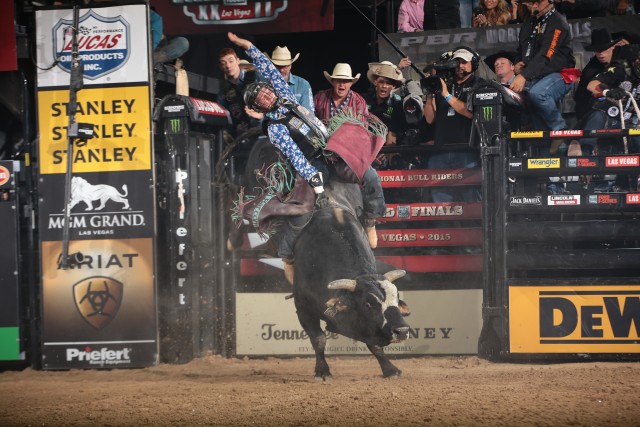
Cooper Davis rides Compact during the third round of the World Finals in Las Vegas (photo by Andy Watson)
PROFESSIONAL BULL RIDERS MONSTER ENERGY BUCK OFF AT THE GARDEN
Madison Square Garden
31st – 33rd Sts. between Seventh & Eighth Aves.
January 15-17, $25-$207 ($505 for PBR Elite Seats) www.pbr.com www.thegarden.com
Professional bull rider Cooper Davis had quite a 2015. The Wharton, Texas, native turned twenty-one, had a son, got married, and, in October, became the first rookie since Jody Newberry in 2003 to win the World Finals, earning him a check for a quarter of a million dollars. Davis will be in New York City January 15-17 for the Professional Bull Riders Monster Energy Buck Off at the Garden, when the best riders in the country will be battling bulls and the clock at the World’s Most Famous Arena for the tenth consecutive year. Started in 1992 by twenty bull riders from the rodeo circuit, the PBR has been growing ever since; in April 2015, it was acquired by entertainment, sports, and fashion heavyweight WME | IMG, which owns and produces such live events as the Miami Open tennis tournament, distributes more than 32,000 hours of sports programming each year, and represents such stars as Oprah Winfrey, Cam Newton, Ben Affleck, Adele, Wayne Gretzky, and Serena Williams. Davis recently took more than eight seconds — the time a competitor must stay atop a bull in order for the ride to qualify — to discuss his family, his weight conditioning, his favorite bulls, swimming with sharks, getting hazed as a rookie, and coming to New York for the first time in this exclusive twi-ny talk.
twi-ny: Congratulations on winning the World Finals event in Las Vegas. You surprised a lot of people with the victory; did you surprise yourself?
Cooper Davis: I don’t think I really surprised myself because I put a lot of hard work and dedication into preparing for that event. Since I started working out three months ago, that was my original goal — to win the World Finals. I didn’t expect to win an event before the World Finals, because I knew it would be a process getting my weight down and adjusting my riding to the new weight.
twi-ny: Yes, you recently dropped a lot of weight. What do you think your ideal weight is?
cd: Going into the finals I was 144; I think my ideal weight is 145–150 pounds.
twi-ny: What kind of diet are you on to maintain your conditioning?
cd: Two thousand calories a day — two thousand good calories, not fried chicken and burgers. Eating healthy and clean and continuing to go to the gym will be critical to my performance here on out.
twi-ny: You recently got married and have a baby boy. Does having a family change the way you approach bull riding? For example, how do you balance the desire to earn more money to support the family with the need to be safe and healthy for your wife and son? Or is it that you’re only twenty-one, so anything goes at this point?
cd: Bull riding is going to be a dangerous sport no matter if you have a family or not. You have to put that in the back of your mind — take one bull at a time and don’t put the pressure of providing for your family on yourself. You know, it does feel good though when you can provide for your family doing something that you love.
Cooper Davis poses with his wife, Kaitlyn, their son, Mackston, and a big check at the PBR World Finals in Las Vegas (photo by Andy Watson)
twi-ny: How did you get involved in professional bull riding? You played football and baseball in high school in Texas as well, but you started riding bulls when you were fourteen, is that right?
cd: Yes. I didn’t start riding until my sister started dating a guy (to whom she is now married, Clayton Foltyn) who rode bulls professionally. He even went to the PBR World Finals a couple of times. I looked up to him a lot and learned a lot from him. I have to give a lot of credit to him.
twi-ny: Does it get scarier or easier as time goes by?
cd: You have to learn how to deal with the pressure. When I’m out there, I don’t think a lot about the bull riding aspect of it. My mind is pretty blank when I nod [the signal for the gate to open and the ride to start]. I can sit on the back of the chutes beforehand and hang out and joke. I don’t get very emotional about it.
twi-ny: Nothing else is going through your mind that split second before you nod and the gate is opened?
cd: A lot of the time you can study a bull and try to figure out his patterns. However, I think the less you think about it, like I do, is better so you can react to him. He may not always follow the pattern that you study.
twi-ny: You’ve said that Black Betty is your favorite bull, all fifteen hundred pounds of him. What makes riding him so special?
cd: It was one of the first bulls that I got a 90-point score on. He was really showy. I like a few other bulls now, but he will always be one of my favorites. Any bull you can be 90 points on is going to be on the favorites list.
twi-ny: What is the experience of riding a bull like?
cd: I went swimming in Cancun over the summer with some whale sharks, and it was the same type of adrenaline rush. It’s like you’re looking right into the face of death sometimes, and I guess the closer to death you get, the more alive you feel.
twi-ny: Do you have any rituals you perform the day of an event?
cd: I will go to the gym and run two to three miles depending on how I feel. If I am sore, I will stretch and try to work it all out. I’ll then go to sports med and try to get to feeling the best I can. I am not very superstitious, though. A lot of guys won’t eat chicken beforehand, because you are what you eat!
twi-ny: When you’re not riding bulls, you’re a student. What are you studying?
cd: I don’t go to college anymore. I went for a semester and figured out that college was not for me at this point in my life. I didn’t want to waste my prime years of bull riding and then wake up years from now wondering what I could have done.
twi-ny: Might law be in your future, down the road?
cd: While I did want to be a lawyer when I was younger, now, however, I would go back for occupational therapy. I would like to work with special-needs children.
twi-ny: As a rookie on the PBR tour, is there any kind of hazing or teasing you get from the other riders?
cd: Some of the older guys like to pick a lot, like J. W. Harris. I’ve been around him a lot. He likes to joke and pick. One time I came into the locker room and my gear bag and rope and helmet were tied to the ceiling. There’s a lot of picking, but they do give you good advice, too. You just have to go with the joking stuff.
twi-ny: Does any of it change after winning such a big event as the World Finals?
cd: No. All of the guys like to pick around. And, I like to joke as well so I don’t think it matters if you’ve been there fifteen years or are a rookie — there’s a lot of picking going on.
twi-ny: The PBR will be celebrating its tenth anniversary at Madison Square Garden January 15–17. In general, MSG is more well known as being home to the Knicks and the Rangers, boxing and the circus, and the Grateful Dead and Billy Joel than country music, rodeos, and bull riding. Will this be your first time riding in New York City, or first time in NYC at all?
cd: It will be my first time in New York. I am really excited about it. It’s one of the events I’ve been looking forward to all season long. It will be neat to ride in MSG because it’s not something New Yorkers get to see every day, and it will be a different atmosphere for me, as well.
twi-ny: What do you expect from the fans?
cd: While I would expect they won’t be as familiar with the bull riding as fans in southern cities, they may actually enjoy it more because they’re not around bull riding as much.
twi-ny: While you’re here in the city, is there anything you’re looking forward to doing aside from competing, like seeing any specific sights?
cd: I am going to walk around Madison Square Garden and take in as much of it in as I can. I will probably only go there once a year, so I am going to try to see as much as I can.
 In the 1960s, a small group of experimental artists rejected the gallery system and the traditional art market by turning the planet into their canvas, creating monumental, often apocalyptic “earthworks” in far-off locations in the American Southwest that were nearly impossible to find. Director James Crump explores who these iconoclastic pioneers were and what they accomplished — and, in some cases, are still doing — in Troublemakers: The Story of Land Art. “The idea of land art is to relate to the idea of the globe, especially after the spaceship, the first picture of the earth, [gave] you the idea that earth is an object, so the idea for these artists after 1963 is that you can shape something, which is a sphere,” explains arte povera expert and art historian Germano Celant, who goes on to talk about the influence of airplane flight and Marcel Duchamp. “So the idea of looking from a high level is changing the perspective, your knowledge about art. And you can design it, you can draw. The area of view is a change in the history of art. It’s all this kind of convergence of information — technology, information, and history — that makes land art.” Crump (Black White + Gray) concentrates primarily on three artists, Robert Smithson, Michael Heizer, and Walter De Maria, combining rarely shown archival footage, photographs, and film clips with old and/or new interviews of artists Carl Andre, Vito Acconci, Charles Ross, Willoughby Sharp, Lawrence Weiner, and Nancy Holt (Smithson’s widow) and gallerists Paula Cooper and Virginia Dwan.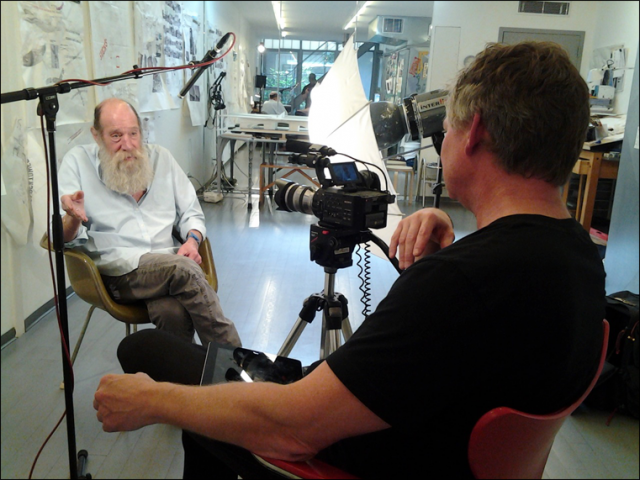
 Japan Society’s January edition of its Monthly Classics series harkens back to its past with Teinosuke Kinugasa’s lush, vibrant jidaigeki film, Gate of Hell; the society sponsored the movie’s U.S. premiere at the Guild Theatre in December 1954, the first Japanese color film ever to be shown in America. Set during the twelfth-century Heiji Rebellion, the samurai drama, based on a play by Kan Kikuchi, focuses on Morito Endo’s (Kazuo Hasegawa) dark, absurd obsession with Lady Kesa (Machiko Kyō), a married woman who is very much in love with her husband, Wataru Watanabe (Isao Yamagata). After protecting Lady Kesa and helping defend his lord, Morito is offered whatever he wants by Kiyomori the Monk (Koreya Senda). The court laughs at Morito when he asks for Lady Kesa’s hand in marriage, but when Kiyomori decides to humor him, Morito opts to pursue his goal, no matter the cost, or the humiliation.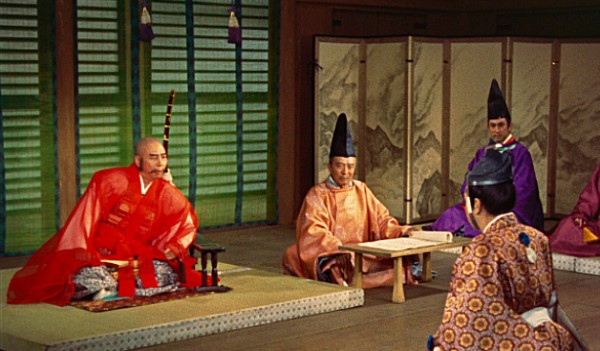
 “Now look, you cats may know more about junk, see,” square film director Jim Dunn (William Redfield) says midway through The Connection, “but let me swing with this movie, huh?” Adapted by Jack Gelber from his play and directed and edited by Shirley Clarke, The Connection is a gritty tale of drug addicts awaiting their fix that was banned for obscenity after only two matinee screenings back in October 1962. In 2013, it was released in a sharp new fiftieth-anniversary print, beautifully restored by Ross Lipman of the UCLA Film & Television Archive, which you can see January 8 as it kicks off the Museum of Arts and Design’s new “Eye of a Director” series. The inaugural program, which continues on Friday nights through February 26, focuses on the work of Clarke and her daughter, documentary filmmaker Wendy Clarke. The Connection takes place in a New York City loft, where eight men are waiting for their man: Leach (Warren Finnerty), the ringleader who has an oozing scab on his neck; Solly (Jerome Raphael), an intelligent philosopher who speaks poetically about the state of the world; Ernie (Garry Goodrow), a sad-sack complainer who has pawned his horn but still clutches tight to the mouthpiece as if it were a pacifier; Sam (Jim Anderson), a happy dude who tells rambling stories while spinning a hula hoop; and a jazz quartet consisting of real-life musicians Freddie Redd on piano, Jackie McLean on sax, Larry Richie on drums, and Michael Mattos on bass. Dunn and his cameraman, J. J. Burden (Roscoe Lee Browne), are in the apartment filming the men as Dunn tries to up the drama to make it more cinematic as well as more genuine. “Don’t be afraid, man,” Leach tells him. “It’s just your movie. It’s not real.” When Cowboy (Carl Lee) ultimately shows with the stuff, Bible-thumping Sister Salvation (Barbara Winchester) at his side, things take a decidedly more drastic turn.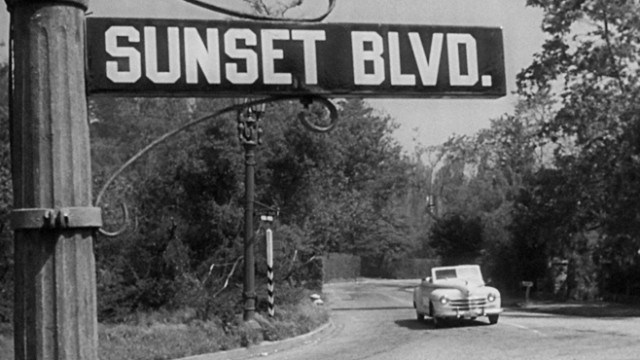
 “You’re Norma Desmond. You used to be in silent pictures. You used to be big,” handsome young screenwriter Joe Gillis (William Holden) remarks to an older woman in Billy Wilder’s Sunset Boulevard. “I am big. It’s the pictures that got small,” the former star (Gloria Swanson) famously replies. It doesn’t get much bigger than Sunset Boulevard, one of the grandest Hollywood movies ever made about Hollywood. The wickedly entertaining film noir begins in a swimming pool, where Gillis is a floating corpse, seen from below. He then posthumously narrates through flashback precisely what landed him there. On the run from a couple of guys trying to repossess his car, the broke Gillis ends up at a seemingly abandoned mansion, only to find out that it is home to Desmond and her dedicated servant, Max Von Mayerling (Erich von Stroheim). They initially mistake Gillis for the undertaker who is coming to perform a funeral service and burial for Desmond’s pet monkey. (You’ve got to see it to believe it.) When Desmond discovers that Gillis is in fact a screenwriter, she lures him into working with her on her script for a new version of Salome, in which she is determined to play the lead role. “I didn’t know you were planning a comeback,” Gillis says. “I hate that word,” Desmond responds. “It’s a return, a return to the millions of people who have never forgiven me for deserting the screen.” But just as Desmond was unable to make the transition from silent black-and-white films to color and sound pictures, getting Salome off the ground is not going to be as easy as she thinks. Hollywood can be a rather vicious place, after all.