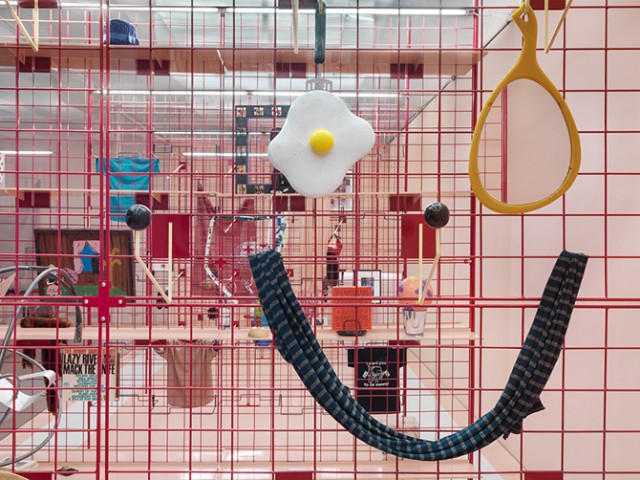
Visitors can exchange gifts on select Sundays as part of “Pia Camil: A Pot for a Latch” exhibition at the New Museum (photo by Maris Hutchinson / EPW Studio)
New Museum of Contemporary Art
235 Bowery at Prince St.
Installation on view Wednesday – Sunday through April 17, $10-$16
Exchange Days: Sunday, March 6 & 20, April 3, 2:00 – 4:00
212-219-1222
www.newmuseum.org
piacamil.me
Mexico City native Pia Camil turns the New Museum Lobby Gallery into an interactive trading post in “A Pot for a Latch” Exchange Day. On March 6 and 20 and April 3 from 2:00 to 4:00, visitors are invited to bring an object to the installation, leaving it while going home with another. The work is inspired by the ceremonial ritual of the Northwest Pacific Coast Indians, which used the potlatch as a way to distribute property. The installation consists of one hundred objects; the event will end once each item has been exchanged. There are very specific rules about what can and can’t be brought to the exhibition; in her invitation, Camil notes, “The object you bring is a talisman of sorts, and it should be thought of in the same way that the ancient Romans conceived of in their term ‘res,’ which denotes a gift that has both a personal value and a history. Bring objects of power, of aesthetic interest, and of poignancy. The monetary value of these items is insignificant; their value lies instead in their richness of meaning and in the new life that they acquire on the grid within the Lobby Gallery. Potential exchange items may include: clothes, curtains, blankets, artworks, photographs, paintings, frames, nondescript items of undetermined function, objects that resemble parts of the human body such as wigs or mannequins, costume jewelry and accessories, mirrors and reflective items, potted plants, colorful items and/or those with interesting shapes and forms, transparent materials such as shower curtains, lingerie, or X-rays, books, and trinkets. Prohibited exchange items include but are not limited to: electronics, heavy items (over twenty pounds), small-scale objects (less than six inches in diameter), loose-leaf paper, tote bags, mass-produced garments, food or other perishables, weapons, and chemicals or other hazardous materials.” In previous installations, Camil has offered fabrics for people to put on at Frieze in “Wearing-watching,” blocked off part of a museum facade with black mesh in “Cuadrado Negro,” and explored the failure of housing projects in a percussive floor video. With “A Pot for a Latch” Exchange Day, she offers visitors the opportunity to have an object of personal value be on view in a museum, giving it a different kind of meaning, while taking home a piece of meaningful art from a stranger, a direct comment on capitalism while referencing the old barter system. The installation is on view every day the New Museum is open, but the exchange takes place only on alternating Sundays.
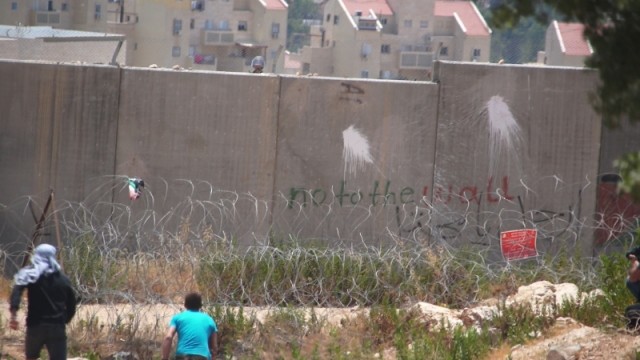
 In Colliding Dreams, cowriters, directors, and producers Joseph Dorman and Oren Rudavsky take a unique and compelling angle in their exploration of the relationship between Jews and Palestinians in what became the State of Israel in 1948. Not only do they show that Zionism means different things to different people, but they also make it clear that when the British “gave” Palestine to the Jews, it was not theirs to give in the first place, and it just so happened that someone else was already living there. “Now, this is a very important point which I would like to make. People don’t usually make it,” explains Kobi Sharett, the director of the Moshe Sharett Heritage Society, which preserves the legacy of his father, the second prime minister of Israel. “And I learned it from my father. He said, in all cases where you have under the pressure of the influence of war, when whole populations change places, move outside, it is always a rule that the minority is leaving and the majority is staying. They are not feeling secure in the place. The case of Palestine is the only one where the majority fled, not the minority. This is why the problem of the refugees is still with us to this very day.” Using archival footage and new interviews, Dorman and Oren Rudavsky trace the history of Zionism and the search for a Jewish state from the 1880s to the present, speaking with a wide range of Jewish and Palestinian historians, professors, authors, politicians, and journalists as well as everyday people on the street. Everyone interviewed lives in the country; they include Hebrew University professors Avishai Margalit, Moshe Halbertal, and Ruth Gavison, PLO executive committee member Hanan Ashrawi, Mossowa Center director Jafar Farah, and peace activists A. B. Yehoshua, Mordecai Bar On, Motti Lerner, Orly Noy, Yuli Tamir, and Saman Khoury. One critical element that becomes obvious early on is how far we are from any kind of consensus; everyone has different views on whether there should be a one-state or two-state solution, what should be done with the settlements in the West Bank, just what Zionism really is, and who has the ultimate right to the land. Khalil Shikaki, the director of the Palestinian Center for Policy and Survey Research, remembers thinking, upon seeing Israeli soldiers in contested territory, “We wanted to say, ‘Go home.’ And you should see the debate that went down between us. People would ask, ‘Where’s home?’”



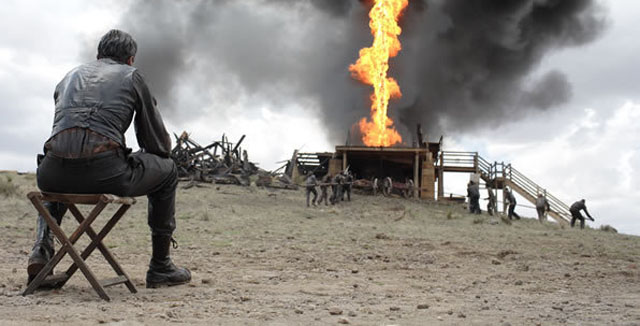
 Daniel Day-Lewis gives a spectacular, Oscar-winning performance as an independent oil man in Paul Thomas Anderson’s There Will Be Blood. Day-Lewis, in remarkable voice, absolutely embodies Daniel Plainview, a determined, desperate man digging for black gold in turn-of-the-century California. His first strike comes at a heavy price as he loses one of his men in a tragic accident, so he adopts the worker’s infant son, raising H.W. (Dillon Freasier) as his own. The growth of his company leads him to Little Boston, a small town that has oil just seeping out of its pores. But after not allowing Paul Sunday (Paul Dano), the charismatic preacher who runs the local Church of the Third Revelation, to say a prayer over the community’s first derrick, Plainview begins his descent into hell. Using Upton Sinclair’s 1927 novel Oil! as a starting point (and employing echoes of Orson Welles’s Citizen Kane and The Magnificent Ambersons in addition to the obvious reference, George Stevens’s classic 1956 oil flick Giant), writer-director Anderson (Boogie Nights, The Master) has created a thrilling epic about greed, power, and corruption as well as jealousy, murder, and, above all, family, where oil gushes out of the ground with fire and brimstone. Robert Elswit’s beautiful, Oscar-winning cinematography is so gritty and realistic, audiences will be reaching for their faces to wipe the oil and blood off. The piercing, classically based score, composed by Radiohead guitarist Jonny Greenwood, builds to a mind-blowing crescendo by the end of the film — which concludes with a controversial finale. Shot in the same location — Marfa, Texas — where Giant was set, There Will Be Blood is an unforgettable journey into the dark heart of one man’s soul. There Will Be Blood is being shown March 5 & 6 at the rather ungodly hour of eleven in the morning as part of the Nitehawk Cinema series “Country Brunchin’” and “Nitehawk Brunch Screenings” and will be preceded by a live performance by New York duo