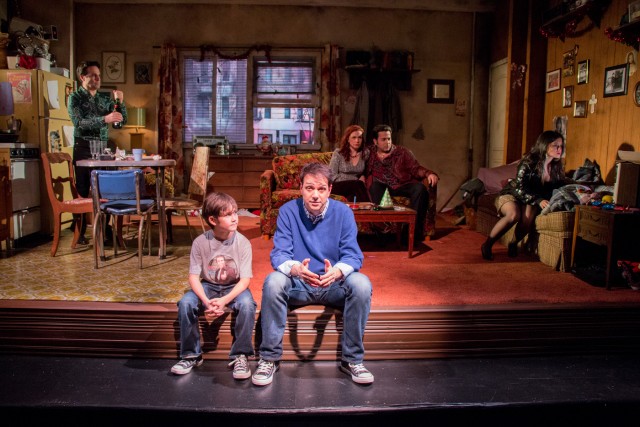
Little Carl (Nico Bustamente) and Adult Carl (Ralph Macchio) go over old times in A ROOM OF MY OWN (photo by Ben Strothmann)
June Havoc Theatre, Abingdon Theatre Company
Abingdon Theatre Arts Complex
312 West 36th St. between Eighth & Ninth Aves.
Tuesday – Sunday through March 13, $65
212-868-2055
abingdontheatre.org
Playwright and director Charles Messina wishes everyone a merry frickin’ Christmas in the raucous and riotous, and poignant and bittersweet, A Room of My Own. Eight years in the making, the show, making its world premiere at the Abingdon Theatre Company through March 13, is based on Messina’s childhood, when he was a boy living with his family in a one-room tenement apartment on Thompson St. in Greenwich Village. Ralph Macchio stars as Carl Morelli, Messina’s alter ego, who serves as the play’s narrator and ostensible scribe, carrying around a MacBook Air along with the marble composition notebook he wrote in when he was a kid, referring to both as the play unfolds through his memory. It’s Christmas season in 1979, a time that Morelli describes as “after Stonewall but before AIDS. Post-Watergate and pre-Reagan. Our little corner of the world was still a staunch Italian American enclave, with the first wave of immigrants who had settled there around the turn of the century, now aging, and dying in the shadow of the church.” Morelli’s father, Peter (Johnny Tammaro), stays at home, collecting disability, while Morelli’s mother, Dotty (Joli Tribuzio), works at a local bakery and has a penchant for stealing things. At night, Peter shares the pull-out couch with ten-year-old Carl (Nico Bustamante), while Dotty sleeps on the sofa with teenage daughter Jeannie (Kendra Jain). Dotty’s gay brother, Jackie (Mario Cantone), lives upstairs with his beloved dog, Lil’ Pish. All six of the characters — including Little Carl — are about as foul-mouthed as they come. After Adult Carl’s introduction, the first words of the play he’s written flow like poetry from Dotty: “So I says, Go an’ f&*k yourself, ya guinea c*cksucka!” And that’s only the beginning, as everyone gets in on the action, even the kids. “Nobody knows how to f&*in’ talk in this family,” Jeannie says. The Morellis are experiencing tough times, as the church is after them for Little Carl’s past-due tuition, which they don’t have — for reasons that become clear later — but Dotty doesn’t hold back her wrath for the principal, who is a nun. “Not for nothin’ but she’s got some balls callin’ this house,” Dotty declares. “They’re supposed to take a vow of poverty or did she forget? Houndin’ workin’ people for a lousy $150.” Jackie soon enters the fray with a series of curse-laced rants, performed with breathless, showstopping glee by Cantone. With Christmas on the horizon, Little Carl asks Santa for a room of his own, but the Morellis are used to not getting what they want.
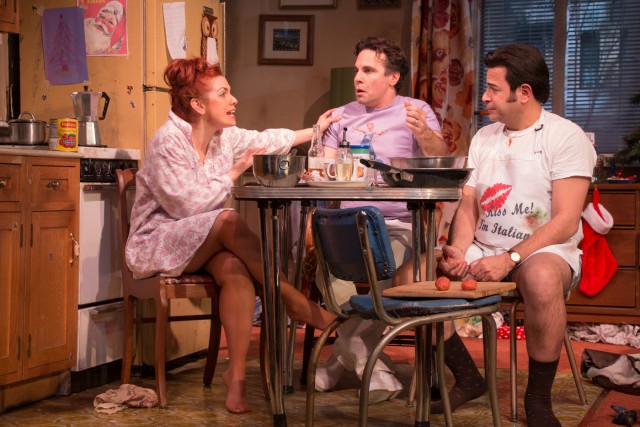
Joli Tribuzio, Mario Cantone, and Johnny Tammaro have a f&*kin’ field day in New York-set un-family-friendly comedy (photo by Ben Strothmann)
Set designer Brian Dudkiewicz places the Morellis’ drab, appropriately sloppy apartment within a picture frame, as if it’s a living snapshot of what once was. Macchio, the Karate Kid and My Cousin Vinny star — who still has those teen-idol good looks — is tender and charming as Adult Carl, who desperately tries to be cool, calm, and collected but usually ends up exasperated as the characters stray from the script or miss their cues. He sits on the edge of the stage, walks into the audience, and occasionally heads onto the set to talk to his family, but the only one who can see or hear him is his younger self. “Don’t do it,” Little Carl says. “Don’t do what?” Adult Carl asks. “Don’t write this,” Little Carl replies. “I have to write it,” Adult Carl answers. Messina then adds some real relish to the interaction between the two Carls, which gets to the heart of the story.
Little Carl: You’re gonna end up with a big problem on your hands. This is dangerous. Trust me.
Adult Carl: Trust you? Trust me.
Little Carl: Trust you? I am you.
Adult Carl: So then trust me.
Little Carl: Why should I trust you when you don’t trust me?
Adult Carl: I don’t trust you because I know me.
Little Carl: So what you’re saying is, you don’t trust yourself?
Adult Carl: That’s enough out of you. I’ll write you out of it.
Little Carl: Oh yeah, how ya gonna do that? I’m the main character, stupid!
Adult Carl: Oh, you think so, huh?
Little Carl: I know so!
Adult Carl: Just do this with me. Please. We need to go back, it’s the only way to go forward.
Little Carl: Lemme ask ya something. . . . Are you gonna tell the truth?
Adult Carl: I’m gonna tell my truth, yes.
Little Carl: Are you gonna tell the truth?!
Adult Carl: I’m gonna . . . fix . . . the truth. . . .
Little Carl: Fix my ass! You’re a liar!
Adult Carl: How am I a liar? Don’t ever call me a liar!
Little Carl: Only liars and writers say they’re gonna tell the truth, when deep down they know they’re gonnna change shit!
Adult Carl: Get back in there!
Little Carl: Are you ready?
Adult Carl: Am I ready for what?
Little Carl: Are you ready for the pain?
Adult Carl: I don’t know. . . .
Little Carl: You better be. You better be made outta steel, just like they were.
Adult Carl: Steel?
Little Carl: Steel. F&*kin’. Beams.
Adult Carl: That. F&*kin’. Mouth. Now would you just please go!
Little Carl: Oh, up yours!
Adult Carl: Up mine? Up yours!
Little Carl: Your mother!
Adult Carl: We have the same mother!
Little Carl: I gotta grow up to be this guy?
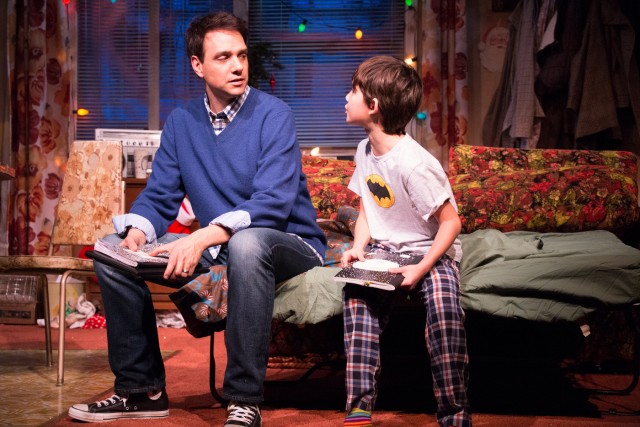
Adult Carl (Ralph Macchio) and Little Carl (Nico Bustamente) clutch their writing notebooks in Charles Messina’s raucous and touching memory play (photo by Ben Strothmann)
Messina’s (An Honest Woman, The Wanderer) sharp writing is evident throughout A Room of My Own, which he also directs with an electric, nonstop pace. The mostly Italian-American cast is exceptional, dressed in Catherine Siracusa’s fab period clothes (just wait till you see Jackie’s green shirt and Dotty’s brown velour pants). Bronx native Tribuzio and Brooklyn kid Tammaro, both veterans of Tony n’ Tina’s Wedding, clearly are having a great time as they lash out at each other with words you’re not likely to find in any dictionary, English or Italian, while getting every gesture and facial expression just right. Bustamente is a wonder in his stage debut, having acted before only in commercials; his interactions with Macchio could have been gimmicky but instead are gentle and heartfelt, even with the cursing, as they combine the past and the present with an eye to the future. And Cantone (Steve, Sex and the City), who, as it turns out, spent a lot of time when he was younger right across the street on Thompson St., visiting his sister (the building can be seen in the backdrop through a window), is a force of nature as Jackie, celebrating gay culture while fighting the loneliness of his closeted life. Much of the cast has been with the project since its inception, so the actors have developed a real feeling of family that translates beautifully to the stage. It’s a treat to be invited into the Morellis’ frantic world, which is sure at times to remind you of your own relatives, even if you’re not Italian and from New York City.
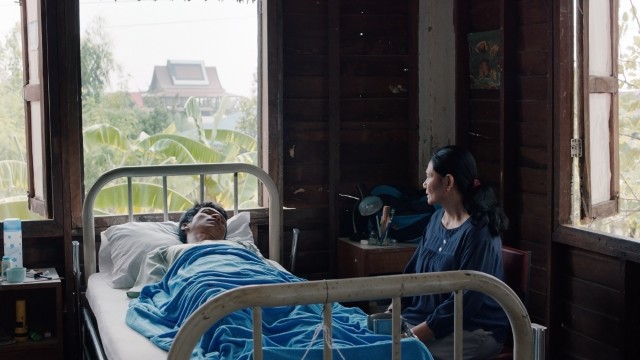
 Cemetery of Splendor is another strange, magical tale from Thai director Apichatpong Weerasethakul, a film that exists on the edge of sleep and wakefulness, like a dream you’ve just had but can’t quite remember all the details of, yet you know it has soothed your soul. In the jungles of Khon Kaen (Weerasethakul’s hometown) in Thailand, an elementary school has been turned into a makeshift hospital treating soldiers who have a mysterious sleeping ailment. (The story was inspired by an actual quarantine of members of the Royal Thai Army in 2012.) Built on the site of a long-ago palace and its cemetery of kings, the clinic uses light therapy to help the sleeping patients, each of whom has a curved fixture by their bed that emits neon lights that continually change color. Jen (Jenjira Pongpas, who also plays a woman named Jen in Weerasethakul’s Mekong Hotel), who attended the school as a child and walks with a pair of crutches because her legs are two different lengths, visits her old friend Nurse Tet (Petcharat Chaiburi), who runs the clinic with Dr. Prasan (Boonyarak Bodlakorn). “The soldiers just sleep,” Nurse Tet says. “The army doesn’t know what to do with them.” Jen develops a bond with one of the patients, Itt (Banlop Lomnoi), eventually communicating through a psychic medium, Keng (Jarinpattra Rueangram), who works with the police contacting the spirits of murder victims and helping find missing persons. At times, Itt wakes up, his sense of smell sharpened, able to “tell the temperature of the lights,” only to fall asleep again. Karma, meditation, past lives, and religious statues and spirits entering human bodies become part of the unusual narrative, all while a parcel of land is curiously being dug up with construction equipment nearby.
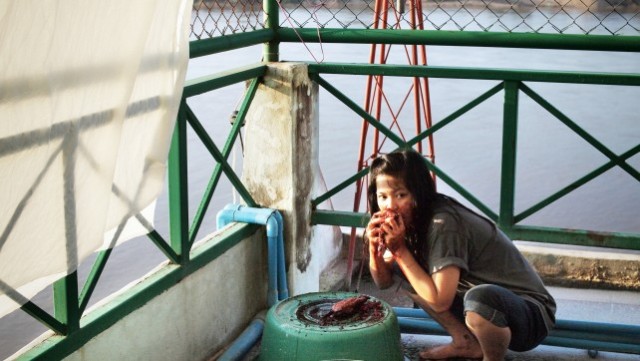
 At the end of the closing credits of Thai director Apichatpong Weerasethakul’s Mekong Hotel, a disclaimer reads, “All characters appearing in this work are actual persons. Any resemblance to other real beings, living or dead, is not coincidental.” As with so many of the Palme d’Or-winning director’s films, Mekong Hotel walks the fine line between fact and fiction, fantasy and reality. The slight work, a meditative tone poem that runs fifty-seven minutes, was shot at the Sam Oar Guesthouse and Resort in Nong Khai in northeast Thailand, near the Friendship Bridge that links Thailand and Laos. Weerasethakul (Blissfully Yours, Syndromes and a Century) plays himself in the film, a director auditioning a guitarist (real-life musician and composer Chai Bhatana), whose playing serves as the musical score for the elegiac tale. (Assistant director Chatchai Suban also makes a cameo.) Meanwhile, an otherworldly narrative is taking place, between Tong (Sakda Kaewbuadee), a banana plantation owner whose dog was just eaten, and Phon (Maiyatan Techaparn), a young woman who lives next door with her mother, Jen (Jenjira Pongpas), a Pob ghost who has a hankering for entrails. (The relationship between the mother and daughter was inspired by one of Weerasethakul’s unrealized projects, Ecstasy Garden.) The slow, contemplative mood never changes as the characters discuss love, a coming flood, refugees, spirits, and jet skiing, often in abstract ways. Weerasethakul wrote, directed, produced, edited, and photographed the film, which features beautiful cinematography, the camera never moving as the characters walk in and out of the frame and the lovely views of the Mekong River linger. Unfortunately, the sum of the intriguing parts don’t make for a cohesive whole; Weerasethakul has been justly celebrated for his short films and full-length works, but Mekong Hotel falls somewhere in between, lost in a kind of no-man’s land. Still, there’s much to admire about this film, especially for the auteur’s longtime fans. Mekong Hotel is having its theatrical premiere at the IFC Center from March 4 to 10 in the series “Mysterious Splendors: The Films of Apichatpong Weerasethakul,” running alongside his latest film, Cemetery of Splendor.