twi-ny recommended events

ARMORY ARTS WEEK 2016

Christian Jankowski directs CRYING FOR THE MARCH OF HUMANITY, which is being shown at Spring/Break Art Show

Christian Jankowski directs CRYING FOR THE MARCH OF HUMANITY, which is being shown at Spring/Break Art Show

It’s that time of year again, when the art world descends on New York City for the start of art fair season. There are no fewer than eleven fairs this week, with the next batch scheduled for May. Below is a brief look at March’s shows, highlighted by participating artists and/or galleries and special projects. The anchor is the Armory Show; prices range from free to a hefty forty-five bucks.

What: Spring/Break Art Show: ⌘COPY⌘PASTE
Where: Skylight at Moynihan Station, 421 Eighth Ave. at 34th St.
When: March 2-7, $10 in advance, $15 at the door
Why: Mira Dancy, Nick Darmstaedter, Sue de Beer, Vanessa Castro, Renee Dykeman, Brock Enright, Daniel Gordon, Christian Jankowski, Janus, Jim Jarmusch, Oliver Jeffers, Joan Jonas, Maripol, Coke Wisdom O’Neal, Walter Robinson, many more

What: The Art Show
Where: Park Avenue Armory, Park Ave. at Sixty-Seventh St.
When: March 2-6, $25
Why: Sherrie Levine, Alex Katz, Gillian Wearing, Trenton Doyle Hancock, Marcel Dzama, Edward Hopper & Company, Frank Stella, Carolee Schneemann, Beauford Delaney, Wolfgang Laib, Sigmar Polke, Milton Avery, Ellsworth Kelly, Cy Twombly, Brice Marden, Richard Diebenkorn, Alfred Stieglitz, Edward Steichen, Richard Artschwager, Daniel Buren, many more

Wednesday, March 2
“Tree Talk” by Maria Elena González, 2:00 & 6:00

What: VOLTA NY
Where: Pier 90, West Fiftieth St. at Twelfth Ave.
When: March 2-6, $25
Why: Ronald Cyrille, Tom Anholt / Günther Förg, Jessica Peters, Florian Heinke / Gavin Nolan, Toshiya Masuda, Paul Brainard, Philip Taaffe, Elad Kopler, Jorge Pineda, Becca Lowry, Anthony Goicolea, Dawit Abebe, Shoplifter, many more

Friday, March 4
Shaun Leonardo: “I Can’t Breathe Workshop and Performances,” 5:00
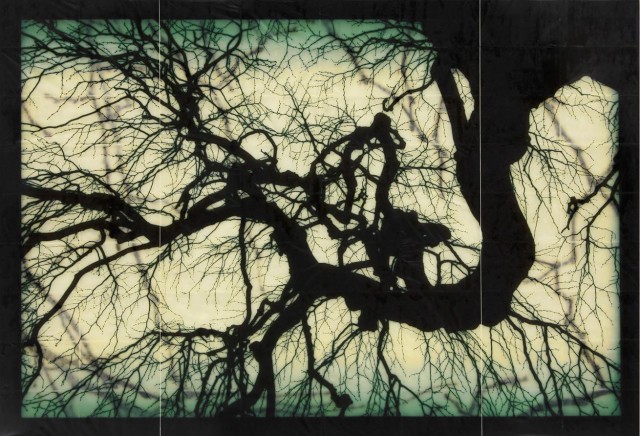
Mike and Doug Starn’s “Structure of Thought 30” will be on view at the Edwynn Houk Gallery booth at the Armory Show (photo courtesy Edwynn Houk Gallery)

Mike and Doug Starn’s “Structure of Thought 30” will be on view at the Edwynn Houk Gallery booth at the Armory Show (photo courtesy Edwynn Houk Gallery)

What: The Armory Show
Where: Piers 92 & 94, Twelfth Ave. at Fiftieth St.
When: March 3-6, $45
Why: Special projects by Kapwani Kiwanga, Emeka Ogboh, Lebohang Kganye, Karo Akpokiere, Ed Young, Athi-Patra Ruga, Jared Ginsburg, Mame-Diarra Niang, Stephen Burks, Sung Jang, Carlo and Mary-Lynn Massoud, Modern, Contemporary, African Perspectives, Armory Presents, Open Forum, more

Thursday, March 3
“Looking Back, Leading the Way,” with El Anatsui and Sam Nhlengethwa, moderated by Bisi Silva, part of the Armory Show 2016 Symposium: African Perspectives, Media Lounge, Pier 94, 5:30

Saturday, March 5
“A Spell That Flows Both Ways,” lecture-performance by Kapwani Kiwanga, Media Lounge, Pier 94, 1:00

What: Art on Paper
Where: Pier 36, 299 South St.
When: March 3-6, $25
Why: Special projects by Suzanne Goldenberg, Libby Black, Laurence Vallières, Alex Paik, Lower Eastside Girls Club, Bob Gill, Javier Calleja, Glenn Goldberg, Federico Uribe, Takaaki Tanaka, Li Hongbo

What: New City Art Fair
Where: hpgrp Gallery, 434 Greenwich St.
When: March 3-6, free with pass
Why: Fumi Ishino, Keigo Nishikiori, Harumi Shimizu, Shuji Terayama, Daisuke Takahashi, snAwk, So Sekiyama, Meguru Yamaguchi

What: Scope
Where: 639 West Forty-Sixth St. at Twelfth Ave
When: March 3-6, $35
Why: Breeder Program (Haven Gallery, Kallenbach Gallery, One Mile Gallery, Jenn Singer Gallery, Barbara Edwards Contemporary, Cordesa Fine Art), Bombay Sapphire Artisan Series winner Aron Belka

What: Pulse
Where: Metropolitan Pavilion, 125 West Eighteenth St. between Sixth & Seventh Aves.
When: March 3-6, $25
Why: Special projects by Erin D. Garcia, Armando Marino, Melissa Pokorny, Anna Paola Protasio, Macon Reed, Yumi Janairo Roth, Mia Taylor, Richard Vivenzio, Jason Willaford

Thursday, March 3
through
Sunday, March 6
Macon Reed, “Eulogy for the Dyke Bar” events, including Last Call podcast broadcast, DJ Happy Hour, Rocky and Rhoda Trivia Night, Stashes and Lashes Drag Show, and Eulogy Ritual, multiple times

What: Clio Art Fair
Where: 508 West Twenty-Sixth St. between Tenth & Eleventh Aves.
When: March 3-6, free
Why: Detlef Ewald Aderhold, Thierry Alet, KO-HEY Arikawa, Manss Aval, Sarah Hai Edwards, Sunil Garg, Andrea Goldsmith, Seunghwui Koo, Emily Madrigal, Jamie Martinez, Roberto Perotti, Kerstin Roolfs, Daniel Rosenbaum, Raimonda Sanna, Gisella Sorrentino, Zoya Taylor, Anthea Zito, others
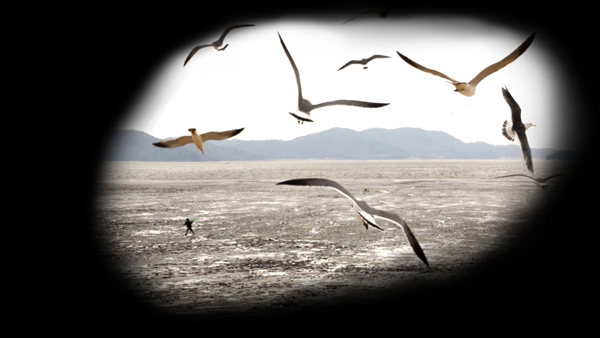
Maija Blåfield’s GOLDEN AGE will be screening at the Moving Image art fair (photo courtesy AV-arkki)

Maija Blåfield’s GOLDEN AGE will be screening at the Moving Image art fair (photo courtesy AV-arkki)

What: Moving Image
Where: 269 Eleventh Ave. between Twenty-Seventh & Twenty-Eighth Sts.
When: March 3-6, free
Why: Amalie Atkins, Perry Bard, Maija Blåfield, Marcos Bonisson and Khalil Charif, boredomresearch, Jeremy Chandler, Sarah Choo Jing, Clément Cogitore, Jennifer Dalton, Rico Gatson, Sofia Hultén, Anthony Iacono, Erdal İnci, George Jenne, Gulnara Kasmalieva and Muratbek Djumaliev, Kalliopi Lemos, Pablo Lobato, LoVid, Alexandre Mazza, Olivia McGilchrist, Lorna Mills, Tameka Norris, Anne Spalter, Mika Taanila, Sergio Vega, Saya Woolfalk, Gil Yefman

What: alt_break art fair
Where: Multiple locations
When: March 3-6, free
Why: alt_break 2016: SHIFT_ consists of site-activated exhibits at Creative Art Works, Fountain House Gallery, and the Center for Social Innovation as well as at the Armory Show, Scope, and Spring/Break, with such artists as Anne-Marie Lavigne, Jee Hee Kang, Lizz Brady, Reba Hasko, Geraldo Mercado, and Sean Naftel

Friday, March 4
Launch event with artists, curators, raffle prizes, and a live performance by Ryan Krause, Fountain House Gallery, 702 Ninth Ave. near Forty-Ninth St., 6:00

Sunday, March 6
Closing panel discussion and reception with curators Audra Lambert, Kimi Kitada, Victoria Manganiello, and Adam Zucker and special guests, moderated by Andrew Kaminski, Center for Social Innovation, Starrett-Lehigh Building, 601 West Twenty-Sixth St. west of Eleventh Ave., third floor, 2:00

What: The Independent
Where: Spring Studios, 50 Varick St.
When: March 4-6, price TBD ($20 in 2015)
Why: The Approach, London; Artists Space, New York; The Box, Los Angeles; Gavin Brown’s enterprise, New York/Rome; Elizabeth Dee, New York; Delmes & Zander, Cologne/Berlin; gb agency, Paris; Herald St, London; Mendes Wood DM, São Paulo; the Modern Institute, Glasgow; Galerie Nagel Draxler, Cologne/Berlin; Neue Alte Brücke, Frankfurt; Office Baroque, Brussels; others
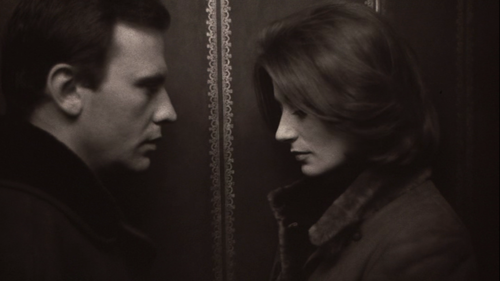

BAMcinématek FAVORITES — GALLIC 60s: A MAN AND A WOMAN / PIERROT LE FOU

Anouk Aimée and Jean-Louis Trintignant play characters trying to escape their pasts in Claude Lelouch’s A MAN AND A WOMAN

A MAN AND A WOMAN (UN HOMME ET UNE FEMME) (Claude Lelouch, 1966)
BAMcinématek, BAM Rose Cinemas
30 Lafayette Ave. between Ashland Pl. & St. Felix St.
Wednesday, March 2, 7:30
718-636-4100
www.bam.org

Winner of both the Oscar for Best Foreign Language Film and the Palme d’Or at Cannes, Claude Lelouch’s A Man and a Woman is one of the most popular, and most unusual, romantic love stories ever put on film. Oscar-nominated Anouk Aimée stars as Anne Gauthier and Jean-Louis Trintignant as Jean-Louis Duroc, two people who each has a child in a boarding school in Deauville. Anne, a former actress, and Jean-Louis, a successful racecar driver, seem to hit it off immediately, but they both have pasts that haunt them and threaten any kind of relationship. Shot in three weeks with a handheld camera by Lelouch, who earned nods for Best Director and Best Screenplay (with Pierre Uytterhoeven), A Man and a Woman is a tour-de-force of filmmaking, going from the modern day to the past via a series of flashbacks that at first alternate between color and black-and-white, then shift hues in curious, indeterminate ways. Much of the film takes place in cars, either as Jean-Louis races around a track or the protagonists sit in his red Mustang convertible and talk about their lives, their hopes, their fears. The heat they generate is palpable, making their reluctance to just fall madly, deeply in love that much more heart-wrenching, all set to a memorable soundtrack by Francis Lai. Lelouch, Trintignant, and Aimée revisited the story in 1986 with A Man and a Woman: 20 Years Later, without the same impact and success. A recently restored print of the original will be shown on March 2 at 7:30 as part of the BAMcinématek series “BAMcinématek: Gallic 60s,” in honor of the film’s fiftieth anniversary. The two-day treat continues March 3 with Jean-Luc Godard’s Pierrot le Fou.
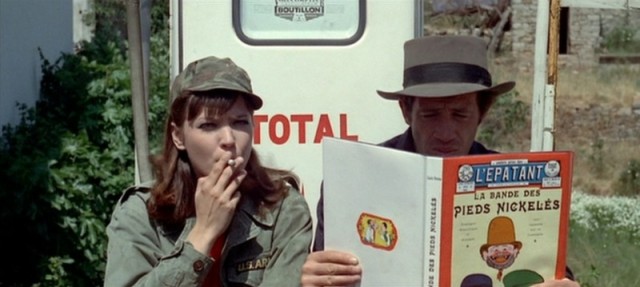
Jean-Paul Belmondo and Anna Karina should be more excited about recent restoration of Jean-Luc Godard classic

Jean-Paul Belmondo and Anna Karina should be more excited about recent restoration of Jean-Luc Godard classic

PIERROT LE FOU (Jean-Luc Godard, 1965)
BAMcinématek, BAM Rose Cinemas
30 Lafayette Ave. between Ashland Pl. & St. Felix St.
Thursday, March 3, 4:30, 7:00, 9:30
718-636-4100
www.bam.org

Art, American consumerism, the Vietnam and Algerian wars, Hollywood, and cinema itself get skewered in Jean-Luc Godard’s fab faux gangster flick / road comedy / romance epic / musical Pierrot Le Fou. Based on Lionel White’s novel Obsession, the film follows the chaotic exploits of Ferdinand Griffon (Jean-Paul Belmondo) and Marianne Renoir (Anna Karina, Godard’s then-wife), former lovers who meet up again quite by accident. The bored Ferdinand immediately decides to leave his wife and family for the flirtatious, unpredictable Marianne, who insists on calling him Pierrot despite his protestations. Soon Ferdinand is caught in the middle of a freewheeling journey involving gun running, stolen cars, dead bodies, and half-truths, all the while not quite sure how much he can trust Marianne.

Filmed in reverse-scene order without much of a script, the mostly improvised Pierrot Le Fou was shot in stunning color by Raoul Coutard. Many of Godard’s recurring themes and styles appear in the movie, including jump cuts, confusing dialogue, written protests on walls, and characters speaking directly at the audience, who are more or less along for the same ride as Ferdinand. And as with many Godard films, the ending is a doozy. A few years ago, when the film was shown at Anthology Film Archives as part of a series selected by John Zorn, the avant-garde musician explained, “Pierrot holds a special place in my heart — I am really a Romantic, not a Postmodern — and this film’s music never ceases to reduce me to tears.” You can see and hear for yourself when last year’s fiftieth-anniversary restoration of this Nouvelle Vague favorite screens on March 3 in the two-day BAMcinématek series “BAMcinématek: Gallic 60s,” which begins March 2 with Claude Lelouch’s A Man and a Woman.

EDM ANTHEMS — FRENCH TOUCH ON FILM: DAFT PUNK UNCHAINED

DAFT PUNK UNCHAINED

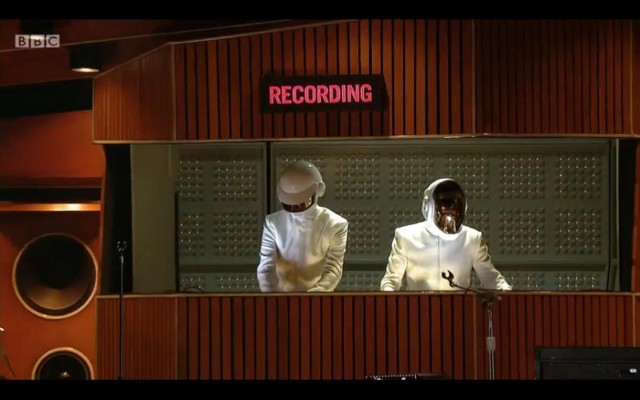
The fascinating history of French EDM pioneers Thomas Bangalter and Guy-Manuel de Homem-Christo is detailed in DAFT PUNK UNCHAINED

DAFT PUNK UNCHAINED (Hervé Martin Delpierre, 2015)
French Institute Alliance Française, Florence Gould Hall
55 East 59th St. between Madison & Park Aves.
Tuesday, March 1, $14, 4:00 & 7:30
Series continues Tuesdays through April 26
212-355-6100
www.fiaf.org

You might think that the phrase “the French Touch,” which is part of the title of FIAF’s March-April edition of its CinéSalon series, refers to the unique style of such French auteurs as François Truffaut, Jean Renoir, Jean-Luc Godard, Louis Malle, Jean Cocteau, Éric Rohmer, and others whose films are often included in these Tuesday-night festivals. But the term actually describes a group of DJs and bands associated with electronic dance music, or EDM, in France. So it is rather appropriate for the series, “EDM Anthems: French Touch on Film,” to kick off with Daft Punk Unchained, a thumping documentary about the patron saints of that movement, the iconoclastic duo of Thomas Bangalter and Guy-Manuel de Homem-Christo, better known as Daft Punk. Director Hervé Martin Delpierre, who cowrote the film with Marina Rozenman, had his work cut out for him, as he had to make the film without the participation of Daft Punk itself, Bangalter and de Homem-Christo, who have not shown their faces in public this century and rarely give interviews of any kind. But Delpierre gets just about everyone else who has ever worked with them to open up, allowing others to interpret the band’s musical evolution and cultural impact as he traces DP’s career from 1992, when they were in the somewhat more traditional bass-guitar-drum combo Darlin’, to the worldwide sensation of their 2013 album, Random Access Memories, as they melded American disco, German techno, and Manchester industrial into something wholly new. A special focus is placed on their mind-blowing show at Coachella in 2006, which single-handedly changed the future of EDM.
Amid rare photographs of Bangalter and de Homem-Christo without their trademark robot helmets or masks and audio clips of radio interviews, Delpierre speaks with such Daft Punk collaborators as Kanye West, Nile Rodgers, Giorgio Moroder, Pete Tong, Todd Edwards, Pharrell Williams, Skrillex, and Paul (Phantom of the Paradise) Williams, in addition to special effects master Tony Gardner, anime director Leiji Matsumoto, and filmmaker Michel Gondry, who first put DP in helmets. Also sharing insight into what makes the duo so significant are former manager Pedro (Busy P) Winter as well as various journalists, record label heads, and friends. “I just think they’re a unique set of individuals. I have a hard time calling them human, just because musically the robots are something else,” Pharrell, who scored a huge hit with Daft Punk on eventual Grammy favorite “Get Lucky,” says. “I just never experienced working with individuals like them. Everything is so concise. There’s a reason behind everything. Nothing is done by coincidence, by accident or mistake. It’s always with an intention to serve a purpose.” What also serves their purpose is avoiding promotion or publicity that would involve their making an appearance of any kind. Thus, we don’t learn about Bangalter and de Homem-Christo’s private lives, how they work with each other, or what they even look like today. But with everyone stressing how individualistic Daft Punk is, how they insist on doing things their own way no matter what, we wound up rooting for them to keep those helmets on and let the groove-heavy mystery linger on. Daft Punk Unchained is screening at FIAF on March 1 at 4:00 and 7:30; the later show will be followed by a Q&A with Delpierre and DJ Superpoze. In addition, Winter will lead a French Electronic Music Master Class on March 3 with Boston Bun, Superpoze, Jacques, and Julian Starke, and there will be a party celebrating the FIAF series on March 4 at Le Bain with Busy P, Boston Bun, Jacques, and Superpoze. The series continues through April 26 with such other films as Mia Hansen-Løve’s Eden, Nicolas Winding Refn’s Drive, and Céline Sciamma’s Girlhood, which are either set in the club scene or feature EDM-based soundtracks.

WOMEN WITHOUT MEN

(photo by Richard Termine)

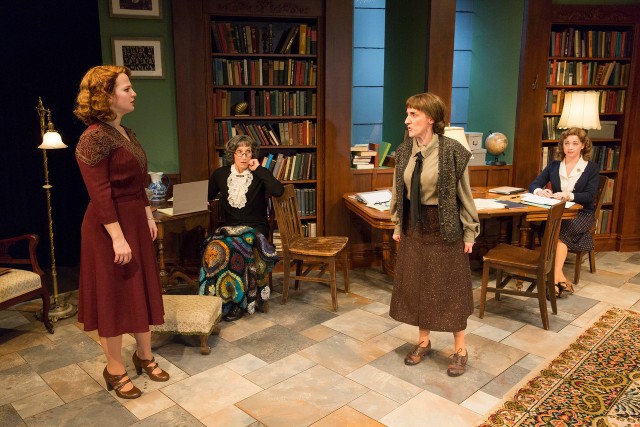
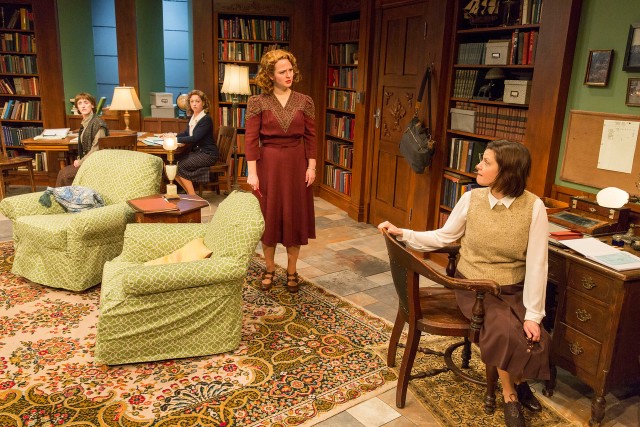
Miss Wade (Emily Walton) and Miss Willoughby (Aedin Moloney) get into it in Hazel Ellis’s WOMEN WITHOUT MEN (photo by Richard Termine)

New York City Center Stage II
131 West 55th St. between Sixth & Seventh Aves.
Tuesday – Sunday through March 26, $27.50 – $65
minttheater.org
www.nycitycenter.org

Two of the best shows of the 2015–16 season are currently running at City Center; one is a brand-new memory play from an award-winning male writer, while the other is a seventy-eight-year-old work by a little-known female writer that is being performed in America for the very first time. On Stage I is John Patrick Shanley’s (Doubt) wonderfully bittersweet Prodigal Son, set in a boys boarding school in New Hampshire in the 1960s. On the much smaller Stage II is Hazel Ellis’s thoroughly delightful Women without Men, set in a girls boarding school in Ireland in 1937. (City Center is the Mint’s new home after the real estate market forced them out of their longtime space on West Forty-Third St.) Another brilliant discovery by Mint Theater producing artistic director Jonathan Bank, Women without Men, which debuted at Dublin’s Gate Theatre in 1938, takes cattiness to a whole new level, making George Cukor’s The Women seem like child’s play. It’s the first day of term at Malyn Park Private School — inspired by the French School, Bray, that Ellis attended — and one by one the teachers show up in their sitting room, where they carry on about the students, the endless rules, and one another, and not just behind each other’s backs. The faculty consists of Madamoiselle Vernier (Dee Pelletier), an elegant, older French woman who enjoys brewing tea and sewing; Miss Ruby Ridgeway (Kate Middleton), a flirty, would-be party girl who likes to show off how much the young girls adore her; Miss Margaret Willoughby (Aedin Moloney), a shrewish disciplinarian who has no patience for anyone who doesn’t fall in line with the system; Miss Connor (Kellie Overbey), a nasty tattletale who has been writing a book about the nature of beauty for twenty years; Miss Marjorie Strong (Mary Bacon), a steadfast, cynical educator who just wants to do her job and avoid controversy and idle chatter; and Miss Jean Wade (Emily Walton), a newcomer who believes that a caring teacher can actually make a difference in the girls’ lives.

But it doesn’t take long for this wide-eyed dreamer to figure out how dastardly her coworkers are. “All day, every day, it’s bicker, bicker, bicker. Everyone talking maliciously about the others all in turn. There isn’t one of them I haven’t wanted to murder — except you,” Miss Wade says to Miss Strong, who replies, “After eighteen years of it, one manages to become detached from one’s surroundings.” Wondering how Miss Strong tolerates the nastiness, Miss Wade asks, “Why should we all unite in making each other’s lives a little hell of trivial tortures?” Miss Strong answers, “What else could you expect? Look at us. A small group of women all cooped up together with no release from each other save in the privacy of our bedrooms. Women brought together not by choice, not by liking, but by the necessity of earning our living. No outside interests, no outside friends, nothing to talk about but the pettifogging details of the school and all that therein is. . . . Dullness, dullness, dullness, and the blighting knowledge that you’ll never get any further, that your life will continue for ever in the same old round and the most you can hope for is to save enough to keep you from want in your old age.” When someone commits a heinous act, all hell breaks loose as suspicious fingers are pointed and things are said that can never be unsaid, with verbal barbs that do a whole lot more than just sting.

(photo by Richard Termine)

Miss Wade (Emily Walton) tries to find a kindred spirit in Miss Strong (Mary Bacon) amid a never-ending barrage of wicked barbs (photo by Richard Termine)

Ellis, an actress who had written only one previous play, 1936’s Portrait in Marble, was in her late twenties when she penned Women without Men, at a time when women in Ireland were losing many of the scant rights they actually had. The 1937 Constitution of Ireland included article 41.2, which declared, “The State recognises that by her life within the home, woman gives to the State a support without which the common good cannot be achieved. The State shall, therefore, endeavour to ensure that mothers shall not be obliged by economic necessity to engage in labour to the neglect of their duties in the home.” The Mint counteracts that decree by producing Women without Men with a primarily female crew; the show is directed with a fluid grace by Jenn Thompson (Abundance, Lost in Yonkers), with spot-on costumes by Martha Hally, effective lighting by Traci Klainer Polimeni, excellent sound design by Jane Shaw (listen for the girls singing outside and for the pitter-patter of rain), and simply fab wigs and hair design by Robert-Charles Vallance. The set is always a highlight of Mint productions, and this one by Vicki R. Davis is no exception; the teachers’ sitting room opens to the audience on two sides, but its claustrophobic feel echoes the way women were trapped at the time. The cast, which also includes Joyce Cohen as the head of the school, Amelia White as the matron, and Shannon Harrington, Alexa Shae Niziak, and Beatrice Tulchin as three girls putting on a play with Miss Wade, is simply grand, delivering Ellis’s laser-sharp lines with passion and zeal. “You’re a nasty-minded, old mischief maker,” Miss Wade tells Miss Willoughby, who immediately shoots back, “Really, Miss Wade, I will not stay here and listen to such wicked language. When you see fit you may apologise to me. Until then I am afraid we cannot remain on friendly terms.” You might not want to become friends with any of these women, but you should not pass up the opportunity to spend two glorious hours in their wicked presence.

SOUNDWALK 9:09

 The Met Breuer photograph by Ed Lederman; The Met Plaza © MMA

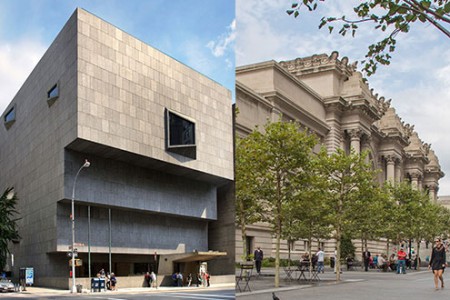
Free app will provide site-specific soundscape for trip between the Met Breuer (photo by Ed Lederman) and the main Met (photo © MMA)

Metropolitan Museum of Art
1000 Fifth Ave. at 82nd St.
The Met Breuer
945 Madison Ave. at 75th St.
Free app available March 1
212-535-7710
www.metmuseum.org
johnlutheradams.net

In 2011, it was announced that the Metropolitan Museum of Art would take over the landmark Breuer building that served as the Whitney Museum of American Art’s third home, from 1966 to 2014. With the Whitney now firmly entrenched on Gansevoort St. at the south end of the High Line, the Met is ready to move into 945 Madison Ave., where it will focus on the art of the twentieth and twenty-first centuries. The modernist building, which was designed by Bauhaus-trained architect Marcel Breuer with Hamilton Smith, will open to Met members March 8-13 and to the general public March 18-20, but on March 1 the institution will start offering a unique way for people to familiarize themselves with the short trip between the Met’s main museum on Fifth Ave. and Eighty-Second St. and the Breuer. MetLiveArts has commissioned Mississippi-born American composer John Luther Adams, who won the Pulitzer Prize in 2014 for Become Ocean, to create his first New York City work, “Soundwalk 9:09,” two new pieces that last nine minutes and nine seconds, the amount of time it is estimated it takes to go from the Met to the Met Breuer. “Soundwalk 9:09,” which includes sounds Adams recorded between the two buildings in addition to crowd-sourced material, will be available for free through the Met and WQXR.

MYSTERIOUS SPLENDORS — THE FILMS OF APICHATPONG WEERASETHAKUL: TROPICAL MALADY

Apichatpong Weerasethakul’s TROPICAL MALADY was both booed and celebrated at the 2004 Cannes Film Festival

Apichatpong Weerasethakul’s TROPICAL MALADY was both booed and celebrated at the 2004 Cannes Film Festival

TROPICAL MALADY (SUD PRALAD) (Apichatpong Weerasethakul, 2004)
IFC Center
323 Sixth Ave. at West Third St.
Monday, February 29, 4:35, and Wednesday, March 2, 12 noon & 7:00
Series runs February 29 – March 10
212-924-7771
www.ifccenter.com
www.kickthemachine.com

Thai director Apichatpong Weerasethakul won the Jury Prize at Cannes for Tropical Malady, a beautiful, mystical work that will thoroughly engage you — if you allow it to. Part tender love story between a country boy (Banlop Lomnoi) and a soldier (Dakda Kaewbuadee), part folktale set in the deep forests of Thailand, Tropical Malady is a like a visual poem in which details are not as important as the overall effect, which is intoxicating. The unorthodox film features ghosts, a shape-shifter, unusual characters, and a playful sense of humor that come together to form a subtle meditation on life and love. Weerasethakul once again displays the gentle, captivating narrative technique that lies at the heart of his oeuvre, which also includes such works as Blissfully Yours, Syndromes and a Century, and 2010 Palme d’Or winner Uncle Boonmee Who Can Recall His Own Lives. Some people at Cannes walked out on Tropical Malady and others stuck around to boo it; Quentin Tarantino headed the group that awarded it the Jury Prize regardless. You can decide to cheer or boo, or merely just experience, it when it screens on February 29 and March 2 as part of the IFC Center series “Mysterious Splendors: The Films of Apichatpong Weerasethakul,” which runs February 29 through March 10 and consists of Weerasethakul’s previously mentioned works as well as his 2000 debut, Mysterious Object at Noon, and his newest films, Mekong Hotel and Cemetery of Splendor.
HIROSHI SUGIMOTO: SEA OF BUDDHA

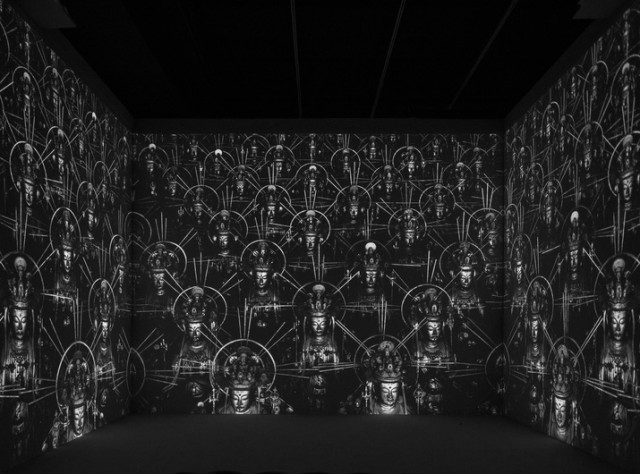
Hiroshi Sugimoto’s three-channel video, “Accelerated Buddha,” explores the nature of time and space, life and death, art and spirituality (photo courtesy the artist’s studio)

Hiroshi Sugimoto’s three-channel video, “Accelerated Buddha,” explores the nature of time and space, life and death, art and spirituality (photo courtesy the artist’s studio and Pace Gallery)

Pace Gallery
510 West 25th St. between Tenth & Eleventh Aves.
Tuesday – Saturday through March 5, free, 10:00 am – 6:00 pm
212-255-4044
www.pacegallery.com
www.sugimotohiroshi.com

Japanese artist Hiroshi Sugimoto explores the nature of impermanence and the relationship between art and spirituality in his multimedia installation “Sea of Buddha,” on view through March 5 at Pace on West Twenty-Fifth St. In 1995, after a seven-year effort, Sugimoto was given permission to photograph the one thousand gilded wooden Buddha statues at Sanjῡsangen-dō (Hall of Thirty-Three Bays) in Kyoto, at a specific time in the morning when the general public is not allowed in and the summer sun casts a particularly special glow on the objects. Perhaps “given” is the wrong word, as he had to pay the temple handsomely for the privilege (and still has to hand over an additional fee every time he displays the photographs). Sugimoto, who lives and works in Tokyo and New York and has previously re-created reality in such series as “Portraits,” “Dioramas,” and “Theaters,” took forty-eight black-and-white pictures of the very similar but not identical statues. Only thirty-six were able to fit in his installation at Pace, where they are arranged at eye level on two sides of an oval room that serves as a kind of shrine. Numbers are critical to the project; Sugimoto, who was inspired by Walter De Maria’s “The Broken Kilometer,” has stated that the total number of photos relate to the forty-eight stages of death; thirty-three (the number of bays at Sanjῡsangen-dō) is a popular numeral in the Bible, associated with Noah, Jesus, King David, Jacob, and others; and some Buddhist teachings state that one thousand enlightened Buddhas will bring wisdom to the world. At first glance, the photos look the same, taken from the same angle, but each Buddha is as different as each human on the planet. An enveloping serenity can be felt as you make your way through the space, more spiritual than religious. In a small adjoining area, Sugimoto’s “Accelerated Buddha” plays on a loop, a mesmerizing five-minute immersive video, projected corner-to-corner onto three sides of the room, in which Sugimoto cuts between the forty-eight photos at an ever-faster pace, starting off very slowly and ending up in a furious blur, echoing the subjective human experience of time from birth to death while also evoking Yayoi Kusama’s Infinity Rooms. The exhibition also features five of Sugimoto’s “Seascapes,” gelatin silver prints of horizon lines on the ocean, quiet, entrancing shots of water and air. “Every time I view the sea, I feel a calming sense of security, as if visiting my ancestral home,” Sugimoto has said of the series. “I embark on a voyage of seeing.” Sugimoto’s latest show at Pace is yet another voyage well worth seeing.