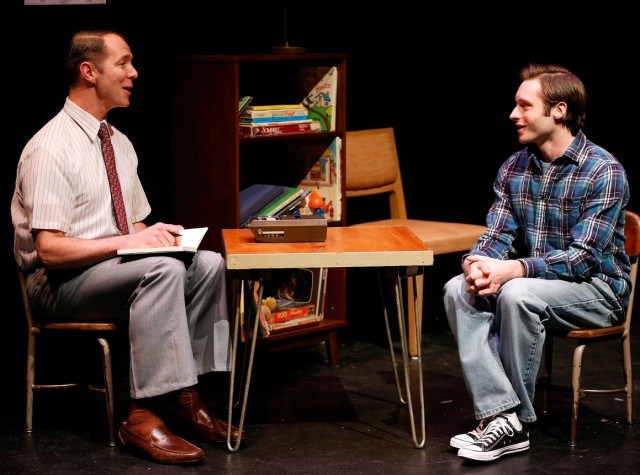
Dr. Wendell Barnes (Paul Niebanck) bonds with Samantha (Bobby Steggert) in Anna Ziegler’s BOY (photo by Carol Rosegg)
The Clurman Theatre at Theatre Row
410 West 42nd St. between Ninth & Tenth Aves.
Tuesday – Sunday through April 9, $62.50
www.keencompany.org
www.ensemblestudiotheatre.org
Award-winning playwright Anna Ziegler takes a unique and imaginative approach to the timely issue of gender identity in the expertly written, inventively staged drama Boy. A joint production of Keen Company and Ensemble Studio Theatre, Boy was inspired by the real-life case of David Reimer as well as the birth of Ziegler’s first child. Bobby Steggert stars as Adam/Samantha, a twin born in Iowa in 1967. Shortly after a botched, unnecessary circumcision accidentally sears off his penis when he is eight months old, his mother, Trudy (Heidi Armbruster), and father, Doug (Ted Koch), seek out the help of eminent physician Wendell Barnes (Paul Niebanck), a doctor in the relatively new field of gender reassignment. “Sam will never lead a normal life. He will never be a father. He will never be normal,” Doug opines in a letter to Dr. Barnes, while Trudy adds, “We saw you on that program and you said that we are blank slates at birth. You said we are shaped by society and not biology.” Dr. Barnes, who is eager to treat the boy, convinces the parents that it is best for the child to be raised as a girl, receiving hormone shots and ultimately an operation to give her a vagina, but he insists that she must never find out that she was born with male genitalia. The play shifts back and forth between various years from 1968 to 1989 as Samantha learns about great literature from Dr. Barnes and Adam falls for a single working mother, Jenny (Rebecca Rittenhouse). Delivering a lecture in 1977, Dr. Barnes explains, “How do we become who we are? Is it a process that takes place entirely within the dark mysteries of the womb, so we emerge fully formed, our character, our future set? Or do we build ourselves, brick by brick, ‘sufficient to have stood though free to fall’? Do we make our house or do we simply inhabit it?” But as Boy shows, there are no easy answers to those questions, whether it’s 1968, 1977, 1989, or today, when such topics as nature vs. nurture and being born a certain way are still rife with controversy.
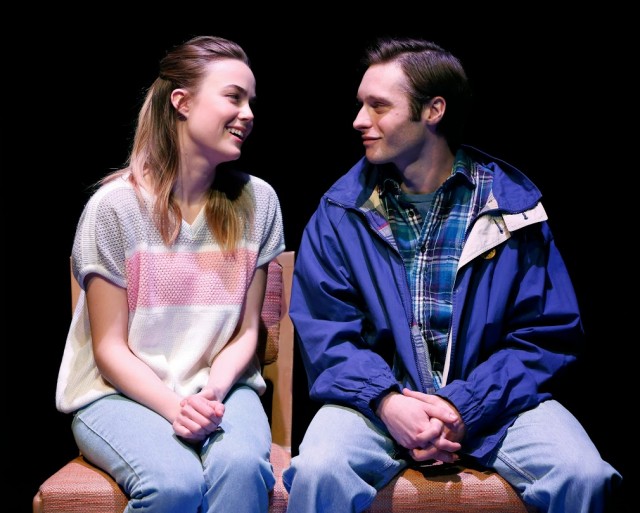
Jenny (Rebecca Rittenhouse) and Adam (Bobby Steggert) consider a relationship in BOY (photo by Carol Rosegg)
No matter the age, Adam/Samantha wears the same outfit in every scene, reaffirming that what matters is on the inside. Steggert (Mothers & Sons, Ragtime) does a marvelous job of depicting how uncomfortable Adam/Samantha is in his/her own skin, displaying a jittery awkwardness that keeps the audience on edge. Ziegler (The Last Match, A Delicate Ship) fills the play with a wide array of literary and pop-culture references, but each one has a critical connection to the story, from John Milton’s Paradise Lost, Maurice Sendak’s Where the Wild Things Are, and Charlotte Brontë’s Jane Eyre to Robert Zemeckis’s Back to the Future 2 and Marlo Thomas’s Free to Be You and Me. Even when Adam imitates Elmer Fudd, saying, “Shh . . . Be vewwy, vewwy quiet . . . I’m hunting wabbits!,” it relates to Jenny’s first appearance onstage, in a bunny costume at a Halloween party, where Adam quite adamantly tells her that he is not Frankenstein but Frankenstein’s monster. “Frankenstein was the guy who made the monster. I’m just the monster,” he points out. The cast is uniformly excellent, with Armbruster (Time Stands Still, Disgraced) and Koch (The Pillowman, Abundance) bringing just the right confusion to the parents, while Niebanck (A Walk in the Woods, Blood and Gifts) is quietly effective as the doctor who befriends Samantha but also stands to gain fame from their association. And Rittenhouse (The Commons of Pensacola) makes Jenny a kind of onstage representative of the audience, not quite understanding all of what is happening but compelled to find out more about Adam. Evoking such works as John Cameron Mitchell’s Tony-winning Hedwig and the Angry Inch and Emily Bentley Solomon’s award-winning adaptation of Daphne Scholinski’s memoir The Last Time I Wore a Dress, Boy also investigates doctors and parents playing god, which continues as science makes leaps and bounds in genetics. Sandra Goldmark’s living-room set features a close-but-not-exact duplicate of the furniture upside down on the walls and ceiling, as if Adam/Samantha is caught between two worlds, unable to settle into his/her place. Director Linsay Firman (Lucas Hnath’s Isaac’s Eye, Ziegler’s Photograph 51) cleverly navigates through the years, dealing with complex issues concerning traditional gender roles in a gentle, tender manner that threatens to explode at any moment. About halfway through the play, Jenny worries that Adam, who named himself after the first man on earth, is just like all the other men she’s met in her life. “I’m not like them,” he insists. No, he most certainly isn’t.
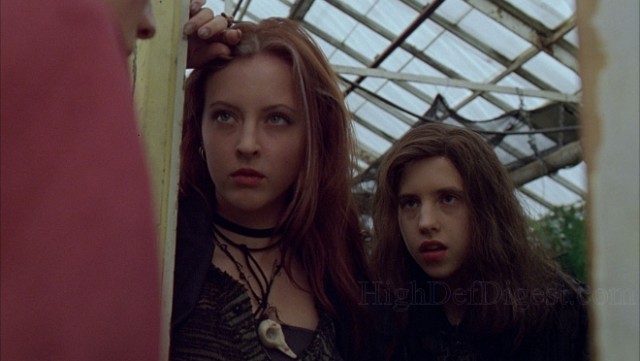

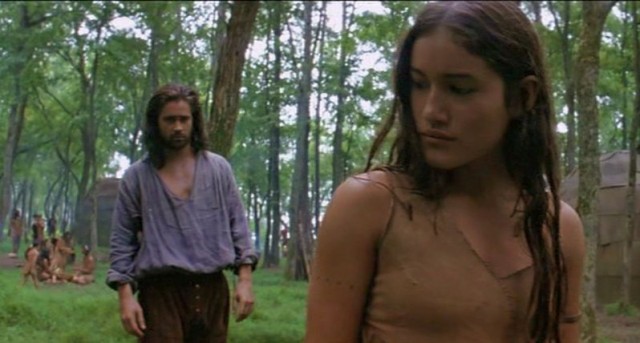
 Although production designers play a critical role in the making of a film, it’s something that the public tends to take for granted; the best of the best are not exactly household names. The Museum of the Moving Image seeks to rectify that in at least one case with its new series, “See It Big! Jack Fisk,” a celebration of the work of Oscar-nominated production designer, art director, and carpenter Jack Fisk. The fifteen-film series runs March 11 to April 1, kicking off with Terence Malick’s The New World. At the time the film was released in 2005, the iconoclastic American auteur had directed a mere four films in his forty-year career, each a gem in its own way — 1973’s Badlands, 1978’s Days of Heaven, 1998’s The Thin Red Line, and 2005’s The New World, and all of which Fisk worked on. Spectacularly photographed by cinematographer Emanuel Luzbeki (who has won three consecutive Oscars as of the 2016 Academy Awards), The New World reimagines the story of Captain John Smith (Colin Farrell) and Pocahontas (Q’orianka Kilcher) as an epic tale of unrequited desire, a fiercely passionate, if not completely accurate, love story for the ages. In 1607, a crew led by Captain Christopher Newport (Christopher Plummer) has landed in what will come to be known as Jamestown. The disgraced Smith, who was nearly hanged for mutiny, is ordered to meet with “the naturals” in order to develop a favorable relationship. But Smith falls deeply for Pocahontas, Chief Powhatan’s (August Schellenberg) beautiful young daughter, who shares his feelings, leading to a dangerous love that threatens to leave death and destruction in its wake. Large stretches of the film feature no dialogue, instead consisting of gorgeously framed shots with gentle, poetic narration from Smith, Pocahontas, and, later, John Rolfe (Christian Bale). The scenes between Farrell and Kilcher nearly ignite the screen, their eyes burning into each other. Malick and Luzbeki focus on lush, rolling fields and rushing rivers that are more than just beautiful scenery; the gorgeous landscape of this new world is filled with promise, with hope, even though we know what eventually, tragically happens. The film, which experienced well-documented casting, editing, and distribution dilemmas, bogs down considerably when Smith’s place in the newly named Rebecca’s life is taken over by Rolfe, but it all builds to a heart-wrenching conclusion. The New World is screening March 11 at 7:00; the series is being held in conjunction with the upcoming release of Malick’s latest film, Knight of Cups, which is being shown April 1 and on which Fisk, who has worked on every one of Malick’s feature films, served as production designer.
 The Museum of the Moving Image’s “See It Big! Jack Fisk” series features all seven collaborations between two-time Oscar nominee Fisk (There Will Be Blood, The Revenant) and Terence Malick, including what might be their least successful, To the Wonder. The polarizing auteur followed up his Oscar-nominated, Palme d’Or-winning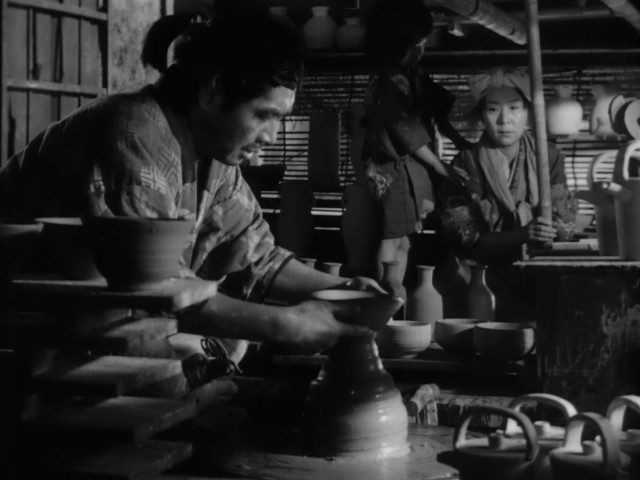
 Asia Society’s “Of Ghosts, Samurai, and War: A Series of Classic Japanese Film” series heads into its second weekend with one of the most important and influential — and greatest — works to ever come from Japan. Winner of the Silver Lion for Best Director at the 1953 Venice Film Festival, Kenji Mizoguchi’s seventy-eighth film, Ugetsu, is a dazzling masterpiece steeped in Japanese storytelling tradition, especially ghost lore. Based on two tales by Ueda Akinari and Guy de Maupassant’s “How He Got the Legion of Honor,” Ugetsu unfolds like a scroll painting beginning with the credits, which run over artworks of nature scenes while Fumio Hayasaka’s urgent score starts setting the mood, and continues into the first three shots, pans of the vast countryside leading to Genjurō (Masayuki Mori) loading his cart to sell his pottery in nearby Nagahama, helped by his wife, Miyagi (Kinuyo Tanaka), clutching their small child, Genichi (Ikio Sawamura). Miyagi’s assistant, Tōbei (Sakae Ozawa), insists on coming along, despite the protestations of his nagging wife, Ohama (Mitsuko Mito), as he is determined to become a samurai even though he is more of a hapless fool. “I need to sell all this before the fighting starts,” Genjurō tells Miyagi, referring to a civil war that is making its way through the land. Tōbei adds, “I swear by the god of war: I’m tired of being poor.” After unexpected success with his wares, Genjurō furiously makes more pottery to sell at another market even as the soldiers are approaching and the rest of the villagers run for their lives. At the second market, an elegant woman, Lady Wakasa (Machiko Kyō), and her nurse, Ukon (Kikue Mōri), ask him to bring a large amount of his merchandise to their mansion. Once he gets there, Lady Wakasa seduces him, and soon Genjurō, Miyagi, Genichi, Tōbei, and Ohama are facing very different fates.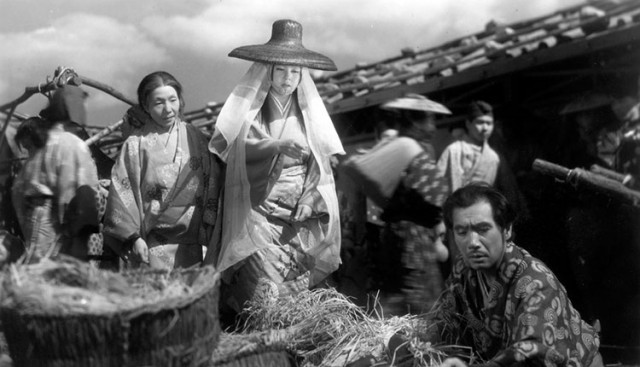
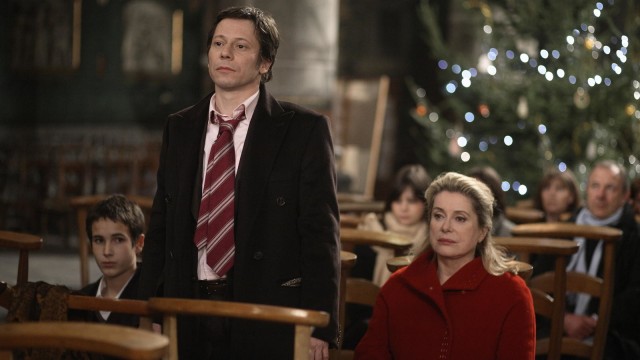
 One of the best films of 2008, A Christmas Tale is yet another extraordinary work from French post-New Wave filmmaker Arnaud Desplechin (La Sentinelle, Esther Kahn). Desplechin, who examined family dysfunction in the masterful