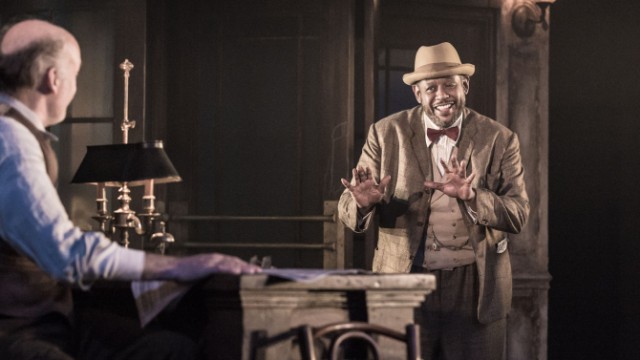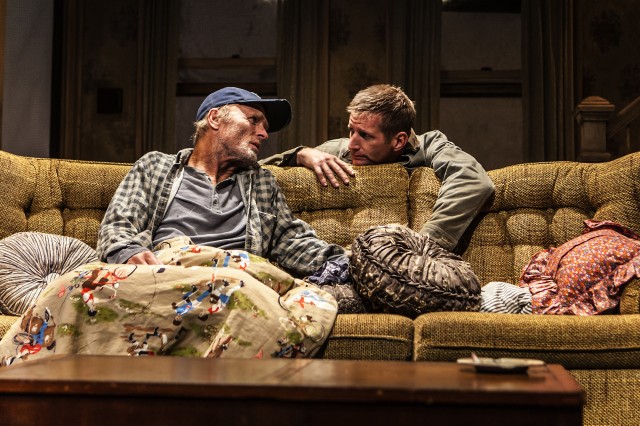
Dodge (Ed Harris) and Tilden (Paul Sparks) have a complicated father-son relationship in New Group revival of Sam Shepard’s BURIED CHILD (photo by Monique Carboni)
The New Group at the Pershing Square Signature Center
The Alice Griffin Jewel Box Theatre
480 West 42nd St. between between Ninth & Tenth Aves.
Tuesday – Sunday through April 3, $30-$115
www.thenewgroup.org
At a talkback following a recent performance of the New Group’s powerful, involving revival of Sam Shepard’s Buried Child at the Pershing Square Signature Center, actor Paul Sparks, who plays Tilden, said, “This is a play you learn about as you do it,” and several of the other actors nodded in agreement. Shepard won the 1979 Pulitzer Prize for Drama for this deep-rooted exploration of the decline of the American dream, but he has not stopped tinkering with it, and he has never explicated its many intricacies, not even to the actors themselves. In the preface to the 2006 revised edition of the play, Shepard explained that he made major changes for the 1995 Steppenwolf production because “enough time had elapsed for me to clearly see the holes in the play. . . . Finally, the language began to settle in and take hold. There were fewer gaps between the actors, the characters, and the words.” Shepard has revisited the play — which was nominated for five Tony Awards for that Steppenwolf version, including nods for director Gary Sinise, actors Lois Smith and James Gammon, and Best Play — once again for this latest edition, helmed by New Group founding artistic director Scott Elliott. Shepard didn’t make any huge alterations this time around, but he has done some nipping and tucking here and there. Perhaps the most critical change is that the play, which has always had three acts and two intermissions, is now being performed in a smooth-flowing 110 minutes without break; in addition, Ed Harris, who plays dying alcoholic patriarch Dodge, is already onstage as the audience enters the cozy Alice Griffin Jewel Box Theatre, spending upwards of a half hour drinking, dozing, and staring off into space as he sits uncomfortably on a ratty couch, an old baseball cap on his head. It’s a superbly effective introduction to Buried Child, a complex play about a dysfunctional family nonpareil, each member more wounded, physically and/or psychologically, than the next. Although their problems are primarily tied to a long-buried secret that has shattered them, it doesn’t appear that they had much happiness prior to that either. Dodge has given up on life, eking through a sickly, shriveled existence, trying to forget who he once was and what might have been. His wife, Halie (Amy Madigan), is in perpetual mourning for their dead son, Ansel, perhaps the family’s only hope at bettering its lot. Halie henpecks Dodge when she’s not out gallivanting around with Father Dewis (Larry Pine) and lording it over her husband. Meanwhile, son Bradley (Rich Sommer) stumbles on the periphery, a bear of a man who lost one of his legs in a chainsaw accident, and another son, Tilden, has returned after being thrown out of New Mexico for unspecified reasons. Tilden, an empty shell of a man, seems more ghost than human, making very little sense in those rare moments he speaks.
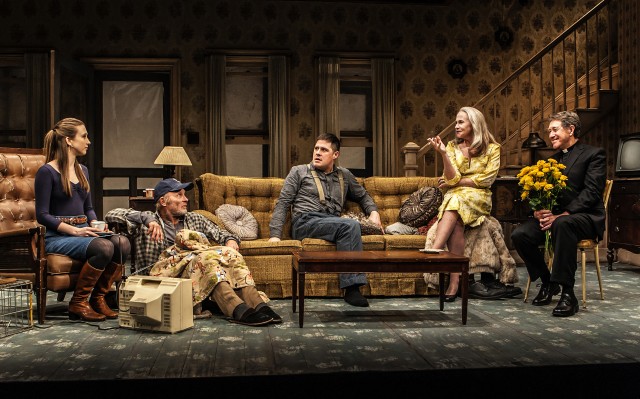
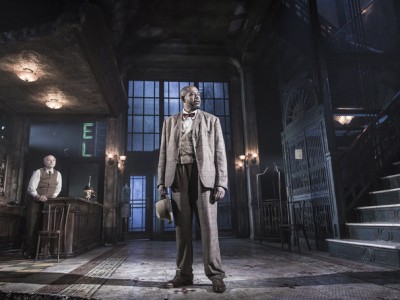
Family secrets threaten to implode a disillusioned clan in BURIED CHILD (photo by Monique Carboni)
Tilden keeps showing up with vegetables he has dug up in the backyard, even though Dodge and Halie insist that nothing has been planted in their dilapidated Illinois farm in decades. If things weren’t already crazy enough, Tilden’s college-age son, Vince (Nat Wolff), suddenly shows up with his girlfriend, Shelly (Taissa Farmiga), after disappearing for six years, and at first neither Dodge nor Tilden recognizes him, which makes Shelly want to leave. Vince is determined to become part of a family again, however, no matter how difficult and challenging that may be. But this is Shepard, so a happy ending may not exactly be on the horizon. It rains throughout much of the play, and occasional drops of water trickle down from the ceiling into a metal pail near the front of the stage, like a metronome interacting with the dialogue, or like a countdown clock ticking its way toward impending doom. Shepard injects lots of dark humor into the work, emphasizing the surreal nature of what is going on, even though the family is surrounded by a heavy shroud of death. As the play opens, Halie is unseen for several minutes as she screams down at Dodge from upstairs. “What’re you watching? You shouldn’t be watching anything that’ll get you excited!” she calls out, to which he responds, “Nothing gets me excited.” Dodge soon refers to himself as “the corpse” and “an invisible man,” claiming, “I don’t enjoy anything!” But he gets a little kick out of Shelly, who is not afraid to speak her mind. “It’s like a Norman Rockwell cover or something,” she says when she first enters, making fun of the house. “I thought it was going to be turkey dinners and apple pie and all that kinda stuff,” she adds once she’s sure that is not quite the case. (The wonderfully run-down living-room set is by Derek McLane.) Mysteries pervade, questions go unanswered, and subplots fade away even as revelations are made, all anchored by a mesmerizing performance by Oscar nominee Harris (Pollock, Wrecks), a Shepard veteran who won an Obie in 1984 for his portrayal of Eddie in the original off-Broadway production of Shepard’s Fool for Love and a 1995 Lucille Lortel Award for playing Carter in Shepard’s Simpatico. The decision to have Harris onstage from the time the doors open — and he never leaves — immediately bonds the audience to Dodge, as if he’s one of us, a bystander watching all the absurdity and chaos exploding around him. (It also gets rid of the dreaded entrance applause.) In fact, although he occasionally watches television, no glow or noise ever emanates from the TV, as if the actual show is what the rest of the characters are doing, which he is watching just as we are. Harris’s real-life wife, Oscar nominee Madigan (Twice in a Lifetime, Shepard’s A Lie of the Mind) — the couple costarred in the New Group’s production of Beth Henley’s underappreciated The Jacksonian in 2013 — is beautifully shrill as the nasty, deeply wounded Halie, playing her like a classic Tennessee Williams femme fatale. (Madigan played Stella opposite Alec Baldwin’s Stanley in Gregory Mosher’s 1992 revival of A Streetcar Named Desire.)
Sommer (The Unavoidable Disappearance of Tom Durnin, Harvey) provides fear and danger as Bradley, the ever-dependable Pine (Casa Valentina, A Public Reading of an Unpublished Screenplay About the Death of Walt Disney) is effectively neutral as the priest, and Sparks (Boardwalk Empire, The Killer) creates a zombielike Tilden exuding a dread that you can practically cut with a knife. Both Farmiga (American Horror Story, The Bling Ring) and Wolff (Heartbeat to Baghdad, The Fault in Our Stars) appear to have shown up from the current day (except for Wolff’s porn stache), although the play takes place at an inexact time during 1970s and there are no specific cultural references. (And for those of you keeping score at home, Pee Wee Reese never played for the Chicago White Sox, but he did hit three home runs for the Brooklyn Dodgers against the Chicago Cubs in Wrigley Field.) Farmiga, in her stage debut, is a little too chipper as the perky Shelly, but Wolff is strong as a young man desperate to reconnect with his family, regardless of what they have become. Themes of disillusionment, ennui, aging, love, lies, and loss permeate Buried Child, a tense, bitterly funny, heartbreaking tragedy that has been reimagined for this must-see revival that feels right at home at the Signature, imbued with freshness and vitality by Elliott (Mercury Fur, Hurlyburly); Shepard was the playwright-in-residence in 1996-97 for the Signature Theatre (but not at this location) and more recently was part of the company’s legacy program, and his large-scale portrait is on the wall alongside that of so many other Signature Theatre playwrights (such as August Wilson, Edward Albee, Tony Kushner, and Paula Vogel). Buried Child is a production of the New Group, not the Signature, but it’s an extremely satisfying sort of homecoming nonetheless, particularly for a show about home.
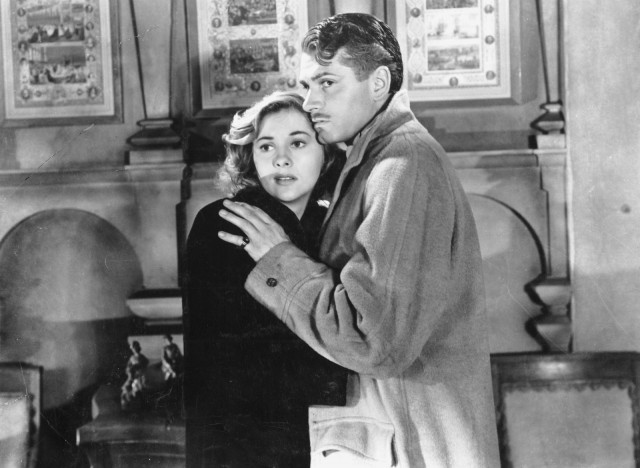
 “Last night I dreamt I went to Manderley again.” The opening line of Rebecca, Alfred Hitchcock’s first Hollywood picture, instantly sends chills down the spine of anyone who has seen the film or read the book on which it is based, Daphne du Maurier’s 1938 novel of the same name. The line is spoken in voice-over by the second Mrs. de Winter (Joan Fontaine), so haunted by the first Mrs. de Winter, the recently deceased Rebecca, that she never even gets a first name, depriving her of her own identity. While serving as a paid companion to snooty wealthy matron Edythe Van Hopper (Florence Bates) on a trip to Monte Carlo, the orphaned young woman meets the dapper but dark Maxim de Winter (Laurence Olivier), an elegant widower who takes a liking to her. Following a whirlwind courtship, they are married, and Maxim takes his mousey bride to his castlelike Cornwall estate, Manderley, where she is constantly compared to and overshadowed by the ghost of Rebecca, idolized as the perfect woman by the large staff, in particular the grim housekeeper, Mrs. Danvers (Judith Anderson), who relentlessly tortures the second Mrs. de Winter. “You wouldn’t think she’d been gone so long, would you?” Mrs. Danvers tells her. “Sometimes, when I walk along the corridor, I fancy I hear her just behind me. That quick light step, I couldn’t mistake it anywhere. It’s not only in this room, it’s in all the rooms in the house. I can almost hear it now.” But just as the second Mrs. de Winter finally tries to establish herself — “I am Mrs. de Winter now” she declares to Mrs. Danvers — Maxim shares a shocking truth about the first Mrs. de Winter that turns her world inside out.