twi-ny recommended events

TRIBECA FILM FESTIVAL 2016: FREE EVENTS

Adam Nimoys documentary about his father will have a special free screening at Tribeca

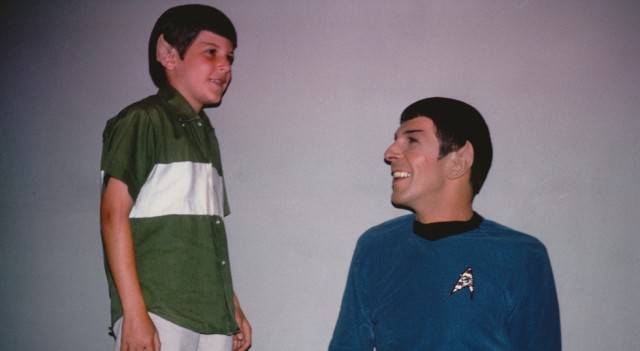
Adam Nimoy’s documentary about his father will have a special free screening at Tribeca

Tribeca Film Festival
Multiple venues
April 14-24
tribecafilm.com

The Tribeca Film Festival used to have more free events, including talks at B&N and the Apple Store, but this year, the fest’s fifteenth anniversary, there are not quite as many panels or screenings that don’t require dinero. (Speaking of dinero, the 2016 gala takes place at the Beacon on April 21, a fortieth anniversary screening of Martin Scorsese’s Taxi Driver, followed by a conversation with Scorsese, TFF cofounder Robert De Niro, Jodie Foster, Cybill Shepherd, and Paul Schrader, moderated by Kent Jones; tickets range from $70 to $355.) The majority of free events are scheduled for Friday, April 22, as part of the Film for All program, which consists of eight free screenings; advance registration is required. (Live links are included below with each listing.) There are also several master classes and special programs highlighting young filmmakers that are first come, first served. [ed. note: We spoke too soon. Shortly after this posted, Tribeca announced free panels at the new Samsung 837 location as well as a free Ghostbusters screening and fan fest. Keep checking here for more free events as they’re added.]

Thursday, April 14
Tribeca Talks: Unscripted & Immersive — Behind the Scenes: The New York Times’ Virtual Reality, with Jake Silverstein, Sam Dolnick, Steve Duenes, and Jenna Pirog, Samsung 837, 837 Washington St., 6:30

Friday, April 15
Tribeca Talks — Master Class: Dolby, with Glenn Kiser, SVA Theatre 2 Beatrice, 3:00

Tribeca Talks: Unscripted & Immersive — Behind the Scenes: LoveTrue Director Alma Har’el in Conversation with Michael Cera, Samsung 837, 837 Washington St., 6:30

Saturday, April 16
Tribeca Talks: Unscripted & Immersive — Behind the Scenes: Making of Invasion! Exploring Empathy and Agency in VR, with Eric Darnell, Maureen Fan, Maciej Gliwa, and Cody Gramstad, Samsung 837, 837 Washington St., 6:30

Sunday, April 17
Downtown Youth Behind the Camera, short films, Regal Cinemas Battery Park, 11:45 am

Tribeca Talks — Master Class: Prepping to Shoot with Catherine Hardwicke, SVA Theatre 2 Beatrice, 3:00

Monday, April 18
Tribeca Talks: Unscripted & Immersive — Behind the Scenes: The Artists of Vrse: A Conversation with Chris Milk, with Gabo Arora, Ari Palitz, Sandy Smolan, and James Nestor, Samsung 837, 837 Washington St., 5:00

Thursday, April 21
Our City My Story, works by young filmmakers in competition, Bow Tie Chelsea Cinemas, free with advance registration, 6:00

Friday, April 22
Film for All: For the Love of Spock (Adam Nimoy, 2016), Bow Tie Cinemas Chelsea 6, free with advance registration, 3:30

Film for All: Command and Control (Robert Kenner, 2016), Bow Tie Chelsea Cinemas, free with advance registration, 3:45

Film for All: The Phenom (Noah Buschel, 2016), Regal Cinemas Battery Park, free with advance registration, 3:45

Film for All: Solitary (Kristi Jacobson, 2016), Regal Cinemas Battery Park, free with advance registration, 4:15

Film for All: Actor Martinez (Mike Ott & Nathan Silver, 2016), Regal Cinemas Battery Park, free with advance registration, 5:00

Film for All: National Bird (Sonia Kennebeck, 2016), Bow Tie Chelsea Cinemas, free with advance registration, 5:30

Film for All: Vice World of Sports (Evan Rosenfeld, 2016), SVA Theatre 2 Beatrice, free with advance registration, 5:30

Film for All: Burden (Richard Dewey & Timothy Marrinan, 2016), Regal Cinemas Battery Park, free with advance registration, 8:45
Free Tribeca Film Festival Street Fair takes place April

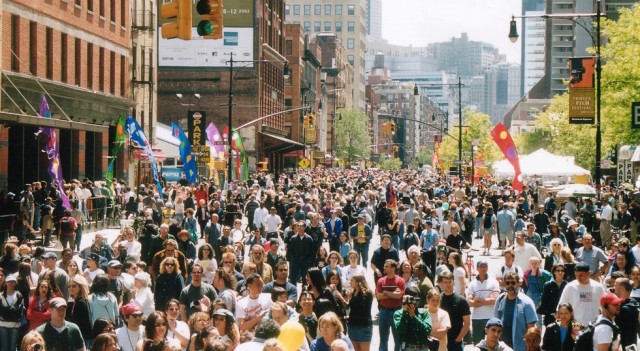
Free Tribeca Film Festival Street Fair takes place April 23

Saturday, April 23
Tribeca on Location: Tribeca Film Festival Street Fair, Greenwich St. from Hubert to Chambers Sts., 10:00 am

Tribeca/ESPN Sports Day, Greenwich St. at North Moore St., 10:00 am

Tribeca Talks — Master Class: Inside Casting, with Ellen Lewis and Ellen Chenoweth, moderated by Bernard Telsey, SVA Theatre 2 Beatrice, 2:30

Ghostbusters Fan Fest, including screening of Ghostbusters (Ivan Reitman, 1984), video greeting by cast of 2016 remake, introduction and conversation with producers behind new Ghostheads documentary, games, guided tour of original Ghostbusters headquarters, and more, Regal Battery Park Stadium 5, 3:00 (followed by sneak preview work-in-progress screening of Ghostheads at 5:30, $23.50)
TRIBECA FILM FESTIVAL: FIFTEEN FOR FIFTEEN

Tom Hanks and John Oliver will get together for a at Tribeca Film Festival

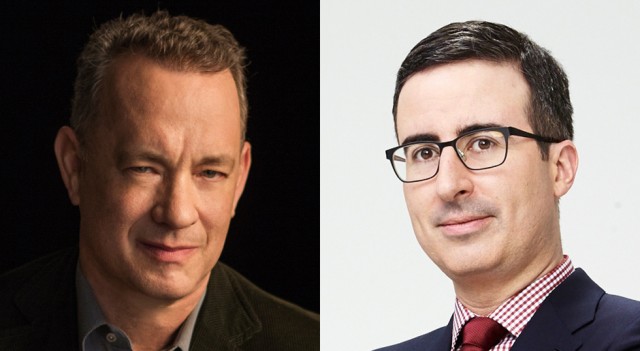
Tom Hanks and John Oliver will get together for a Storytellers talk at Tribeca Film Festival

Tribeca Film Festival
Multiple venues
April 14-24, $14-$43.50
tribecafilm.com

In 2002, Jane Rosenthal, Robert De Niro, and Craig Hatkoff founded the Tribeca Film Festival, helping to rebuild Lower Manhattan socially, culturally, and economically following 9/11. The festival is celebrating its fifteenth anniversary this year with another packed slate of film screenings, talks, master classes, and a major symposium, running from April 14 to 24 at the SVA Theatre, Bow Tie Cinemas Chelsea, Regal Cinemas Battery Park, the Borough of Manhattan Community College, and the festival hub at 50 Varick St. Ticket prices continue to climb, so it’s not exactly cheap to attend, but that hasn’t stopped many events from nearly selling out already despite costing $23.50 for most regular screenings and between $33.20 and $43.50 for conversations and films with postscreening talks. In honor of Tribeca’s fifteenth birthday, below are fifteen highlights from this year’s fest, with one extra thrown in for good luck.

Thursday, April 14
Tribeca Talks — Storytellers: Patti Smith with Ethan Hawke, SVA Theatre 1 Silas, rush ticketing only, 3:00

Tribeca Tune In: Grace and Frankie, screening of two episodes from season two, followed by discussion with Jane Fonda and Lily Tomlin, moderated by Gayle King, SVA Theatre 1 Silas, $33.50, 5:00

Contemporary Color (Bill & Turner Ross, 2016), followed by a conversation between David Byrne and the directors, with appearances by color guarders, JZT@BMCC, $23.50, 9:00

Saturday, April 16
TFI Interactive, all-day immersive symposium, divided into the MakerSpace, the Conference, and the Interactive Playground exhibit, festival hub at 50 Varick St., $40, 11:00 am

Monday, April 18
Tribeca Talks — Directors Series: Andrea Arnold in conversation with Ira Sachs, SVA Theatre 2 Beatrice, $43.50, 2:00

Tribeca Tune In: For the Love of Spock (Adam Nimoy, 2016), followed by a conversation with Adam Nimoy, Zachary Quinto, David Zappone, and Scott Manzt, moderated by Gordon Cox, SVA Theatre 2 Beatrice, $33.20, 5:00

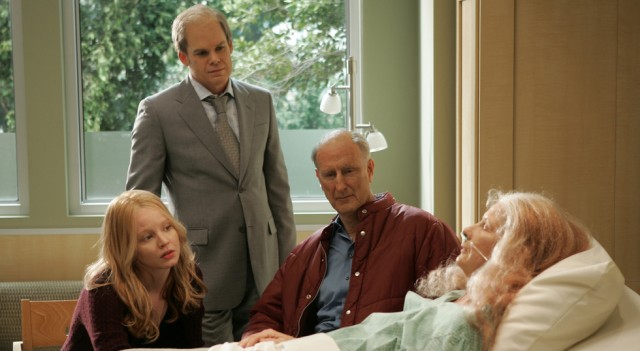
SIX FEET UNDER creator Alan Ball will offer live commentary during screening of final episode at Tribeca Film Festival

SIX FEET UNDER creator Alan Ball will offer live commentary during anniversary screening of final episode at Tribeca Film Festival

Tuesday, April 19
Tribeca Tune In: Fifteenth anniversary screening of Six Feet Under series finale, with live commentary by show creator Alan Ball, moderated by Matt Zoller Seitz, SVA Theatre 1 Silas, $33.50, 4:30

Tribeca Tune In: Full Frontal with Samantha Bee, conversation with Samantha Bee and head writer Jo Miller, moderated by Stacey Wilson Hunt, SVA Theatre 1 Silas, $33.50, 7:30

Wednesday, April 20
Tribeca Talks: Daring Women Summit, featuring keynote conversations, discussions, presentations, and more, with Samantha Bee, Allana Harkin, Rachel Sklar, Donna Karan, Rosie Perez, Kate Ward, Lea Goldman, Kathleen Grace, Sophia Rossi, Stephanie Laing, Amy Emmerich, LaLa Anthony, Julie Ann Crommett, Nahnatchka Khan, Liz Meriweather, Danielle Nussbaum, Mya Taylor, Catie Lazarus, Kristi Zea, Laura Walker, Anna Sale, Phoebe Robinson, Cindy Gallop, Kathryn Minshew, and others to be announced, festival hub at 50 Varick St., $150, 10:30 am

Tribeca Talks — Directors Series: Jodie Foster with Julie Taymor, festival hub at 50 Varick St., $43.50, 5:30

Tribeca Talks — Directors Series: Alfonso Cuarón with Emmanuel Lubezki, SVA Theatre 1 Silas, $43.50, 6:00

Thursday, April 21
Tribeca Talks After the Movie: Starring Austin Pendleton (David H. Holmes & Gene Gallerano, 2016), followed by discussion with Austin Pendleton, Olympia Dukakis, Peter Sarsgaard, Denis O’Hare, George Morfogen, and directors David H. Holmes and Gene Gallerano, moderated by Gordon Cox, SVA Theatre 2 Beatrice, $43.50, 2:30

Tribeca Talks After the Movie: I Voted? (Jason Grant Smith, 2016), followed by discussion with Jason Grant Smith, Katie Couric, Dan Abrams, and Dr. DeForest Soaries, SVA Theatre 2 Beatrice, $43.50, 5:30

Friday, April 22
Tribeca Talks — Storytellers: Tom Hanks with John Oliver, JZT@BMCC, rush ticketing only, 6:00

Saturday, April 23
Tribeca Talks: What We Talk About When We Talk About the Bomb, with Michael Douglas, Eric Schlosser, Emma Belcher, Joe Cirincione, Robert Kenner, and Smriti Keshari, SVA Theatre 2 Beatrice, $43.50, 5:00

Tribeca Talks — Directors Series: Baz Luhrmann with Nelson George, SVA Theatre 1 Silas, $43.50, 6:00

TICKET ALERT: BRUNCH EATS

brunch eats

The Intrepid Sea, Air & Space Museum
12th Ave & West 46th St.
Wednesday, May 11, $60-$85, twenty-one and over only, 8:00 – 11:00
villagevoice.com

In an 1895 article in Hunter’s Weekly entitled “Brunch: A Plea,” British writer Guy Beringer suggested a new cure for the hangover: “Instead of England’s early Sunday dinner, a post church ordeal of heavy meats and savory pies, why not a new meal, served around noon, that starts with tea or coffee, marmalade and other breakfast fixtures before moving along to the heavier fare? By eliminating the need to get up early on Sunday, brunch would make life brighter for Saturday-night carousers. It would promote human happiness in other ways as well. Brunch is cheerful, sociable and inciting. It is talk-compelling. It puts you in a good temper, it makes you satisfied with yourself and your fellow beings, and it sweeps away the worries and cobwebs of the week.” The Village Voice is putting Beringer’s idea into use with its inaugural Brunch Eats, a “breakfast-for-dinner” event that completes its foodie hat trick that already features the annual Choice Eats and Choice Streets. On May 11 at 8:00, more than twenty local eateries will be serving their unique takes on the breakfast-lunch mashup known as brunch at night, on board the flight deck of the Intrepid Sea, Air & Space Museum. So far, the following restaurants have been announced, with more to come: Butter & Scotch, the Black Ant, Calle Dao, Le Fond, Nha Minh, Osteria Cotta, Streets BK, and Underwest Donuts; there will also be special libations and live music. These events tend to sell out in advance, so act now, especially if you want the VIP treatment; general admission is $65, while $85 VIP tickets include a gift bag and access to the Space Shuttle Pavilion. “Brunch, for me, is an extended breakfast that should be enjoyed whenever you have time properly to engage in cooking and eating,” British chef Yotam Ottolenghi has explained. On May 11, you’ll be able to extend your brunching well into the night.

BLACKBIRD

(photo by Brigitte Lacombe)

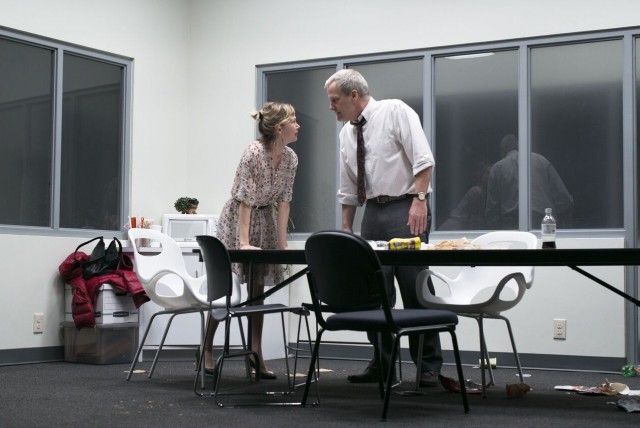
Una (Michelle Williams) and Ray (Jeff Daniels) revisit a past traumatic event in very different ways in BLACKBIRD (photo by Brigitte Lacombe)

Belasco Theatre
111 West 44th St. between Sixth & Seventh Aves.
Monday – Saturday through June 11, $39 – $145
blackbirdbroadway.com

In 2007, Jeff Daniels starred with Alison Pill in the off-Broadway premiere of David Harrower’s Olivier Award–winning play, Blackbird, directed by Joe Mantello at Manhattan Theatre Club. Nine years later, Daniels is revisiting the incendiary work by digging even deeper into his controversial character in the show’s must-see Broadway debut, running at the Belasco through June 11. Daniels plays Peter, a man suddenly forced to confront his past when Una (Michelle Williams) surprises him at his office late one afternoon. Fifteen years earlier, Peter, then forty years old and known by his given name, Ray, had an inappropriate and illegal relationship with Una, who was twelve at the time. “What cinched the decision to return was that Ray still terrified me,” Daniels wrote in a recent column in the New York Times. “Every actor knows you can’t run from the ones that scare you. It’s not the acting of the character, nor is it the dark imagination it takes to put yourself through all of his guilt, regret, and shame. To truly become someone else, you have to hear him in your head, thinking, justifying, defending, wanting, needing, desiring. The more I looked back at the first production, the more I saw what I hadn’t done, where I hadn’t gone. I’d pulled up short. Found ways around what was necessary. When it came time to truly become Ray, I’d protected myself. He’d hit bottom. I hadn’t.” Daniels indeed hits rock bottom in his remarkable, and terrifying, portrayal of Ray, humanizing a man who committed a horrible crime and tries to escape its consequences and get on with his life, changing his identity and moving away. But as Una, Williams is Daniels’s equal, fully inhabiting the difficult role of a young woman who, on the cusp of adolescence, had her future shut down by Ray’s actions. Tiny, wearing giant heels, and wrapped in a red puffer coat, Williams suggests both a fully adult woman and a sexualized child, delivering a character who never had opportunities to figure out who she is and potentially live a normal life. Their confrontation takes place in a small employee cafeteria in Ray’s office, where he at first denies even knowing who she is, although his head looks like it is about to explode. “This was pointless. Absolutely pointless. Can you see that?” Ray asks her, adding, “You’re a / some kind of ghost / turning up from nowhere to / Go home. / Please. / Leave me alone.” Una responds, “I do feel like a ghost. / I do. / I feel like a ghost. / Everywhere I go. . . . / You made me into a ghost.”

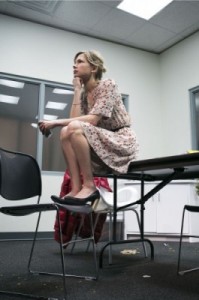
Una (Michelle Williams) considers where life has brought her in BLACKBIRD (photo by Brigitte Lacombe)

Una (Michelle Williams) considers where life has brought her in BLACKBIRD (photo by Brigitte Lacombe)

Williams and Daniels go at it in real time during the play’s ninety minutes, as details of past and present slowly emerge. Their words come in fits and starts, with incomplete sentences and several long monologues that are filled with emotion. While Una is often coy, Ray is angry, afraid not only of Una but of being discovered; as they play a vicious game of cat and mouse, switching between roles of attacker and prey, figures occasionally walk past in the hall or a colleague of Ray’s knocks on the door and asks for him. (These extras are seen only in silhouette through frosted doors and windows.) But even though we know in our hearts that what Ray did to Una was completely wrong, Daniels is able to elicit compassion for Ray, while Williams sometimes makes us feel like Una is taking advantage of the situation in unfair ways. I hated myself for thinking that, but that’s part of the beauty of Harrower’s (Knives in Hens) piercing dialogue and Mantello’s (The Humans, Other Desert Cities) astute, no holds-barred direction. “I am entitled to something. / To live,” Ray says. “I lost more than you ever did,” Una replies. “I lost / because I never had / had time to to to begin.” Scott Pask’s set is cold and unfeeling, almost antiseptic except for the mess of food wrappers and garbage left behind by employees. Trash becomes an integral part of the proceedings. Una tells a story about getting upset when she saw a man drop a can of beer and a cigarette on the sidewalk. “It’s not the litter / it wasn’t the litter / the dirtying,” she says. “It was the man, the person doing that. / Because he hasn’t been, been / schooled / educated / civilized enough / and I thought, / I just thought you are a beast.” She’s of course not talking only about the stranger but about Ray as well. But Ray refuses to see himself as a beast, and Una refuses to regard herself as garbage.

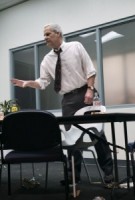
Ray (Jeff Daniels) tries to avoid a meltdown when part of his past comes rushing back in BLACKBIRD (photo by Brigitte Lacombe)

Ray (Jeff Daniels) tries to avoid a meltdown when part of his past comes rushing back in BLACKBIRD (photo by Brigitte Lacombe)

Watching Blackbird is as uneasy and uncomfortable as it is captivating and physically and mentally exhausting. I found myself leaning forward in my seat, mesmerized by every word and every nuance and movement by three-time Oscar nominee Williams (Cabaret, My Week with Marilyn) and Emmy, Drama Desk, and Obie winner Daniels (The Newsroom, The Squid and the Whale) as they worked their magic. They both give dynamic, unrelenting performances that are brave and bold. It’s more than just a battle of wits and power, or an argument about the nature of love, or an exploration of the very different responsibilities of adults and children. The production, which includes excellent sound design by Fitz Patton and lighting by Brian MacDevitt, masterfully challenges the viewer to disregard extremes and do some genuine soul searching of their own. Of course, just by calling the woman “Una” sets herself off by herself, as if she is alone in the world. (The film version, the debut feature by Australian theater director Benedict Andrews, is called Una; Rooney Mara plays Una, with Ben Mendelsohn as Ray.) On the way out of the Belasco, you’re likely to find yourself in a heated discussion with your companion over whether the show was honest and truthful about pedophilia, whether it was more of a glorified rape apology, whether it was a love story, or whether it treated both characters equally. You’re also likely to find yourself wanting a thorough shower.

CHANTAL AKERMAN — IMAGES BETWEEN THE IMAGES: HOTEL MONTEREY AND LA CHAMBRE

HOTEL MONTEREY

Chantal Akerman’s HOTEL MONTEREY was filmed in an Upper West Side transient hotel

HOTEL MONTEREY (Chantal Akerman, 1972) and LA CHAMBRE (Chantal Akerman, 1972)
BAMcinématek, BAM Rose Cinemas
30 Lafayette Ave. between Ashland Pl. & St. Felix St.
Friday, April 8, 2:30 & 7:30
Series continues through May 1
718-636-4100
www.bam.org

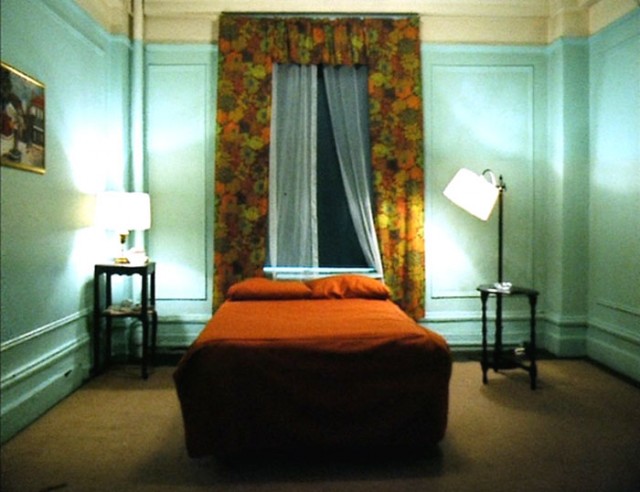
BAMcinématek continues its month-long tribute to the late Chantal Akerman, which began April 1 with a two-week run of the Belgian auteur’s latest, and last, film, No Home Movie, with a double feature of two extraordinary experimental works she made while living in New York City in the early 1970s. In 1972, following 1968’s Saute ma ville and 1971’s L’enfant aimé ou Je joue à être une femme mariée, Akerman and cinematographer Babette Mangolte took a camera to the Hotel Monterey, an Upper West Side welfare hotel, and set it up in the lobby, elevator, and various floors as it made its way upstairs and ultimately to an open window, where it ventures outside into the gray dimness of the city. The camera very rarely moves before then, instead capturing curious residents as they hang out in the lobby, look into the lens, or choose not to get into the dark elevator with the unexpected object; each shot lasts approximately one minute, and the entire film is silent. In hallways, the static shots sometimes look like photographs or paintings, the dreary, fading colors of the walls and floors adding a haunting, mysterious quality that is at times eerily reminiscent of Stanley Kubrick’s The Shining, which came out eight years later, while also evoking Michael Snow’s Wavelength. Occasionally, the camera enters a room: in one, a pregnant woman looks off in a Vermeer-like pose; in another, a well-dressed gentleman sits in a chair, looking directly into the lens; and in a third, a woman sits in a chair by a window, as if wondering what awaits her. A shot of an empty room with a striking red bed in the center can’t help but lead viewers into creating their own stories about what might have gone on there. Artfully edited by Geneviève Luciani, Hotel Monterey is a mesmerizing, and challenging, sixty-five-minute architectural journey into the physical and psychological properties of what film can show and how it is perceived.
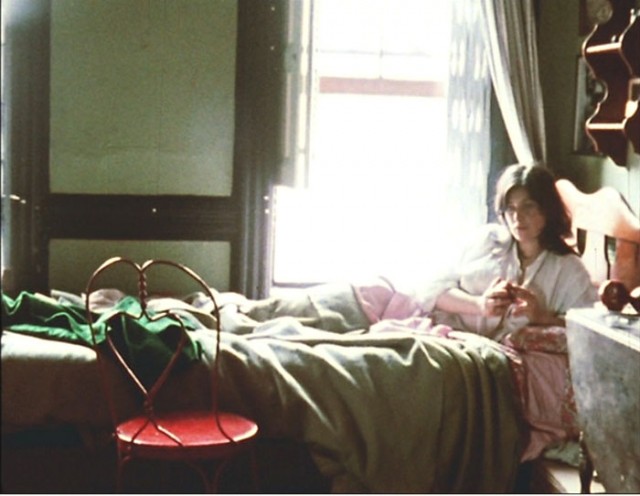
LA CHAMBRE

LA CHAMBRE repeatedly scans a downtown tenement apartment, where the director alluringly waits in bed

The day after shooting Hotel Monterey, Akerman and Mangolte went downtown to SoHo, where they made La Chambre, an eleven-minute silent film influenced by Snow’s <----> (“Back and Forth”). In a cramped room in a tenement house where Akerman occasionally stayed, a camera slowly pans around the space, sometimes stuttering to remind the viewer that there is someone holding it. The camera treats every object the same, revolving past a table, a sink, a stovetop with a kettle on it, and Akerman in a white nightgown in bed. As it returns to familiar spots, you look deeper, perhaps to see if you missed anything the previous time, or to check if something changed, a natural inclination while watching a movie. However, the only element that changes is Akerman herself; each time the camera pans by her, she is in a slightly different position, fully aware she is being watched — but taking the power back as she stares directly into the camera, playing off her sexuality. She even picks up an apple and lasciviously takes a bite out of it, referencing Eve in the Garden of Eden. And then the camera suddenly goes from rotating counterclockwise to clockwise, completely shifting the visual narrative while obliterating all expectations, Akerman boldly telling everyone who is in control. It’s a thrilling eleven minutes that makes you rethink the way you experience cinema, especially in this age of social media and constant surveillance; in the early 1970s, people did not have the same opportunities to post aspects of their everyday life for all to see, and they were not used to being on camera everywhere they went, including lobbies and elevators.

Both La Chambre and Hotel Monterey, along with Saute ma ville, which is also set in small rooms, reveal Akerman’s fondness for shooting in tight, often confining spaces. For the Brussels-born director, these tableaux evoked her mother’s imprisonment in Auschwitz as well as the trapped role of women in society. “We can read the Akerman-room as a sort of artist’s installation, a reduced stage on which the filmmaker reenacts her agency as artist,” Ivone Margulies explains in “La Chambre Akerman: The Captive as Creator,” a paper delivered at the December 2005 symposium “Images between Images” at Princeton. “Despite the affinity of this room with other video and performance images, ‘la chambre Akerman’ can be found only in her films. For this room gains its performative raison d’être from its relations to other spaces. The primary impetus for the room is its erection of a separate, rigorously demarcated space for the self. . . . The Akerman-chamber works as a display case for the conflict between artistic autonomy and the temptations of another less productive, obsessive kind of autonomy.” Throughout her career, Akerman, who was also a writer and installation artist, was nothing if not autonomous and obsessive; she actually made Hotel Monterey and La Chambre with money she had skimmed from her job at a gay porn theater in New York. All of the elements would later come together in her boundary-shattering feminist classic, Jeanne Dielman, 23, quai du Commerce, 1080 Bruxelles. Akerman died last October, reportedly by suicide, shortly after the death of her mother. “Chantal Akerman: Images between the Images” continues through May 1 with such other films by Akerman as Tomorrow We Move, The Meetings of Anna, From the Other Side, News from Home, and La Captive. In addition, Jeanne Dielman is at Film Forum through April 7 and Anthology Film Archives will host “Chantal Akerman x 2,” showing No Home Movie and Là-Bas April 15-21.

JAPAN SINGS! THE JAPANESE MUSICAL FILM: YOU CAN SUCCEED, TOO

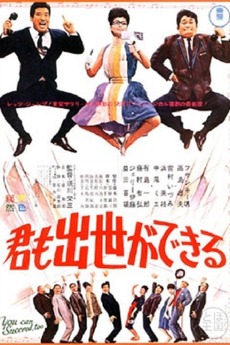
YOU CAN SUCCEED, TOO

Musical comedy YOU CAN SUCCEED, TOO takes a playful look at U.S. and Japanese business practices

YOU CAN SUCCEED, TOO (KIMI MO SHUSSE GA DEKIRU) (君も出世ができる) (Eizo Sugawa, 1964)
Japan Society
333 East 47th St. at First Ave.
Friday, April 8, 7:00
Festival runs April 8-23
212-715-1258
www.japansociety.org

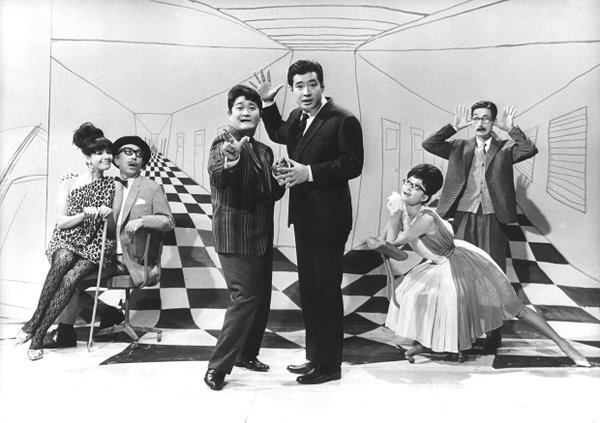
Japan Society’s 2016 Globus Film Series, “Japan Sings! The Japanese Musical Film,” opens April 8 with Eizo Sugawa’s riotous, robust 1964 delight, You Can Succeed, Too. With the Tokyo Summer Olympics approaching, Towa Tourism is locked in a heated battle with Kyokuto Tourism for big travel clients. While Yamakawa (Frankie Sakai) has developed a can’t-miss plan to succeed at Towa — either marry the president’s daughter, become a union leader, or find the president’s weakness and exploit it — his friend Nakai (Tadao Takashima) does not enjoy the urban rat race and would rather settle down in the countryside. When the president, Nobuo Kataoka (Yoshitomi Masuda), returns from a trip to the United States with his daughter, Yoko (Izumi Yukimura), he puts her in charge of the foreign office as she extolls the virtues of efficient American business practices over the old-fashioned Japanese ways. Yamakawa sets his sights on Yoko despite restaurant owner Ryoko’s (Mie Nakao) obvious desire to marry him and move to the country for a more simple life, but Yoko is more attracted to the oblivious Nakai, who soon finds himself in the middle of the president’s untoward relationship with the much younger, hot-to-trot cocktail hostess Beniko (Mie Hama). It all comes to a head as a pair of American tourists (Ernest and Marjorie Richter) and a prominent U.S. executive seek the right Japanese tourism company to do business with.
you can succeed 2

You Can Succeed, Too has a ball skewering the world of business, centered around the hysterical antics of comedian Sakai (Shogun, Mothra), who wears striped pajamas that resemble prison clothes (as if he is trapped by his need to succeed), putt-putts around in a tiny, checkered Mr. Bean–like car, and stretches his elastic face into hysterical expressions that recall early silent film comedy. Tatsuo Kita’s sets are spectacularly mod and endlessly imaginative — just wait till you see Beniko’s pink apartment — while Etsuko Yagyu’s costumes, particularly Yoko’s candy-colored, Audrey Hepburn–like outfits, are oh-so-fab, all wonderfully captured by Masaharu Utsumi’s splendid cinematography. The story takes some silly sitcomlike plot twists that become rather frustrating, but that can mostly be forgiven as Sugawa (The Beast Shall Die, River of Fireflies) includes numerous subtle and not-so-subtle digs at America and changing attitudes in postwar Japan; there are metaphors comparing business to battle, one of Yamakawa’s plans involves screaming out “Banzai!,” and a key scene takes place at the American-style nightclub Charade, as if this is all fake anyway. And the songs are a hoot, featuring a Hollywood-influenced score by Toshirô Mayuzumi (The Pornographers, The Insect Woman) and crazy choreography, all coming three years before How to Succeed in Business without Really Trying. You Can Succeed, Too is screening April 8 at 7:00 and will be introduced by series curator Michael Raine, followed by a karaoke party with singer and musician Yasuno Katsuki, emceed by Brian Walters. “Japan Sings! The Japanese Musical Film” continues through April 23 with such other rarities as Umetsugu Inoue’s The Stormy Man, Kengo Furusawa’s Irresponsible Era of Japan, Nagisa Oshima’s Sing a Song of Sex, and Takashi Miike’s The Happiness of the Katakuris.

FREE TICKET ALERT — DUKE RILEY: FLY BY NIGHT

Duke Riley

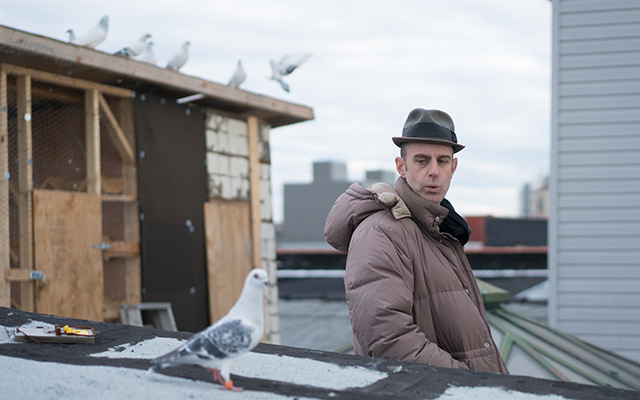
Duke Riley brings his pigeons to the Brooklyn Navy Yard for special weekend performances from May 7 to June 12 (photo by Will Star)

Who: Creative Time and Duke Riley
What: “Fly by Night”
Where: Brooklyn Navy Yard, Sands St. at Navy St.
When: Fridays, Saturdays, and Sundays, May 7 – June 12, free but advance tickets required, 7:00 or 7:30
Why: In his winter 2013–14 exhibition at Magnan Metz in Chelsea, “See You at the Finish Line,” the Boston-born, Brooklyn-based artist Duke Riley documented in astounding detail his use of camera-carrying homing pigeons he sent between Cuba and Key West. Riley has now teamed up with nonprofit arts organization Creative Time, whose previous projects include Kara Walker’s “A Subtlety or the Marvelous Sugar Baby” at the Domino Sugar Factory in Williamsburg and “Drifting in Daylight” in Central Park, for “Fly by Night,” in which thousands of pigeons will emerge from a former naval aircraft carrier docked at the Brooklyn Navy Yard on weekend nights at dusk in May and June and put on a performance in the sky involving LED lights with special messages. “With the keen timing of a conductor, this winged symphony weaves together the narrative threads of overlapping histories — a forgotten waterfront island, a creature we see daily in our landscape but rarely look at, and an artist who stands on a rooftop linking his past to his present in a swirling crescendo,” curator Meredith Johnson explains in a statement. “Like the birds themselves, no two performances are the same. Lacing together old New York and new, ‘Fly by Night’ asks us to stop, watch, listen, and revere this extraordinary creature that has shared the triumphs and tragedies of the human experience — uniting individuals, cultures, and generations of fanciers in a tale of both the ancient and modern city.” Admission to the performances are free but must be reserved in advance here. In addition, the project is seeking volunteers to help engage the public, ensure safety, and assist with tech issues; you can find out more about those opportunities and benefits here.