Roarke Menzies will celebrate the release of his sophomore album, CORPOREAL, at Sunnyvale on April 7 (photo by Josh Simpson)
Who:Roarke Menzies,Imaginary Tricks,the Despot,Breanna Barbara,O Paradiso What: Album release party for Corporeal Where:Sunnyvale Brooklyn, 1031 Grand St. at Morgan Ave., 347-987-3971 When: Thursday, April 7, $7, 9:00 Why: This past October, we talked to New York City-based artist and composer Roarke Menzies about his debut solo album, Shapes. The Vancouver-born, Brooklyn-based Menzies, who also composes electronic scores for film, dance, and spoken-word theater (with Paul Rome), hasn’t wasted much time, already preparing to release his sophomore album, Corporeal. “A blank hard drive — no memories, just structure, architecture, an empty page — is marked with human data: mouth sounds, sung melodies, lips, teeth, breath, traces of bodily presence,” he states about the project. “Corporeal is a series of musical collages that consider the repetitive, hypnotic acts of the body in performance, as well as the storied, figurative romance — utopian and fatal — between human and machine.” The seven songs, which feature such titles as “For Vinyl-Covered Stages,” “Flicker Film,” “Apparatus or Caress,” and “The Wake,” combine found and created sounds with mysterious vocals to create atmospheric aural adventures that come alive with the rattle and hum of real life. As Menzies describes, “A voice echoes down an audio cable. A sewing machine is cranked by human hands. Fists pound and beat on a sheet of steel.” Menzies will be the release of Corporeal on April 7 at Sunnyvale in Brooklyn; also on the bill are Imaginary Tricks, the Despot, and Breanna Barbara, with DJ sets by O Paradiso. You can find out more about the event here and check out a sample song and pick up the album here.
“Orchidelirium” focuses on the frenzy created by Victorian orchid hunters and collectors (photo by twi-ny/mdr)
The New York Botanical Garden
Enid A. Haupt Conservatory
2900 Southern Blvd., Bronx
Tuesday – Sunday through April 17, $8-$10 children two to twelve, $20-$25 adults, 10:00 am – 6:00 pm
718-817-8700 www.nybg.org orchidelirium slideshow
The Orchid Show at the New York Botanical Garden is always one of the highlights of spring, and the fourteenth annual presentation is one of the best yet. Part of the NYBG’s ongoing celebration of its 125th anniversary, “Orchidelirium” zeroes in on the history of orchid collecting, focusing on some of the Victorian botanists and explorers who risked their lives to find and collect the rare, beautiful plants during a particularly fruitful frenzy around the turn of the nineteenth century. The excellent signage explains that one of the elements that makes orchids so special, so unusual and compelling, is “the fusion of the male portion of the flower (stamen) and the female portion (pistil) into one structure called the column — often visible protruding from the center.” This makes it easy to project a rather erotic look on many of the thirty thousand species’ blooms — not that we’re claiming that the sensual, sexual nature of orchids is what has driven men to go to extreme lengths to capture the spectacular flowers. The show spotlights a few of the more fascinating field botanists: Czech farmer, inventor, and gardener Benedikt Roezl became known at the Prince of Orchid Hunters, discovering some eight hundred species in Central and South America. William George Spencer Cavendish, the sixth Duke of Devonshire, and his gardener, Joseph Paxton, amassed a huge private collection. Medical assistant and naturalist Sir Joseph Dalton Hooker traveled to India and the Himalayas with a large entourage to bring back orchids. Henry Frederick Conrad Sander, the self-described Orchid King, became royal orchid grower to Queen Victoria and would leave no orchids behind for others when his hunters came upon new species. (An orchid bought by the NYBG from Sander in 1904, still alive and growing, is on display in the show.) John Dominy, responsible for the first man-made hybrid in the 1850s, earned the following declaration from orchidologist John Lindley: “You will drive the botanists mad!” And William Arnold, Gustav Wallis, David Burke, and František Klaboch (Roezl’s nephew) all died while hunting orchids.
Fourteenth annual orchid show is a highlight of the NYBG’s 125th anniversary celebration (photo by twi-ny/mdr)
As always, the show, arranged this year to evoke Victorian-era glasshouse designs, particularly those of collector and scholar James Bateman, features wonderful quotes and poems. “I never was more interested in any subject in my life than this of Orchids,” said Charles Darwin, for whom Darwin’s star orchid is named. “Wildly, that I be unfathomed / Of this strange miracle, / My own seeks the cloven foot-print / The orchid clutched like a shell,” Howard McKinley Corning wrote in his poem “I Seek the Orchid.” In “Short Talk on Orchids,” Anne Carson points out, “We live by tunneling for we are people buried alive. To me, the tunnels you make will seem strangely aimless, uprooted orchids.” And in “Orchids,” Theodore Roethke explains, “They lean over the path, / Adder-mouthed, / Swaying close to the face, / Coming out, soft and deceptive, / Limp and damp, delicate as a young bird’s tongue.” That description works for the show itself, which consists of hundreds of orchids, gorgeously arranged in pots, on trees, in a Wardian case, and in central displays bursting with unique shapes and color. Other plants and flowers have their beauty, but there’s something about orchids that sets them apart from the rest of the natural world, like they know something we don’t and we can only bow down to their grace and elegance. When we’re not taking photos, that is.
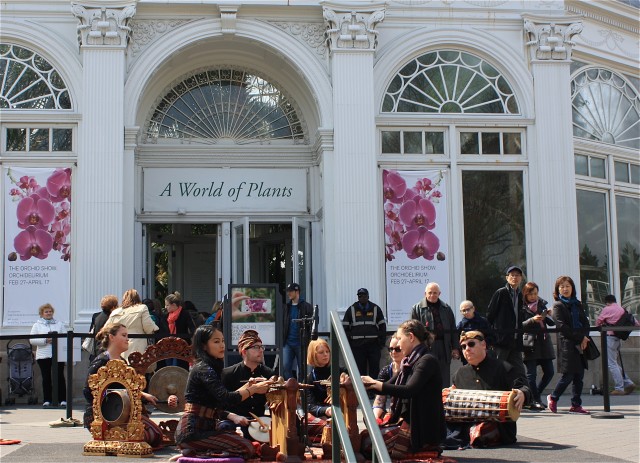
Gamelan Dharma Swara will perform on April 9-10 as part of NYBG orchid show (photo by twi-ny/mdr)
Numerous programs are being held at the NYBG in conjunction with “Orchidelirium.” On Saturdays and Sundays, “World Beat: Music & Dance Around the World of Orchids” includes performances by New York City-based Indonesian troupe Gamelan Dharma Swara on April 9-10 and Nego Gato Afro-Brazilian Music and Dance Ensemble on April 16-17. Also on April 9-10, Spike Jonze’s Adaptation., inspired by Susan Orlean’s book The Orchid Thief: A True Story of Beauty and Obsession, will be screened in Ross Hall. Experts lead orchid care demonstrations on Saturdays and Sundays at 2:00 and 3:00, while other experts will answer your questions in the shop on Saturdays and Sundays from 1:30 to 4:30. Tours are held Tuesdays through Fridays at 12:30 and 2:30. A special class on fragrant orchids will be held on April 9 at 10:00 ($59). And “Orchid Evenings” ($35, 6:30 – 9:30) are take place April 9, 15, and 16, when the show is open at night and you can sip ginger vanilla fusion and other cocktails while enjoying this stunning show in a different light.
Infinity Float session at Q Flatiron relieves stress and anxiety
Multiple locations
April 11-17, all treatments $50 www.spaweek.com
Spa Week has been one of our favorite events for more than ten years; twice a year, spring and fall, hundreds of spas provide an enormous array of top-of-the-line full-length health, wellness, and beauty treatments, including massages and facials, manicures and pedicures, microdermabrasion, peels, waxing, laser hair removal, cellulite reduction, and more, for $50 each, for one week only. The appointments go fast; would-be hedonists need to sign up on spaweek.com online and book ahead of time. Every year spas offer new technologies and techniques, from LED photofacials and acupuncture to organic, vegan, and allergen-free treatments; spring 2016, taking place April 11-17, focuses on health and wellness in the face of technology. We may love ordering organic smoothies, booking spin and yoga classes, and counting steps on smartphones and tablets, but constant electronic connection and input takes its toll on mind and body in back and neck pain, anxiety, and facial tension. To reverse the damage from technology overload, this year spas have created treatments that specifically focus on relieving muscular and energetic stress, such as the Office Relief Massage at KUR Skin Lab, which includes a guided meditation to address subconscious tension, and the Short Geek Massage at Haven Spa, for neck, back, and shoulder tightness from mouse, keyboard, and screen time, plus the groundbreaking Infinity Float at Q Flatiron, which features an hour disconnected from everything in a totally private spacious float tank. Returning favorites include the Cherry and Gooseberry Seasonal Spring Facial at L’institut Sothys, the super-effective OxyTrio Face Treatment at one of Skin Spa’s six New York City locations, and GemVie’s high-tech Dermaplaning and Turbo Microcurrent, Dermalift, or Microdermabrasion for Face and Décolleté treatments. NOTE: It’s important to remember not to schedule a treatment via the spa’s website; you must register on the official Spa Week site (a matter of entering your email address) and book from there in order to receive the special deals.
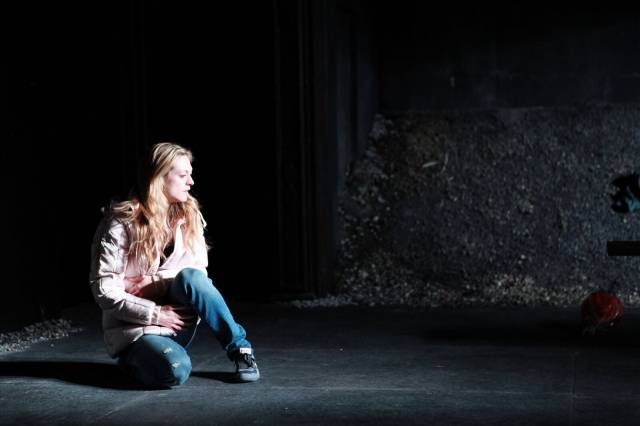
Marin Ireland gives a tour-de-force performance in IRONBOUND at the Rattlestick (photo by Sandra Coudert)
Rattlestick Playwrights Theater
224 Waverly Pl. between Eleventh & Perry Sts.
Tuesday – Sunday through April 24, $55-$70
866-811-4111 www.rattlestick.org wptheater.org
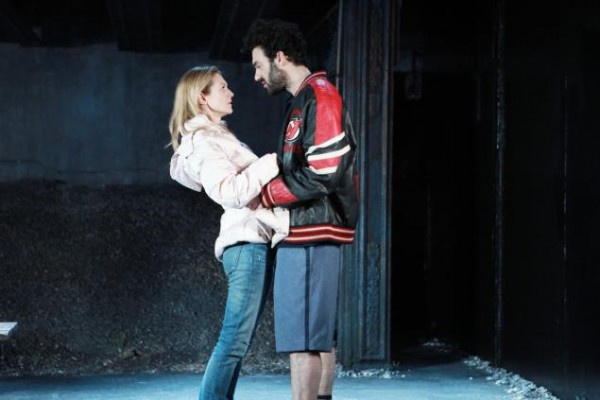
Marin Ireland is an absolute marvel in Ironbound, an otherwise relatively standard play by Polish-born playwright Martyna Majok that gets a terrific staging at the Rattlestick by director Daniella Topol. Tony and Independent Spirit Award nominee Ireland is onstage for all eighty minutes as Darja, a cleaning woman who can’t find success and happiness in her life. Darja spends the entire play at a shoddy bus stop across the street from a New Jersey factory where she used to work before it closed, assuring that the American dream will remain just out of her reach. The story shifts back and forth between 1992, when Darja is with her first husband and true love, Maks (Josiah Bania), a fellow Eastern European immigrant who is determined to become a blues musician in Chicago; 2006, when she meets Vic (Shiloh Fernandez), a young drug dealer; and 2014, as she argues with longtime boyfriend Tommy (Morgan Spector) over their future and what to do about Darja’s son, who has disappeared. The focus is primarily on the present, as Darja, now a cynical self-preservationist, confronts Tommy about his extramarital activities. When he tries to calm her down, she barks at him, “We are not having nice conversation now. The past. Memories. No.” She might give the impression that she’s in charge, but there’s an underlying fear and desperation that makes her more vulnerable than she wants to reveal. “I am forty-two years old, married-twice-already woman: I have no time for stupid. So I weigh you on scale. Okay?” she tells Tommy, but it’s clear that she’s losing control.
Darja (Marin Ireland) and Tommy (Morgan Spector) argue about their future together in IRONBOUND (photo by Sandra Coudert)
The set, by lighting designer Justin Townsend (Here Lies Love,The Other Place), features a lone bench in front of a murky, creepy bus shelter strewn with gravel and garbage. Overhead, stretching the length of the theater front to back, hang five enormous, riveted steel beams (actually painted wood) that make the audience feel as if it is waiting for the bus with Darja, huddled underneath a trestle. You can’t take your eyes off Ireland (Reasons to Be Pretty, Glass Chin,Marie Antoinette), whose every physical movement and glare speaks volumes. The rest of the cast play their roles well, but their characters and tales are nowhere near as interesting and compelling as Darja’s, and they become somewhat quaint and repetitive as the show goes on and overdoes the obvious distinctions between rich and poor. Director Daniella Topol (Charles Ives Take Me Home, Lascivious Something) keeps the attention firmly on Darja, where it belongs, letting Ireland do what she does best. Ironbound, which premiered in the fall of 2015 at the Round Theatre in Washington, DC (with Bania and three different actors), is a presentation of the Women’s Project Theater, which is “dedicated to developing, producing and promoting the work of female theater artists at every stage in their careers.”
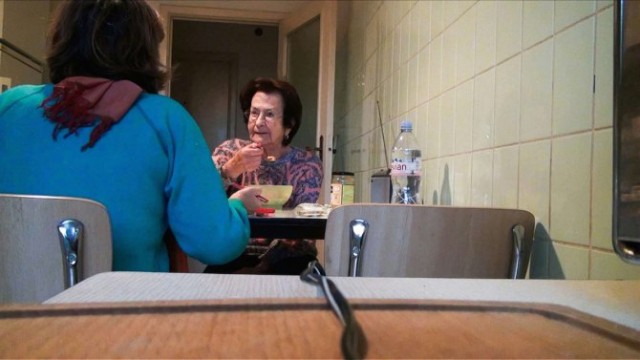
Chantal Akerman creates a unique profile of her mother in deeply personal NO HOME MOVIE
NO HOME MOVIE (Chantal Akerman, 2015)
BAMcinématek, BAM Rose Cinemas
30 Lafayette Ave. between Ashland Pl. & St. Felix St.
April 1-14
Series continues through May 1
718-636-4100 www.bam.org icarusfilms.com
Chantal Akerman’s No Home Movie was meant to be a kind of public eulogy for her beloved mother, Natalia (Nelly) Akerman, who died in 2014 at the age of eighty-six, shortly after Chantal had completed shooting forty hours of material with her. But it also ended up becoming, in its own way, a public eulogy for the highly influential Belgian auteur herself, as she died on October 5, 2015, at the age of sixty-five, only a few months after the film screened to widespread acclaim at several festivals (except at Locarno, where it was actually booed). Her death was reportedly a suicide, following a deep depression brought on by the loss of her mother. No Home Movie primarily consists of static shots inside Nelly’s Brussels apartment as she goes about her usual business, reading, eating, preparing to go for a walk, and taking naps. Akerman sets down either a handheld camera or a smartphone and lets her mother walk in and out of the frame; Akerman very rarely moves the camera or follows her mother around, instead keeping it near doorways and windows. She’s simply capturing the natural rhythms and pace of an old woman’s life. Occasionally the two sit down together in the kitchen and eat while discussing family history and gossip, Judaism, WWII, and the Nazis. (The elder Akerman was a Holocaust survivor who spent time in Auschwitz.) They also Skype each other as Chantal travels to film festivals and other places. “I want to show there is no distance in the world,” she tells her mother, who Skypes back, “You always have such ideas! Don’t you, sweetheart.” In another exchange, the daughter says, “You think I’m good for nothing!” to which the mother replies, “Not at all! You know all sorts of things others don’t know.”
Shots of a tree fluttering in the Israeli wind enhance the peaceful calm of NO HOME MOVIE
Later they are joined by Chantal’s sister, Sylviane, as well as Nelly’s home aide. The film features long sections with no dialogue and nobody in the frame; Akerman opens the movie with a four-minute shot of a lone tree with green leaves fluttering in the wind in the foreground, the vast, empty landscape of Israel in the background, where occasionally a barely visible car turns off a far-away road. Akerman returns to Israel several times during the film, sometimes shooting out of a moving car; these sections serve as interludes about the passage of time as well as referencing her family’s Jewish past. At one point, Akerman makes potatoes for her mother that they eat in the kitchen, a direct reference to a scene in Akerman’s feminist classic, Jeanne Dielman, 23 Quai due Commerce, 1080 Bruxelles. Knowing about what happened to both mother and daughter postfilming casts a shadow over the documentary, especially when Chantal tells her mother, “I’m in a very, very good mood. . . . Let’s enjoy it; it’s not that common.” As the film nears its conclusion, there is almost total darkness, echoing the end of life. Through it all, Akerman is proud of her mother; reminiscing about kindergarten, she remembers, “And to everybody, I would say, this is my mother.” No Home Movie achieves that very same declaration, now for all the world to see and hear. No Home Movie is screening April 1-14 at BAM Rose Cinemas, kicking off the month-long BAMcinématek series “Chantal Akerman: Images between the Images,” which continues through May 1 with such other films by Akerman as Toute une nuit, Night and Day, A Couch in New York, Letters Home, and La Captive. In addition, Marianne Lambert’s new documentary, I Don’t Belong Anywhere: The Cinema of Chantal Akerman, continues (for free) at Film Forum through April 5, the extraordinary Jeanne Dielman is at Film Forum through April 7, and Anthology Film Archives will host “Chantal Akerman x 2,” showing No Home Movie and Là-Bas April 15-21.
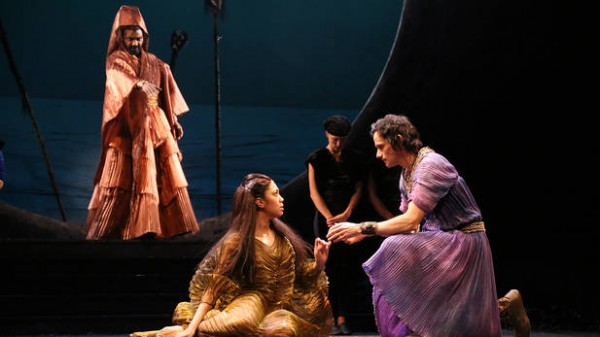
Pericles (Christian Camargo), the prince of Tyre, has tough times trying to find love and family in Trevor Nunn TFANA production in Brooklyn (photo by Gerry Goodstein)
Theatre for a New Audience, Polonsky Shakespeare Center
262 Ashland Pl. between Lafayette Ave. & Fulton St.
Tuesday – Sunday through April 10, $75-$85
866-811-4111 www.tfana.org
There’s a reason why so many theater lovers, and even Shakespeare aficionados, have never seen or even read Pericles: It’s not a very good play. In addition, the general consensus among scholars is that it’s only one-third Shakespeare anyway: Most think pamphleteer and innkeeper George Wilkins, a friend of Shakespeare’s, wrote the first two acts and that Shakespeare penned the third. The play has never been performed on Broadway, has never been made into a film, and has been presented only once at the Public’s Shakespeare in the Park outdoor summer festival at the Delacorte, in 1974, with Mary Beth Hurt and Randall Duk Kim. (However, in the fall of 2014, the Public did take a trimmed-down version of Pericles on the road in its Mobile Shakespeare Unit.) Now award-winning British director Sir Trevor Nunn, who has brought us The Life and Adventures of Nicholas Nickleby, Arcadia, Copenhagen, and, yes, Cats, Les Misérables, and Starlight Express, is tackling Pericles for the first time, the thirty-fifth Shakespeare play he has directed. (He is planning on completing all thirty-seven from the first folio with upcoming productions of King John and A Midsummer Night’s Dream.) In his first show initiated in the United States with an American cast, Nunn is directing a rousing version of Pericles at Theatre for a New Audience’s (TFANA) Polonsky Shakespeare Center, where it has been extended through April 10. The play is narrated by real-life fourteenth-century English poet John Gower (Raphael Nash Thompson), serving as a kind of one-man Greek chorus. Pericles (Christian Camargo), the prince of Tyre, has traveled to Antioch to solve a riddle that will win him the hand of the daughter (Sam Morales) of King Antiochus (Earl Baker Jr.); if he fails, he will be killed. Realizing that the riddle is about incest between the king and the princess and that he will be slain even if he gives the right answer, Pericles asks for more time, and the king grants him his request while also sending his henchman, Thaliard (Oberon K. A. Adjepong), to murder the prince. Pericles flees home, where his trusted adviser, Helicanus (Philip Casnoff), tells him he must leave at once, certain that King Antiochus will do anything to see him dead. And so Pericles sets out on a series of Odysseus-like adventures that include several shipwrecks as he marries Thaisa (Gia Crovatin), daughter of Simonides (John Rothman), the king of Pentapolis; has a daughter, Marina (played as a teenager by Lilly Englert), who is raised by Cleon (Will Swenson), the governor of Tarsus, and his wife, Dionizya (Nina Hellman); and mourns the passing of his wife, who dies in childbirth.
Nunn’s Pericles takes place on a relatively empty stage with minimal props; scenic designer Robert Jones’s backdrop features a ritualistic large circle that occasionally opens up to introduce characters and shine bright colors (or the sun or moon) onto the otherwise stark setting. PigPen Theatre Co. founding members Alex Falberg, Ben Ferguson, Curtis Gillen, Ryan Melia, Matt Nuernberger, Arya Shahi, and Dan Weschler are joined by musicians Haley Bennett, John Blevins, Philip Varricchio, and Jessica Wang to perform a medieval dumb show throughout the play (they are playing when the house opens, so arrive early to get right into the mood); the delightful period music is by Shaun Davey, who also composed the score for the 2002 Royal Shakespeare Company production of Pericles, during Nunn’s stint as artistic director of the RSC. Camargo (Dexter, The Hurt Locker), who has previously played Coriolanus and won an Obie as Hamlet at TFANA, is at first forthright as Pericles, then heartbreaking as the prince’s life takes dark turn after dark turn. Englert, who made her stage debut in Julie Taymor’s TFANA production of A Midsummer Night’s Dream and followed that by playing Cordelia in Arin Arbus’s King Lear at TFANA, is strong and confident as Marina as she faces personal danger. The rest of the cast, which also includes John Keating, Zachary Infante, and Ian Lassiter as the three fishermen; Adjepong and Patrice Johnson Chevannes as brothel owners; Keating as Boult, their bawdy, gangly servant; Lassiter as their main customer, Lysimachus, governor of Mytilene; and Baker Jr. as Cerimon, the physician, are in full sync throughout the two-hour, forty-five-minute show, but it’s TFANA regular Constance Hoffman’s mind-blowing costumes that rule the day, a wild and thrilling mix of Greek classical, African, street-corner bum, and Goth, balancing glorious pinks, deep oranges, purples, and white with black, brown, and gray. Dionyza’s hat and the bawd’s outfit are unforgettable, drawing the audience’s attention away from the huge holes in the story; Nunn does some patching as well, fiddling around with the kitchen-sink-mishmash of a narrative by moving things around and adding elements of Wilkins’s novel The Painful Adventures of Pericles. It all might not make for a great play itself, but it is quite a grand entertainment, and about as good an introduction to this work as you’re likely to get. (On April 10, following the last performance of Pericles, the musicians from PigPen Theatre will give a concert that is free to TFANA season subscribers and anyone who purchased a ticket to see Pericles between March 29 and April 10; premium $125 tickets are also available, which come with various bonuses.)
Cao Fei’s HAZE AND FOG is part of Modern Mondays presentation at MoMA on April 4
Who:Cao Fei,Klaus Biesenbach What:Modern Mondays presentation of films and conversation Where:MoMA Film, Museum of Modern Art, 11 West 53rd St. between Fifth & Sixth Aves., 212-708-9400 When: Monday, April 4, $8-$12, 7:00 Why: As an appetizer to her first U.S. solo museum show, opening April 20 at MoMA PS1, Beijing-based Chinese artist Cao Fei will be at MoMA in Midtown on April 4 for the Modern Mondays presentation “An Evening with Cao Fei.” The program features excerpts from several of her films, including 2004’s Cosplayers, 2006’s Whose Utopia?, 2007-11’s RMB City, 2013’s Haze and Fog, and 2014’s La Town. In addition, Fei will sit down with MoMA PS1 director Klaus Biesenbach, who organized the exhibition, for a conversation about her work, which is part of a young generation of Chinese artists concerned with contemporary sociocultural and economic challenges in a rapidly changing China. “I try to find different ways to connect and interact with society,” the thirty-seven-year-old multimedia artist has said. “At the same time, I am trying to construct a new model of society.” The Modern Mondays series continues April 11 with Rosa Barba, April 18 with Tony Conrad, and April 25 with Lynette Wallworth.




 Chantal Akerman’s No Home Movie was meant to be a kind of public eulogy for her beloved mother, Natalia (Nelly) Akerman, who died in 2014 at the age of eighty-six, shortly after Chantal had completed shooting forty hours of material with her. But it also ended up becoming, in its own way, a public eulogy for the highly influential Belgian auteur herself, as she died on October 5, 2015, at the age of sixty-five, only a few months after the film screened to widespread acclaim at several festivals (except at Locarno, where it was actually booed). Her death was reportedly a suicide, following a deep depression brought on by the loss of her mother. No Home Movie primarily consists of static shots inside Nelly’s Brussels apartment as she goes about her usual business, reading, eating, preparing to go for a walk, and taking naps. Akerman sets down either a handheld camera or a smartphone and lets her mother walk in and out of the frame; Akerman very rarely moves the camera or follows her mother around, instead keeping it near doorways and windows. She’s simply capturing the natural rhythms and pace of an old woman’s life. Occasionally the two sit down together in the kitchen and eat while discussing family history and gossip, Judaism, WWII, and the Nazis. (The elder Akerman was a Holocaust survivor who spent time in Auschwitz.) They also Skype each other as Chantal travels to film festivals and other places. “I want to show there is no distance in the world,” she tells her mother, who Skypes back, “You always have such ideas! Don’t you, sweetheart.” In another exchange, the daughter says, “You think I’m good for nothing!” to which the mother replies, “Not at all! You know all sorts of things others don’t know.”