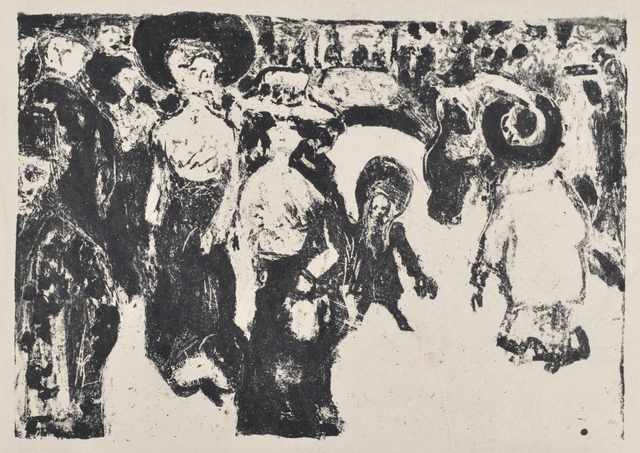
Ernst Ludwig Kirchner, “Street Life in Dresden,” lithograph on heavy cream Japan paper, 1908
Who: Eric Fischl and Jane Kallir
What: Discussion about the work of Ernst Ludwig Kirchner and the evolution of drawing over the last century
Where: Galerie St. Etienne, 24 West 57th St. between Fifth & Sixth Aves., 212-245-6734
When: Wednesday, May 18, free, 6:30
Why: “Ecstatic drawing is the foundation of the new art,” German Expressionist painter and Die Brücke cofounder Ernst Ludwig Kirchner said in 1919. On May 18, New York City native and painter and sculptor Eric Fischl will be at Galerie St. Etienne in Midtown to discuss “The Art of Drawing” with gallery owner Jane Kallir, held in conjunction with the exhibition “Ernst Ludwig Kirchner: Featuring Watercolors and Drawings from the Robert Lehman Collection,” which continues through July 1. The exhibition comprises more than fifty pen-and-ink drawings, woodcuts, watercolors, etchings, and lithographs by Kirchner, who committed suicide in 1938 at the age of fifty-eight, shortly after the Nazis detained or destroyed more than six hundred of his works. “Just as he preferred moving models, Kirchner himself moved as he drew, changing position or walking through town with a sketchbook in hand. He drew every day and nearly everywhere he went, filling at least 180 sketchbooks, over 12,000 sheets,” Kallir writes in her extensive exhibition essay. “Drawing is the key to Kirchner’s art, and his sketches are the key to his drawings. But the sketches should not be viewed as studies per se. Rather, the sketches birthed new forms, conceived in the throes of ‘ecstatic’ experience, that ‘crystallized and hardened’ in subsequent pictures.” Fischl, whose work includes such series as “Art Fair,” “Corrida in Ronda,” “The Travel of Romance,” “Ten Breaths,” and “The Bed, the Chair . . .” in addition to the MTA mosaic “The Garden of Circus Delights” in Penn Station, will lend insight into his own creative process as well. Free advance reservations are not required but recommended and can be made here.
 As it turns out,
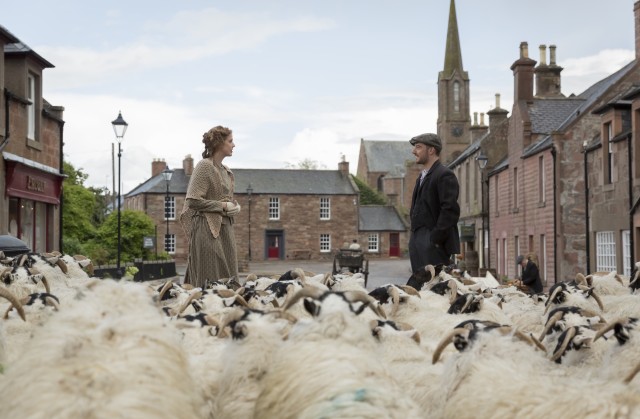
 A golden glow hovers over Sunset Song, Terence Davies’s lush adaptation of Scottish writer Lewis Grassic Gibbon’s seminal 1932 novel about family, land, war, and one young woman’s coming-of-age. Although it has the epic feel of a sweeping historical tale, the film takes place over just a few years in the second decade of the twentieth century, seen through the eyes of Chris Guthrie (Agyness Deyn). Her father, John (Peter Mullan), is a brutish farmer who runs his household with an iron fist. He lashes out, literally and figuratively, at his strapping son, Will (Jack Greenlees), who stands and takes it, choosing not to fight back, and treats his wife, Jean (Daniela Nardini), like a housekeeper and baby-making machine. In one of the most wrenching scenes of the film, John drags Jean, who doesn’t want to have any more children, upstairs to rape her in order to increase the size of their family; Jean’s terrifying screams from the bedroom evolve into shrill cries as she gives birth to twins. Following a horrific tragedy, Chris is forced to give up her education — she was studying to become a teacher — and work on the family farm. Upon meeting fellow farmer Ewan Tavendale (Kevin Guthrie), friendship turns into something more as Scotland gets involved in World War I.