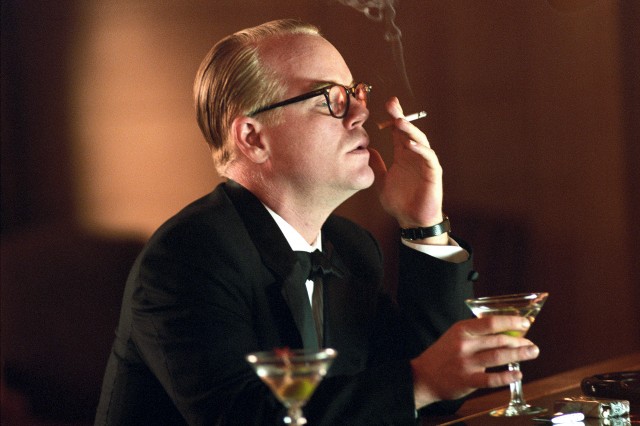
Philip Seymour Hoffman won an Oscar for his intense portrayal of Truman Capote
CAPOTE (Bennett Miller, 2005)
Museum of the Moving Image
35th Ave. at 36th St., Astoria
Friday, September 23, $12, 7:00
Series continues through October 2
718-777-6800
www.movingimage.us
www.sonyclassics.com
 In November 1959, Richard Hickock (Mark Pellegrino) and Perry Smith (Clifton Collins Jr.) brutally murdered a Kansas family. After reading a small piece about the killings in the New York Times, New Yorker writer Truman Capote (Philip Seymour Hoffman) sets out with his research assistant, Harper “Nell” Lee (Catherine Keener), to cover the story from a unique angle, which soon becomes the workings of the classic nonfiction novel In Cold Blood. Capote tells police chief Alvin Dewey (Chris Cooper) right off the bat that he cares only about the story, not what happens to the killers, which does not endear him to the local force. But when the murderers are captured, Capote begins a dangerous relationship with Smith, who comes to think of the writer as a true friend, while Capote gets caught up deeper than he ever thought possible. Based on the exhaustive biography by Gerald Clarke, Capote is a slow-moving character study featuring excellent acting and some interesting surprises, even for those who thought they knew a lot about the party-loving chronicler of high society and high living. Hoffman, who died from a drug overdose in 2014 at the age of forty-six, earned an Oscar for portraying the socialite author, who was played the following year by Toby Jones in Douglas McGrath’s Infamous, which was based on a book by George Plimpton. Capote, which was also nominated for Best Picture, Best Director (Bennett Miller), Best Supporting Actress (Keener), and Best Adapted Screenplay (Dan Futterman), is screening on September 23 in the Museum of the Moving Image series “Philip Seymour Hoffman: The Master,” a sixteen-film tribute to Hoffman, a native New Yorker who left us well before his time. The series continues through October 2 with such Hoffman films as John Patrick Shanley’s Doubt (introduced by Shanley), Todd Solondz’s Happiness, Paul Thomas Anderson’s Magnolia, and Anthony Minghella’s The Talented Mr. Ripley.

Philip Seymour Hoffman doesn’t quite understand what’s happening to him in SYNECDOCHE, NEW YORK
SYNECDOCHE, NEW YORK (Charlie Kaufman, 2008)
Museum of the Moving Image
35th Ave. at 36th St., Astoria
Sunday, September 25, $12, 4:00
718-777-6800
www.movingimage.us
www.sonyclassics.com
In films such as Being John Malkovich (Spike Jonze, 1999), Adaptation. (Spike Jonze, 2002), Confessions of a Dangerous Mind (George Clooney, 2002), and Eternal Sunshine of the Spotless Mind (Michel Gondry, 2004), writer Charlie Kaufman has created bizarre, compelling alternate views of reality that adventurous moviegoers have embraced, even if they didn’t understand everything they saw. Well, Kaufman has done it again, challenging audiences with his directorial debut, the very strange but mesmerizing Synecdoche, New York. Philip Seymour Hoffman stars as the bedraggled Caden Cotard, a local theater director in Schenectady mounting an inventive production of Death of a Salesman. Just as the show is opening, his wife, avant-garde artist Adele Lack (Catherine Keener), decides to take an extended break in Europe with their four-year-old daughter, Olive (Sadie Goldstein), and Adele’s kooky assistant, Maria (Jennifer Jason Leigh). As Caden starts coming down with a series of unexplainable health problems (his last name, by the way — Cotard — is linked with a neurological syndrome in which a person believes they are dead or dying or do not even exist), he wanders in and out of offbeat personal and professional relationships with box-office girl Hazel (a nearly unrecognizable Samantha Morton), his play’s lead actress, Claire Keen (Michelle Williams), his therapist, Madeleine Gravis (Hope Davis), and Sammy (Tom Noonan), a man who has been secretly following him for years. After winning a MacArthur Genius Grant, Caden begins his grandest production yet, a massive retelling of his life story, resulting in radical shifts between fantasy and reality that will have you laughing as you continually scratch your head, hoping to stimulate your brain in order to figure out just what the heck is happening on-screen. Evoking such films as Federico Fellini’s 8½ and City of Women, Woody Allen’s Stardust Memories, and Ingmar Bergman’s Wild Strawberries as well as the labyrinthine tales of Argentine writers Jorge Luis Borges and Julio Cortazar, Synecdoche, New York is the kind of work that is likely to become a cult classic over the years, requiring multiple viewings to help understand it all. The film is screening September 25 at the Museum of the Moving Image, with the elusive Charlie Kaufman on hand to talk about working with Hoffman. Four years after the film was released, Hoffman starred in Mike Nichols’s Broadway version of Death of a Salesman, the show his character is putting together in Synecdoche, New York.



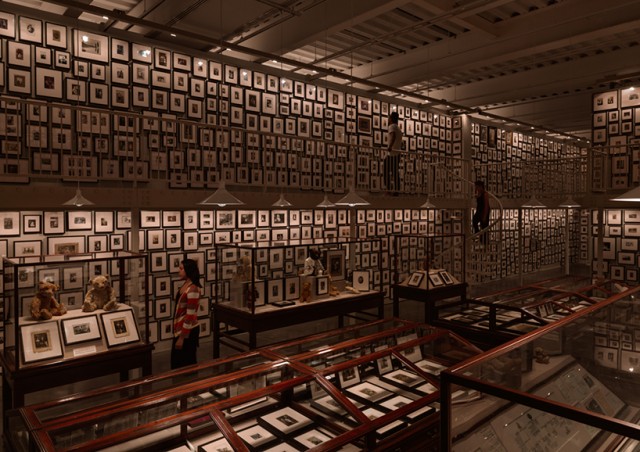
![Vanda Vieira-Schmidt Weltrettungsprojekt [World Rescue Project] consists of more than thirty thousand drawings (photo by Maris Hutchinson / EPW Studio)](https://twi-ny.com/wp-content/uploads/2016/09/the-keeper-2-e1474394670620.jpg)


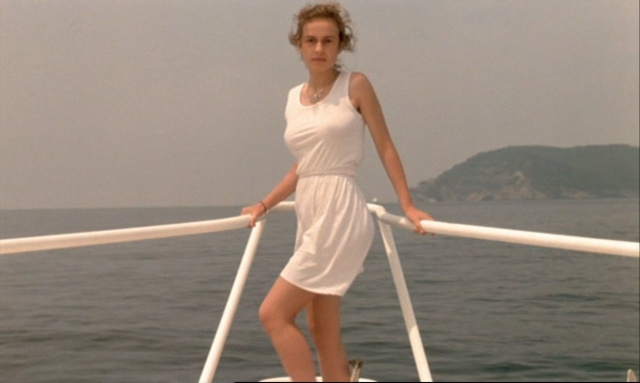
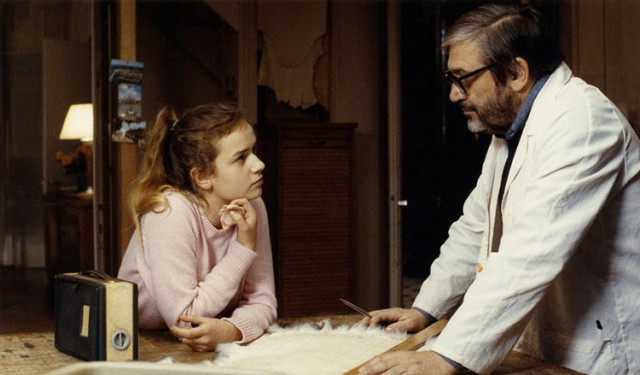
 Sandrine Bonnaire won the César for Most Promising Actress in her film debut, Maurice Pialat’s À nos amours, and she has more than fulfilled that promise in her still-vibrant thirty-plus-year career. Bonnaire stars as fifteen-year-old Suzanne, who suddenly becomes sexually promiscuous one summer. “‘Don’t you think one can die of love?’” she asks, rehearsing for a camp play. “‘You told me you loved me. What kind of a world is this?’” As Suzanne flits about from lover to lover, her family begins to notice a change in her and is not very happy about it. Her mother (Evelyne Ker) and father (Pialat) are on the verge of a breakup, and her creepy brother, Robert (Dominique Besnehard), doesn’t really get any of it; all three seem emotionally stunted, able only to express their feelings about Suzanne’s behavior by striking her physically. Suzanne is a decidedly contemporary Western European ingénue; the film casts no aspersions on her and does not judge her actions, even if her mother and Robert do. Bonnaire was around the same age as her character when she made the film, which contains significant nudity and bed scenes if not graphic depictions of sex; the film would likely have been wildly controversial if made in Hollywood with a fifteen-year-old American actress. Suzanne’s father, a furrier who has left his wife for another woman, is sad that she has lost one of her dimples, a sign of her maturing; when she was a baby, he wanted to protect her from kidnapping, but now he knows and accepts that he no longer has control over her life. Suzanne enjoys the sex she is having but is obviously seeking something more; but Pialat, the director of the film and who also plays the fictional father, never delves too deeply into her psyche, refusing to provide any easy answers or simplistic resolutions for this complex coming-of-age story.