twi-ny recommended events

BAM NEXT WAVE FESTIVAL: BRIDGE OVER MUD

(photo courtesy of the artist)

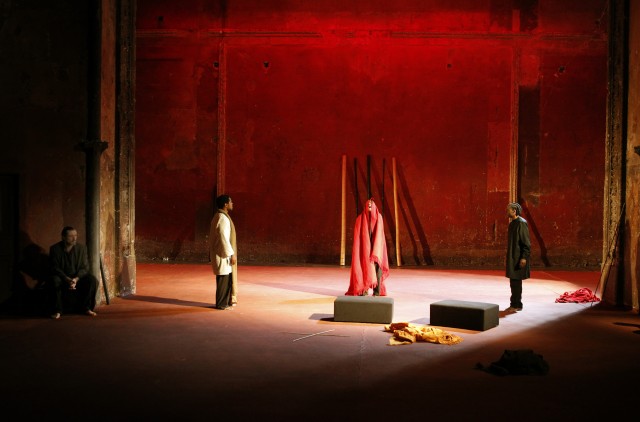
Norway’s Verdensteatret pulls into the BAM Fisher this week with the U.S. premiere of experimental, immersive multimedia production (photo courtesy of the artist)

BROEN OVER GJØRME
BAM Fisher, Fishman Space
321 Ashland Pl.
September 7-10, $25, 7:30 & 9:30
718-636-4100
www.bam.org
verdensteatret.com

BAM’s 2016 Next Wave Festival kicks off this week with the U.S. premiere of the immersive audiovisual theatrical presentation Bridge over Mud, a multimedia extravaganza by the Oslo-based arts collective Verdensteatret. “Bridge over Mud is in its very nature a fragmented and abstract work. Its main substance rests in a poetic space that stimulates your senses through a symphonic multimedia expression. The form profits both from visual art and video art, sound art and performance,” Elisabeth Leinslie writes in her September 2014 essay “You Walk as Far as the Shoes of Reason Will Take You – Then You Jump,” continuing, “This generates a challenging complexity where opposing forces collide in ‘impossible paradoxes’ on one hand and surprisingly harmonic cadences on the other. It’s a symphony of elements that entice your senses. Listening to this work may take you to places you’ve never been before.” The sixty-minute piece features abstract projections, kinetic sculpture, more than sixty speakers, a tuba player, two vocalists, and nearly two hundred feet of train tracks winding through the intimate Fishman Space at the BAM Fisher. Bridge over Mud was created by company members Asle Nilsen, Lisbeth J. Bodd, Piotr Pajchel, Eirik Blekesaune, Ali Djabbary, Martin Taxt, Espen Sommer Eide, Torgrim Torve, Elisabeth Gmeiner, Niklas Adam, Kristine Sandøy, Thorolf Thuestad, Janne Kruse, Laurent Ravot, and Benjamin Nelson, each of whom brings a unique aspect to the troupe, which “endeavors to use a collaborative process to deeply integrate different artistic disciplines into projects that bridge the gap between artistic borders.” Both exhibition and concert, Bridge over Mud is an attempt by Verdensteatreter (Louder, And All the Question Marks Started to Sing) “to play the whole room like one big instrument.” We can’t wait to check this wild one out.

MOHOLY-NAGY: FUTURE PRESENT

László Moholy-Nagy, “Room of the Present” (Raum der Gegenwart), mixed media, constructed in 2009 from plans and other documentation dated 1930 (Van Abbemuseum, Eindhoven, © 2016 Hattula Moholy-Nagy/VG Bild-Kunst, Bonn/Artists Rights Society (ARS), New York, photo by David Heald © Solomon R. Guggenheim Foundation)

László Moholy-Nagy, “Room of the Present” (Raum der Gegenwart), mixed media, constructed in 2009 from plans and other documentation dated 1930 (Van Abbemuseum, Eindhoven, © 2016 Hattula Moholy-Nagy/VG Bild-Kunst, Bonn/Artists Rights Society, New York, photo by David Heald © Solomon R. Guggenheim Foundation)

Solomon R. Guggenheim Museum
1071 Fifth Ave. at 89th St.
Daily through September 7, $25 (pay-what-you-wish Saturday 5:45 – 7:45)
212-423-3587
www.guggenheim.org

“For a new ordering of a new world the need arose again to take possession of the simplest elements of expression, color, form, matter, space,” László Moholy-Nagy wrote in 1922’s “On the Problem of New Content and New Form.” That belief is on spectacular display in “Moholy-Nagy: Future Present,” which continues at the Guggenheim through September 7. The first major U.S. retrospective of the Austria-Hungary–born utopian modernist in nearly half a century, the show is a natural fit for the swirling ramp of Frank Lloyd Wright’s building, unfurling chronologically as Moholy-Nagy (1895 – 1946; pronounced “muh-HOH-lee nahj) experimented with an ever-widening range of artistic disciplines, melding art, technological innovation, utilitarian design, science, and social transformation. The exhibit begins with a kind of preface, Moholy-Nagy’s “Room of the Present,” which was never realized in his lifetime. The Gesamtwerk (“total work”) features films by Viking Eggeling, Sergei Eisenstein, and Dziga Vertov, photographic slides, posters, sculptures, architectural designs, and, in a box in the center, a re-creation of Moholy-Nagy’s most famous work, the kinetic “Light Prop for an Electric Stage.” It’s an excellent preparation for what follows, more than three hundred diverse works that appear tailor made for the Guggenheim space — in fact, his work is part of the museum’s founding collection (courtesy of Hilla Rebay) and was included at the Museum of Non-Objective Painting, the forerunner of the Guggenheim.

László Moholy-Nagy, “A II (Construction A II),” oil and graphite on canvas, 1924 (© 2016 Hattula Moholy-Nagy/VG Bild-Kunst, Bonn/Artists Rights Society, New York)

László Moholy-Nagy, “A II (Construction A II),” oil and graphite on canvas, 1924 (© 2016 Hattula Moholy-Nagy/VG Bild-Kunst, Bonn/Artists Rights Society, New York)

Moholy-Nagy, who was also a writer and Bauhaus teacher who left Europe for good in 1937 and moved to Chicago, where he started the New Bauhaus, today’s Institute of Design at the Illinois Institute of Technology, produced enamel paintings with abstract geometric forms, haunting camera-less photograms, striking typography, avant-garde film, theater and opera stage design, collages using cut-outs resulting in seemingly impossible perspective, and three-dimensional works using such industrial materials as Trolit, Formica, Plexiglas, and Galalith. The exhibition is like marching in a parade of eye-opening creativity, all from the vision of one man. “Dual Form with Chromium Rods” hangs from above, like an imaginary space station. The oil and graphite painting “A 19” captures the essence of Moholy-Nagy’s fascination with color and geometry. “Photogram,” from 1926, reveals the large hand of the artist. “Space Modulator” (1939-45) and “Papmac” feature lines incised on Plexiglas and paint on both the inside and the outside of the plastic. “Slide” is a manipulation in which the Tiller Girls dance troupe appears to be racing down an imaginary slide in a way that would make Busby Berkeley proud. And finally, when you arrive at the top, you get to go back down again, experiencing Moholy-Nagy’s breathtaking oeuvre in reverse; while that is true, of course, for every Guggenheim show, it’s a real joy going backward through this particular artist’s forward-thinking process. “If the unity of art can be established with all the subject matters taught and exercised, then a real reconstruction of this world could be hoped for — more balanced and less dangerous,” Moholy-Nagy wrote in 1943’s “The Contribution of the Arts to Social Reconstruction.” The exhibit, one of the best of 2016, is on for only a few more days; it would be a shame to miss it. It’s also a shame that Moholy-Nagy died of leukemia in 1946 at the age of fifty-one; it would have been thrilling to see what he could have done in the ensuing years, as technological innovation spiraled in the aftermath of WWII.

DANCE NOW FESTIVAL 2016

LMNO3 is among the participants in annual competitive DANCE NOW Festival at Joes Pub (photo by Justin Skrakowski)

LMnO3 (Deborah Lohse, Cori Marquis, and Donnell Oakley) is among the participants in annual competitive DANCE NOW Festival at Joe’s Pub (photo by Justin Skrakowski)

Joe’s Pub
425 Lafayette St. by Astor Pl.
September 7-10, 29, $20-$30, 7:00
212-967-7555
www.dancenownyc.org
publictheater.org

For its twenty-first annual season, the DANCE NOW Festival will consist of forty choreographers presenting short works of no more than five minutes on the small stage at Joe’s Pub. The competitive festival, which encourages experimentation and innovation, takes place September 7-10, hosted by TruDee (aka Deborah Lohse). September 7 will feature B.S. Movement / Bryan Strimpel and Shaina Branfman, binbinFactory / Satoshi Haga & Rie Fukuzawa, Katherine Helen Fisher, Mark Gindick, Jordan Isadore, Heidi Latsky Dance, PearsonWidrigDanceTheater, Amber Sloan, and Jaclyn Walsh. The September 8 lineup boasts the Bang Group, Adam Barruch / Anatomiae Occultii, Lawrence Goldhuber / BIGMANARTS, Jane Comfort and Company, Malcolm Low / Formal Structure, Kyle Marshall, Kate Watson Wallace | anonymous bodies, Jessy Smith, Nicole Wolcott, and Wallie Wolfgruber. September 9 brings together BOOMERANG, C.K.M. & Artists, Norbert de la Cruz III, the Dance Cartel, Raja Feather Kelly / the feath3r theory, Gina Gibney Dance, Paula Josa-Jones, Khaleah London / LAYERS, Gabrielle Revlock, and the one and only Gus Solomons jr. And September 10 is highlighted by LMnO3, Cori Marquis + the Nines [IX], Li-Chiao Ping, PORTABLES / Claire Porter, Take Dance, Makiko Tamura / small apple co., Megan Williams, the Wondertwins, Yin Yue Dance, and ZviDance. On September 24, ten of the choreographers will be invited back for an encore evening, with the overall challenge winner receiving a $1,500 development stipend and a one-week residency at DANCE NOW Silo on Kirkland Farm in Bucks County.

MAX ROSE

MAX ROSE

Jerry Lewis stars as a newly widowed octogenarian who becomes obsessed with a mystery about his late wife in MAX ROSE

MAX ROSE (Daniel Noah, 2016)
Landmark Sunshine Cinema
143 East Houston St. between First & Second Aves.
September 2-9
212-330-8182
www.landmarktheatres.com
www.facebook.com/MaxRoseMovie

In his first starring role in more than twenty years, Jerry Lewis is superb in the otherwise clichéd and maudlin melodrama Max Rose. Lewis plays the title character, an eighty-seven-year-old former jazz pianist whose just lost his beloved wife of sixty-five years, Eva (Claire Bloom). While dealing with his sudden loneliness, Max finds a small compact that a man named Ben gave to Eva on November 5, 1959, with an inscription declaring his secret love. Max becomes obsessed with finding out who the man is and determining whether his marriage was a fraud. Meanwhile, his granddaughter, Annie (Kerry Bishé), is helping Max through this difficult time, even though her own marriage might be in trouble, and Annie’s father, Max’s son, Christopher (Kevin Pollak), is experiencing his own family dilemmas. Christopher tries to reestablish a relationship with Max, but the father keeps pushing the son away. Writer-director Daniel Noah’s feature-film debut has all the hallmarks of, well, a Hallmark movie of the week, laden with genre clichés that the talented cast fights to rise above. Bishé (Argo, Halt and Catch Fire) is absolutely lovely as Max’s dedicated granddaughter, but Pollak isn’t given enough to do as Max’s beat-upon son. A scene in which Max cavorts with a group of new elderly friends has a bittersweet joy to it, at least partially because all four actors — Lewis, Rance Howard, Lee Weaver, and Mort Sahl — were in their eighties when it was filmed. Dean Stockwell, who recently turned eighty, makes a strange appearance near the end, and Bloom is an octogenarian as well.

The plot jumps around, as does the emotional manipulation, heightened by Michel Legrand’s overly sentimental score, and Noah throws in a few odd references, including one to Kurt Vonnegut, which harkens back to Lewis’s appearance in the critically despised Slapstick of Another Kind, an adaptation of Vonnegut’s 1976 novel, Slapstick, that earned Lewis a Golden Raspberry nomination for Worst Actor. (He lost to Sylvester Stallone in Rhinestone.) Noah also has a thing about flowers, from Max’s last name, Rose, to the name of the social administrator, Ms. Flowers (Illeana Douglas), at the assisted living facility he moves into, but that never quite reaches full bloom, like the rest of the narrative. But throughout the film’s eighty-three minutes, it is impossible to take your eyes off Lewis; the director, and the camera, love him, and for good reason. Sitting in his favorite chair in his red sweater, legs spread, rising pants revealing long white socks that approach his knee, Lewis recalls his role as Jerry Langford in Martin Scorsese’s The King of Comedy, when he was kidnapped and tied up, the look in his eyes revealing all you need to know about his character, only now much sadder and forlorn. Best known as a slapstick comedian and muscular dystrophy telethon host, Lewis is a graceful and talented actor, his every movement filled with the knowledge gained over a long life. An early version of the film premiered at the Cannes Film Festival in 2013; the movie is finally getting its theatrical release, playing a short one-week run at the Landmark Sunshine. Deduct a star if Lewis is just not your thing.

SEE IT BIG! THE 70MM SHOW: INHERENT VICE

INHERENT VICE

Reese Witherspoon and Joaquin Phoenix reveal that opposites attract in INHERENT VICE

INHERENT VICE (Paul Thomas Anderson, 2014)
Museum of the Moving Image
35th Ave. at 36th St., Astoria
Saturday, September 3, and Sunday, September 4, $15 (ticket purchase may be applied toward same-day admission to museum), 7:00
718-777-6800
www.inherentvicemovie.com
www.movingimage.us

It makes sense that award-winning writer-director Paul Thomas Anderson, who has made such complex, challenging films as Magnolia, There Will Be Blood, and The Master, has made the first cinematic adaptation of a novel by reclusive, iconoclastic author Thomas Pynchon, who has written such complex, challenging books as Gravity’s Rainbow, V., and Vineland. It also makes sense that the book he chose to adapt is Inherent Vice, probably the most lighthearted and breezy of Pynchon’s tomes. But it also makes sense that the film itself is complex and challenging — and downright confusing. Walking out of the theater, we were pretty sure we liked what we had just seen, even if we didn’t completely understand what had happened. (As Jena Malone said of the making of the film, “The logic becomes the chaos and the chaos becomes the logic.”) The neonoir takes place in 1970 in the fictional Valley town of Gordita Beach (based on Manhattan Beach, where Pynchon lived for a long time). Joaquin Phoenix stars as Larry “Doc” Sportello, a mutton-chopped ex-hippie who is now a private gumshoe working out of a health clinic. One day his ex, Shasta Fay Hepworth (a transplendent Katherine Waterston), shows up to ask him to get her out of a jam involving her billionaire boyfriend, Mickey Wolfmann (Eric Roberts), who has gone missing, perhaps at the hands of Wolfmann’s high-society wife, Sloane (Serena Scott Thomas). Meanwhile, Doc is also hired by Hope Harlingen (Malone) to determine whether her supposedly dead husband, surf-sax legend Coy (Owen Wilson), is actually alive. As Pynchon himself says in the book trailer, “At that point, it gets sort of peculiar,” and peculiar it does indeed get, as Doc becomes immersed in a web of lies and deceit, dealing with a dangerous cult known as the Golden Fang (where Martin Short plays a sex-crazed dentist with a wild abandon), a curious health facility called the Chryskylodon Institute run by Dr. Threeply (Jefferson Mays), and Det. Bigfoot Bjornsen (Josh Brolin), a “renaissance cop” who has no time for any of Doc’s hippie crap, as the Manson murders hover over everything. Well, at least that’s what we think the plot is about.

INHERENT VICE

Doc (Joaquin Phoenix) and Bigfoot (Josh Brolin) don’t agree on much in Paul Thomas Anderson adaptation of Thomas Pynchon novel

As with all Anderson films, Inherent Vice looks and sounds great; cinematographer Robert Elswit, who has shot most of Anderson’s films, bathes the quirky drama in hazy, syrupy colors, while Jonny Greenwood’s score is accompanied by songs by Can, Sam Cooke, Minnie Riperton, the Marketts, and Neil Young. (In fact, Young’s Journey through the Past experimental film served as an influence on Anderson when making Inherent Vice, as did David Zucker, Jim Abrahams, and Jerry Zucker’s Police Squad and Naked Gun series, Robert Altman’s 1973 Philip Marlowe movie The Long Goodbye, and Howard Hawks’s 1946 version of Raymond Chandler’s The Big Sleep.) It all has the feel of the Coen brothers’ The Big Lebowski as reinterpreted by Anderson and Pynchon — who might have been on-set during at least some of the shooting and supposedly makes a cameo in the picture. The film is littered with absurdist jokes and oddities, from the way Bigfoot eats a chocolate-covered banana to a trio of FBI agents picking their noses, from the right-wing Vigilant California organization to a clip from the 1952 Cold War propaganda film Red Nightmare. Phoenix once again fully inhabits his character, who putt-putts around in an old Dodge Dart and just wants life to be mellow and groovy. Brolin is hysterical as his foil, the straitlaced, flattop cop who has a penchant for busting down doors. The large cast also includes Benicio del Toro as Sauncho Smilax, Doc’s too-cool lawyer; Reese Witherspoon as Penny Kimball, Doc’s well-coiffed girlfriend; Maya Rudolph (Anderson’s real-life partner and the daughter of Riperton) as receptionist Petunia Leeway; Sasha Pieterse as Japonica Fenway, who hangs with Golden Fang dentist Rudy Blatnoyd (Short); and Joanna Newsom as Sortilège, the film’s narrator (who does not appear in the book). Inherent Vice is yet another unique cinematic experience from Anderson, one that is likely to take multiple viewings to understand just what is going on, but as with his previous films, it is likely to be well worth the investment. Inherent Vice is screening September 3 & 4 at 7:00 in the Museum of the Moving Image series “See It Big! The 70mm Show,” which comes to a close this weekend with Kenneth Branagh’s Hamlet as well.

VOYEURISM, SURVEILLANCE, AND IDENTITY IN THE CINEMA: DAVID HOLZMAN’S DIARY

DAVID HOLZMAN’S DIARY

L. M. Kit Carson presages the YouTube Generation in DAVID HOLZMAN’S DIARY

DAVID HOLZMAN’S DIARY (Jim McBride, 1967)
Anthology Film Archives
32 Second Ave. at Second St.
Friday, September 2, 7:15, and Saturday, September 3, 9:00
Series continues through September 4
212-505-5181
anthologyfilmarchives.org

New York City native Jim McBride’s directorial debut, the seminal David Holzman’s Diary, presages the YouTube Generation and reality shows in its depiction of a man obsessed with capturing virtually every moment of his life on camera. L. M. Kit Carson stars as David Holzman, a twenty-five-year-old unemployed schlemiel who goes everywhere with his 16mm camera, photographing the streets of his Upper West Side neighborhood, his model girlfriend, Penny (Eileen Dietz), and the woman in the apartment across the street. He also often turns the camera on himself as he discusses his life and moviemaking, directly and indirectly referencing Jean-Luc Godard, Alfred Hitchcock, Vincente Minnelli, Orson Welles, and Luchino Visconti. The black-and-white film is set up as if it’s a documentary, with choppy cuts and a barely audible soundtrack of a radio playing music and sharing the news of the day (July 1967). Holzman is happiest when he gets a new fish-eye lens and shows it off by carrying it through the streets above his head, offering a different perspective of the city. Like today’s world, McBride (The Big Easy, Great Balls of Fire!) brings up issues of voyeurism and privacy, because to Holzman, it’s as if nothing really exists unless it’s on film or television (or, now, the internet). Thus, it makes sense that David Holzman’s Diary is screening as part of the Anthology Film Archives series “Voyeurism, Surveillance, and Identity in the Cinema,” being held in conjunction with the International Center of Photography’s inaugural exhibition in its new downtown space on the Bowery, the multimedia “Public, Private, Secret.” The film series continues with Shirley Clarke’s Portrait of Jason on September 2 & 4 and the short film program “Exhibitionism / Self-Fashioning” on September 3 & 4. The two-floor exhibition explores how we allow ourselves to be seen, and how we look at others, in public and private in the second decade of the twenty-first century, with works by Andy Warhol, Cindy Sherman, Doug Rickard, Gillian Wearing, Garry Winogrand, Sophie Calle, Lyle Ashton Harris, Jill Magid, Phil Collins, Shelly Silver, Rashid Johnson, Martine Syms, Trevor Paglen, and others.

FELLINI: 8½

Guido Anselmi (Marcello Mastroianni) is in a bit of a personal and professional crisis in Fellini masterpiece “8½”

WEEKEND CLASSICS: 8½ (Federico Fellini, 1963)
IFC Center
323 Sixth Ave. at West Third St.
September 2-5, 11:00 am
Series continues through September 25
212-924-7771
www.ifccenter.com

“Your eminence, I am not happy,” Guido (Marcello Mastroianni) tells the cardinal (Tito Masini) halfway through Federico Fellini’s self-reflexive masterpiece 8½. “Why should you be happy?” the cardinal responds. “That is not your task in life. Who said we were put on this earth to be happy?” Well, film makes people happy, and it’s because of works such as 8½. Fellini’s Oscar-winning eighth-and-a-half movie is a sensational self-examination of film and fame, a hysterically funny, surreal story of a famous Italian auteur who finds his life and career in need of a major overhaul. Mastroianni is magnificent as Guido Anselmi, a man in a personal and professional crisis who has gone to a healing spa for some much-needed relaxation, but he doesn’t get any as he is continually harassed by producers, screenwriters, would-be actresses, and various other oddball hangers-on. He also has to deal both with his mistress, Carla (Sandra Milo), who is quite a handful, as well as his wife, Luisa (Anouk Aimée), who is losing patience with his lies. Trapped in a strange world of his own creation, Guido has dreams where he flies over claustrophobic traffic and makes out with his dead mother, and his next film involves a spaceship; it doesn’t take a psychiatrist to figure out the many inner demons that are haunting him. Marvelously shot by Gianni Di Venanzo in black-and-white, scored with a vast sense of humor by Nino Rota, and featuring some of the most amazing hats ever seen on film — costume designer Piero Gherardi won an Oscar for all the great dresses and chapeaux — is an endlessly fascinating and wildly entertaining exploration of the creative process and the bizarre world of filmmaking itself. And after seeing 8½, you’ll appreciate Woody Allen’s 1980 homage, Stardust Memories, a whole lot more. “Weekend Classics” continues September 9-11 with Fellini Satyricon before concluding September 23-25 with City of Women.