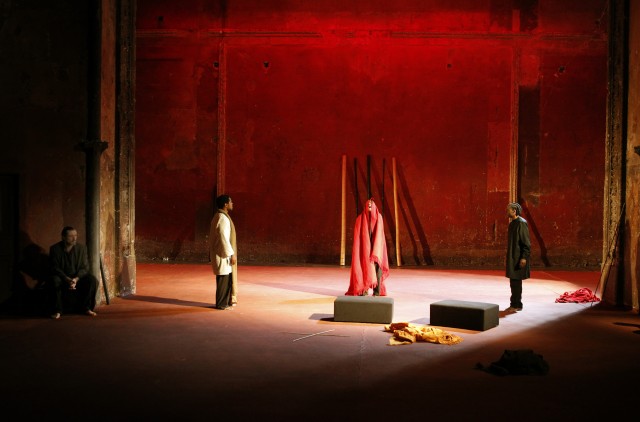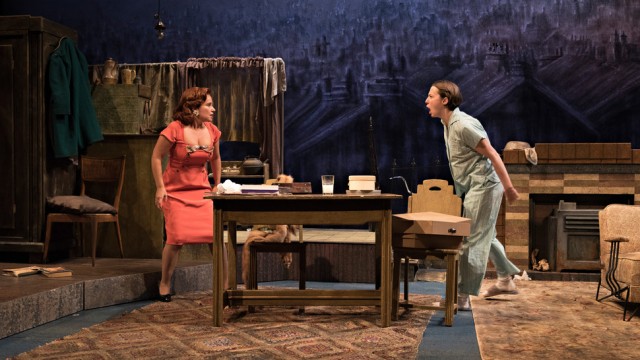
Helen (Rachel Botchan) and Jo (Rebekah Brockman) hold nothing back in Pearl revival of A TASTE OF HONEY (photo by Russ Rowland)
The Pearl Theatre
555 West 42nd St. between Tenth & Eleventh Aves.
Tuesday – Sunday through October 30, $59-$79
212-563-9261
www.pearltheatre.org
The Pearl Theatre revival of Shelagh Delaney’s first play, A Taste of Honey, a British breakthrough written when she was eighteen, is a thoroughly engaging, bittersweet coming-of-age tale about a working-class mother and her peculiar daughter in dank, depressing postwar Britain — late-1950s Manchester, to be precise. Single mom Helen (Rachel Botchan) and her teenage daughter, Jo (Rebekah Brockman), are on the move again, settling into their new flat in a factory town. It’s a dreary, bleak apartment with a bathroom down the hall and a fine view of the gasworks. The two constantly bicker over just about everything, from money to men, furniture to booze. At one point Jo, who calls her mother “Helen,” notes, “You should prepare my meals like a proper mother,” to which Helen responds, “Have I ever laid claim to being a proper mother?” When one of Helen’s many male friends, Peter (Bradford Cover), a one-eyed playboy, starts talking marriage, Jo quickly falls for Jimmy (Ade Otukoya), a black male nurse and sailor who is about to ship out. In the second act, Jo finds herself in trouble and turns to the effeminate Geoffrey (John Evans Reese), creating a strange simulacrum of family after her mother has taken off with Peter. Through it all, the trio of trumpeter Max Boiko, guitarist Phil Faconti, and bassist Walter Stinson plays jazz and music-hall numbers, wandering around the set and even sitting on the couch with the actors, each acknowledging the others’ presence. Helen and Jo are also both aware of the audience, addressing them directly several times, trying to get the crowd on their side. “She’d lose her head if it was loose,” Jo says early on, while Helen asks, “Wouldn’t she get on your nerves?”
A Taste of Honey has quite a history. It debuted in London in 1958, where it caused a stir as a reaction to the Angry Young Men movement led by John Osborne and Kingsley Amis. (“I don’t like a too-knowledgeable woman,” Osborne said at the time. “I feel it is against her sex.”) The show moved to Broadway two years later, with Angela Lansbury as Helen, Joan Plowright as Jo, Nigel Davenport as Peter, Billy Dee Williams as Jimmy, and Andrew Ray as Geoffrey; a 1981 Great White Way revival featured Valerie French as Helen and Amanda Plummer as Jo. The story was also made into a 1961 movie by Tony Richardson, written by Delaney and starring Rita Tushingham in her first film. (The famous title song was written for the movie and is played at the start of this revival; Williams recorded his own take for a 1961 album.) The faithful Pearl version is directed by Austin Pendleton, whose fine A Day by the Sea has been extended at the Mint. Harry Feiner’s cluttered set captures the feel of a dingy working-class flat, while the large background charcoal drawing of the company town is a reminder of what might be Jo’s only real skill. “I thought you said you weren’t good at anything,” Helen says after finding Jo’s sketchbook. Jo answers, “It’s only a drawing.” Helen adds, “I didn’t realize I had such a talented daughter,” to which Jo boasts, “I’m not just talented, I’m geniused.” Pearl veteran Botchan and Brockman are naturals as Helen and Jo, fighting the way only mothers and daughters can; it’s a thrill watching them go for each other’s throats even as a little care and love trickle through.
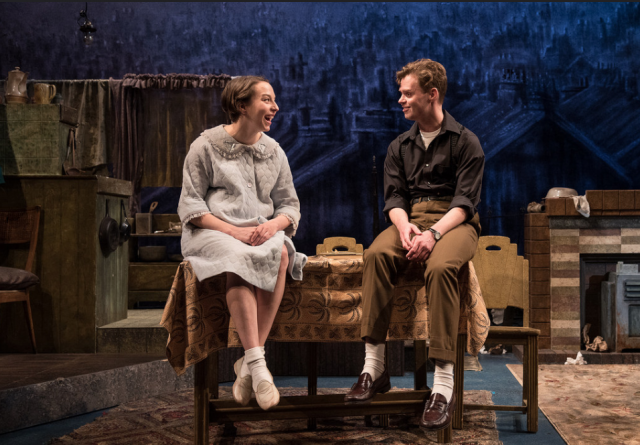
Jo (Rebekah Brockman) seeks solace from Geoffrey (John Evans Reese) in Shelagh Delaney’s A TASTE OF HONEY (photo by Russ Rowland)
There’s a timeless quality about Delaney’s writing that keeps A Taste of Honey fresh and poignantly funny, dealing with such issues as the economy, race, homosexuality, and broken families, led by two strong female characters who speak their mind. Delaney, who was immortalized on the covers of the Smiths’ Louder than Bombs compilation and “Girlfriend in a Coma” single — in 1986, Smiths leader Morrissey told NME, “I’ve never made any secret of the fact that at least fifty percent of my reason for writing can be blamed on Shelagh Delaney”; Morrissey also incorporated two lines from the play into the song “Reel around the Fountain” — went on to write several other plays and screenplays but never again achieved the critical success her debut work brought her; she passed away in 2011 at the age of seventy-two. But as the working class in America continues its own decline amid hard-fought struggles for economic equality for women, gay rights, increases in the minimum wage, an end to racism, and affordable housing, A Taste of Honey feels as relevant as ever.

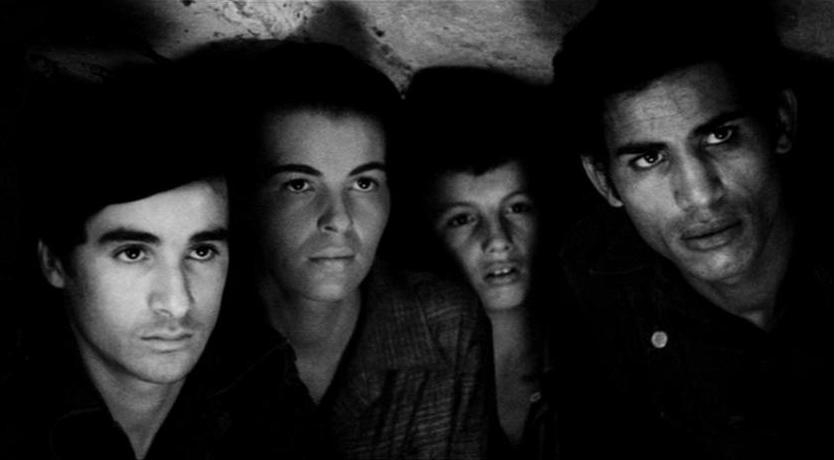
 In Italian director Gillo Pontecorvo’s gripping neo-Realist war thriller The Battle of Algiers, a reporter asks French paratroop commander Lt. Col. Mathieu (Jean Martin), who has been sent to the Casbah to derail the Algerian insurgency, about an article Jean-Paul Sartre had just written for a Paris paper. “Why are the Sartres always born on the other side?” Mathieu says. “Then you like Sartre?” the reporter responds. “No, but I like him even less as a foe,” Mathieu coolly answers. In 1961, French existentialist Sartre wrote in the
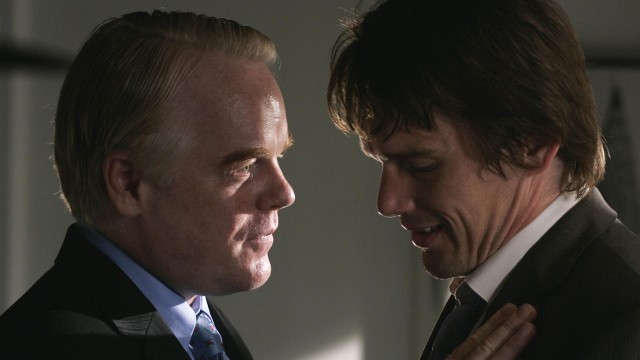
 Sidney Lumet spins an intriguing web of mystery and severe family dysfunction in Before the Devil Knows You’re Dead. Andy (Philip Seymour Hoffman) and Hank (Ethan Hawke) are very different brothers who are both in desperate financial straits. Andy, a real estate exec, has a serious drug problem and a fading marriage to his sexy but bored young wife (Marisa Tomei), while ne’er-do-well Hank can’t afford the monthly child-support payments to his ex-wife (Aleksa Palladino) and daughter (Amy Ryan). Andy convinces Hank to knock off their parents’ (Albert Finney and Rosemary Harris) jewelry store, but when things go horribly wrong, everyone involved is forced to face some very difficult situations, leading to a harrowing climax. Seymour and Hawke are both excellent, the former cool, calm, and collected, the latter scattershot and impulsive. Tomei gives one of her finest performances as the woman sleeping with both brothers. Lumet tells the story through a series of flashbacks from various characters’ point of view, with fascinating overlaps — although a bit overused — that offer different perspectives on critical scenes. Hoffman chose the role of Andy over Hank, which leads to several surprises, including an opening scene you will never forget. Adapted from a script by playwright Kelly Masterson — whom Lumet had never met or even spoken with — Before the Devil Knows You’re Dead (the title comes from an Irish toast that begins, “May you be in heaven half and hour…”) is a thrilling modern noir from one of the masters of melodrama. The underrated film is screening on October 1 at 2:30 in the Museum of the Moving Image series “Philip Seymour Hoffman: The Master,” a sixteen-film tribute to Hoffman, a native New Yorker who left us well before his time. The series continues through October 2 with such other Hoffman films as Paul Thomas Anderson’s Magnolia, Anthony Minghella’s The Talented Mr. Ripley, and Anton Corbjin’s A Most Wanted Man.
 Writer-director Ari Folman imagines a sad but visually dazzling future in the spectacular fantasy The Congress. Inspired by Stanislaw Lem’s 1971 short novel The Futurological Congress, the film follows Robin Wright playing a fictionalized version of herself, an idealistic actress about to turn forty-five who has let her career come second to raising her two children, daughter Sarah (Sami Gayle) and, primarily, son Aaron (Kodi Smit-McPhee), who is slowly losing the ability to see and hear. Wright’s longtime agent, Al (Harvey Keitel), has a last-chance opportunity for her: Jeff Green (Danny Huston), the head of Miramount, wants to scan her body and emotions so the studio can manipulate her digital likeness into any role while keeping her ageless. They don’t want the modern-day Robin Wright but the young, beautiful star of The Princess Bride, State of Grace, and Forrest Gump. The only catch is that in exchange for a substantial lump-sum payment, the real Wright will never be allowed to act again, in any capacity. With no other options, she reluctantly takes the deal. Twenty years later, invited to speak at the Futurological Congress, she enters a whole new realm, a fully animated world where men, women, and children live out their entertainment fantasies. Shocked by what she is experiencing, Wright meets up with Dylan Truliner (Jon Hamm), who has been animating her digital version for years, as a revolution threatens; meanwhile, Green has another offer for her, even more frightening than the first.