twi-ny recommended events

DOOMOCRACY

Will Star/Shooting Stars Pro (photo courtesy of Creative Time)

Voting rights is only one of the hot-button topics explored in Pedro Reyes’s political house of horrors (photo by Will Star/Shooting Stars Pro; courtesy of Creative Time)

Brooklyn Army Terminal
58th St. between First & Second Aves.
Through November 6, free, 6:00 – 12 midnight
creativetime.org
www.pedroreyes.net

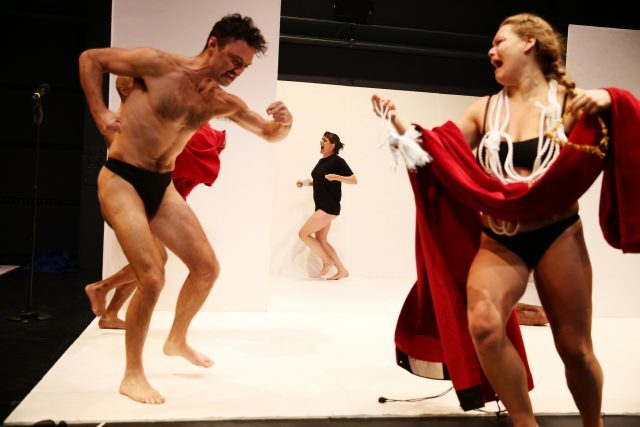
While other New Yorkers were going to costume parties or trick-or-treating with their kids, I spent Halloween night in a political house of horrors deep in Brooklyn. Through November 6, Creative Time, the New York City nonprofit arts organization that has presented such outstanding site-specific projects as Kara Walker’s “A Subtlety” at the abandoned Domino Sugar Factory, “Drifting in Daylight” in Central Park, Mike Nelson’s “A Psychic Vacuum” in the Old Essex Street Market, and Duke Riley’s “Fly by Night” at the Brooklyn Navy Yard, has now turned its attention to the state of the nation as a contentious and perverse presidential election comes to a close. Mexican multidisciplinary artist and activist Pedro Reyes’s labyrinthine, Dada-esque Doomocracy has taken over the Brooklyn Army Terminal, where a dozen people at a time are guided through a series of scripted vignettes that deal with police brutality, voting rights, school safety, corporate greed, the health-care system, climate change, pollution, the unequal distribution of wealth, drone attacks, and other hot-button issues.

Will Star/Shooting Stars Pro (photo courtesy of Creative Time)

A candy coffin salesman (Matthew Korahais) takes a sweet view of death in participatory Creative Time project at the Brooklyn Army Terminal (photo by Will Star/Shooting Stars Pro; courtesy of Creative Time)

Directed by Meghan Finn, written by Paul Hufker, and curated by Creative Time artistic director Nato Thompson, Doomocracy is fully interactive; after being hauled into a van and driven to a secret spot, you will be pushed and prodded, get yelled at, be forced to climb four flights of stairs, burrow through a narrow corridor, and play a game of soccer over the course of about sixty minutes. Some of the scenarios are goofier than others, constructed with a low-budget DIY sensibility that you just have to go with, but they all make their points (although there’s a serious flaw in the abortion-related room), revealing the darker sides of America that we seem powerless to stop. The cast features more than thirty actors; standouts include Marjorie Conn as a voting poll receptionist, Matthew Korahais as a ghoulish coffin salesman, Carolina Do as a futuristic artisanal air saleswoman, and Joseph Gregori as a park ranger who offers the best surprise of the night. And it’s a thrill just walking through the nearly century-old army terminal, which was designed by Cass Gilbert during WWI to serve as a military depot and supply base and currently functions as an industrial warehouse and commercial complex managed by the New York City Economic Development Corporation. The fully booked Doomocracy also fits in well with the recent Escape Room craze, where people have to solve puzzles to proceed, but in this case there appears to be no real way out from this endless national nightmare.

MY FIRST FILM FEST: WHERE THE WILD THINGS ARE

WHERE THE WILD THINGS ARE

Carol (voiced by James Gandolfini) and Max (Max Records) discuss life in Spike Jonze’s inventive live-action version of WHERE THE WILD THINGS ARE

WHERE THE WILD THINGS ARE (Spike Jonze, 2009)
Film Society of Lincoln Center, Walter Reade Theater
165 West 65th St. at Amsterdam Ave.
Sunday, November 6, 9:00
Series runs November 3-8
212-875-5601
www.filmlinc.org

The endlessly inventive Spike Jonze (Being John Malkovich, Adaptation.) has done the seemingly impossible, expanding Maurice Sendak’s classic 1963 children’s book, Where the Wild Things Are, into a fun and fantastical feature-length film. Written by Jonze and Dave Eggers (A Heartbreaking Work of Staggering Genius), the movie uses the ten sentences of the book and Sendak’s magical characters and transforms them into a world of wonder. Acting out after his sister’s friends crush his igloo and his divorced mother (Catherine Keener) ignores him in favor of a new boyfriend (Mark Ruffalo), nine-year-old Max (Max Records) runs away and sails across the ocean, landing on a faraway island where seven giant monsters live. In search of a leader, they name Max king, but he gets more than he bargained for as the ruler of the cynical Judith (voiced by Catherine O’Hara), the dumpy Ira (Forest Whitaker), the independent KW (Lauren Ambrose), the mysterious Bull (Michael Berry Jr.), the sad sack Alexander (Paul Dano), the dependable Douglas (Chris Cooper), and, most importantly, the manic-depressive Carol (James Gandolfini).

WHERE THE WILD THINGS ARE

Max becomes king of the forest in cinematic adaptation of Maurice Sendak’s classic bedtime story

Each character represents a different part of Max, a developing emotion that he must learn to deal with as he grows up. He is immediately drawn to Carol, whom he first sees destroying the group’s small, makeshift homes, echoing Max’s feelings about his own family situation. Max’s relationship with Carol — himself in the midst of a breakup with KW — is the heart of the story, as Carol goes from one extreme to another, at one point bouncing around the forest with sheer glee, then snuggling up with everyone in a warming group sleep, and finally turning into a dangerous ogre. As Jonze has pointed out, Wild Things, which received the full blessing of Sendak, is not necessarily a movie for children but about childhood. It beautifully captures a child’s innate sense of adventure and imagination while also showing that choices come with consequences. Fans of the book will be amazed at how well Jonze depicts the Wild Things themselves, which come alive as if they just jumped right out of the pages of the book; actors (not the voice-over artists) are in the costumes, their faces digitally manipulated by CGI effects, but they feel as real as they did when your mother first read you the enchanting story while tucking you in your bed. Where the Wild Things Are is screening November 6 at 9:00 at the Walter Reade Theater as part of the inaugural Film Society of Lincoln Center series “My First Film Fest,” which consists of thirteen films that form a first film festival for young moviegoers, from Hayao Miyazaki’s My Neighbor Totoro and Nausicaä of the Valley of the Wind to Charlie Chaplin’s Modern Times and Claude Nuridsany and Marie Pérennou’s Microcosmos, in addition to Yared Zeleke’s Lamb, followed by a Q&A with Zeleke; the New York premiere of Émilie Deleuze’s Miss Impossible, followed by a Q&A with Deleuze; the North American premiere of Hubert Viel’s Girls in the Middle Ages; and a sneak preview of Mike Mitchell and Walt Dohrn’s Trolls. Although the intent is to have kids “remember their first film festival,” several of the screenings take place at six o’clock and later, which might not be appropriate for younger children, the intended audience for most of these tales.

WILLIAM SHAKESPEARE’S CORIOLANUS

(photo by Carol Rosegg)

Dion Johnstone is fierce as Coriolanus in bloody Red Bull production (photo by Carol Rosegg)

Barrow Street Theatre
27 Barrow St. at Seventh Ave. South
Tuesday – Sunday through November 20, $80-$100
www.redbulltheater.com
barrowstreettheatre.com

Director Michael Sexton and Red Bull Theater transport one of William Shakespeare’s lesser-known, lesser-performed plays, Coriolanus, to up-to-the-minute contemporary times in a fast and furious immersive adaptation bursting with passion and energy. Set and lighting designer Brett J. Banakis has transformed the Barrow Street Theatre into the site of an Occupy movement in Rome, where hungry young citizens (Edward O’Blenis, Olivia Reis, and others) are protesting the government’s control of corn. “We are accounted poor citizens, the patricians good. What authority surfeits on would relieve us,” one citizen proclaims. “If they would yield us but the superfluity, we might guess they relieved us humanely. But they think we are too dear. The leanness that afflicts us is as an inventory to particularize their abundance. Our sufferance is as a gain to them. Let us revenge it with our pikes ere we become rakes; for the gods know I speak this in hunger for bread, not in thirst for revenge.” While patrician Menenius Agrippa (Patrick Page) understands their complaints, his good friend, Roman general Cauis Martius (Dion Johnstone), dismisses the Occupiers as “dissentious rogues” and “fragments.” Later, when Martius returns a hero in the battle against Corioles and his archenemy, Tullus Aufidius (Matthew Amendt), earning him the new name Coriolanus, the citizens, spurred on by manipulative tribunes Brutus (Merritt Janson) and Sicinius (Stephen Spinella), decide to do whatever they can to prevent him from becoming elected consul, taking up weapons and smashing ballot boxes. As Coriolanus’s pride and power grow, his mother, Volumnia (Lisa Harrow), his wife, Virgilia (Rebecca S’manga Frank), their son (Reis), and family friend Valeria (Christina Pumariega), a chaste lady of Rome, try to tone down the rhetoric and focus on his humanity, but there appears to be no stopping an inevitable, and bloody, conclusion.

The exquisite Patrick Page is once again at his best as Menenius Agrippa in CORIOLANUS (photo by Carol Rosegg)

The exquisite Patrick Page is once again at his best as Menenius Agrippa in CORIOLANUS (photo by Carol Rosegg)

It might be Rome, 493 BCE, but it could just as easily be America, 2016, inside the Barrow Street Theatre. A platform juts out from the stage, with the audience sitting around three sides. The characters enter and leave by weaving through the aisles, often interacting with the crowd, shaking hands, giving them a balloon, or handing out ballots. The immersive structure helps cover up some of the play’s difficulties and deficiencies, particularly after Coriolanus is banished and considers joining up with Aufidius to take Rome forcefully. In his U.S. debut, Stratford Festival star Johnstone is fierce and aggressive in a challenging role that does not offer much subtlety; it is easier to get frustrated by Coriolanus’s choices than to get behind him as a heroic figure. Page (Casa Valentina, Spring Awakening), one of New York City’s finest and most natural stage actors, nearly steals the show as Menenius, his dialogue rolling eloquently off his tongue in a thrilling baritone that rattles through the theater; his Menenius is like a modern-day campaign manager unable to rein in his boss from certain self-destruction. Janson (TFANA’s Tamburlaine the Great, Notes from Underground) and two-time Tony winner Spinella (Angels in America, Red Bull’s Volpone) evoke a devious teaming of Nancy Pelosi and Mitch McConnell, taking dastardly delight as political puppeteers fomenting rebellion. Harrow (Wit, Last Days of Chez Nous) is divinely elegant as Coriolanus’s distressed though determined mother, while Aaron Krohn is strong and stalwart as Coriolanus’s devoted right-hand man, General Cominius; Zachary Fine is a hoot as Titus Lartius and several others; and Amendt plays Aufidius like he’s a wasted British rock star. And costume designer Ásta Bennie Hostetter has fun with the outfits, from bold military uniforms to dapper suits, from hoodies to an Occupier’s T-shirt that says, “There is no capitalism without racism.” Longtime character actor Dakin Matthews, who has appeared in such recent political plays as The Audience and All the Way and was formerly artistic director of the Berkeley Shakespeare Festival, serves as dramaturg, noting in the program that Coriolanus “must appear before the people in humble garb, displaying his wounds and getting their ‘voices’ (votes), and then have their election confirmed by the people’s tribunes, who are so opposed to his elevation that they conspire to deny it to him by manipulating the people’s affections,” which sounds eerily familiar given what is happening in the current presidential campaign. Sexton (Shakespeare’s Margaret for Red Bull, Titus Andronicus at the Public), artistic director of the Shakespeare Society, keeps things chaotically orderly and involving, although a drug-party scene goes a bit over the top even as it adds needed humor. Red Bull excels at reviving seventeenth- and eighteenth-century plays (Volpone, The School for Scandal, ’Tis Pity She’s a Whore), and Coriolanus is yet another triumph for this always inventive and extremely talented company.

POETIC AND POLITICAL — THE CINEMA OF RABAH AMEUR-ZAÏMECHE: ADHEN

Rabah Ameur-Zaïmeche will be at FIAF on November 1 to screen and discuss ADHEN, which he directed, cowrote, and stars in

Rabah Ameur-Zaïmeche will be at FIAF on November 1 to screen and discuss ADHEN, which he directed, cowrote, and stars in

CINÉSALON: ADHEN (DERNIER MAQUIS) (Rabah Ameur-Zaïmeche, 2008)
French Institute Alliance Française, Florence Gould Hall
55 East 59th St. between Madison & Park Aves.
Tuesday, November 1, $13, 4:00 & 7:30
Series continues Tuesdays through December 13
212-355-6100
www.fiaf.org

FIAF celebrates the career of French-Algerian indie writer, director, actor, and producer Rabah Ameur-Zaïmeche in its November-December CinéSalon program “Poetic and Political: The Cinema of Rabah Ameur-Zaïmeche.” The seven-week series will include all five of his films, realistic meditations on immigration, family, history, religion, and rebellion made between 2001 and 2015. The festival begins November 1 with 2008’s gentle and patient slice-of-life drama, Adhen. Christian Milia-Darmezin stars as Titi, a new Muslim convert who works at a small French company that repairs shipping pallets. Titi is teased by some of his fellow workers (Serpentine Kebe, Abel Jafri, Mamadou Koita, Sylvain Roume as Giant, Salim Ameur-Zaïmeche as Bashir) because he is not circumcised, so the not-very-bright Titi takes scissors to himself, landing him in the hospital. Meanwhile, the boss, Mao (Rabah Ameur-Zaïmeche), sets up a mosque for his employees, believing it will be good for morale, although he threatens to cut their bonuses if they don’t attend prayers every Friday. Growing worker unrest over low pay and long hours increases when Mao doesn’t let them participate in the selection of the Iman (Larbi Zekkour) and the mechanics start talking about unionizing.

A muezzin (Serpentine Kebe) calls fellow workers to prayer in ADHEN

A muezzin (Serpentine Kebe) calls fellow workers to prayer in Rabah Ameur-Zaïmeche’s ADHEN

Adhen is beautifully shot by cinematographer Irina Lubtchansky, who lets her camera linger at the end of scenes, moving away from the characters and slowly turning up from the stacks and stacks of red pallets to a lightly cloudy bright blue sky or from a conversation about raises to trees blowing in the wind on the shore of a flowing river. The pallets are piled so high they are like physical barriers to the workers’ success, except when the muezzin (Kebe) climbs to the top and calls everyone to prayer, as if religion is the only answer to their problems. Later, when Giant encounters a trapped animal he thinks is a huge rat, the parallel between the frightened creature and the employees is palpable. Ameur-Zaïmeche, who cowrote the script with Louise Thermes, even gets away with such overt metaphors as a boss named Mao dealing with red pallets that transport commercial goods. He maintains a slow, easygoing pace throughout, regardless of where the emotions of the characters and story lead, from funny and proud to angry and resentful. Winner of the Special Jury Prize at the Dubai International Film Festival, Adhen is screening November 1 at 4:00 and 7:30; the later show will be followed by a Q&A with Ameur-Zaïmeche, moderated by Algerian-born French author and NYU visiting professor Zahia Rahmani. “Poetic and Political: The Cinema of Rabah Ameur-Zaïmeche” continues Tuesday nights through December 13 with Ameur-Zaïmeche’s Wesh Wesh, Back Home (Bled Number One), Smugglers’ Songs, and Story of Judas in addition to an election-night Director’s Choice screening of Stanley Kubrick’s Dr. Strangelove or: How I Learned to Stop Worrying and Love the Bomb, followed by a reception with live election results.

TWI-NY TALK: GRADY GERBRACHT

(photo © 2016 by Grady Gerbracht)

Grady Gerbracht, “#incidentalart No. 08,” #incidentalart #found #painting #composition #abstract #texture #color #marks #Nola #alley #neworleans #street #photography #poons #buffed #swastika (photo © 2016 by Grady Gerbracht)

#incidentalart
Senaspace Art & Tattoo
229 Centre St.
Tuesday – Sunday through November 6, free, 12 noon – 8:00 pm
212-966-5151
www.senaspace.com
www.gradygerbracht.info

For the past twenty years, New York native Grady Gerbracht has been making the most of his daily commute, taking photographs of unique elements he finds on city streets and walls, what he refers to as “incidental” works of art. He can be moved by rust, an unusual splotch of color, a piece of tape, stains, cigarettes in mud, and unusual surface textures. He posts the photographs on Instagram and Facebook, numbering each one and identifying them with pertinent information as well as adding his own interpretation; for example, “#incidentalart No. 18” is described as “#incidentalart #wrap #sculpture #architecture #christo #jeanclaude #form #stretch #storefrontforartandarchitecture,” while “#incidentalart No. 26” features the labels “#incidentalart #found #painting #composition #color #texture #patina #pattern #duct tape #grid #surface #marks #abstract.” As he notes in his hashtags, various pieces are reminiscent of the work of Mark Rothko, Christo and Jeanne-Claude, and Larry Poons.

A teacher, curator, “sonic sculptor,” and “spontaneous composer,” Gerbracht, who lives in Brooklyn with his wife and their two children, has previously created such projects as “viaDUCT,” “Commutes: NJ Transit Series,” and “Site & Sound,” involving photography, sound, performance, and intervention in relation to architectural space. He’s had solo exhibitions and been in group shows at Sculpture Center, Smack Mellon, the International Festival of Performance Art in Toronto, the Queens Museum, the Drawing Center, the National Museum of Contemporary Art in Helsinki, and the Anarchist Art Fair. His current solo exhibit, “#incidentalart,” consisting of twenty-six of his #incidentalart photographs, continues at Senaspace through November 6.

twi-ny: You’ve been taking these “incidental” pictures for twenty years. What got you started?

Grady Gerbracht: I have been doing this for a long time, so it’s hard to say when it began. There was not a landmark event or aha! moment which started it all. It was more of a gradual evolution of personal formal style in confluence with certain conceptual concerns. I think every artist has a particular aesthetic sensibility which is unique to them. Each of us is compelled to make certain kinds of marks or forms, or make certain kinds of pictures, which is how we can tell one artist’s hand from another. I am sure that my openness to aesthetic sensibilities that are not my own has been influenced by a lifetime of learning and teaching about art. To teach, one has to be familiar with art history in all its variety. One also has to be able to get inside the mind of other artists during critiques and studio visits in order to provide constructive criticism. Chance operations (as per John Cage and others) are of interest to me as well. It seems that all of these elements add up to my interest in finding and calling attention to things that look like art in my everyday surroundings.

(photo © 2016 by Grady Gerbracht)

Installation shot of Grady Gerbracht’s “#incidentalart” show at Senaspace features select groupings (photo © 2016 by Grady Gerbracht)

twi-ny: Why did you decide to call the series “incidental”?

GG: I chose the term Incidental Art because it is the best way I can explain my interests. There are other terms being used to describe similar ideas, such as involuntary painting and found objects. I find this nomenclature too limiting. Though I deliberately selected the works in this show to be based on ideas of two-dimensional painting for the sake of simplicity, my concept of Incidental Art is broader than that. The next exhibition could easily be images of things that look like sculptures, or of found situations that look like performance art or happenings.

twi-ny: The photos in the show were mostly taken in New York City, with a few from Chicago as well. Have you documented other cities in your travels, or is there something unique about the streets in these two metropolises?

GG: Another conceptual strand that runs through my work is the idea of turning the “wasted time” of my daily commute into productive studio time by actively making art during my travels between home and day job workplace. I made a commitment to do just that years ago when I had a three-hour commute to my first teaching job and I noticed that I was spending more time commuting than I was actually teaching. I could explain this through Marxist critical theory (and I have in academic journals) but quite honestly, it is just a practical way to make the best use of my time and it allows me to express myself creatively while on the go. I live in Brooklyn and my office is in Manhattan, so the majority of the images are from these boroughs. Sometimes I travel for my work, so there are images from Chicago and New Orleans in this exhibition because I have traveled to those cities recently.

twi-ny: Photography has changed a lot since 1996. What kind of cameras have you used over the years? Has that had any impact on the photos you take?

GG: Technology has changed a lot. I have made photos that fit into the umbrella term of Incidental Art with everything from professional 35mm and medium-format film cameras and DSLRs to my iPhone. The current exhibition is called “#incidentalart” because all of the images were made with an iPhone and uploaded to @gradygerbracht on Instagram with the hashtag #incidentalart. All of the images were produced actual size for the maximum resolution possible on my phone — that is why they are 15″ square. I wanted to be honest about what they are.

twi-ny: You post your photos on Instagram as well as Facebook, which have become repositories for amateur and professional photographers. Do you think that helps or hinders the concept of photography as art?

GG: Because of my commitment to make work during my commutes, I had been using the tools at hand to facilitate my process. I was not taking it very seriously, so I had no problem using the iPhone and Instagram feed. The images became very popular among social media friends and acquaintances, and many times people would ask when I was going to exhibit these images “IRL.” I was not planning to do it, but eventually it became clear that there was a demand so I decided to go ahead and show them.

I could have used fractal software to blow them up larger and look more like “contemporary art,” but I wanted to acknowledge what they are and where they came from. I did not want to stray too far from the immediacy of this pocket-sized studio technology. I still make pictures with my high-resolution DSLR, but that is not what this exhibit is about. The gallery space is relatively small and the venue is not a slick, commercial Chelsea warehouse-sized space, so it seemed appropriate to produce the images at this size for many reasons. I come from a tradition of conceptual art and institutional critique, so I can’t show anything without some consideration of context. I always think about it when I show my work; in fact, many of my projects make direct references to the spaces they are shown in.

Grady Gerbracht

Multimedia artist and teacher Grady Gerbracht peeks through Felix Gonzalez-Torres’s “Untitled (Golden)” (photo by Kerry Gaertner Gerbracht)

twi-ny: Is there a kind of aha! moment when you come upon something that you want to photograph? Are you looking for something specific? For example, many of the photographs in the show share a visual theme of looking like textured paintings, with three-dimensional qualities.

GG: I shoot things I am attracted to, but I also try to shoot things that look like art that I would not make — some of the images in the current exhibition look like Rothko paintings and I like his work, but the one used on the invitation card [ed. note: see top of page] looks very much like a Larry Poons painting and I never really liked the overly worked gobs of paint in his work. The fact is that I saw it on the street while traveling for work in New Orleans and thought, Hey, that wall in the alley looks like a Poons painting, so I framed it that way and the rest is history. I have been doing this so long my kids have begun to stop me on the street and say things like, “Dad, do you want to take a picture of that?” when they see some kind of peeling paint or some rich texture. They know what kind of surfaces I am attracted to — mostly things that look like paintings.

twi-ny: You’ve helped install many art shows in a professional capacity; did that make it harder or easier to install your own work?

GG: It is never easy for the artist to install his or her own work. It helps to have others whose opinions you trust to help with editing and placement decisions. Physically it is just math, so that part is easy.

twi-ny: The mounted photographs are hanging in very specific groupings. What was the reasoning behind how you decided to group them?

GG: I was not planning on hanging them in groups, but when I laid them out in the gallery and started looking at them, considering which should go where, I noticed that certain ones complemented each other, so the final groupings evolved out of aesthetic resonance. I also wanted to show that they could be purchased in groups or in pairs because they are small and affordable works one could compose with them, like tiles.

FESTIVAL ALBERTINE

Ta-Nehisi Coates is the curator of third annual Festival Albertine

National Book Award winner Ta-Nehisi Coates is curator of third annual free Festival Albertine

Albertine Books
972 Fifth Ave. between 78th & 79th Sts.
November 2-6, free
www.albertine.com

The third annual Festival Albertine, a sociocultural exploration of identity in the United States and France, will take place November 2-6, featuring more than two dozen artists, writers, choreographers, lawyers, sociologists, and curators participating in seven free events at Albertine, a project of the Cultural Services of the French Embassy in the Payne Whitney mansion on Fifth Ave. at Seventy-Ninth St. This year’s festival, with a focus on changing labels, immigration, and the politics of race, is curated by Ta-Nehisi Coates, a writer for the Atlantic who won the National Book Award for what might very well be the most important nonfiction work of the last decade, Between the World and Me. Referencing James Baldwin’s 1972 memoir, No Name in the Street — Baldwin, like Coates, lived in both New York and Paris — Coates explained in a statement, “Baldwin was drawing a not-so-subtle comparison with his own identity as a black American. He was also doing something more — asserting the labels we use to ascribe identity are situational. The words ‘black,’ ‘Arab,’ ‘Muslim,’ ‘American,’ and ‘French’ are not bone-deep and immutable but categories that have no meaning outside of history and events. There is something both sanguine and challenging in Baldwin’s view. It proposes that conflicts between cultures are not inevitable but the result of policies and decisions. But it also puts responsibility on people, themselves, to make the requisite changes in policy.” Coates also points out the role the arts can play in politics, particularly during this fierce campaign season, explaining, “Art shapes the imagination and outlines the sense of what is possible. It is art that attacks and interrogates our labels and chosen names, and reduces us to our common humanity.” Among the wide range of participants are Kehinde Wiley, Jacqueline Woodson, Benjamin Millepied, Darryl Pinckney, Thelma Golden, David Simon, Catherine Meurisse, Rabah Ameur-Zaïmeche, Scholastique Mukasonga, Chris Jackson, Denis Darzacq, and Zahia Rahmani. Admission is free, with no RSVP necessary. If you can’t make it to a specific discussion, you can livestream it here.

Wednesday, November 2
“When Will France Have Its Barack Obama?,” with Jelani Cobb, Iris Deroeux, Pap Ndiaye, and Benjamin Stora, moderated by Ta-Nehisi Coates, 7:30

Thursday, November 3
“From the Margins to the Mainstream: High Art vs. Low Art in France and the U.S.,” with Kelly Sue Deconnick, D’ de Kabal, Catherine Meurisse, and David Simon, moderated by Ta-Nehisi Coates, 7:30

Friday, November 4
“Blacklisted: From Hollywood to Paris,” with Rabah Ameur-Zaïmeche, Claire Diao, and Nina Shaw, moderated by Kamilah Forbes, 7:30

Saturday, November 5
“Europe and America in the Black Literary Imagination,” with Laurent Dubois, Scholastique Mukasonga, Maboula Soumahoro, and Darryl Pinckney, moderated by Chris Jackson, 5:00

“Art, Race & Representation,” with Denis Darzacq, Kehinde Wiley, Thomas Lax, and Nacira Guénif-Souilamas, moderated by Thelma Golden, 7:30

Sunday, November 6
“Every Name in the Street,” with Raphaël Confiant, Zahia Rahmani, Claudia Rankine, and Jacqueline Woodson, moderated by Adam Shatz, 3:00

“Race, Equity, and Otherness in Ballet and Society,” with Virginia Johnson and Benjamin Millepied, moderated by Jennifer Homans, 5:30

OH, HELLO

(photo by Joan Marcus)

George St. Geegland (John Mulaney) and Gil Faizon (Nick Kroll) make their Broadway debut in OH, HELLO (photo by Joan Marcus)

Lyceum Theatre
149 West 45th St. between Sixth & Seventh Aves.
Tuesday – Sunday through January 22, $59- $159
ohhellobroadway.com

It’s no mean feat to turn brief comedy sketches into feature-length productions; just ask Saturday Night Live, which has produced such critical flops as It’s Pat, A Night at the Roxbury, Superstar, The Ladies Man, and MacGruber. Yet somehow, Upright Citizens Brigade regular Nick Kroll and former SNL writer John Mulaney, who started performing as opinionated aging showbiz hangers-on Gil Faizon and George St. Geegland, respectively, in the East Village club Rififi in 2005 and later at the Cherry Lane Theatre and on the Comedy Central series Kroll Show from January 2013 to March 2015, have transformed their absurdist two-minute bits into the Broadway smash Oh, Hello, an uproarious send-up of celebrity culture and the Great White Way itself. The goofy, sloppy Faizon and the eccentric, possible serial killer St. Geegland, the hosts of the cable access show Too Much Tuna, have finally reached the big time, making it to Broadway with a play about themselves, a pair of old Upper West Side vaudeville types whose rent is suddenly going up from $75 to thousands a month. Desperate to keep their longtime abode, Faizon, who still hurts from losing a CBS announcing gig decades before, and St. Geegland, the author of the seminal works Next Stop, Ronkonkoma and Rifkin’s Dilemma, try to score a gig on NY1, as if that will make everything right. Amid self-deprecating riffs and a deep, abiding love for the music of Steely Dan, the two old guys manage to put on quite a show.

(photo by Joan Marcus)

Septuagenarian Upper West Side pranksters prepare for entrance of F. Murray Abraham in OH, HELLO (photo by Joan Marcus)

Oh, Hello, named after the two men’s trademark greeting, is a clever and inventive one hundred nonstop minutes of hilarity, as fellow Georgetown grads Mulaney and Kroll — who were inspired to create the characters after seeing a pair of elderly men, attached at the hip, both purchasing a copy of Alan Alda’s autobiography Never Have Your Dog Stuffed, at the Strand — try to crack each other up as much as the audience, particularly in their offbeat, offhanded pronunciations of various words and phrases that just make no sense. Scott Pask’s ramshackle set matches Faizon and St. Geegland’s dishevelment to a T, made up of leftover detritus from other shows, including family photos from an August Wilson play. Inside references abound, some that you will get, and some that you won’t, but little does that matter. There are even jokes about Alda, Bobby Cannavale, Aziz Ansari, and Griffin Dunne — Griffin Dunne? — but it turns out that each of those actors have made surprise guest appearances on the prank show Too Much Tuna. (We got John Oliver the night we went, and the Last Week Tonight host couldn’t stop laughing, which was infectious.) Kroll and Mulaney never miss a chance at a visual gag or a ridiculous pun, from the bit of shirt peeking through Faizon’s zipper, to both of them ripping unseen tech intern Ruvi Nandan, to John Slattery and Jon Hamm supposedly serving as their understudies. Two-time Tony nominee Alex Timbers, who has directed such elaborate productions as Here Lies Love, Rocky, and Peter and the Starcatcher in addition to Bloody Bloody Andrew Jackson, goes with the flow, relishing all of the shabby DIY madness. And yes, there is definitely too much tuna. It genuinely doesn’t matter whether you like Mulaney or Kroll individually or whether you were a fan of Kroll Show; everyone is welcome to say Oh, Hello.