Lynn Nottage’s SWEAT examines the dying American dream in factory towns such as Reading, Pennsylvania (photo by Joan Marcus)
Martinson Hall, the Public Theater
425 Lafayette St. at Astor P.
Extended through December 18, $95
212-539-8500
www.publictheater.org
If Hillary Clinton or anyone from the Democratic National Committee had seen Lynn Nottage’s blistering Sweat prior to election day, they might have focused more sharply on the electorate that has made Donald Trump our next president. Originally presented last year by the Oregon Shakespeare Festival as part of its “American Revolutions: the United States History Cycle” and then at Arena Stage in Washington, DC, earlier this year, Sweat is a provocative drama that intelligently and sharply deals with such issues as race, drugs, poverty, NAFTA, education, and, primarily, jobs. The story takes place in Reading, Pennsylvania, moving back and forth between 2000, as George W. Bush seeks the Republican presidential nomination, and 2008, when former best friends Chris (Khris Davis) and Jason (Will Pullen) try to get their lives back on track after eight years in prison. Most of the play is set in a local bar run by Stan (James Colby), who spent twenty-eight years working at the steel-tubing mill before an injury on the job left him with a noticeable limp. The bar regulars include three forty-something women who currently work at the factory: Chris’s mother, Cynthia (Michelle Wilson), an African American woman whose husband, Brucie (John Earl Jelks), is a drug addict who disappears for long stretches of time; Jason’s mother, Tracey (Johanna Day), a white woman and widow; and Jessie (Miriam Shor), a divorced white woman who drowns her sorrow in booze. Meanwhile, Latino bus boy Oscar (Carlo Albán) cleans up after them. In 2008, Chris and Jason’s parole officer, Evan (Lance Coadie Williams), is trying to help them, but they both may be too far gone, overwhelmed by their anger.
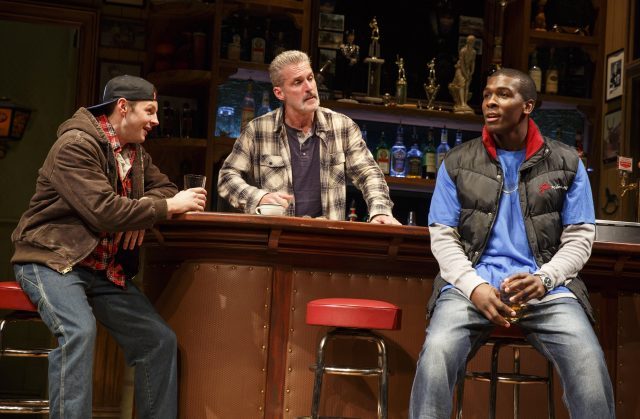
Jason (Will Pullen), Stan (James Colby), and Chris (Khris Davis) think about a better future in SWEAT (photo by Joan Marcus)
As rumors spread about big changes at the mill, from news that the owner’s grandson is taking over and that a high-level position is open to everyone to possible layoffs and a move to Mexico, things heat up at the bar. “I’ve been on the floor for twenty-four years,” says Cynthia, who is considering applying for the opening. Tracey responds, “Well, I got you beat by two. Started in ’seventy-four, walked in straight outta high school. First and only job. Management is for them. Not us.” The floor is the only job the women have ever had, perhaps the only decent job available to them in this working-class town, filled with immigrant families of German descent. Stan, who has heard it all before, puts it into perspective: “Give me a break. That place hasn’t changed since I walked in there in ’sixty-nine. Not a lightbulb, not one single nut or bolt. As a matter of fact it hasn’t changed much since my grandfather began working there in ’twenty. Good luck, sweetheart,” he tells Cynthia. “I don’t know him, but I can tell you that Olstead’s grandson is the same brand of asshole as all of ’em, stuffing his pockets rather than improving the floor.” But Stan also recognizes that not everything is actually the same, particularly in regard to management’s treatment of the employees. “You don’t see the young guys out there. They find it offensive to be on the floor with their Wharton MBAs,” he argues. “And the problem is they don’t wanna get their feet dirty, their diplomas soiled with sweat . . . or understand the real cost, the human cost of making their shitty product.”

Tracey (Johanna Day) and Oscar (Carlo Albán) get into a misunderstanding in SWEAT (photo by Joan Marcus)
Brooklyn-based Pulitzer Prize winner Nottage (Ruined, Meet Vera Stark) spent a lot of time in Reading, the steel and textile town that was ranked as the most impoverished city in America in 2011 and has remained in the top ten ever since, with extremely high unemployment and low education leading to a poverty rate of more than forty percent. She met with many of the struggling people there, encountering feelings of desperation, sadness, and betrayal, and turned their stories into Sweat, which continues at the Public Theater’s Martinson Hall through December 18. (Nottage has also developed the Reading Project, which seeks to use art and activism to improve the community.) “These are the conversations we should be having, and I feel like as artists we should be socially engaged, and that at times we can be strategic in the ways we engage audiences,” she told American Theatre in July 2015. Not a single word or movement is out of place in the incendiary production, which features impeccable performances by the outstanding ensemble cast, expertly directed by longtime Nottage collaborator Kate Whoriskey (How I Learned to Drive, Ruined), who maintains a fierce powder-keg pace that ultimately explodes in shocking violence on John Lee Beatty’s rotating set. As the characters’ American dream turns into a nightmare, the bar television follows Bush’s ascendancy during the 2000 primaries, but there’s only the briefest discussion of politics in the show; Sweat is not a condemnation of any one party or politician but of everything that has led to there being so many Readings throughout the United States, as evidenced by the results of the 2016 presidential election.

The state of the economy turns friends into enemies in SWEAT (photo by Joan Marcus)
“Between my new lady and Uncle Sam, money got a way of running outcha pocket. Nobody tells you that no matter how hard you work there will never be enough money to rest. It’s fact. A fact that should be taught to every child!” Chris, who wants to get out of the factory and become a teacher, tells Jason. “I kinda wanna do something a little different than my Moms and Pops. Yo, I got aspirations. There it is. And I won’t apologize,” he says, but it’s not that easy to break away in these small towns. “Dude, you ever given any thought to what you might do if this don’t work out?” Chris asks Jason, who responds, “Nah, not really. Knock on wood. I plan on retiring from the plant when I’m like fifty with a killa pension and money to burn, buy a condo in Myrtle Beach, open a Dunkin’ Donuts and live my life. Right, Stan?” As Stan can vouch, that’s not the way things generally turn out. Nottage has beautifully and honestly captured these characters’ lost dreams and desires, along with their frustrations and tenuous friendships, in a searing play about the literal and figurative shackles that bind too many Americans in this supposed land of plenty. (Be sure to pick up the four large broadsheets in the Public Theater lobby collectively called “Boom & Bust: The Rise & Fall of American Cities,” which details evolving economic situations in Butte, Montana, Silicon Valley, California, Eagle Ford Shale, Texas, and Detroit, Michigan; you can read more about it and other digital dramaturgy here.)


 Robert Bresson’s heartbreaking 1966 masterpiece, Au hasard Balthazar, is an unforgettable tale of the life and times of a most unusual yet completely ordinary donkey. As the opening credits roll, we hear writer and pianist Jean-Joël Barbier performing Franz Schubert’s Sonata No. 20, interrupted by the braying of a donkey and concluding with the sound of bells ringing. In a small rural community in France, a donkey has been born. Young Jacques and his sister baptize him and name him Balthazar, after one of the three Magi who presented the infant Jesus with gifts. Jacques and his neighbor, Marie, adore the donkey, treating him not only as their friend but their surrogate child, believing they are destined to marry. But they are torn apart by a land dispute between their fathers, and when they become teenagers, although the upstanding Jacques (Walter Green) still desires Marie (Anne Wiazemsky), she shamefully gives herself to Gérard (François Lafarge), the sinister leader of a local gang of bike-riding juvenile delinquents. Gérard abuses Marie as well as Balthazar, who soon sets off on a journey inspired by Fyodor Dostoyevsky’s The Idiot and the Stations of the Cross, going from owner to owner in a series of vignettes that also represent the seven deadly sins. His big, dark eyes appearing to understand what is happening to him, Balthazar encounters lust, gluttony, greed, sloth, wrath, envy, and pride but soldiers on, loved by Marie, who becomes ever-more helpless, unable and unwilling to take control of her destiny, much to the disappointment of her parents (Philippe Asselin and Nathalie Joyaut). Her sad fate seems predetermined, as does that of her beloved Balthazar, who literally and figuratively bears the heavy weight of the sins of all around him.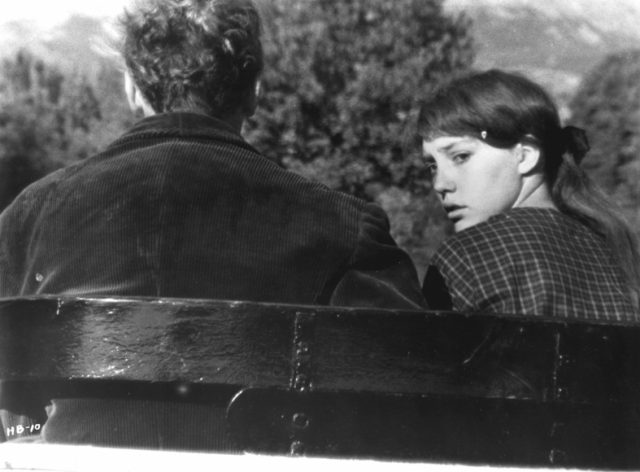

 Hardboiled action director and comic Takeshi Kitano, who is best known for such violent films as Violent Cop, Sonatine, and Boiling Point, has also made family dramas and romances as well (Kikujiro, A Scene at the Sea), and Dolls might be his most emotional, introspective picture. Dolls opens with a Bunraku puppet theater excerpt from Monzaemon Chikamatsu’s The Courier for Hell before delving into the dark story of Matsumoto (Hidetoshi Nishijima) and Sawako (Miho Kanno). Matsumoto dumps Sawako so he can marry the boss’s daughter, but when Sawako tries to kill herself and ends up in a mental hospital, Mastumoto decides to take care of the speechless, frightened shell of a woman she has become. He leads her through the seasons, tied to her by a red cord, a pair of bound beggars. Two subplots, which we’re not sure were absolutely necessary, also deal with love and loss, obsession and desire. Joe Hisaishi’s music is gorgeous, as is Katsumi Yanagijima’s cinematography. Kitano, who wrote, directed, and edited Dolls, mixes in sensational colors to balance out black-and-white tuxedos or long patches of snow: You’ll be mesmerized by the red rope, a purple-and-black butterfly, Sawako’s pink child’s toy, a glowing blue bridge, Matsumoto’s bright yellow car, a green public phone, a blue drink, twirling pinwheels, a shockingly blue umbrella, a park filled with cherry blossoms, and Yohji Yamamoto’s sparkling costumes. The film is bleak, slow-paced, and heart-tuggingly pure, a rewarding experience that will stay with you for a long time.