The Pershing Square Signature Center
The Irene Diamond Stage
480 West 42nd St. between Tenth & Eleventh Aves.
Tuesday-Sunday through December 4, $30-$50
212-244-7529 www.signaturetheatre.org
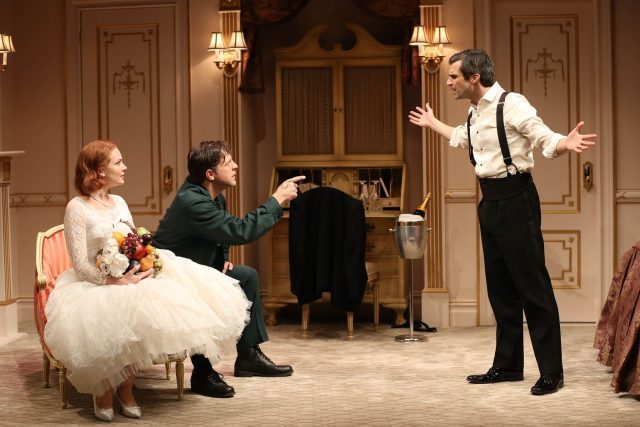
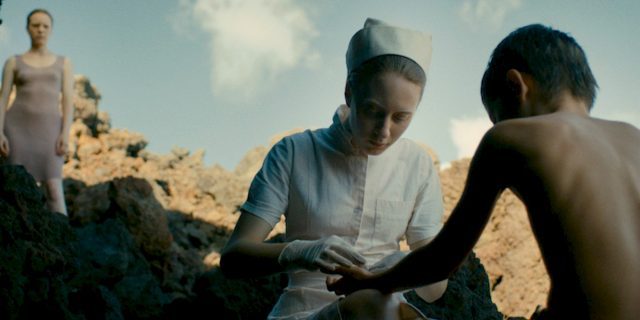
South African playwright Athol Fugard revisits a painful part of his past in the Signature Theatre revival of his 1982 success, “Master Harold” . . . and the boys. Inspired by an actual event that continues to cause him shame, the play is set in St. George’s Park Tea Room in Port Elizabeth, South Africa, in 1950, just two years after Apartheid began. It’s a rainy afternoon, and the dapper Sam (Leon Addison Brown) is keeping watch on the empty restaurant while Willie (Sahr Ngaujah) cleans up. They discuss an upcoming ballroom dance competition, as the smooth-moving Sam offers advice to the stiff, distracted Willie. Sam tells him, “The secret is to make it look easy. Ballroom must look happy, Willie, not like hard work. It must . . . Ja! . . . it must look like romance.” Willie responds, “Now another one! What’s romance?” to which Sam answers, “Love story with happy ending. A handsome man in tails, and in his arms, smiling at him, a beautiful lady in evening dress!” They are soon joined by Hally (Noah Robbins), the seventeen-year-old son of the white family they work for as servants. While Willie calls the boy “Master Harold,” Sam refers to him as the more familiar Hally; the two are very close, and Sam is a kind of surrogate father to Hally, since the white boy’s real father is an alcoholic who has been hospitalized. Hally relates how he was beaten by his teacher at school that day, and Sam compares it to getting “strokes with a light cane” in prison. Hally dreams that things will get better. “I oscillate between hope and despair for this world as well, Sam. But things will change, you wait and see,” he says. “One day somebody is going to get up and give history a kick up the backside and get it going again.” Sam asks, “Like who?” Hally replies, “They’re called social reformers. Every age, Sam, has got its social reformer. My history book is full of them.” And Sam answers, “So where’s ours?” Meanwhile, Hally teaches Sam about history and language, discussing Winston Churchill, Napoleon, Charles Darwin, Abraham Lincoln, and William Shakespeare. “Vestiges, feudal system, and abolished. I’m all right on oppression,” Sam says, pointing out some words he doesn’t quite understand, in addition to one he does, all too well. But after Hally gets a call from his mother with news about his father, the relationship between Sam and Hally takes a nasty turn.
“Master Harold” . . . and the boys premiered at Yale in 1982 — it was initially banned in South Africa — with Željko Ivanek as Hally, Zakes Mokae as Sam, and Danny Glover as Willie; it then moved to Broadway with Mokae, Glover, and Lonny Price taking over as Hally, earning a Drama Desk Award as Outstanding New Play. In the 2003 Broadway revival, Christopher Denham was Hally, Michael Boatman was Willie, and Glover played Sam. The new Signature version, directed by the eighty-four-year-old Fugard, is superb in all respects. Christopher H. Barreca’s tea-room set has a lurking coldness, the rain outside threatening a coming storm inside as well. Brown (The Trip to Bountiful, Two Trains Running), who has appeared in two previous Fugard productions at the Signature, is outstanding as the refined and poised Sam, who only wants everyone to be happy and to better his own situation in life, while Ngaujah (Fela!) is effective as his comic foil, a black man who seems content to stay where he is, not rocking any boats. Robbins (Brighton Beach Memoirs, Punk Rock) simmers to a slow boil as Hally, Fugard’s alter-ego — the writer’s real name is Harold Athol Lanigan Fugard, there really was a Sam and Willie, and his mother did run the St. George’s Park Tea Room — leading to an explosive, powerful conclusion. “Master Harold” . . . and the boys is part of the Signature’s Legacy Program; four years ago, Fugard was the inaugural Residency One playwright at their new home, reviving Blood Knot and My Children! My Africa! in addition to premiering The Train Driver and The Painted Rocks at Revolver Creek. Fugard and the Signature have brought back “Master Harold” . . . and the boys at an opportune moment, with America in the midst of a presidential election rife with heated arguments over class, race, gender, education, immigration, and the unequal distribution of wealth. Fugard writes and directs with such skill, and with such subtlety, that the play works in many contexts, relating to discrimination of all kinds everywhere, even when it’s a deeply personal tale story that still haunts him today. (There will be a discussion with dialect coach Barbara Rubin prior to the November 9 show, post-show talkbacks with members of the cast and creative team will follow the November 10, 15, and 22 performances, and the Signature Book Club will delve into Fugard’s Cousins: A Memoir on December 1 at 7:30.)
DJ Donwill and Wyatt Cenac will be yelling at blaxploitation films at Alamo Drafthouse on November 10 & 17
Alamo Drafthouse Downtown Brooklyn
445 Albee Square West
Thursday, November 10 & 17, $15, 9:35
718-513-2547 drafthouse.com
In a 2007 episode of Scrubs, J.D. (Zach Braff) and Chris (Donald Faison) discuss the stereotype of black families yelling at movie screens. Many people don’t want talking of any kind in theaters, while others just go with the flow. Comedian Wyatt Cenac (The Daily Show, Night Train) and comedic MC Donwill have been enjoying the concept at their monthly “Shouting at the Screen” events, which are back in town, taking place at the new Alamo Drafthouse in Brooklyn. On November 10 and 17, Cenac and Donwill will “re-create the magic of Magic Johnson theaters” in a kind of alternative MST3K while watching blaxploitation and black cult films. There will also be trivia questions and drinking games. Be prepared to shout along with everyone else, conventional cinema etiquette be damned.
DOC NYC continues its rapid growth with a wide-ranging schedule for its seventh year, featuring more than two hundred film screenings, workshops, university showcases, panel discussions, master classes, Q&As, and more. The festival of nonfiction film runs November 10-17 at IFC Center, the SVA Theatre, and Cinépolis Chelsea, with tickets ranging from $10 to $30. (Badges are necessary to attend “Short List Day,” “Documentary & Journalism Day,” “Smart Producing Day,” “Pitch Perfect Day,” and “Show Me the Money Day” events.) Among the many highlights are documentaries about David Lynch, Jane Jacobs, John Coltrane, Fred Hersch, Ken Loach, Sharon Jones, Robert Mapplethorpe, L7, and Tony Conrad as well as such topics as gender identity, abortion, religion, human rights, the ivory trade, African American journalism, disabilities, guns, food, and O.J. The impressive list of directors includes Werner Herzog, Barbara Kopple, Stanley Nelson, Katy Grannan, Raoul Peck, Ava DuVernay, Kirk Simon, and Kirsten Johnson. Below is a look at three festival films that have previously played in New York City and have been reviewed on twi-ny. Keep watching for more reviews as the festival approaches and gets under way.
NFL hero Steve Gleason takes a new look at life after being diagnosed with ALS
GLEASON (Clay Tweel, 2016)
Thursday, November 10, Cinépolis Chelsea, 6:00
Thursday, November 17, Cinépolis Chelsea, 11:45 gleasonmovie.com
“It’s not gonna be easy but it’s gonna be awesome,” Steve Gleason promises his unborn child in the extraordinary documentary Gleason, a heartbreaking yet uplifting tale about dedication, family, and never giving up. On September 26, 2006, scrappy New Orleans safety and special teams stalwart Gleason became an all-time inspirational Saints hero when, on Monday Night Football, he blocked Atlanta Falcon Michael Koenen’s punt less than a minute and a half into the Saints’ first home game in the Superdome following the devastation wrought by Hurricane Katrina the previous summer. The play, which resulted in a touchdown when the ball was recovered by Curtis DeLoatch in the end zone, has been memorialized with a statue titled “Rebirth” in front of the stadium. But Gleason became a different kind of hero five years later when the undrafted free agent was diagnosed with amyotrophic lateral sclerosis (ALS), better known as Lou Gehrig’s disease, a generally fatal neuromuscular disease. Right after that, the Washington State native, who at the age of thirty-four was given three to five years to live, found out that his wife, artist and free spirit Michel Varisco, was pregnant with their first child, a boy. Determined to pass on as much of a legacy as he could to his unborn baby, Gleason began a vlog, a series of deeply personal five-minute videos in which he spoke openly and honestly about how they would never have the traditional father-son relationship but he wanted the boy to know that he was loved and cherished. But that is only the beginning of an incredible story that is poignantly told in Gleason.
Directed and edited by Clay Tweel (Make Believe, Print the Legend), the film features powerful clips from Gleason’s video journal; intimate footage shot by Ty Minton-Small and David Lee, who lived with Gleason, Varisco, and their son, Rivers, for two years; and interviews with family members and friends as Gleason’s physical conditions worsens but his heart and will grow stronger. “People will say, ‘Oh, it’s such a sad, tragic story,’ Gleason explains in the film. “It is sad, and so they’re right, but it’s not all sad. I think there is more in my future than in my past.” Gleason, with Michel’s father, Paul Varisco, form Team Gleason, a grass-roots nonprofit organization dedicated to helping people with ALS have a better quality of life, taking them on adventure vacations and giving them access to cutting-edge technology that increases their ability to communicate as the disease destroys their speech and movement. Among Steve’s famous friends and supporters are Saints quarterback Drew Brees and his wife, Brittany, and Pearl Jam guitarist Mike McCready and singer Eddie Vedder. Steve and Michel hold nothing back, sharing their deepest fears and insecurities while his condition deteriorates. As he tries to get the most out of his limited time with Rivers, Gleason also reexamines his troubled relationship with his father, Mike, a born-again Christian who is often at odds with his son. The real superstar of the film, however, is the brave and courageous Michel, who devotes her life to her husband and son despite increasing difficulties. In a statement about the film, Michel said, “I hope people who need a good laugh or a heavy cry can get that from this film. I hope people who need to be reminded to love their kids or their friends can get that from this movie. I hope people with ALS who want to use this film to show others what their lives really are like can get that from this movie. I hope people who have strained relationships with their parents will want to work on those relationships after they watch this movie. I hope people who have wanted to do something great in life will go ahead and do it after seeing this movie. People have told me that they have gotten all of these things from watching Gleason. And I think that’s pretty awesome.” Gleason, which is not always easy to watch, achieves all that and more, and indeed, that’s pretty awesome. The Sundance hit will be at DOC NYC on November 10 and 17, with Tweel and Michel Varisco participating in a Q&A after the first screening. Tweel will also take part in the panel discussion “Short List Day: Character Studies” on November 11 at 12 noon.
The colorful Anthony Weiner marches in the Gay Pride Parade as he runs for mayor in 2013, a bright future potentially ahead of him
WEINER (Josh Kriegman & Elyse Steinberg, 2016)
Monday, November 14, Cinépolis Chelsea, 3:45
Tuesday, November 15, Cinépolis Chelsea, 9:45 www.ifcfilms.com
Near the end of Weiner, one of the most revealing and entertaining documentaries about a political figure you’re ever likely to see, one of the directors, Josh Kriegman, asks subject extraordinaire Anthony Weiner, “Why have you let me film this?” It’s a great question, and one that can be inquired of Weiner’s wife as well, Huma Abedin, who stands alongside her scandal-ridden husband nearly every step of the way. (Of course, the film was made prior to the most recent scandal, which led to the dissolution of their marriage.) In May 2011, during his seventh term as a fierce, fiery congressman representing parts of Brooklyn and Queens, Weiner was forced to resign in disgrace after it was discovered that he had sent lewd pictures of himself to several women over a public social media account while lying about it as well. Just two years later, the Brooklyn-born Weiner decided to get back in the game, running for mayor of New York City. Kriegman, who was a senior aide to Weiner in 2004-5 and his New York chief of staff in 2005-6, thought the comeback campaign would make a fascinating story, and Weiner agreed, giving him virtually unlimited access to his family and staffers. Initially, everything is going better than expected: Weiner is leading in the polls and getting his message across. But then the sexting scandal rises up again, and it all starts falling apart. Weiner tries hard to fight the good fight, concentrating on communicating his political platform, but the media only wants to ask him and his brave wife about the sexting, even when it is clear that the people of New York City prefer to talk about the issues. “I guess the punch line is true about me. I did the things . . . but I did a lot of other things too,” Weiner acknowledges. Of course, maybe Weiner never really had a fair chance. The movie begins with a telling quote from Marshall McLuhan: “The name of a man is a numbing blow from which he never recovers.”
Yet another texting scandal forces Anthony Weiner to reconsider his options under media scrutiny
PBS and MTV veterans Kriegman and codirector Elyse Steinberg amassed more than four hundred hours of footage for their feature debut, and very rarely does Weiner or Abedin shut them out, even when things appear to hit rock bottom. Kriegman focuses his camera on Weiner, who doesn’t flinch as he considers all his options and, all too often, takes the wrong path, whether it’s getting angry with a patron in a Jewish deli or arguing with Lawrence O’Donnell on a videolink interview. Weiner continually performs self-defeating acts that Abedin, a longtime Hillary Clinton supporter who is now vice chairwoman of the presumptive Democratic presidential nominee’s campaign, gracefully and painfully points out to him, but she sticks with her husband and his campaign to the bitter end. Kriegman and Steinberg show Weiner hanging out at home, walking around barefoot, and playing with son Jordan, who was born in December 2011. But it’s truly heartbreaking when the directors zero in on Abedin’s forlorn face as the scandal grows and grows and the media has a field day with it. Weiner is seamlessly edited by Eli Despres (Blackfish, Red Army), who keeps the tension high even when we know what is coming, as the narrative plays out like a unique kind of political thriller. It’s impossible to take your eyes off the screen, to stop watching Weiner and Abedin as they have to deal with his dirty laundry in public. In addition to allowing Kriegman and Steinberg to follow him everywhere, the usually charismatic Weiner is decidedly dour as he sits down for a candid wraparound interview with the filmmakers. “Shit. This is the worst. This is the worst. Doing a documentary on my scandal,” Weiner opines at one point, displaying a rare moment of genuine regret as opposed to his usual hubris. But the film, which makes no judgments — and which Weiner and Abedin have refused to see so far — is as much about the relationship between media and politics as it is about one specific politician who made some personal mistakes, and it does not bode well for our future. Will Weiner ever be able to stage another comeback? He’s a determined guy, almost to the point of obsession, with a deep desire to help the people of New York City and the country, but then there’s that name, and the photos he posted, and the strange faces that he makes, so a third chance might just be one too many. A most human drama that won the U.S. Grand Jury Documentary Prize at Sundance, the extraordinary Weiner will be shown at DOC NYC on November 14 and 15 at Cinépolis Chelsea. In addition, Kriegman and Steinberg will discuss the making of the film in the special programs “First Time Doc Maker Day: Morning Manifesto” on November 10 at 10:00 am and “Short List Day: Unfolding Stories” on November 11 at 10:30 am. By then we’ll know how much Abedin’s emails found on Weiner’s laptop impacted the 2016 presidential election.
Sharon Jones is nervous about returning to the stage after tough cancer battle in Barbara Kopple’s intimate, affecting documentary
MISS SHARON JONES! (Barbara Kopple, 2015)
Wednesday, November 16, Cinépolis Chelsea, 5:00
Thursday, November 17, Cinépolis Chelsea, 9:45 sharonjonesandthedapkings.com
“I feel my day is coming, it’s my time,” soul singer extraordinaire Sharon Jones is shown saying at the beginning of Barbara Kopple’s touching and intimate documentary, Miss Sharon Jones! But that was before the former wedding singer and Rikers Island corrections officer, who was born in 1958 in North Augusta, South Carolina, raised in Brooklyn, and later lived in Queens, was diagnosed in June 2013 with stage two pancreatic cancer. Jones, who has been called the female James Brown — she tells a story in the film about the time she met the Godfather of Soul — allows the Oscar-winning Kopple (Shut Up & Sing, Harlan County, USA) remarkable access as she cuts off her trademark locks and chooses a wig, undergoes painful chemotherapy, is cared for by her close friend and holistic nutritionist Megan Holken, and visits her old stomping grounds in Augusta, Georgia. Jones shares her thoughts about her future, feeling responsible for the financial well-being of her longtime band, the Dap-Kings. “First and foremost, we’re a family,” Daptone Records cofounder and saxophonist Neal Sugarman says. In fact, “family” is a word that pops up often in the film when people describe their relationship with Jones, who has never married and has no children. Among those who talk about Jones, her amazing talent, and her fight with cancer are her oncologist, Dr. James Leonardo; her manager, Alex Kadvan, who is with her every step of the way; her assistant manager Austen Holman, who tries not to break down on camera; Daptone Records cofounder and bassist Gabe Roth; guitarist Binky Griptite, who is up front about his financial troubles while the band is on hiatus; drummer Homer Steinweiss; and Dapettes Starr Duncan Lowe and Saundra Williams.
Sharon Jones, the female James Brown, takes the stage in Barbara Kopple’s MISS SHARON JONES!
Jones is a fiery dynamo onstage, pounding the floor in her bare feet, shaking her dreads wildly, a relentless performer in a compact package. (We’ve seen Miss Jones perform numerous times, including with Prince at Madison Square Garden, and Kopple does a masterful job capturing Jones’s infectious passion and energy.) She proves herself to be quite the character offstage as well, an unpredictable force who is at ease lighting up a cigar while fishing in a lake, not embarrassed to admit that her dream is to dance on Ellen with Ellen DeGeneres, and lifted by the power when delivering an awe-inspiring rendition of the Gospel standard “His Eye Is on the Sparrow” in a Queens church. Of course, the film is filled with lots of great music, all originals by Sharon Jones & the Dap-Kings, including “I Learned the Hard Way,” “Get Up and Get Out,” “Longer & Stronger,” “I’ll Still Be True,” and “100 Days, 100 Nights.” As the chemotherapy nears its conclusion, Jones, itching to return to the stage, wonders whether she’ll be strong enough to go back out on tour behind their latest record, the aptly titled Give the People What They Want.After seeing the film, Jones posted on social media, “I never thought I had a story, but Barbara Kopple and her team captured a beautiful one during the most difficult months of my life. They were able to make the difficulty in what I went through mean a lot. You see a part of life I never would have looked at and it was moving for me to be able to see all the people it affected.” Miss Sharon Jones! is indeed a moving, deeply affecting film. It is playing at DOC NYC on November 16 and 17, with Kopple and coproducer David Cassidy participating in Q&As after the screenings. Kopple will also take part in the panel discussion “Short List Day: Character Studies” on November 11 at 12 noon.
Artists will respond publicly to Zoe Leonard’s “I want a president” on the High Line (photo by Timothy Schenck)
Who: Eileen Myles, Justin Vivian Bond, Sharon Hayes, Pamela Sneed, Wu Tsang, Fred Moten, Nath Ann Carrera, Morgan Bassichis, Mel Elberg, Malik Gaines, Alexandro Segade, Layli Long Soldier What: Artists respond to Zoe Leonard’s “I want a president” Where: The High Line, Chelsea Market Passage, Little West Twelfth St. When: Sunday, November 6, free with advance RSVP, 1:00 – 3:30 Why: In 1992, as Bill Clinton was battling incumbent George H. W. Bush for the presidency of the United States of America, artist Zoe Leonard delivered a passionate declaration about what kind of a leader she was hoping would take on the most powerful job in the world, a person who has experienced the trials and tribulations that everyone does. Her treatise began, “I want a dyke for president. I want a person with aids for president and I want a fag for vice president and I want someone with no health insurance and I want someone who grew up in a place where the earth is so saturated with toxic waste that they didn’t have a choice about getting leukemia. I want a president that had an abortion at sixteen and I want a candidate who isn’t the lesser of two evils. . . .” Now, just two days before America goes to the polls to vote in the most contentious presidential election in history, a group of fellow artists will come together on the High Line, under a large-scale version of Leonard’s typed letter with cross-outs, sharing their thoughts and ideas in response to the proclamation. “I am interested in the space this text opens up for us to imagine and voice what we want in our leaders, and even beyond that, what we can envision for the future of our society,” Leonard said in a statement. “I still think that speaking up is itself a vital and powerful political act.” From 1:00 to 3:30, Sharon Hayes, Fred Moten, Wu Tsang, Morgan Bassichis, Mel Elberg, Malik Gaines and Alexandro Segade, Layli Long Soldier, Pamela Sneed, Eileen Myles, and Justin Vivian Bond and Nath Ann Carrera will get their turn at the bully pulpit for special readings and performances. (Myles, who ran for president in 1992 as an independent, is scheduled to go on at 3:00.) Leonard’s commissioned work, displayed on the western pillar of the Standard, will remain on view through November 17. Admission is free with advance RSVP.
Julie Christie is trapped in a suburban nightmare in Donald Cammell’s DEMON SEED
DEMON SEED (Donald Cammell, 1977)
Anthology Film Archives
32 Second Ave. at Second St.
Sunday, November 6, 3:00, and Tuesday, November 8, 9:00
Series runs through November 13
212-505-5181 anthologyfilmarchives.org
In his 1964 book, Understanding Media: The Extensions of Man, Marshall McLuhan declared, “In a culture like ours, long accustomed to splitting and dividing all things as a means of control, it is sometimes a bit of a shock to be reminded that, in operational and practical fact, the medium is the message. This is merely to say that the personal and social consequences of any medium — that is, of any extension of ourselves — result from the new scale that is introduced into our affairs by each extension of ourselves, or by any new technology.” Screen Slate and Anthology Film Archives have teamed up on a series that shows that concept at work in a very specific way. Continuing through November 13, “Screen Slate Presents: The Medium Is the Massacre” consists of a dozen horror films and specially chosen shorts that ratchet up the fear factor using cutting-edge technology and new media. Based on the novel by Dean R. Koontz, Donald Cammell’s creepy, claustrophobic 1977 futuristic thriller Demon Seed offers a very different look at motherhood. The film stars a surprisingly game Julie Christie as Susan Harris, a frustrated housewife whose husband, Alex (Fritz Weaver), is the leader of a team that has built a master computer known as Proteus (voiced by Robert Vaughn). When Alex goes off for several months to further Proteus’s already impressive attributes, the supercomputer starts developing a mind of its own, locking Susan in the house and deciding she must give birth to its child.
Cammell, who codirected Performance with Nicolas Roeg, fills Demon Seed with trippy, psychedelic visuals (the fab animated sequence is by Jordan Belson and Bo Gehring with Ron Hays) and cool technological flourishes, along with an electronic score by Ian Underwood and Lee Ritenour supplementing Jerry Fielding’s central musical themes. The film delves into suburban paranoia with Toffler-esque flare and an Orwellian fear of artificial intelligence. The film harkens back to Stanley Kubrick’s 2001: A Space Odyssey and Joseph Sargent’s Colossus: The Forbin Project while influencing such future films as John Badham’s WarGames, which also names its supercomputer “Joshua” and casts Weaver look-alike John Wood as computer creator Dr. Stephen Falken. Demon Seed is screening with Ericka Beckman’s 1999 experimental short Hiatus and Soda_Jerk’s one-minute Undaddy Mainframe on November 6 and 8 at Anthology. “Demon Seed with video effects by Ron Hays was perhaps the first film to integrate video with other special effect film processes,” Denise Gallant wrote in a 1982 issue of American Cinematographer. Programmed by Jon Dieringer of Screen Slate, “The Medium Is the Massacre” continues through November 13 with such other tech-savvy frightfests as David Cronenberg’s Videodrome (Cronenberg was directly influenced by McLuhan, who lectured at the university he attended), John Flynn’s Brainscan, Tobe Hooper’s Poltergeist, and Kiyoshi Kurosawa’s Pulse, each accompanied by at least one related short film. “Whenever the dragon’s teeth of technological change are sown, we reap a whirlwind of violence,” McLuhan also said, in a March 1969 Playboy interview.
Henry V (Ramsey Nasr) doesn’t take kindly to French threats in Ivo van Hove’s KINGS OF WAR (photo by Richard Termine)
BAM Howard Gilman Opera House
Peter Jay Sharp Building
230 Lafayette Ave.
November 3-6, $30-$130
718-636-4100 www.bam.org tga.nl/en
If you’ve ever wondered just what all the fuss is about Ivo van Hove, then hustle over to BAM’s Howard Gilman Opera House and see the Dutch-based Belgian theater director’s latest wonder, Kings of War. A follow-up of sorts to Roman Tragedies, van Hove’s five-and-a-half-hour merging of Shakespeare’s Julius Caesar, Antony and Cleopatra, and Coriolanus that played at BAM in November 2012, Kings of War seamlessly combines the Bard’s Henry V, Henry VI Parts I, II, and III, and Richard III into a dazzling four-and-a-half-hour multimedia extravaganza. The Toneelgroep Amsterdam production opens with a projection on a video screen of every English king or queen starting with Queen Elizabeth II and going backward to Henry IV, immediately linking the past to the present. Jan Versweyveld’s set and An D’Huys’s costumes bring them together further, with the characters dressed in contemporary clothing — the men in suits, the women in dresses, pantsuits, and heels — while the stage, inspired by Winston Churchill’s WWII War Room, features modern computers and old television monitors playing scenes from war movies. Translated into Dutch by Rob Klinkenberg and freely adapted by Bart van den Eynde and Peter van Kraaij, the play focuses on the kings and their thirst, or lack thereof, for power and the awesome responsibility they take on when deciding to go to war or not, exploring the psychological battles going on inside their head. Henry V (Ramsey Nasr) becomes a fast learner as he attempts to negotiate with the dauphin of France (Robert de Hoog) and his liaison (Chris Nietvelt) to prevent a war, but soon he is claiming the hand of Katharina (Hélène Devos) from her father, Charles VI (Leon Voorberg), in order to establish peace. Henry VI (Eelco Smits) is not quite as successful, a whimpering coward who does not want to be king; his feeble wooing of Margareta (Janni Goslinga) is hysterical. And then comes the dastardly Richard III, portrayed with a captivating bravado by Hans Kesting, sporting a hump and an ugly birthmark on his face; his bold pursuit to marry Lady Anne (Devos) after having just killed her beloved husband is utterly thrilling.
Henry VI (Eelco Smits) is not quite up to being king in four-and-a-half-hour extravaganza (photo by Richard Termine)
In a program note, van Hove, who recently directed the back-to-back Arthur Miller plays A View from the Bridge and The Crucible on Broadway and the David Bowie / Enda Walsh collaboration Lazarus at New York Theatre Workshop, explains, “It is fascinating to witness how crucial decisions about life and death are made. This play shows man at his most noble and at his most perverse. . . . It is inspiring to discover Shakespeare as a contemporary who is dealing with the type of events we see on the news every day: the dark machinations of the people in power and the violence that their decisions bring about.” Also inspiring is van Hove’s brilliant staging. The War Room changes with each new king, who is crowned in a stylistic manner as a brass band (Konstantin Koev, Charlotte van Passen, Daniel Quiles Cascant, Daniel Ruibal Ortigueir) plays and contratenor Steve Dugardin sings. The back of the set leads to morgue-like white corridors where various men meet their fate; the behind-the-scenes action is shown live on a large screen divided into rectangular grids, as a cameraman roams across the stage, getting up close and personal with the characters. (The video is by Tal Yarden.) It’s particularly effective during the spectacular Richard III section; as the king tries to convince the widowed Lady Anne that he is in love with her, her dead husband can be seen both on the screen as well as at the very back, on a gurney, his presence looming over them. Later, when Richard examines himself in a full-size mirror, the multiple images are breathtaking as van Hove reveals the villain’s many faces.
Richard III (Hans Kesting) takes a strange path in wooing Lady Anne (Hélène Devos) in Ivo van Hove epic at BAM (photo by Richard Termine)
Most members of the terrific cast play multiple roles, with Nasr as Henry V and Richmond, Eelco Smits as Henry VI and Grey, Bart Siegers as Edward IV, York, and Henry V’s chief of staff, Leon Voorberg as Charles VI, Warwick, and Stanley, Aus Greidanus Jr. as Gloucester and Buckingham, and de Hoog as the dauphin, Suffolk, and Clarence. The language has been modernized, which might at first bother Shakespeare purists, especially when reference is made to the current political situation in America, but that’s yet another way van Hove fuses the past with the present, as the fight for supremacy in the corridors of power is, of course, timeless and universal. (Thus, the ticking of metronomes as the finale approaches.) The nearly 270 minutes, with one intermission, fly by fairly quickly, as the play hits all the high notes at a gripping pace, zeroing in on deaths and coronations. Van Hove excels at adaptations, preferring them to new works; the Obie and Tony winner has previously been at BAM with Ingmar Bergman’s Cries and Whispers, Tony Kushner’s Angels in America, John Cassavetes’s Opening Night, and Sophocles’s Antigone, in addition to Roman Tragedies, continually coming up with remarkably innovative ways to tell stories, taking audiences to places they have never been before. Kings of War is another grand triumph, a staggering achievement from a true creative genius.
Peter Dunning reflects back on his hard life in Tony Stone documentary
PETER AND THE FARM (Tony Stone, 2016)
Metrograph
7 Ludlow St. between Canal & Hester Sts.
Opens Friday, November 4
212-660-0312 www.peterandthefarmfilm.com metrograph.com
“There’s not a part of this farm that has not been scattered with my sweat, my piss, my blood, my spit, my tears, fingernails, skin, and hair,” Peter Dunning says in Tony Stone’s Peter and the Farm. Dunning and Stone essentially show all that and more in the intimate documentary, holding nothing back, resulting in a film that is often difficult to watch, following a crotchety, suicidal, alcoholic sixty-nine-year-old organic meat farmer with a mangled hand who is estranged from his family and runs his 187-acre Vermont farm seemingly by himself. “I’m living in hell,” he says with cold detachment. Dunning is brutal with his animals, which include cows, sheep, and pigs, or at least it seems brutal to this city boy; Stone shows him shooting, skinning, and beheading one sheep, which caused me to look away from the screen, something I very rarely do. Stone also zooms in on a cow’s butt as it relieves itself of a massive amount of feces, followed by a vet sticking nearly his entire arm inside the animal to check if it is pregnant.
Stone (Severed Ways: The Norse Discovery of America), a New York City native who produced the film with his wife, musician, photographer, and actress Melissa Auf der Maur (the couple previously collaborated on Out of Our Minds and cofounded the multidisciplinary arts space Basilica Hudson), casts no judgment on Dunning, letting him just go about his business mostly on his own; they occasionally speak to each other, Stone an off-camera presence à la Albert Maysles. It’s a fascinating relationship — the two met at a farmers market when Stone was nine years old — made more than a little creepy because Dunning initially wanted Stone to film his suicide. But Peter soldiers on against all the odds, getting up every morning and feeding his flock, riding the John Deere, sharing poignant memories, and lamenting his life, which turned out very different from the way he imagined it. Peter and the Farm, which previously screened at such festivals as True/False in Missouri and New Directors / New Films at MoMA and Lincoln Center, opens November 4 at Metrograph, with Stone participating in a Q&A at the 7:00 show on Friday.