twi-ny recommended events

COIL 2017 — MOLLY LIEBER + ELEANOR SMITH: BASKETBALL

BASKETBALL

Molly Lieber + Eleanor Smith will present world premiere of BASKETBALL as part of Coil 2017

Baryshnikov Arts Center, Howard Gilman Performance Space
450 West 37th St. between Ninth & Tenth Aves.
January 7-10, $20
Festival runs January 3-22
212-811-4111
www.bacnyc.org
www.ps122.org/basketball

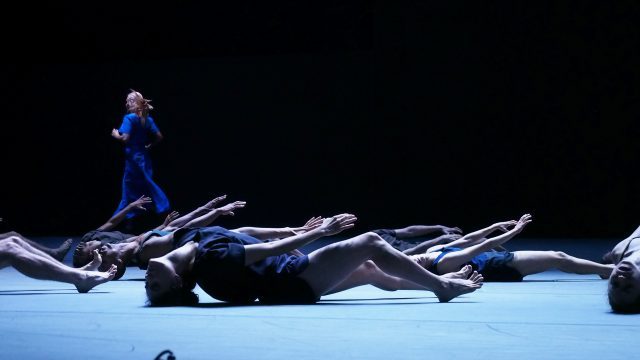
“We don’t present objects, static fixed ideas. These are living, breathing, complicated, flawed, and wonderful experiences. Profound and unpredictable. Difficult,” outgoing PS122 artistic director Vallejo Gantner said about Coil 2017, the last he will oversee. Although he was referring to the multidisciplinary festival as a whole, his words also apply to the highly anticipated world premiere of Molly Lieber + Eleanor Smith’s Basketball, a PS122 commission that runs January 7-10 at Baryshnikov Arts Center. Since 2006, Lieber (Maria Hassabi, Donna Uchizono, luciana achugar) and Smith (Ivy Baldwin, Juliana F. May/MAYDANCE, Katie Workum) have been creating physically and emotionally powerful duets rooted in improvisation. In such works as Tulip, Beautiful Bone, and Rude World, the pair invites the audience into intimate experiences that can be both gorgeous and uncomfortable, as if they have opened up the door on an imaginary private life. Their pieces are also a celebration of the female body. In the seventy-five-minute Basketball, Lieber and Smith, who were nominated for a 2013 Bessie Award for Emerging Choreographer — Lieber also won a 2016 Outstanding Performer Bessie “for her introspective and tenacious performances” — explore past shames as they merge back and forth through time and space. Coil 2017 continues through January 22 with such other dance-related programs as Antony Hamilton and Alisdair Macindoe’s Meeting, Pavel Zuštiak / Palissimo’s Custodians of Beauty, Nicola Gunn’s Piece for Person and Ghetto Blaster, and Bobbi Jene Smith and Keir GoGwilt’s A Study on Effort.

AMERICAN REALNESS: ÉTROITS SONT LES VAISSEAUX by KIMBERLY BARTOSIK/daela

(photo by Ryutaro Mishima)

Joanna Kotze and Lance Gries will perform Kimberly Bartosik / daela’s ÉTROITS SONT LES VAISSEAUX at Gibney Dance January 6-7 (photo by Ryutaro Mishima)

Gibney Dance: Agnes Varis Performing Arts Center
280 Broadway between Chambers & Reade Sts.
January 6-7, $15, 5:00 & 7:00
American Realness runs January 6-12
gibneydance.org
americanrealness.com

In April 2016, Brooklyn-based company Kimberly Bartosik / daela premiered the duet Étroits sont les Vaisseaux at Gibney Dance’s Agnes Varis Performance Lab. On January 6 and 7, as part of the multidisciplinary American Realness festival and in conjunction with APAP | NYC, Bartosik (The Materiality of Impermanence, Ecsteriority) will be presenting four encore performances at the Gibney lab, both days at 5:00 and 7:00. The very intimate show, which will be performed for a small audience, was inspired by Anselm Keifer’s eighty-two-foot-long “Étroits sont les Vaisseaux,” an undulating installation that is on long-term view at MassMoca. The duet will again be performed by Joanna Kotze (Find Yourself Here, Between You and Me) and Lance Gries (Etudes for an Astronaut, The FIFTY Project), with lighting and set design by Roderick Murray, costumes by Bartosik, Kotze, and Gries, sound by Bartosik and Murray, and choreography by Bartosik in close collaboration with the dancers. The piece deals with time and tides, running twenty-four minutes and fifty seconds, based on the lunar day, which lasts twenty-four hours and fifty minutes.

CONTEMPORARY DANCE SHOWCASE 2017: JAPAN + EAST ASIA

(photo © Naoshi Hattori.; courtesy of Aichi Arts Center)

Five duos will perform at Japan Society’s seventeenth Contemporary Dance Showcase: Japan + Asia (photo © Naoshi Hattori.; courtesy of Aichi Arts Center)

Japan Society
333 East 47th St. at First Ave.
Friday, January 6, and Saturday, January 7, $30, 7:30
212-715-1258
www.japansociety.org

Traditionally, we like to end our year by seeing the Alvin Ailey American Dance Theater in its December season at City Center, then start every other year off right with the Contemporary Dance Showcase: Japan + East Asia every January at Japan Society. The seventeenth edition of the biennial event takes place January 6 and 7, as five acts will perform special duets. The 2017 lineup features the North American premiere of Korean company JJbro’s playful and energetic Jimmy & Jack; the North American premiere of Japanese troupe Co. Un Yamada’s unique interpretation of Igor Stravinsky’s 1923 Les Noces (The Wedding), which the maestro called “Choreographed Scenes with Music and Voices”; the North American premiere of Taiwan company B DANCE’s Hugin/Munin, involving the title characters, ravens whose names mean “thought” and “memory,” respectively, sitting on Norse god Odin’s shoulders (choreographed by Po-Cheng Tsai); the North American premiere of Taiwain troupe In Theatre’s Tschüss!! Bunny, choreographed by Yen-Cheng Liu, examining life and death and rebirth, inspired by the concept “Now is the moment, and creation is the assembling of the fragments of lives”; and the world premiere of TranSenses, a collaboration between Japanese dancer and choreographer Akiko Kitamura and Canadian media alchemist and audiovisual sculptor Navid Navab. There are still tickets left to catch this biennial treat; the January 6 performance will be followed by a Meet-the-Artists Reception.

NO LIMITS: ZAO WOU-KI

Zao Wou-Ki, Hommage à Chu Yun—05.05.55 (Homage to Chu Yun—05.05.55), oil on canvas, 1955 (private collection, Switzerland; photo by )

Zao Wou-Ki, “Homage to Chu Yun — 05.05.55,” oil on canvas, 1955 (private collection, Switzerland; photo by Dennis Bouchard)

Asia Society
725 Park Ave. at 70th St.
Daily through January 8, $7-$12 (free Friday nights from 6:00 to 9:00)
212-288-6400
asiasociety.org

“I like people to be able to stroll in my works, as I do when creating them,” Chinese-French painter Zao Wou-Ki said in 1967. Visitors can continue strolling in Zao’s works at Asia Society’s “No Limits: Zao Wou-Ki” exhibition through January 8, his first museum retrospective in the United States. The show consists of more than four dozen works, from oil paintings and ink drawings to watercolors and etchings. The extremely popular artist — his 1958 painting “Abstraction” sold at auction in December 2013 for nearly $15 million — pushed physical, geographic, psychological, and artistic boundaries through his long career, combining historical and contemporary methods and themes throughout his oeuvre. The Asia Society show is divided into three sections: “Calligraphy Is the Starting Point,” “To Learn Is to Create,” and “A Place to Wander,” each offering its own delights. Postwar abstraction master Zao, who died in 2013 at the age of ninety-three, displayed a unique color sense, contributing to a sense of mysterious welcome in his works. Paintings such as “Homage to Chu Yun — 05.05.55,” “Red Pavilion,” “Chestnut,” and “Water Music” look alive on the canvas, as if tantalizingly drifting through the viewer’s mind. Zao’s influences are often apparent, from Pablo Picasso, Paul Klee, and Paul Cézanne to Marc Chagall, Jean Dubuffet, and Sam Francis, some of whom he got to know during his travels. Born in Beijing, he left Shanghai for Paris in 1948 to immerse himself in art. “His intended two-year adventure turned into a lifetime abroad and culminated in an artistic reputation that defies easy categorization,” cocurators Dr. Ankeney Weitz and Dr. Melissa Walt write in their catalog introduction. “Painter, printmaker, master of brush and ink, Zao was a pioneer who fused disparate influences and techniques and moved easily between the worlds in which he lived, learned, and created.” (The show is also cocurated by Edith K. Jetté and Michelle Yun.) Not everything is so captivating; his later works tend to be more inconsistent, the color schemes not as thrilling. His heyday was clearly from the mid-1940s to the mid-1960s, a creative epiphany. “It’s that it is not easy to break free,” Zao, the Picasso of China, said in 1964. “Everybody is bound by a tradition — I, by two. To make a good painting, you have to understand.” Thanks to this exhibit, we now do.

YANIRA CASTRO | A CANARY TORSI: PERFORMANCE | PORTRAIT

Performance Portrait

a canary torsi’s responsive multimedia installation “Performance Portrait” offers visitors a chance to respond to dancers (photo by Julie Wyman)

PERFORMANCE | PORTRAIT @ APAP
The Glass House, the Invisible Dog Art Center
51 Bergen St.
January 5-15, free, 4:30 – 8:30
theinvisibledog.org
acanarytorsi.org

After being exhibited as part of the “Wonderland” group show at the Invisible Dog Art Center, a canary torsi’s latest collaborative project, Performance | Portrait, moves just down the street to the IDAC’s Glass House in conjunction with APAP | NYC, the annual Association of Performing Arts Presenters conference, which features special performances throughout New York City every January. Puerto Rico–born Yanira Castro founded a canary torsi (an anagram of her name) in 2009, specializing in site-adaptive interactive works that blur the boundaries between audience and performer. In Paradis, the audience followed the dancers around the Brooklyn Botanic Garden, occasionally interacting with one another. In Court/Garden, Castro created a space inspired by the court of Louis XIV, exploring image, assembly, presentation, and consumption.

Many of those elements are at the center of Performance | Portrait, which runs at the Glass House from January 5 to 15. The responsive multimedia work, made in conjunction with installation artist Kathy Couch, interaction designer Stephan Moore, and filmmaker Julie Wyman, consists of a projector that is activated once a person steps on a small box in between a screen and a curtain. The projector beams an image of four dancers, one at a time (Anna Azrieli, Leslie Cuyjet, Peter Schmitz, David Thomson), who were previously filmed by Wyman at a different location but in front of the same curtain where the viewer now stands. Each dancer gazes directly into the camera, essentially right into the viewer’s eyes; just as the viewer is waiting for the dancer to do something entertaining, it appears that the often uncomfortable dancers (each was filmed for four hours) are waiting for the viewer to do something entertaining as well. Castro is calling into question the gaze, audience expectation, the interplay before performer and crowd, and performer expectation, the dancers turning the tables on the viewer, who is likely to get antsy rather quickly unless he or she can just settle in and go head-to-head with the dancer for a while. It feels like a different take on the staring contests Marina Abramović held with MoMA visitors in “The Artist Is Present.” As the viewer stands there, the performers change over the course of time, but once the viewer steps off the box, the dancer fades into nothingness, for without an audience, can there be a performance?

MARCEL PAGNOL’S MARSEILLE TRILOGY

MARIUS (courtesy Janus Films)

Fanny (Orane Demazis) and César (Raimu) share a moment of happiness in MARIUS (courtesy Janus Films)

MARIUS (Alexander Korda, 1931)
FANNY (Marc Allégret, 1932)
CÉSAR (Marcel Pagnol, 1936)
Film Forum
209 West Houston St.
January 4-12
212-727-8110
filmforum.org

One of the great trilogies in the history of cinema, Marcel Pagnol’s Marseille Trilogy will be playing at Film Forum January 4-12 in a new 4K restoration, including marathon viewings of Marius, Fanny, and César on January 7, 8, 11, and 12. French novelist, playwright, screenwriter, and director Pagnol penned all three scripts, the first two based on his stage plays, as he investigated love, honor, betrayal, friendship, religion, scandal, and social ritual among the petit bourgeois, the lower-middle-class citizens of the port town of Marseille. Shot on location, the three films, also known as the Fanny Trilogy, center on the big, boisterous César (Raimu in a marvelous comedic tour de force), who runs a local bar with his ne’er-do-well son, Marius (Pierre Fresnay). Marius is childhood friends with the sweet Fanny (Orane Demazis), who declares her love for him only after the rich, successful older merchant Honoré Panisse (Fernand Charpin) requests her hand in marriage. As Fanny’s mother, Honorine (Alida Rouffe), and aunt, Claudine (Milly Mathis), contemplate the potential match, Fanny tries to convince Marius to marry her instead, but he is hesitant, drawn instead to the sea despite his love for Fanny. Directed by Alexander Korda (Rembrandt, The Private Life of Henry VIII), Marius is a rollicking good romance with a surprising dash of naughtiness and featuring an outstanding group of minor characters, including Paul Dullac as Félix Escartefigue, Alexandre Mihalesco as Piquoiseau, Robert Vattier as Albert Brun, and Edouard Delmont as Dr. Félicien Venelle. The camaraderie among the characters is infectious — many of the actors previously played the same roles onstage — with César leading the way, a big, boisterous man whose bravura mix of insults and praise is as potent as the drinks in his bar.

FANNY (courtesy Janus Films)

Things get serious for César (Raimu), Fanny (Orane Demazis), and Honoré Panisse (Fernand Charpin) in FANNY (courtesy Janus Films)

It’s a great start to the trilogy, which continues with 1932’s Fanny, directed by Marc Allégret (Zouzou, Lady Chatterley’s Lover). If you don’t want to know what happens next, don’t read on, but make sure to see all three films, as each one is a gem. Marius has headed out to sea for five years, leaving behind a pregnant Fanny, who is shocked but delighted when Panisse agrees to marry her anyway, raising the child as if he were his own. César is overjoyed to have a grandson, who is named after him, Césariot, even though all have decided to keep everything secret in order to avoid scandal. But when Marius shows up during a brief layover, he is curious about the baby and is determined to find out the truth. Most of the cast returns for Fanny, except Auguste Mouries now plays Escartefigue, along with such new characters as Mangiapan (Marcel Maupi) and the local priest, Elzéar Bonnegrâce (Louis Boulle).

CÉSAR (courtesy Janus Films)

Marcel Pagnol’s Marseille Trilogy concludes with CÉSAR (courtesy Janus Films)

The conclusion, directed and written for the screen by Pagnol, César was made four years later but takes place twenty years in the future. As Panisse lies dying in bed, Father Elzear (Thommeray) presses him to confess his sins and, most important, reveal the truth about his son’s birth to the boy himself, Césariot (André Fouche). Meanwhile, Marius toils away in a garage in another town, having been out of everyone’s life for fifteen years. (If the plot of the entire trilogy sounds very familiar, then you must have seen Jacques Demy’s The Umbrellas of Cherbourg.) The setup makes for some hysterical battles between the priest, the doctor, and Panisse, as organized religion takes some heavy hits. Pagnol also explores different reactions to death, sharing clever insight as well as sharp humor. The trilogy, which was restored by Compagnie Méditerranéenne de Film — MPC and the Cinémathèque Française and has been remade (in part or whole) by such directors as James Whale, Joshua Logan, and Daniel Auteuil, is thoroughly charming, a realistic depiction of life with all its grace and indignities. It won’t take long until you feel like you’re a member of this dysfunctional but enchanting family.

NEVER BEFORE, NEVER AGAIN

never-before-never-again

Triskelion Arts
Muriel Schulman Theater
106 Calyer St. (enter on Banker St.)
January 5-8, $16-$20
www.triskelionarts.org

Most of the winter performance festivals, such as Under the Radar, COIL, Prototype, and American Realness, consist of experimental works that have either already been performed elsewhere or will afterward. However, the nonprofit Triskelion Arts, which was founded in Brooklyn in 2000 to “foster the development and presentation of the performing arts,” has something very different in mind with its “Never Before, Never Again” festival, which consists of dance, music, comedy, theater, poetry, and other disciplines in improvisational performances that have never been presented before and never will again quite like they will be during the third annual event, running January 5-8. The improv celebration begins January 5 with the Lovelies; Alyssa Gersony; Judah Levenson, Hank Mason, and Shane Gertner; kamrDANCE; NOW ACCEPTING ALL OFFERS MADE; and Katelyn Halpern & Dancers. On January 6, the lineup features Schmidt / Keenoy Movement / Sound Lab; slowdanger; Jog Films; Debbie Z & Friends; and the Lovelies. Saturday’s roster boasts Mauri Connors and Mindy Toro; TanzKlub; the Shelburne Trio (bassist Kevin Farrell, dancer Rachel Mckinstry, and poet Josh Adler); stb x at; Sarah Foster / MoveWorks; and Boom Bat Gesture Performance Group. The festival concludes January 8 with Ali Perkins; Kirsten Schnittker; Jason Mears / Quentin Tolimieri; There’s No Law (Rachel Cohen, Michael Henry, Irene Siegel); and Lokasparsa Dance Projects / clyde forth. Tickets are $16 in advance, $20 at the door to check out these now-you-see-it, now-you-don’t performances.