twi-ny recommended events

FILM SCREENING AND ARTIST TALK: CUTIE AND THE BOXER

CUTIE AND THE BOXER

Documentary tells the engaging story of a pair of Japanese artists and the life they have made for themselves in Brooklyn

CUTIE AND THE BOXER (Zachary Heinzerling, 2013)
Japan Society
333 East 47th St. at First Ave.
Friday, January 27, $15, 7:00
212-715-1258
www.japansociety.org
www.facebook.com/cutieandtheboxer

Zachary Heinzerling’s Emmy-winning Cutie and the Boxer is a beautifully told story of love and art and the many sacrifices one must make to try to succeed in both. In 1969, controversial Japanese Neo Dada action painter and sculptor Ushio Shinohara came to New York City, looking to expand his career. According to the catalog for the recent MoMA show “Tokyo 1955-1970: A New Avant-Garde,” which featured four works by Ushio, “American art had seemed to him to be ‘marching toward the glorious prairie of the rainbow and oasis of the future, carrying all the world’s expectations of modern painting.’” Four years later, he met nineteen-year-old Noriko, who had left Japan to become an artist in New York as well. The two fell in love and have been together ever since, immersed in a fascinating relationship that Heinzerling explores over a five-year period in his splendid feature-length theatrical debut. Ushio and Noriko live in a cramped apartment and studio in DUMBO, where he puts on boxing gloves, dips them in paint, and pounds away at large, rectangular canvases and builds oversized motorcycle sculptures out of found materials. Meanwhile, Noriko, who has spent most of the last forty years taking care of her often childlike husband and staying with him through some rowdy times and battles with the bottle, is finally creating her own work, an R. Crumb-like series of drawings detailing the life of her alter ego, Cutie, and her often cruel husband, Bullie. (“Ushi” means “bull” in Japanese.) While Ushio is more forthcoming verbally in the film, mugging for the camera and speaking his mind, the pig-tailed Noriko is far more tentative, so director and cinematographer Heinzerling brings her tale to life by animating her work, her characters jumping off the page to show Cutie’s constant frustration with Bullie.
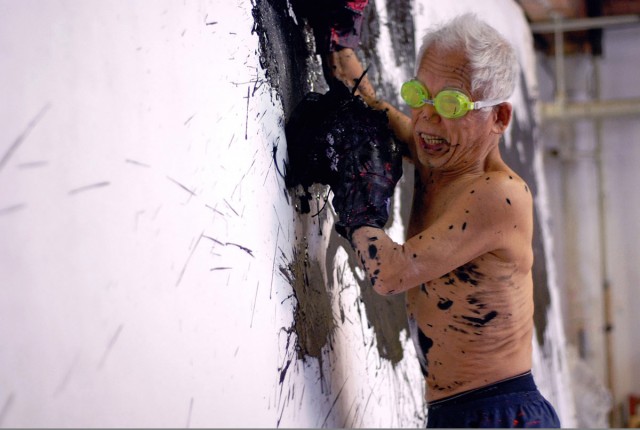
Ushio Shinohara creates one of his action paintings in CUTIE AND THE BOXER

Ushio Shinohara creates one of his action paintings in Emmy-winning CUTIE AND THE BOXER

During the course of the too-short eighty-two-minute film — it would have been great to spend even more time with these unique and compelling figures — the audience is introduced to the couple’s forty-year-old son, who has some issues of his own; Guggenheim senior curator of Asian Art Alexandra Munroe, who stops by the studio to consider purchasing one of Ushio’s boxing paintings for the museum; and Chelsea gallery owner Ethan Cohen, who represents Ushio. But things never quite take off for Ushio, who seems to always be right on the cusp of making it. Instead, the couple struggles to pay their rent. One of the funniest, yet somehow tragic, scenes in the film involves Ushio packing up some of his sculptures — forcing them into a suitcase like clothing — and heading back to Japan to try to sell some pieces. Cutie and the Boxer is a special documentary that gets to the heart of the creative process as it applies both to art and love, focusing on two disparate people who have made a strange yet thoroughly charming life for themselves. Cutie and the Boxer is screening January 27 at 7:00 at Japan Society and will be followed by a discussion and Q&A with Ushio and Noriko in the gallery, where Ushio’s “Tokyo Bazooka” was on display in 1982 and where the couple was part of the memorable “Making a Home” exhibition in 2007.
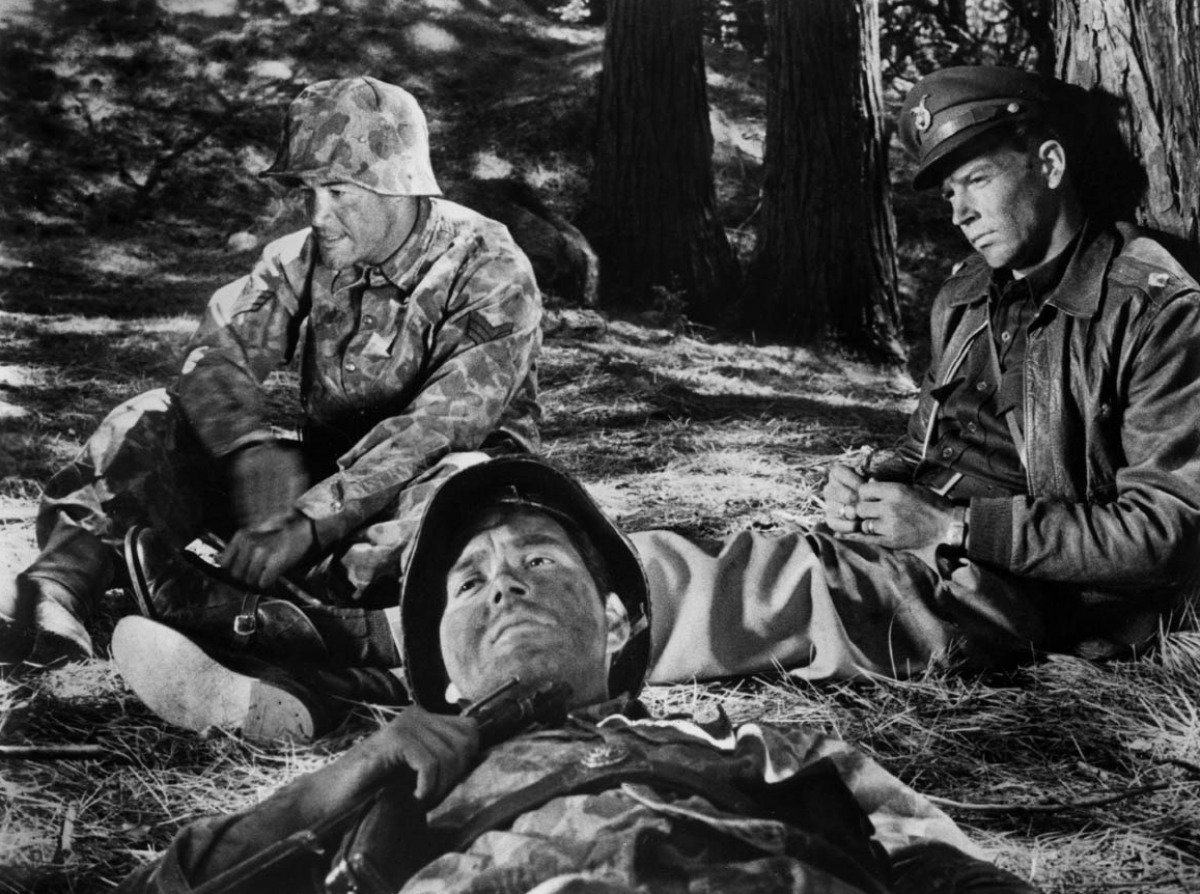

STANLEY KUBRICK: FEAR AND DESIRE / THE SEAFARERS

Stanley Kubrick’s first feature-length film, FEAR AND DESIRE, is screening at IFC retrospective with bonus treat

FEAR AND DESIRE (Stanley Kubrick, 1953) / THE SEAFARERS (Stanley Kubrick, 1953)
IFC Center
323 Sixth Ave. at West Third St.
Monday, January 30, 12:20 & 7:30
Series runs through February 2
212-924-7771
www.ifccenter.com

IFC Center is celebrating the January 27 theatrical release of Alex Infascelli’s documentary S Is for Stanley, about longtime Stanley Kubrick aide Emilio D’Alessandro, with a two-week festival that includes every one of the Bronx-born ex-pat’s feature works, nearly all of which are being projected in DCP, along with a pair in 35mm. Kubrick’s 1953 seldom-seen psychological war drama, Fear and Desire, will be shown on January 30, along with the auteur’s half-hour industrial short The Seafarers. His first full-length film, made when he was twenty-four, Fear and Desire is a curious tale about four soldiers (Steve Coit, Kenneth Harp, Paul Mazursky, and Frank Silvera) trapped six miles behind enemy lines. When they are spotted by a local woman (Virginia Leith), they decide to capture her and tie her up, but leaving Sidney (Mazursky) behind to keep an eye on her turns out to be a bad idea. Meanwhile, they discover a nearby house that has been occupied by the enemy and argue over whether to attack or retreat. Written by Howard Sackler, who was a high school classmate of Kubrick’s in the Bronx and would later win the Pulitzer Prize for The Great White Hope, and directed, edited, and photographed by the man who would go on to make such war epics as Paths of Glory, Full Metal Jacket, and Dr. Strangelove, or How I Learned to Stop Worrying and Love the Bomb, Fear and Desire features stilted dialogue, much of which is spoken off-camera and feels like it was dubbed in later. Many of the cuts are jumpy and much of the framing amateurish. Kubrick was ultimately disappointed with the film and wanted it pulled from circulation; instead it was preserved by Eastman House in 1989 and restored twenty years later, which is good news for film lovers, as it is fascinating to watch Kubrick learning as the film continues. His exploration of the psyche of the American soldier is the heart and soul of this compelling black-and-white war drama that is worth seeing for more than just historical reasons. “There is a war in this forest. Not a war that has been fought, nor one that will be, but any war,” narrator David Allen explains at the beginning of the film. “And the enemies who struggle here do not exist unless we call them into being. This forest then, and all that happens now, is outside history. Only the unchanging shapes of fear and doubt and death are from our world. These soldiers that you see keep our language and our time but have no other country but the mind.”
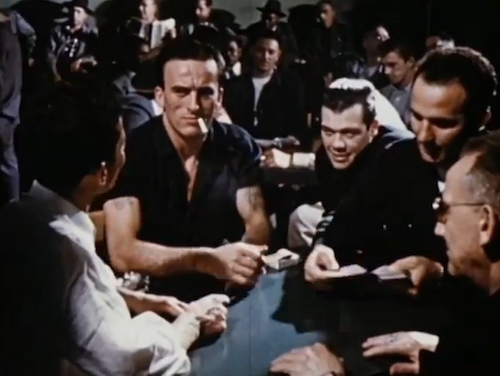
THE SEAFARERS

Stanley Kubrick cut his teeth making such promotional films as THE SEAFARERS

Fear and Desire lays the groundwork for much of what is to follow in Kubrick’s remarkable career; however, the same can’t be said for The Seafarers, a promotional short he directed and photographed in 1953 for the Seafarers International Union, aka the SIU, which is still in existence. “This is a story simple but dramatic, a story about the men who crew our ships, the seafarers,” television newsman Don Hollenbeck, who narrates the film, says in an onscreen preface. The straightforward script, written by Will Chasan, discusses how the union works, detailing responsibilities, benefits, job security, procedures, and more as Kubrick’s camera roams a hiring hall, a food station, various ports, a card game, the Seafarers Log printing press, and a barbershop with a nudie calendar, all set to a splendidly clichéd, lilting musical score. Kubrick also takes viewers inside an actual meeting, where secretary-treasurer Paul Hall gives a speech; Hall went on to become the SIU’s second president and in 1967 was honored with the naming of the Paul Hall Center for Maritime Training and Education in Maryland. Kubrick’s first color film, The Seafarers doesn’t lend a whole lot of insight into his methods, but it is a treat that will satisfy completists. Kubrick was also going to make The Halifax Story, about the 1949 Canadian Seamen’s Union strike, but that project never reached fruition. The IFC Center series continues through February 2 with all of Kubrick’s feature films in addition to Steven Spielberg’s A.I. Artificial Intelligence, based on a treatment by Kubrick. S Is for Stanley director Infascelli will be on hand for Q&As following screenings of his Italian documentary on Friday at 8:00 and Saturday at 7:15.

TELL HECTOR I MISS HIM

(photo by Ahron R. Foster)

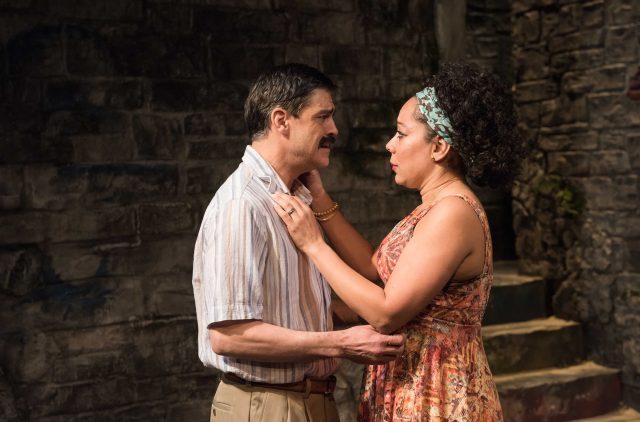
Relationship between Mostro (Juan Carlos Hernández) and Samira (Selenis Leyva) is tested in TELL HECTOR I MISS HIM (photo by Ahron R. Foster)

Atlantic Stage 2
330 West 16th St. between Eighth & Ninth Aves.
Tuesday – Sunday through February 19, $35-$60
atlantictheater.org

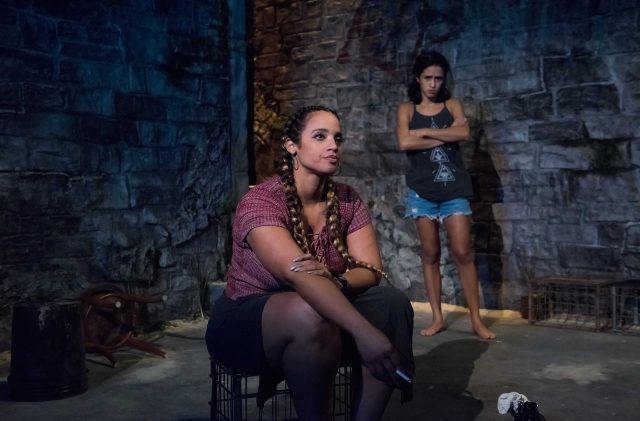
Paola Lázaro’s debut play, Tell Hector I Miss Him, comes alive with the rhythms of real life, moving to the energy of salsa music. Inspired by actual events, Lázaro, who was born and raised in San Juan and has degrees from Purchase and Columbia, explores love and hope, machismo and girl power in a tight-knit Puerto Rican slum centered around a bodega run by the highly principled and old-fashioned Mostro (Juan Carlos Hernández) and his wife, Samira (Orange Is the New Black’s Selenis Leyva). As the play opens, an offstage couple is going at it heavily, the woman calling the shots. “Fuck me like I’m a trash bag. Like I don’t mean nothing to you. Like you don’t like me,” she cries out. “But you do mean something to me and I do like you,” the man responds. “But I don’t want you to like me! So fuck me like you don’t like me,” she demands again. The play follows twelve people as they go about their days, hitting various highs and lows. Sixteen-year-old Isis (a dynamic, scene-stealing Yadira Guevara-Prip) declares her undying passion for twenty-six-year-old Malena (OITNB’s Dascha Polanco), who is not gay but does not mind the unexpected attention. The not-too-bright Palito (Sean Carvajal) sells drugs with his hardheaded brother, Jeison (Victor Almanzar), while devoting himself to Malena’s best friend, Tati (Analisa veleZ), who is just using him. The simple-minded Toño (Alexander Flores), whose Mami (Lisa Ramirez) is a junkie, has been thrown out of high school for making the moves on a teacher. And the deeply depressed Hugo (Flaco Navaja), whose wife has moved out, develops an unusual friendship with El Mago (Luis Vega), a hippie magician who lives on the streets. Meanwhile, a mysterious young white woman called La Gata (Talene Monahon) roams around like an alley cat, saying nothing except “Meow.”

(photo by Ahron R. Foster)

Malena (Dascha Polanco) is wooed by Isis (Yadira Guevara-Prip) in Paola Lázaro’s debut play (photo by Ahron R. Foster)

The play unfolds in a series of vignettes on Clint Ramos’s appropriately dank set, where the bodega is down the stairs of an old fort, between stone walls that form a kind of dungeon, trapping the residents of this community; above is a horizontal row of eight monitors showing the gentle waves lapping at the Puerto Rican shore, an effect that is both calming and representative of a bigger world outside that most of the characters might never get to know. Director David Mendizábal (Look Upon Our Lowliness, Locusts Have No King) pays heed to Lázaro’s stage directions in the script, which include such notes as “Fast as fuck” and “Fast, but not as fuck.” A protégée of Stephen Adly Guirgus’s, Lázaro, who is also an actress — she was nominated for a Drama Desk Award for Outstanding Featured Actress in a Play for Ramirez’s To the Bone in 2015 — leaves some of the dialogue in Spanish, without translation, but audiences will get the point; much of the English dialogue crackles. “That’s why I stopped shaving my ass. That shit itches,” Tati tells Malena. Commenting on Malena’s aroma, Isis says, “It smells like a walk through the most beautiful botanical garden in the most exotic place in the world. It smells like the whole world, all the races, united to create a floral scent and not because they were forced to by a government, but because they wanted to. The races wanted to unite and create the scent of the world.” At 140 minutes with an intermission, the play is probably about twenty minutes too long; a few scenes could use some trimming, and the ending could come sooner, but Lázaro thankfully never provides any easy answers while avoiding genre clichés, and the ensemble is solid throughout. Tell Hector I Miss Him, which has been extended at the Atlantic’s Stage 2 through February 19, introduces a vibrant, exciting new voice to New York theater.

GLOBAL WARNING — NATURE IS A MOTHER: SNOWPIERCER

SNOWPIERCER

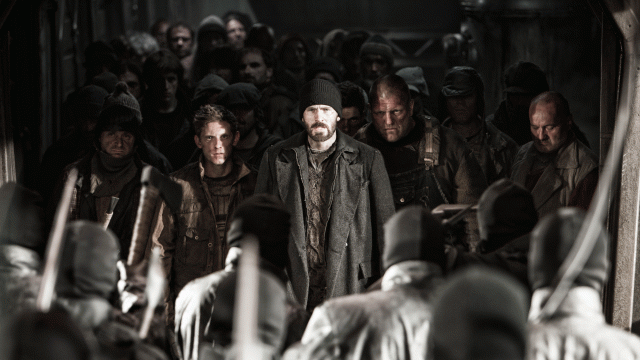
Curtis (Chris Evans) leads a revolt in Bong Joon-ho’s futuristic thriller, SNOWPIERCER

WAVERLY MIDNIGHTS: SNOWPIERCER (Bong Joon-ho, 2014)
IFC Center
323 Sixth Ave. at West Third St.
Friday, January 27, 12:25 am, and Saturday, January 28, 12:05 am
Series runs Friday and Saturday nights through April 1
212-924-7771
www.ifccenter.com
www.snowpiercer-film.com

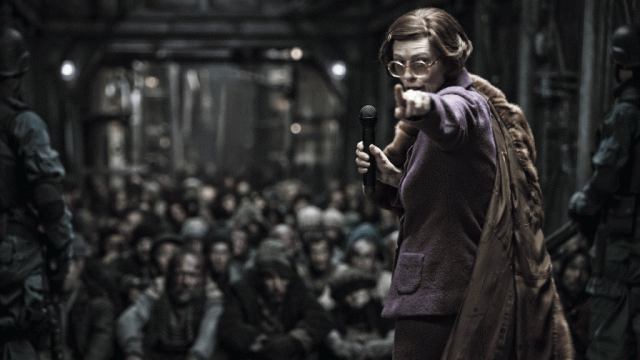
Korean director Bong Joon-ho, who had a huge international hit in 2006 with The Host and a major critical success with 2009’s Mother, made his English-language feature debut with Snowpiercer, a nonstop postapocalyptic thrill ride that takes its place with such other memorable train films as The Great Train Robbery, From Russia with Love, The Train, and Murder on the Orient Express. It’s 2031, seventeen years after the chemical C7, which was supposed to end climate change, instead froze the earth, killing all living beings except for a group of survivors on board a train run by a perpetual motion machine. In the rear of the train, men, women, and children are treated like prisoners, beaten, tortured, dressed in rags, their only food mysterious gelatin blocks. Soldiers led by the cold-hearted Mason (Tilda Swinton) and the yellow-clad Claude (Emma Levie), whose outift brings virtually the only color to this dark, dank, deeply depressing setting, violently keep the peace as the two women heartlessly dictate orders and abscond with the children. But Curtis Everett (Chris Evans) and Edgar (Jamie Bell) hatch a plan to get past the guards and make their way to the front of the train in order to find out just what is really going on and to meet with Wilford, the wealthy entrepreneur running the engine. With the help of defiant mother Tanya (Octavia Spencer), elder statesman Gilliam (John Hurt), train engineer Namgoong Minsu (Bong regular Song Kang-ho), and Namgoong’s daughter, Yona (Go Ah-sung), Curtis attempts to lead a small revolution that is seemingly doomed to failure.
SNOWPIERCER

Mason (Tilda Swinton) has something to say about potential revolution on board train to nowhere

Inspired by the French graphic novel Le Transperceneige by Jean-Marc Rochette and Benjamin Legrand (who both make cameos in the film), Snowpiercer is a tense, gripping thriller that unfolds as a microcosm of contemporary society, intelligently taking on race, class, poverty, drug addiction, education, and corporate greed and power. Evans (Captain America, Push) is almost unrecognizable as Everett, a flawed hero trying to make things right, followed every step of the way by cold-blooded killer Franco the Elder (Romanian star Vlad Ivanov of Police, Adjective and 4 Months, 3 Weeks and 2 Days). The film features splendid production design by Ondrej Nekvasil; each train car offers a completely different look and feel as Curtis heads toward the front, leading to a finale that is everything the conclusion to the Matrix trilogy wanted to be. Bong (Memories of Murder), who cowrote the film with Kelly Masterson (Before the Devil Knows You’re Dead), doesn’t shy away from violence in telling this complex story – of course, it doesn’t hurt that one of the producers is Korean master Park Chan-woo (the Vengeance trilogy, Thirst), who had just made his first English-language film as well, 2013’s Stoker. A fantastically claustrophobic chase film, Snowpiercer is screening January 27 and 28 in the IFC Center Waverly Midnights series “Global Warning: Nature Is a Mother,” consisting of films in which weather plays a key role; the series continues weekends through April 1 with such other climate-related works as Douglas Trumbull’s Silent Running, George Miller’s four Mad Max flicks, Ron Underwood’s Tremors, and Alfred Hitchcock’s The Birds.

THE PRESENT

(photo © Joan Marcus)

Anna (Cate Blanchett) makes an explosive point at fortieth birthday party (photo © Joan Marcus)

Barrymore Theatre
243 West 47th St. between Broadway & Eighth Ave.
Tuesday – Sunday (and some Mondays) through March 19, $59 – $159
thepresentbroadway.com

The Present brings us quite a gift, the Broadway debut of Oscar-winning actress Cate Blanchett, who is absolutely captivating in an uneven black comedy that can go from penetrating to tiresome in the blink of an eye. “An eclectic mix,” Yegor (David Downer) says about the guests at Anna’s (Blanchett) explosive fortieth birthday party, but he also could be speaking about the play itself. Adapted for the Sydney Theatre Company by Andrew Upton from Anton Chekhov’s first major play, sometimes known as Platonov, which remained unperformed in Chekhov’s lifetime, The Present is a three-hour look at lust, the aging aristocracy, personal and professional failure, and fear of death. Upton, who is married to Blanchett, transports the story to 1990s Russia, where the Clash and Joy Division dominate the soundtrack. Anna is considering remarrying following the death of her beloved husband, a much older man called the General, at least in part to maintain control of her late husband’s vast holdings. Among those interested in Anna, either as a bride, a one-night stand, or a business partner are Nikolai (Toby Schmitz), a doctor and Anna’s stepbrother, who has brought hot young student Maria (Anna Bamford) as his date; the practical Yegor, an older businessman who has come with his bland son, Dimitri (Brandon McClelland); Kirill (Eamon Farren), a snarky DJ who is the son of retired lawyer Alexi (Martin Jacobs); and Mikhail Platonov (Richard Roxburgh), the General’s best friend who is married to Sasha (Susan Prior), the daughter of retired colonel Ivan (Marshall Napier) and the sister of Nikolai. Also at the party are Sergei (Chris Ryan), Anna’s stepson, who is married to Sophia (Jacqueline McKenzie), and former KGB operative Osip (Andrew Buchanan). “Birthdays are always lively. Balancing the past and the present is tricky at the best of times,” Yegor pronounces. “But that’s Russia these days, isn’t it, Alexi?” Alexi responds, “Russia? I couldn’t tell you.” Anna holds court as her guests drink heavily, argue over politics and socioeconomic conditions, and flirt with one another, risking their friendships, marriages, and reputations in one misguided night of debauchery. “It’s so hard to do what you really, really desperately want in life,” Anna says. “It’s so much easier to do shit you don’t care either way about.”

(photo © Joan Marcus)

Mikhail (Richard Roxburgh) and Anna (Cate Blanchett) wonder what might have been in Sydney Theatre Company’s THE PRESENT on Broadway (photo © Joan Marcus)

Chekhov’s play has previously been adapted by the likes of Michael Frayn, Lev Dodin, Trevor Griffiths, and David Hare, with such actors as Rex Harrison, James McArdle, and Stephen Rea playing Mikhail Platonov. Roxburgh (Rake, Hacksaw Ridge), who has been performing with Blanchett for more than twenty years — the duo has played Trigorin and Nina in The Seagull, Vanya and Yelena in Uncle Vanya, and Hamlet and Ophelia in Hamlet — is dynamic when he and Blanchett are together onstage, but it’s difficult to understand why all the other women are so enamored of him. Upton (The Maids, The Cherry Orchard) has made Mikhail, a disgruntled, disappointed schoolteacher who wanted to be a famous writer, and Anna much older than in Chekhov’s original, which works well for the parts of the play dealing with aging and death but leaves much to be desired regarding sexual chemistry and several far-fetched plot twists. The smoke-filled scene in which various women state their love for Mikhail is quite a sight but doesn’t make narrative sense. And while some elements of the anarchic narrative are exciting, particularly those involving Anna’s revolutionary spirit, the table-dancing scene is a bit ludicrous. The play is sort of Chekhov light, with aspects of Don Juan and A Midsummer Night’s Sex Comedy tossed in. Director John Crowley (Brooklyn, A Behanding in Spokane) can’t gain control of the overall chaos, although many individual scenes crackle and, figuratively and literally, explode. Over the course of the too-long three-hour show, you can’t take your eyes off two-time Oscar winner Blanchett (Blue Jasmine, Hedda Gabler), who wears three awesome outfits by Alice Babidge, who also designed the sets; even when Blanchett is in the background, her every movement is mesmerizing, lit beautifully by Nick Schlieper. When she is offstage, the play suffers, but when she is front and center, armed and dangerous, downing drinks, trying to nail down her future, The Present is a rather fine offering.

BROADWAYCON 2017

(photo by Chad Batka)

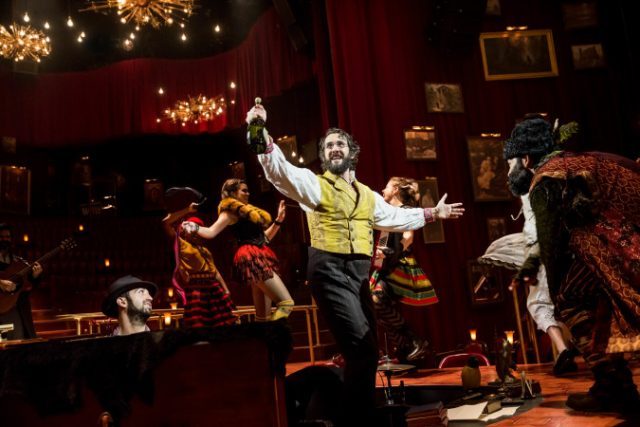
Josh Groban and other members of the creative team of NATASHA, PIERRE AND THE GREAT COMET OF 1812 will be at second annual BroadwayCon on July 27 (photo by Chad Batka)

Jacob K. Javits Convention Center
655 West 34th St. (11th Ave. between 34th & 39th Sts.)
January 27-29, $250 General Pass, $65-$95 Day Pass
www.broadwaycon.com
www.javitscenter.com

BroadwayCon takes a major step up in its second year, moving from the New York Hilton to the Javits Center this weekend. The founders and presenters, which include Melissa Anelli, Anthony Rapp, Playbill, and Mischief Management, are discussing performance and payment details with Actors’ Equity, but whatever they decide, there is still an impressive roster of events. Gold passes ($600) are sold out, but you can still get a General Pass ($250) or single-day tickets ($65-$95) to see cast and crew members and/or participate in fan meetups for such shows as Annie, Kinky Boots, Wicked, In Transit, Hamilton, Les Misérables, Ragtime, Natasha, Pierre and the Great Comet of 1812, and many others in addition to autograph and/or photobooth sessions with Kelli O’Hara, Rebecca Luker and Danny Burstein, Michael Cerveris and Judy Kuhn, Carolee Carmello, Jane Houdyshell and Reed Birney, Chita Rivera, Jeremy Jordan, Donna Murphy, Alison Fraser, Mary Testa, and Chip Zien, Rapp, and many more. Below are only some of the highlights.

Friday, January 27
The Art of Perseverance with Melissa Errico, Programming Room A, 11:00 am

Cabaret and the Next Generation of Artists, with Shoshana Feinstein, Joe Iconis, Jay Armstrong Johnson, Julia Mattison, and Benjamin Rauhala, moderated by Jennifer Ashley Tepper, Programming Room E, 2:00

Women in the World of Sondheim, with Katie Welsh, Emily Whitaker, and Stacy Wolf, Programming Room A, 2:30

Chandeliers and Caviar: Natasha, Pierre and the Great Comet of 1812, with Brittain Ashford, Gelsey Bell, Nicholas Belton, Denée Benton, Nick Choksi, Amber Gray, Josh Groban, Dave Malloy, Grace McLean, Michael Paulson, Paul Pinto, and Lucas Steele, MainStage, 5:00

Annie Forty-Year Reunion, with Jennifer Ashley Tepper, Steve Boockvor, Shelley Bruce, Martin Charnin, Mary Jane Houdina, Andrea McArdle, Thomas Meehan, and Charles Strouse, MainStage, 8:00 PM

Saturday, January 28
Everybody Say Yeah: Three Years at Kinky Boots, with Killian Donnelly, Todrick Hall, Julie James, Taylor Louderman, and Jerry Mitchell, MainStage, 11:00 am

Madam Secretary Panel, with Sebastian Arcelus, Erich Bergen, Keith Carradine, Tim Daly, Željko Ivanek, Patina Miller, and Bebe Neuwirth, moderated by Anthony Rapp, MainStage, 1:00

William Ivey Long: A Lifetime in Theatre, Programming Room C, 3:00

Shaina Taub Performance, Marketplace Stage, 3:30

Joel Grey Q&A, MainStage, 4:00

Sunday, January 29
Born to Boogie: Broadway’s Choreographers, with Lorin Latarro and Spencer Liff, Programming Room C, 10:00 am

Raising Broadway Babies: Working Moms on Broadway, with Carmen Ruby Floyd, Blair Goldberg, and Erin Quill, moderated by Vasthy Mompoint, Programming Room C, 11:00 am

This Is A Bronx Tale Panel, with Richard H. Blake, Nick Cordero, Ariana DeBose, Chazz Palminteri, Glenn Slater, and Bobby Conte Thornton, MainStage, 12 noon

Judy Kuhn Q&A, with Judy Kuhn and moderator Ilana Levine, Marketplace Stage, 5:00

Geek Out — Freak Out: Our Favorite Songs, with Andrew Keenan-Bolger and Leigh Silverman, moderated by Mark Blankenship, Programming Room D, 5:00

VINCE GIORDANO: THERE’S A FUTURE IN THE PAST

Vince Giordano

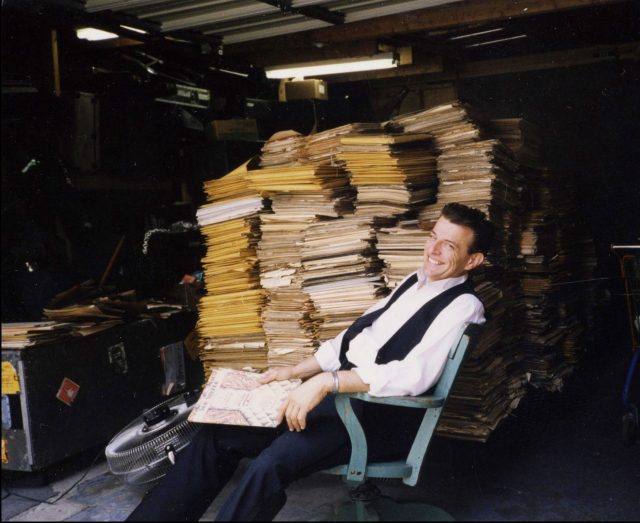
Vince Giordano shows off his remarkable collection of Jazz Age arrangements in THERE’S A FUTURE IN THE PAST

VINCE GIORDANO: THERE’S A FUTURE IN THE PAST (Dave Davidson & Amber Edwards, 2016)
Cinema Village
22 East 12th St. between University Pl. & Fifth Ave.
Through Thursday, January 26
212-529-6799
www.cinemavillage.com
www.firstrunfeatures.com

Vince Giordano has an infectious glee throughout most of Vince Giordano: There’s a Future in the Past, a lively documentary that celebrates his dedication and passion for keeping the music of the 1920s and 1930s alive. “He’s totally consumed by his mission,” one member of his band, the Nighthawks, explains. “He’s meant to be a bandleader,” another one says. Director-producers Dave Davidson and Amber Edwards follow the youthful Giordano, who will turn sixty-five in March, as the band plays at the Newport Jazz Festival, with Garrison Keillor on A Prairie Home Companion, at Sofia’s in the Edison Hotel, at Lincoln Center’s Midsummer Night’s Swing, and at the New York Hot Jazz Festival at the Players club as well as recording a tune in the studio with David Johansen for Boardwalk Empire. The Grammy-winning Giordano and the Nighthawks have performed music for nearly two dozen films, including several by Woody Allen. But leading a Jazz Age band in the modern era is no easy task; Giordano, who plays the tuba, the string bass, and the bass saxophone and handles the vocals, has no roadies and no agent, so he and partner Carol Hughes are seen lugging equipment around, scrambling for gigs, and getting the orchestrations just right, testing Giordano’s gleeful onstage demeanor. “When I first met him, I thought he was very unusual and a nice person, but I didn’t think he was exceptional and crazy like he is,” Hughes says. The Brooklyn-born Giordano is also a music historian and archivist, having collected some sixty thousand arrangements, with twenty-five hundred brought to any single show, making for a wide range of setlists. Among those singing Giordano’s praises are many members of the eleven-piece Nighthawks, some of them who have been part of the band since the 1970s; sharing fun stories are reed players Mark Lopeman and Dan Levinson, trumpeters Jon-Erik Kellso and Mike Ponella, violinist Andy Stein, pianist Peter Yarin, trombonist Jim Fryer, and guitarist Ken Salvo.

The heart of the film is watching the remarkable band play such songs as “Stampede,” “Shake That Thing,” “The Moon and You,” and a glorious “Rhapsody in Blue” at Town Hall, by such legendary composers and bandleaders as George Gershwin, Fletcher Henderson, Paul Whiteman, Bix Beiderbecke, and Duke Ellington. One of the most poignant parts occurs when Sofia’s, where Vince Giordano and the Nighthawks played every Monday and Tuesday night for five years, closes, so Giordano must find a new home, which he does, at Iguana NYC. (You can also catch them at the “Highlights in Jazz” forty-fourth annual gala on February 9 at BMCC’s Tribeca Performing Arts Center with Ms. Vinnie Knight and Cynthia Sayer & Her Joyride Band.) Vince Giordano: There’s a Future in the Past is a poignant tale of a New York City treasure whose obsession brings great joy to the rest of us.