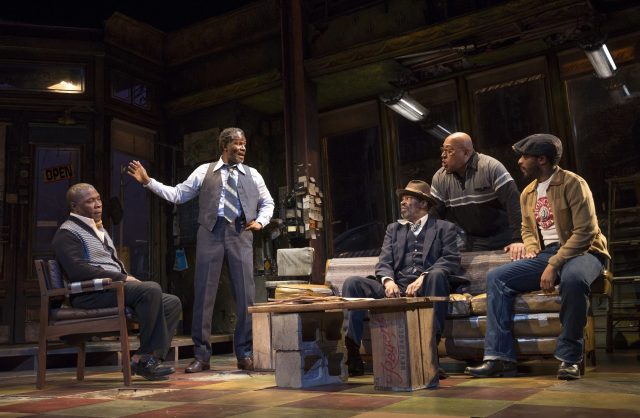
August Wilson’s dazzling JITNEY finally makes its long-awaited Broadway debut (photo © 2017 Joan Marcus)
Manhattan Theatre Club at the Samuel J. Friedman Theatre
261 West 47th St. between Broadway & Eighth Aves.
Tuesday – Sunday through March 12, $79-$169
jitneybroadway.com
www.manhattantheatreclub.com
August Wilson’s Jitney, the first play he wrote in the American Century Cycle, also known as the Pittsburgh Cycle, is the last of the ten plays to reach Broadway, and all one can ask is, What took so long? Jitney is another masterpiece from the Pittsburgh-born playwright, whose cycle comprises ten plays, each set in a different decade of the twentieth century, capturing the black experience in America over one hundred years with grace, honesty, dignity, humor, and a soul-searching reality. Coincidentally, the film version of Wilson’s second play to hit Broadway, the Tony- and Pulitzer Prize-winning Fences, was released in December; the first movie based on a Wilson play, Fences garnered Oscar nominations for Best Picture, Best Actor (director Denzel Washington), Best Supporting Actress (Viola Davis), and Best Adapted Screenplay (Wilson). A Manhattan Theatre Club production at the Samuel J. Friedman Theatre, Jitney takes place in a ramshackle car service office in 1977 in Pittsburgh’s Hill District, where taxis won’t go. The gypsy cab company is run by the soft-spoken, straightforward Becker (John Douglas Thompson). His motley group of drivers consists of Turnbo (Michael Potts), a confrontational gossip who can’t stay out of other people’s business; YoungBlood (André Holland), an angry Vietnam vet trying to provide for his wife, Rena (Carra Patterson), and baby; Fielding (Anthony Chisholm), an aging, stumbling alcoholic who’s been separated from his wife for twenty-two years; and the practical, sensible Doub (Keith Randolph Smith), who is a kind of den father, keeping the peace while spouting such sage phrases as “Time go along and it come around.” Stopping by often is the sharply attired Shealy (Harvy Blanks), who takes phone calls at the station for his numbers racket, and Philmore (Ray Anthony Thomas), a regular customer who drinks himself into oblivion and then needs a ride home. Tensions rise when Becker eventually lets everyone know that the city will be tearing down the building soon, leaving them all jobless, and Becker’s son, Booster (Brandon J. Dirden), arrives after spending twenty years in prison, desperate to reestablish a relationship with his estranged father.
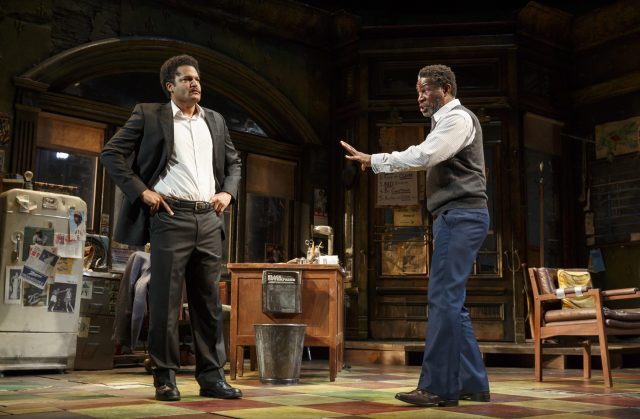
Son Booster (Brandon J. Dirden) and father Becker (John Douglas Thompson) face each other after twenty years in JITNEY (photo © 2017 Joan Marcus)
The Olivier Award-winning Jitney is a glorious play, a spectacular blending of poetic, incisive dialogue, powerful, soaring performances, and intimate, seamless staging by director Ruben Santiago-Hudson, who won a Tony for his role in Wilson’s Seven Guitars, later directed that work as well as the recent Signature revival of the Pulitzer Prize-winning The Piano Lesson (starring Dirden), and was Wilson’s personal choice to portray him in the playwright’s autobiographical one-man show, How I Learned What I Learned. As with virtually every Wilson play, the cast is exceptional, bringing the beautifully developed characters to life in ways that make them feel like they’re your friends or acquaintances. Most of the actors have appeared in previous Wilson shows, including Thomas, who played Becker in Jitney at the Cincinnati Playhouse, and Chisholm, who has been playing Fielding since 1996 and once toured the Hill District with Wilson, who died in 2005 at the age of sixty. So every Wilson show has a welcoming family aspect surrounding it, and Jitney is no exception. When the play ended, I felt a tinge of sadness, wanting to spend more time with every one of these characters. The appropriately musty, messy set, by Tony-winning designer David Gallo (Wilson’s King Headley III, Gem of the Ocean, Radio Golf, 2000 production of Jitney at Second Stage), features ratty chairs and couches, newspaper clippings of Pittsburgh sports teams, an old pot-bellied stove, and large windows across the back of the stage that tantalizingly reveal who’s coming into the station next. Originally written in 1979 and rewritten in 1996, Jitney is very much about taking control of one’s life and being part of something bigger, regardless of the odds. At one point, Doub questions why Becker took so long to tell him about the station being torn down. “That ain’t what I mean, Becker,” Doub says. “It’s like you just a shadow of yourself. The station done gone downhill. Some people overcharge. Some people don’t haul. Fielding stay drunk. I just watch you and you don’t do nothing.” “What’s to be done?” Becker responds, adding “I just do the best I can do,” to which Doub boldly replies, “Sometime your best ain’t enough.” Like the rest of the dialogue, those words hit hard, resonating loud and clear in this stunning triumph.
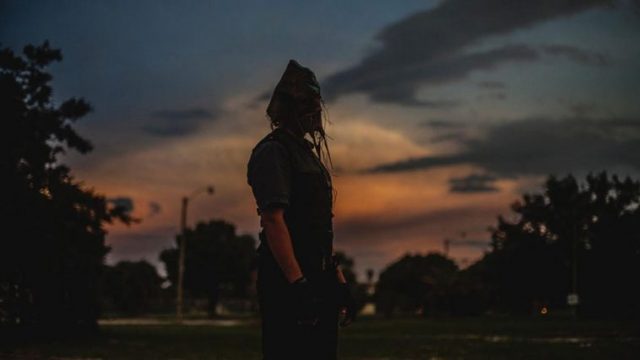
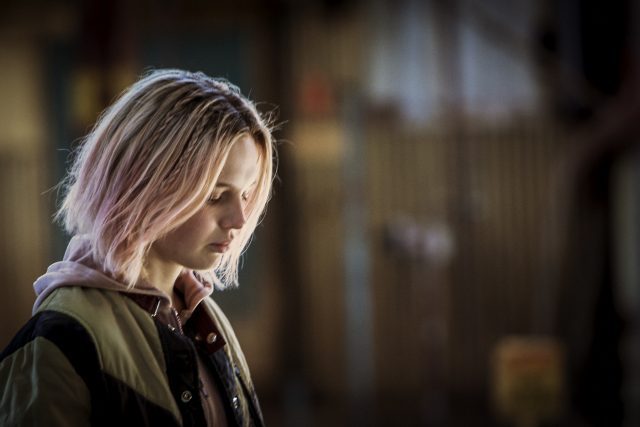
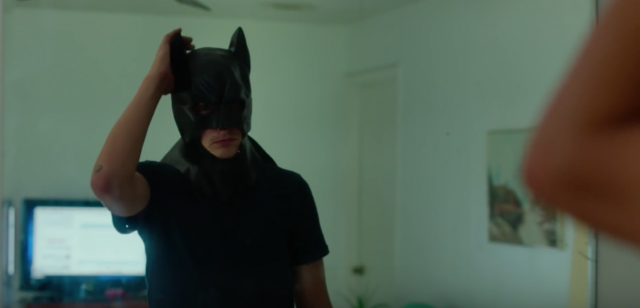
 There’s an ominous cloud hanging over Tim Sutton’s deeply poetic Dark Night, a grim, gripping journey into the dark night of America’s soul. The title of Sutton’s third film, following Pavilion and Memphis, also references Christopher Nolan’s 2012 Batman movie, The Dark Knight Rises, for reasons that become apparent about halfway through. Dark Night opens with a close-up of a young woman’s disbelieving eyes, red, white, and blue lights flashing across her face; the camera then pulls back as the woman, wearing an American flag top, lowers her head, taking stock of an unrevealed tragedy. For the next eighty-five minutes, Sutton goes back to the beginning of this fateful day, following the lives of a small group of men, women, and children in a suburban Florida community as they go about their usual business. They play on computers, put on makeup, pet animals, and head over to the mall. One concerned mother and her detached son speak with an off-screen interviewer as if searching for reasons in the aftermath of a horrific event, but in this case it hasn’t happened yet. In many of the vignettes, there is little or no dialogue, as the characters, all nonprofessional actors mostly found on the streets of Sarasota, speak with their actions, particularly when several of the males, including a military vet and a teen with dazzling blue eyes, load firearms. In this Blue Velvet-like town, danger lurks just below the surface.


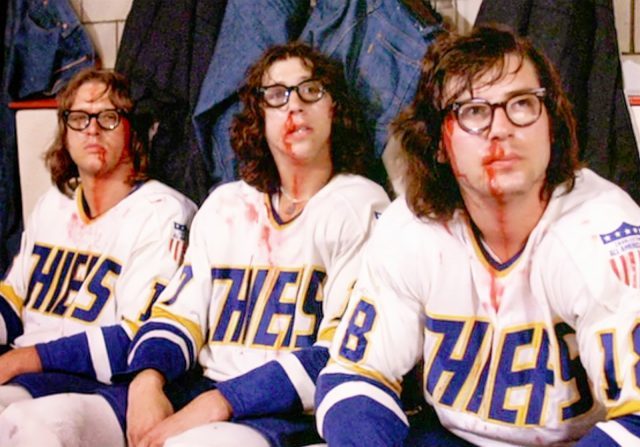
 One of the best sports films ever made, Slap Shot is a riotously bloody look at minor-league hockey. Paul Newman — who declared this one of his favorite pictures — stars as Reggie Dunlop, an aging loser serving as player-coach of the Charlestown Chiefs and trying to keep his marriage going with Francine (Jennifer Warren). When the general manager (Strother Martin) tells him that the team is being shut down at the end of the season, Dunlop decides to send it off with a bang. Lying to his team that if the Chiefs fill the seats and start winning they will move to Florida, he incorporates a different style of play into their game, led by the brutal, vicious, and utterly hilarious Hanson brothers (real-life brothers Jeff and Steve Carlson and their Johnstown Jets teammate Dave Hanson), who never met an opponent they wouldn’t punch, trip, slash, spear, or slam face-first into the boards well after the whistle. Even Dunlop gets in on the fun, throwing his share of right hands. The only player not participating in the hijinks is Ned Braden (Michael Ontkean), who believes in sportsmanship and a more gentlemanly game of skill and beauty, not exactly what men like Ogie Oglethorpe (minor-league player Ned Dowd, whose sister, Nancy, wrote the book that the movie is based on, inspired by the real-life antics of the Johnstown Jets) and Tim “Dr. Hook” McCracken (Paul D’Amato) have in mind. You don’t have to be a hockey fan to love Slap Shot, which is really, when it comes right down to it, just a little film about the trials and tribulations of everyday life. Look for cameos by Paul Dooley, M. Emmett Walsh, Melinda Dillon, Nancy Dowd as Andrea, and actual hockey players Bruce Boudreau, Jean Tétreault, Connie Madigan, Cliff Thompson, and Joe Nolan, among others. Slap Shot is screening February 3 in the Metrograph series “Universal in the 70’s: Part One,” a tribute to the decade when the studio took advantage of the growing independent-cinema movement; the two-week, eighteen-film festival continues through February 7 with such other gems as Clint Eastwood’s awesome High Plains Drifter, Alfred Hitchcock’s Family Plot, Jeremy Kagan’s The Big Fix, and Don Siegel’s underseen Charley Varrick.
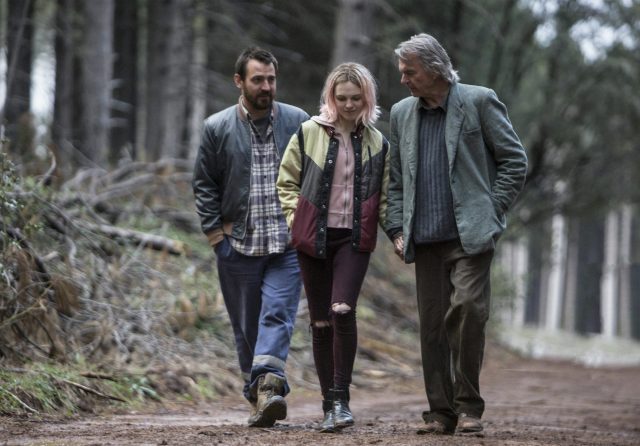
 The Daughter is a taut Australian melodrama from actor, director, and writer Simon Stone, his feature directorial debut, inspired by his 2014 stage adaptation of Henrik Ibsen’s The Wild Duck for Sydney’s Belvoir St Theatre company. The film builds slowly, teasing out the tension, until it gets so wrapped up in itself that the stream of revelations unfolding near the end feels overwrought and anticlimactic, as viewers will have figured out many of the twists much earlier. Still, it’s a compelling tale, well acted by a solid cast, although one overblown character nearly brings it all tumbling down. Ne’er-do-well prodigal son Christian (Paul Schneider) has returned home for the first time in fifteen years, for the wedding of his father, Henry (Geoffrey Rush), to his much younger housekeeper, Anna (Anna Torv). The wealthy local mill owner in a rural New South Wales town, Henry has just announced that his factory is closing. Christian, an alcoholic who is having problems with his girlfriend, Grace (Ivy Mak), and has never gotten over his mother’s death, reconnects with his childhood friend, Oliver (Ewen Leslie), a millworker who is married to Charlotte (Miranda Otto); they have a lovely daughter, teenager Hedvig (Odessa Young), a smart girl who is very close to her grandfather, Walter (Sam Neill), who takes care of a forest on his property as well as a home-made sanctuary for injured animals. Long-held secrets begin to emerge, spinning both families into severe crises as the past refuses to stay hidden.