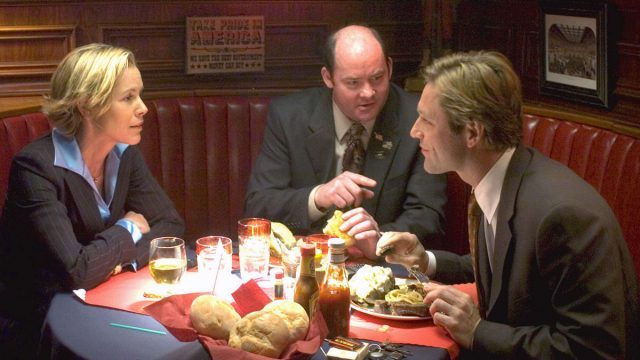
Linda Bassett, Deborah Findlay, Kika Markham, and June Watson star in Caryl Churchill’s ESCAPED ALONE (photo by Richard Termine)
BAM Harvey
651 Fulton St.
February 15-26, $30-$90
718-636-4100
www.bam.org
Award-winning British playwright Caryl Churchill artfully reproduces the random textures and intricate rise and fall, and the complicated rhythms of our banal daily conversations in the glorious Escaped Alone, which continues at BAM through February 26. But under those chats, lurking in the interstices and bubbling just underneath the surface, are horrors that are exposed in dystopian apocalyptic interludes. Churchill masterfully captures the zeitgeist of life in the twenty-first century through the gossiping of a quartet of women just passing the time. Mrs. Jarrett (Linda Bassett) is walking along the street when she hears three acquaintances chattering away behind a fence. She steps through a gate to join Sally (Deborah Findlay), Lena (Kika Markham), and Vi (June Watson) in Vi’s grassy and sunny suburban backyard where, over the course of an hour, the women discuss children, television programs, cooking, jokes, and how things change as they get older. “It all goes by,” Sally says wistfully early on. Every so often Mrs. J steps out of the scene as red neon lights flash around the proscenium (evoking the special lighting effects employed in Churchill’s recent Love and Information) and proceeds to deliver deadly funny details of various devastating global catastrophes, including floods, mass hunger, and killer viruses, as if she is a lone witness. She then returns to her chair like nothing happened. Meanwhile, Sally, Lena, and Vi each give a personal monologue of their own, the lights dimming on the other three and zeroing in on the speaker as one by one the women share their inner fears in a matter-of-fact manner.

Mrs. Jarrett (Linda Bassett) discusses global calamities in ESCAPED ALONE at BAM (photo by Richard Termine)
The play takes its name from a quote from the Book of Jonah that was also used by Herman Melville in Moby-Dick: “I only am escaped alone to tell thee.” Sally, who has a cat problem, Lena, who wants to be invisible, and Vi, who had a rather unfortunate incident with her husband, might still be trying to escape while Mrs. J faces it in her own way, ending her first monologue by saying, “Survivors were now solitary and went insane at different rates.” The characters regularly fly off on tangents, speaking in partial sentences that combine to form a kind of fluid, abstract stream-of-consciousness poetry that is absolutely lovely to listen to. Peter Mumford’s lighting is virtually a character in itself, making the most of Miriam Buether’s bright, charming set, which recalls the famous Robert Frost quote “Good fences make good neighbors.” (The fence also evokes Donald Trump’s wall, except this one offers free entry and exit.) The four women, who were all in the original Royal Court Theatre production, are extraordinary, their words ricocheting off one another like a championship doubles match at Wimbledon. Longtime Churchill collaborator James Macdonald (Cloud Nine, A Number) oversees it all with a deft hand, keeping every little bit utterly captivating. Now seventy-eight, multiple Obie winner Churchill (Top Girls, Serious Money) has written yet another stunning work, cutting into the contemporary mind like a surgeon, exposing the mystifying stories we tell ourselves to get through our days.

 At the beginning of Miles Joris-Peyrafitte’s compelling feature debut, As You Are, two figures disappear into the woods, and a gunshot is heard. The rest of the film goes back and forth between the videotaped interrogation of the main characters and the events leading up to the shooting, told from multiple points of view. Carefully trying to avoid coming-of-age genre clichés, As You Are is an astute, expertly told story about teen angst by the twenty-three-year-old Joris-Peyrafitte, who cowrote the film with Madison Harrison and composed the score with Patrick Higgins. It’s 1993-94, and Jack (Owen Campbell) is a loner, a friendless high school skateboarder who listens to music (GG Allin, the Melvins, Nirvana) in his room, takes long, solitary bus rides, and lives with his single mother, Karen (Mary Stuart Masterson), in an isolated house in upstate New York. Karen is dating Tom (Scott Cohen), whose own loner son, Mark (Charlie Heaton), hits it off immediately with Jack. They are soon joined by fellow high school outcast Sarah (Amandla Stenberg), as flashbacks show the trio dealing with bullying, drugs, first love, physical abuse, firearms, and sexual identity while Detective Erickson (John Scurti) continues his questioning and the narrative heads toward an ambiguous conclusion.




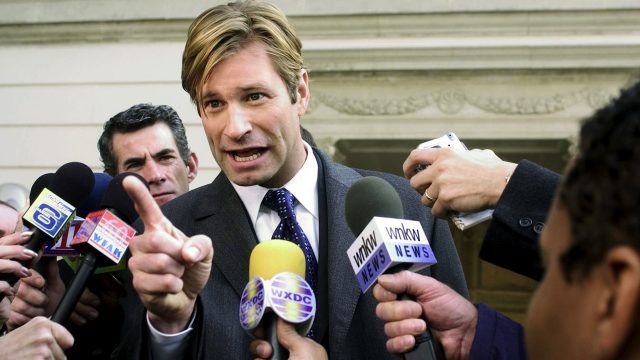
 Jason Reitman, the son of producer-director Ivan Reitman (Stripes, Ghostbusters, Dave), made his sparkling feature-film debut with the brilliant Thank You for Smoking, a devilishly delightful black comedy based on the novel by acerbic wit Christopher Buckley. Aaron Eckhart gives a riotous performance as Nick Naylor, a fast-talking, handsome, smarmy lobbyist for the Academy of Tobacco Studies, a Big Tobacco laboratory that, remarkably, cannot find a link between cigarettes and health risks. A master of spin, Naylor seems to even believe himself when he tells a young boy dying of cancer that he’s better off smoking. As a grandstanding senator (William H. Macy) plans congressional hearings on the evils of tobacco — especially on teenagers — Naylor is being groomed as the industry’s savior by his high-strung boss (J. K. Simmons) and the Captain (Robert Duvall) while trying to establish a meaningful relationship with his son (Cameron Bright). The fine ensemble also features Katie Holmes as a hot young reporter who’ll go to virtually any length to get a story; Sam Elliott as the Marlboro Man, who is dying of lung cancer; Rob Lowe as a Zen-like Hollywood agent who is considering Naylor’s idea of making cigarette smoking cool in the movies again; and Dennis Miller and Joan Lunden as themselves, adding a bit of reality to the hysterical situation, which might not be as far off from the truth as we might think, especially with President Donald Trump recently promising to enact a ban preventing administration members from becoming lobbyists for five years after they leave government service.