twi-ny recommended events

PHILIP GLASS AT 80

Philip Glass continues his eightieth birthday celebration with a series of special events in New York City

Philip Glass continues his eightieth birthday celebration with a series of special events in New York City

PHILIP GLASS 80th BIRTHDAY CONCERT SEASON
Multiple venues
February- April
philipglass.com

Composer and pianist extraordinaire Philip Glass, master of “music with repetitive structures,” turned eighty on January 31, and he is celebrating the milestone with a series of special performances in his longtime hometown of New York City. At National Sawdust in Brooklyn, “Philip @ 80” will feature the Complete Piano Etudes by Maki Namekawa on February 24 ($35-$40, 7:00); Bridging the Gap III, consisting of works by Paola Prestini, John Zorn, and Glass performed by cellist Jeffrey Zeigler, bassist Trevor Dunn, percussionist Ches Smith, and Yale School of Music students on March 5 ($29-$34, 7:00), with panel discussions moderated by Steve Smith; and Glass teaming up with Foday Musa Suso and Ziegler on March 12 ($50-$60, 7:00). On March 16 at Carnegie Hall ($35-$200), artistic director Glass will be the focus at the thirtieth annual Tibet House U.S. Benefit Concert, with performances by Laurie Anderson, Ben Harper, Iggy Pop, Alabama Shakes, Sufjan Stevens, Patti Smith and Her Band, the Scorchio Quartet, Tenzin Choegyal and Jesse Paris Smith, and New Order’s Bernard Sumner, Tom Chapman, and Phil Cunningham. And on April 20, the Tribeca Film Festival will host a screening of Jean Cocteau’s La Belle et la Bête with Glass’s live score performed by the Philip Glass Ensemble. In addition, Glass has been selected to hold the Richard and Barbara Debs Composer’s Chair at Carnegie Hall for the 2017–18 season, which will feature many classics and premieres.

A MAN OF GOOD HOPE

(photo by Rebecca Greenfield)

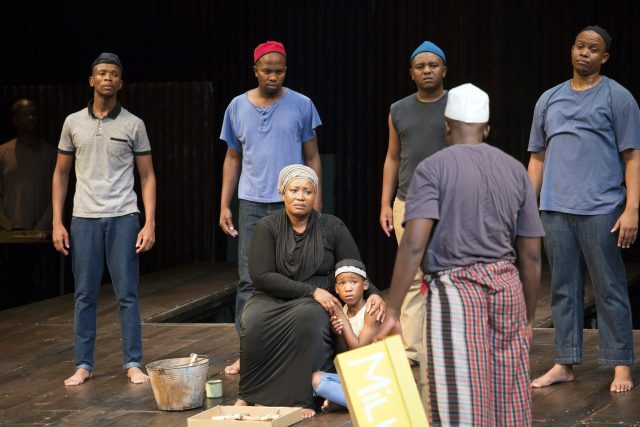
Yindy (Pauline Malefane) and Asad (Siposethu Juta) face some hard truths in A MAN OF GOOD HOPE (photo by Rebecca Greenfield)

BAM Howard Gilman Opera House
30 Lafayette Ave. between Ashland Pl. & St. Felix St.
February 15-19, $24-$80
718-636-4100
www.bam.org

The second time South African writer Jonny Steinberg met Asad Abdullahi, he observed how the Somali refugee became wistful after snapping a twig and smelling its sap. “I felt a whim rising. A man who can break a twig and take me with him to another world, I thought, is a man about whom I ought to write a book,” Steinberg explains in a program note about A Man of Good Hope, a musical drama based on his 2015 book making its U.S. premiere at BAM February 15-19. Presented by London’s Young Vic and Cape Town’s Isango Ensemble, A Man of Good Hope follows Asad from his early childhood in Mogadishu, where his mother (Zanele Mbatha) is shot in cold blood right in front of him, to his attempts to settle in Kenya, Ethiopia, Tanzania, Zimbabwe, and South Africa while dreaming of escaping all the hardships and living in America. Asad is played by Siposethu Juta or Phielo Makitle, Zoleka Mpotsha, Luvo Tamba, and Ayanda Tikolo as he grows into a man, constantly encountering a stream of new people, both friends and enemies, and struggling to survive, always looking over his shoulder, aware of ever-present danger. Many of the people he meets disappear from his life; his acquaintances and relatives end up brutally murdered, and relationships are as evanescent as the cash in his hand. However, despite the serious nature of his story, A Man of Good Hope is filled with humor and joy. “His fear crossed a boundary right then and inhabited me,” Jonny (composer and conductor Mandisi Dyantyis) says early on about Asad. “I saw what he saw and felt what he felt. It was a gift. In that moment he gave me the ink with which I have written this book.”
(photo by Rebecca Greenfield)

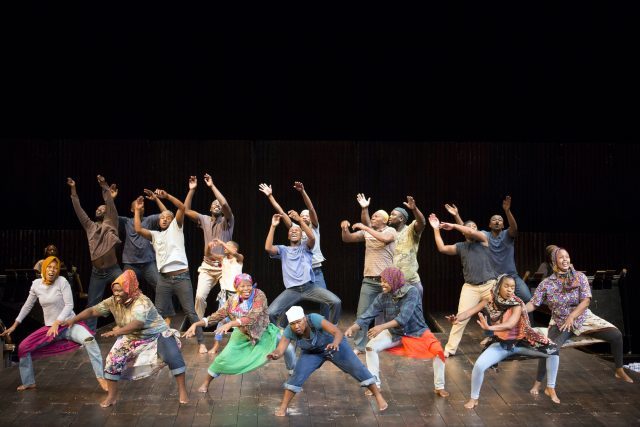
Cape Town’s Isango Ensemble excels in BAM presentation of A MAN OF GOOD HOPE (photo by Rebecca Greenfield)

The set consists of a central angled wooden platform with two small stairs at the back for entries and exits; along both sides are seven marimbas, played by various members of the twenty-three-person troupe. When they’re not on the platform, the cast watches from the right and left, occasionally chiming in like a Greek chorus. The dialogue is mostly in English with some lines in African languages; in addition, the characters occasionally speak in operatic tones or break into full-fledged songs featuring traditional melodies and movement (by Lungelo Ngamlana). Director Mark Dornford-May uses freestanding doorways to depict border crossings on the characters’ journeys, or attempted journeys, to other countries, evoking the current refugee crisis and xenophobia so prevalent around the world as well as, serendipitously, the new American president’s desire to build a wall between Mexico and the U.S.A. Dornford-May, the cofounder and artistic director of Isango, also employs creative ways to show travel by car and the transformation of Asad as he ages. And the costumes, so colorful in the first half, make a very specific shift after intermission. The fine, barefoot cast also includes Dyantyis as Steinberg and the conductor, music director and Isango cofounder Pauline Malefane as Yindy and Sadicya, Sindiswa Sityata as Yindy’s mother, Ayanda Eleki as Yindy’s father, Khanya Sakube as Tube, Zamile Gantana as Rooda, Busiswe Ngehame as Foosiya (just wait till you hear her ring tone), Luvo Rasemeni as Zena, Sonwabo Ntshata as Kaafi, Cikizwa Ndamase as Zulfa, Sifiso Lupuzi as Madoda, and Thobile Dyasi as Abdi. (We saw Juta as the eight-year-old Asad, and he was exceptional, reaching emotional levels far beyond his years.) The ambiguous ending is followed by exuberant curtain calls, everyone dancing and smiling, a testament to the stubborn persistence of the human capacity for happiness amid the harsh and heartbreaking conditions we continually create for each other and ourselves.


OSCAR — OUR FAVORITE BEST PICTURE WINNERS: THE HURT LOCKER

Iraq War drama puts viewers in the middle of the action

Kathryn Bigelow’s explosive Iraq War drama puts viewers in the middle of the action

THE HURT LOCKER (Kathryn Bigelow, 2009)
Metrograph
7 Ludlow St. between Canal & Hester Sts.
Sunday, February 19, 4:00 & 8:45
Series runs February 18 – March 1
212-660-0312
metrograph.com
thehurtlocker-movie.com

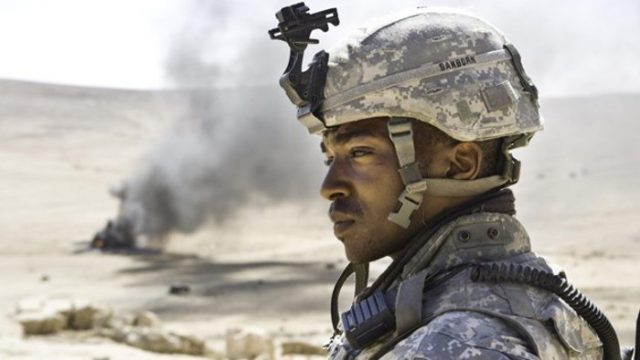
Metrograph is getting ready for the Academy Awards by screening some of its favorite Best Picture champs, beginning February 18 with Michael Curtiz’s Casablanca, followed February 19 by Frank Capra’s It Happened One Night and Kathryn Bigelow’s The Hurt Locker. Based on embedded journalist Mark Boal’s experiences in Iraq, The Hurt Locker follows a three-member Explosive Ordnance Disposal unit as they are called in to defuse a series of dangerous situations involving various kinds of bombs, including IEDs and other life-threatening explosive devices. Team leader Will James (Jeremy Renner) is an expert bomb defuser and maverick who doesn’t follow protocol and likes to live on the edge. Spc. Owen Eldridge (Brian Geraghty) is a greenhorn who just wants to survive the last forty days of their rotation. And Sgt. J. T. Sanborn (Anthony Mackie) likes to go by the book and take no unnecessary chances, which puts him in constant conflict with the unpredictable James. Recalling the second half of Stanley Kubrick’s 1987 Vietnam drama Full Metal Jacket, The Hurt Locker unfolds in a series of harrowing set pieces in which the EOD unit is called in to either safely detonate or defuse explosive devices while under the eyes of local Iraqis, any of whom could potentially be the bomber or a sniper.
THE HURT LOCKER

Sgt. J. T. Sanborn (Anthony Mackie) is distressed by the realities of the Iraq War in THE HURT LOCKER

Director Kathryn Bigelow (Blue Steel, Point Break) masterfully builds suspense scene after scene, beginning with the edge-of-your-seat opener through to the gripping conclusion. The experiences of the EOD unit serve as a microcosm for modern warfare in general and the U.S. involvement in the Middle East specifically, placing viewers in the midst of a tense, bitter, psychologically and emotionally draining battle that can never be won. The outstanding cast also features Guy Pearce, Ralph Fiennes, David Morse, and Evangeline Lilly in small roles; many of the Iraqis were played by actual war refugees. Shot in Jordan not far from the Iraq border, The Hurt Locker is a remarkable story, one of the best war films of the young century. Nominated for nine Academy Awards and winner of six (Best Picture, Best Director, Best Original Screenplay, Best Editing, Best Sound Mixing, and Best Sound Editing), The Hurt Locker is screening February 19 at 4:00 and 8:45 in the Metrograph series “Oscar: Our Favorite Best Picture Winners,” which continues with such other great flicks as Federico Fellini’s La Strada, Billy Wilder’s The Apartment, and John Schlesinger’s Midnight Cowboy.

KEEP QUIET

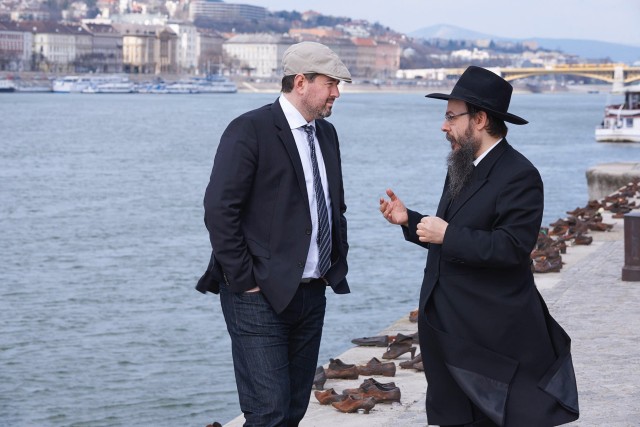
Former Hungarian right-wing leader Csanád Szegedi meets with Rabbi Boruch Oberlander in KEEP QUIET

Former Hungarian right-wing leader Csanád Szegedi meets with Rabbi Boruch Oberlander in KEEP QUIET

KEEP QUIET (Joseph Martin & Sam Blair, 2016)
Lincoln Plaza Cinema
1886 Broadway at 63rd St.
Opens Friday, February 14
212-757-2280
keepquietmovie.com
www.lincolnplazacinema.com

“When you create a story about yourself that’s based on a lie about who you are and who your family is, sooner or later it’s bound to be revealed,” political journalist Anne Applebaum says at the beginning of Joseph Martin and Sam Blair’s engrossing documentary, Keep Quiet. “Who are we really?” In 2012, Csanád Szegedi was a terrifying young star in Hungary’s far-right Jobbik party, one of the founders of the paramilitary, pro-Nazi, nationalist Hungarian Guard, rising to election to the European Parliament on the strength of a resurgent, virulent anti-Semitism. “I wanted everyone to believe in the world as I saw it,” he says in the film. “Anti-Semitism and discrimination of Jews was a powerful motivation.” But it all came crumbling down when the public heard an audio recording of the young leader’s phone conversation with disgruntled Jobbik party member Zoltán Ambrus, who tells Szegedi that his family is actually Jewish. At first Szegedi refuses to believe it, but soon his maternal grandmother is admitting to him that she is indeed a Holocaust survivor, with a number tattooed on her arm and memories of the camps.

Martin (Win a Baby, Scientologists at War) and Blair (Personal Best, Maradona ’86) detail how Szegedi dealt with this dramatic revelation as the conflicted man shares his innermost thoughts, meets with Orthodox Rabbi Boruch Oberlander, and travels to Auschwitz with Holocaust survivor Eva “Bobby” Neumann. He undergoes a radical transformation that not everyone trusts as the film explores who we are, the impact of where we come from, and whether blood trumps all. Keep Quiet is particularly relevant in a world that is experiencing yet another frightening rise in anti-Semitism, especially in Europe. Martin and Blair also delve into Hungary’s history with the Jews, and it’s not a very pleasant one. The film gets to the very heart of the matter, examining the nature of religious hatred in one man who reevaluates everything he believes in when the tables are suddenly turned. Keep Quiet, which features a beautiful score by cellist and composer Philip Sheppard, was shown in the World Documentary Competition at the 2016 Tribeca Film Festival and is opening theatrically February 17 at Lincoln Plaza.

GOOD SAMARITANS

GOOD SAMARITANS (photo courtesy New York City Players

Rosemary (Rosemary Allen) and Kevin (Kevin Hurley) have some healing to do in GOOD SAMARITANS (photo courtesy New York City Players

Abrons Arts Center Playhouse Theater
466 Grand St. at Pitt St.
Wednesday – Saturday through February 25, $25
212-598-0400
www.abronsartscenter.org
www.nycplayers.org

“I will try my best not to be sinful,” the frumpy Rosemary (Rosemary Allen) sings at the beginning of experimental theater director Richard Maxwell’s revival of his absurdist black comedy Good Samaritans, which opened last night at Abrons Arts Center. Originally produced by Maxwell’s New York City Players in 2004 and earning an Obie for Allen, the ninety-minute play features five songs written by Maxwell; his trademark odd dialogue delivered in a dry, stylized manner that highlights its theatricality; and an existential plot that is delightfully mysterious. Rosemary, who is in her seventies, runs an urban rehabilitation center where the bedraggled Kevin (Kevin Hurley), a man in his fifties, suddenly shows up one evening, in desperate need of a bathroom. “I will make it my business to make your business my business,” the straightforward Rosemary tells him. “I don’t want you here. You don’t want to be here. That’s what we have in common. In a couple six months, we’ll see what you’re made of. . . . The twelve-step program, faith-teaching, and work therapy are to help the client reenter mainstream society.” Rosemary, who’s been working at the center for thirty-five years, is sure she can help him, because that is what she does. “You came to me. And I’m telling you. I’m the answer, the only answer you need,” she assures him. Soon they’re helping each other, in a rather unexpected way.

GOOD SAMARITANS (photo courtesy New York City Players

Kevin Hurley and Rosemary Allen reprise their original roles in Richard Maxwell’s revival of GOOD SAMARITANS (photo courtesy New York City Players

Maxwell (Isolde, The Evening) was looking through his previous work (he’s written twenty plays since 1997) when he decided to bring back Good Samaritans, the first time he has revived one of his plays. He believed that it “feels even more resonant in 2017,” and he has a point, with Americans more obsessed than ever with self-identity. “Where is your house? Where is your ID? You know? Why are you here?” Rosemary asks, but Kevin never reveals why he has been placed in the facility, allowing the audience not only to wonder but also to consider what sins of their own might be in need of rehabilitation. The superb acting relies on the intentionally emotionless delivery of lines, but the relationship between the two protagonists is actually filled with a passion that sucks you into their curious tale, which becomes even stranger whenever the characters break out into song, accompanied by guitarist James Moore and pianist David Louis Zuckerman. At the center of it all is a deep need for human connection of almost any kind, and when Rosemary and Kevin do connect, it’s both wildly unanticipated and gently touching. Original designer Stephanie Nelson’s set is brightly cold and antiseptic, a cinder-block cafeteria with long tables and one small window that is hard for the characters to look out of, as if they’re trapped in a kind of way station. (Nelson also designed the lighting and the costumes.) A longtime nurse, Allen seems born to play Rosemary, embodying the intake counselor with an offbeat glee that seems to hover right beneath the surface; meanwhile, Hurley (Sea Plays, Bad Boy Nietzsche!) is affecting as a man in search of meaning. Together they face love and fear, loneliness and desire in ninety captivating minutes. Maxwell (People without History, Neutral Hero), a Guggenheim Fellow who with the New York City Players has won five Obies, has a unique way of interpreting the world we live in, and he is thankfully being a Good Samaritan himself by giving us all another opportunity to see this splendid work.

SURVIVING AND RESISTING: A PRESIDENTS DAY EVENT

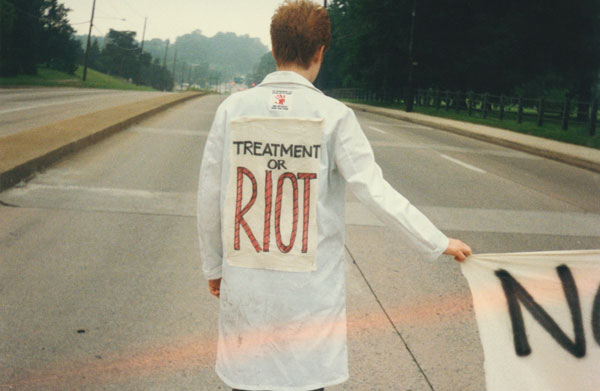
HOW TO SURVIVE A PLAGUE provides a fascinating inside look at AIDS activists fighting the power

HOW TO SURVIVE A PLAGUE (David France, 2012)
IFC Center
323 Sixth Ave. at West Third St.
Monday, February 20, $15, 7:30
212-924-7771
www.ifccenter.com
www.surviveaplague.com

With protests continuing around the country, and the world, against Donald Trump and his administration, IFC Center is honoring Presidents Day with the special evening “Surviving and Resisting: A Presidents Day Event.” The centerpiece is a screening of the gripping 2012 Oscar-nominated documentary How to Survive a Plague. For his directorial debut, longtime journalist David France, one of the first reporters to cover the AIDS crisis that began in the early 1980s, scoured through more than seven hundred hours of mostly never-before-seen archival footage and home movies of protests, meetings, public actions, and other elements of the concerted effort to get politicians and the pharmaceutical industry to recognize the growing health epidemic and do something as the death toll quickly rose into the millions. Focusing on radical groups ACT UP and TAG (Treatment Action Group), France follows such activist leaders as Peter Staley, Mark Harrington, Larry Kramer, Bob Rafsky, and Dr. Iris Long as they attack the policies of President George H. W. Bush, famously heckle presidential candidate Bill Clinton, and battle to get drug companies to create affordable, effective AIDS medicine, all while continuing to bury loved ones in both public and private ceremonies. France includes new interviews with many key activists who reveal surprising details about the movement, providing a sort of fight-the-power primer about how to get things done. The film also shines a light on lesser-known heroes, several filled with anger and rage, others much calmer, who fought through tremendous adversity to make a difference and ultimately save millions of lives. How to Survive a Plague is screening at 7:30 on February 20, along with three new short documentaries, Jem Cohen’s Birth of a Nation and two works from Laura Poitras’s Field of Vision online platform, Alex Winter’s Trump’s Lobby and Josh Begley’s Best of Luck with the Wall, followed by a Q&A and book signing with France, Cohen (Museum Hours, Instrument), and journalist, documentarian, and visual artist Poitras (Citizenfour, “Astro Noise”). It should be quite a night as people gather to discuss how to survive the plague that has infected the White House.

THE DRESSMAKER’S SECRET

(photo by Carol Rosegg)

Estranged friends Mária (Tracy Sallows) and Irma (Caralyn Kozlowski) face some difficult choices in THE DRESSMAKER’S SECRET (photo by Carol Rosegg)

The Simon Studio
59E59 Theaters
59 East 59th St. between Park & Madison Aves.
Tuesday – Sunday through March 5, $25
212-279-4200
www.59e59.org
www.dressmakerssecret.com

A superb cast is the highlight of the world premiere of The Dressmaker’s Secret, a play with a compelling story and intriguing characters that nearly get lost in a somewhat muddled production running at 59E59 through March 5. It’s late 1963, and Hungarian refugee Mária (Tracy Sallows) and her nineteen-year-old son, Robi (Bryan Burton), are living a meager existence in Kolozsvár in Romania. Mária is a very serious, dour woman who wants only the best for her son, an electrician who dreams about moving to America. He’s at odds with his mother, who refuses to tell him who his father is. “I love you,” Mária says. “I hate you. I want my own life, away from you and away from this country,” Robi responds before apologizing. The dowdy Mária is making a stylish dress for her long-estranged friend Irma (Caralyn Kozlowski), a tall, beautiful woman whose brother, Robert (Robert S. Gregory), might be Robi’s father, but Mária’s not talking. Slowly — and slowly is the operative word here — the four characters reveal secret after secret, leading to a tear-jerking finale that would make the Lifetime network proud.

(photo by Carol Rosegg)

Irma (Caralyn Kozlowski) and Robi (Bryan Burton) wonder what’s to come in world premiere at 59E59 (photo by Carol Rosegg)

The Dressmaker’s Secret was cowritten by opera singer and playwright Sarah Levine Simon (The Portrait) and Vassar professor Mihai Grünfeld, adapted from his unpublished novel and inspired by his memoir, Leaving: Memories of Romania. Directed by Roger Hendricks Simon (Bard at the Bar), who is married to Sarah, the production suffers from seemingly endless set changes between more than a dozen scenes that unnecessarily bring the action to a halt, especially in the tiny, intimate theater where the audience is practically sitting on the stage. The show would have benefited greatly from a more imaginative set design that kept things simple. At nearly two and a half hours, the play is also in need of severe trimming and much less repetition. The play’s best line, and it’s an emotional powerhouse, ends up feeling clichéd after it pops up twice more. But still, the central story, a kind of Sophie’s Choice with political intrigue and ramifications that are relevant given the current refugee crisis, is riveting, and the acting is excellent. Gregory (Othello, The Glass Menagerie) brings a Shakespearean bravura to the bold Robert, Burton (The Night Of; Neon Joe, Werewolf Hunter) has just the right amount of naïveté as the confused Robi, Kozlowski (Prodigal Son, Dirty Dancing) is sexy and charming as the fashionable Irma, and Sallows (The Audience, Angels in America) plays the deeply conflicted Mária with grace and dignity. It may take a little work on the part of the audience, but there’s plenty to like about The Dressmaker’s Secret, despite the rough edges.