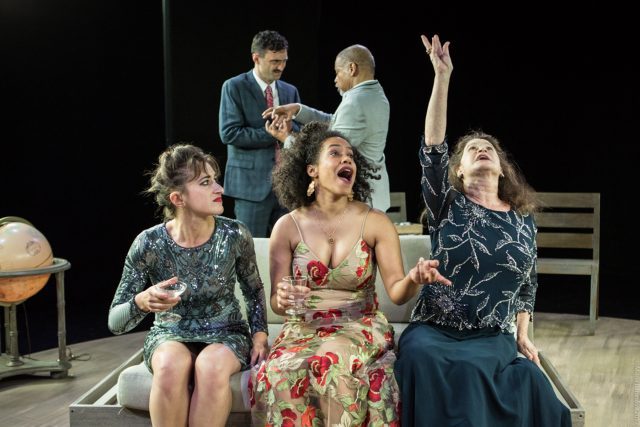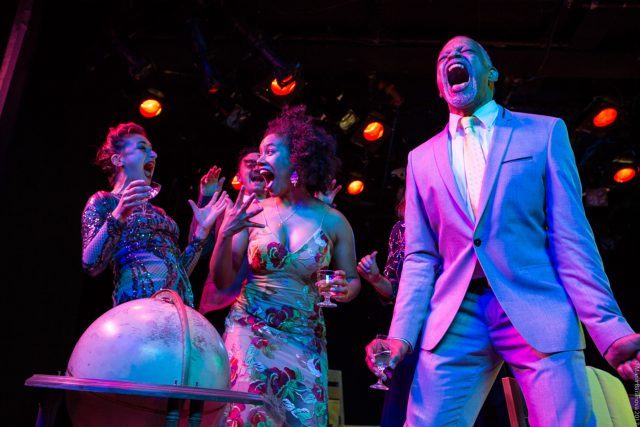
A group of men and women gathers around a table telling stories in Annie Baker’s The Antipodes (photo by Joan Marcus)
The Pershing Square Signature Center
The Romulus Linney Courtyard Theatre
480 West 42nd St. between Tenth & Eleventh Aves.
Tuesday – Sunday through June 11, $30 through May 14, $90 after
212-244-7529
www.signaturetheatre.org
Near the beginning of Annie Baker’s first play for her Residency Five program at the Signature Theatre, John, a character declares, “Tell me a story.” Baker takes that conceit to a whole new level in her follow-up, The Antipodes, which has been extended at the Signature through June 11. The set-up is essentially fairly simple: a group of coworkers sit in ergonomic chairs around a table in an office, where they spend their days sharing deeply personal tales that might or might not lead to the one that their boss, Sandy (Will Patton), needs as he seeks material for a successor to their biggest hit, Heathens. The audience, sitting on two sides of Laura Jellinek’s pristine set, never learns what kind of company the seven men and two women work for — but it’s apparently at least somewhat bureaucratic and corporate, as Josh (Josh Hamilton) has to fill out forms over and over in an ongoing effort to try to get his ID. The tale they seek involves monsters, but no dwarves, elves, or trolls; they could be making movies, video games, apps, or an animated television series, although it doesn’t really matter, because it’s all about the stories themselves. “There are seven types of stories in the world,” Dave (Josh Charles) says, while Danny M1 (Danny Mastrogiorgio) claims there are thirty-six, Josh ten, and Brian (Brian Miskell) eighteen. They share intimate sexual episodes, moments that shaped their lives, and random tales that go nowhere. Josh philosophizes about the nature of time, Eleanor (Emily Cass McDonnell) doesn’t understand why she can’t use her cell phone, Danny M2 (Danny McCarthy) is hesitant to contribute, and Adam (Phillip James Brannon) remembers being hit by lightning. Scenes often end in the middle of a discussion, then pick up in the midst of a new topic, with no clear delineation of the time change except when Sarah (Nicole Rodenburg), Sandy’s assistant — who knows more than she’s letting on — arrives to take lunch orders, wearing a different chic outfit each time, courtesy of costume designer Kaye Voyce. While it doesn’t appear that they are accomplishing anything, Sandy, a straight shooter who is having some issues at home, pushes them to keep going. “I just wanted to remind all of you that what you’re doing is important. We need stories. As a culture. It’s what we live for. These are dark times. Stories are a little bit of light that we can cup in our palms like votive candles to show us the way out of the forest.” Even Brian, the note-taker and researcher, gets in on the action. But the team starts getting nervous when Sandy suddenly doesn’t show up one day.

Dave (Josh Charles) and Adam (Phillip James Brannon) listen to others’ stories in latest exceptional work by Annie Baker (photo by Joan Marcus)
The Antipodes, which sounds like a mythical monster but actually means “contrary” or “the exact opposite,” has all the makings of a pretentious play about the art of playwrighting, a work about the writer’s struggle to come up with a good idea, but Pulitzer Prize winner Baker (The Flick, Circle Mirror Transformation), who wrote the two-hour show specifically for the Romulus Linney Courtyard Theatre, proves that it’s not that obvious. Instead, it’s a carefully crafted existential take on everyday existence, on the things humans do to get by, from eating and drinking to having sex, from going to work and communicating with others to dealing with life’s little problems. “We can do anything,” Sandy points out, as if he’s speaking for Baker the playwright, who is firmly in control. The show is also about the concept of time, which in a play can be manipulated by the writer. “There are two kinds of time. Vertical and horizontal. And if something happens in horizontal time, it can be . . . it’s not permanent,” Josh explains. “You can reverse it. Like one of them is the time that we think of when we think of normal time that’s moving forward and you can’t go back. But then there’s another kind of time and if you do something in that kind of time you can . . . uh . . . it’s more flexible.” Director Lila Neugebauer, who has done an extraordinary job navigating through time and space in such complex multicharacter dramas as The Wayside Motor Inn, The Wolves, and Everybody, makes every movement count, never allowing the narrative flow to drag, whether by way of a bit of magic about where lunch comes from or Adam lying on the floor to tell “the first story ever told.” The actors form an utterly believable group, fellow employees with unique personalities, some of whom bond while others remain outsiders, just as in real life. “The stories we create teach people what it’s like to be someone else on a visceral level,” Sandy tells his crew. “As storytellers we know how to shift perspective and inhabit different viewpoints. Imagine what would happen if everyone in the world could do every once in a while what we already do on a daily basis. It would be revolutionary.” The Antipodes is another exceptional play from one of the theater’s finest minds, a writer who is never afraid of going for the revolutionary in her work.


“Vines . . . are like internships,” Ulrich (Pascal Tagnati) tells Marc Châtaigne (Vincent Macaigne) in Antonin Peretjatko’s madcap colonialist farce, Struggle for Life. “Don’t drop one till you got another.” Nothing ever goes right for middle-aged schlemiel Châtaigne, who has been assigned by Rosio (Jean-Luc Bideau) of the Ministry of Standards to oversee the construction of an indoor ski resort in the jungles of Guiana; Guia-Snow, Rosio explains, will show South America that France can export a coveted resource, cold weather. Châtaigne’s contact in Guiana is lunatic bureaucrat Galgaric (Mathieu Amalric), who assigns him a driver named Tarzan (Vimala Pons), a grown woman who is interning with the Department of Forestry and Water and is in charge of renovating gardens. Soon Châtaigne and Tarzan are lost in the jungle, encountering a variety of oddballs, including Christian Duplex (Pascal Légitimus), Georges (Thomas De Pourquery), and Damien (Rodolphe Pauly), each of whom is somehow involved in either tearing down or saving the Amazon. Meanwhile, Châtaigne is being hunted by strange and skillful tax minister Maître Friquelin (Fred Tousch). They also meet up with dangerous insects and animals, cannibals, and parking meters. Jerry Lewis’s The Patsy meets Woody Allen’s Bananas in this hit-or-miss satire of French colonialism and government programs, in which interns are given a tremendous amount of power and responsibility, with director-cowriter Peretjatko (La Fille du 14 juillet) leaving no sight gag unturned. Yes, a lot of them are just plain stupid, but a whole bunch are just plain funny as well.
From 1967 to 1975, a group of more than two dozen Swedish journalists came to America to document the civil rights movement. More than thirty years later, director and cinematographer Göran Hugo Olsson discovered hours and hours of unused 16mm footage — the material was turned into a program shown only once in Sweden and seen nowhere else — and developed it into The Black Power Mixtape 1967-1975, a remarkable visual and aural collage that focuses on the Black Panthers and the Black Power movement, a critical part of American history that has been swept under the rug. Olsson and Hanna Lejonqvist have seamlessly edited together startlingly intimate footage of such seminal figures as Eldridge Cleaver, Bobby Seale, Huey P. Newton, Dr. Martin Luther King, Jr., and Stokely Carmichael, including a wonderfully personal scene in which Carmichael interviews his mother on her couch. But the star of the film is the controversial political activist Angela Davis, who allowed the journalists remarkable access, particularly in a jailhouse interview shot in color. (Most of the footage is in black-and-white.) Davis also adds contemporary audio commentary, sharing poignant insight about that tumultuous period, along with Abiodun Oyewole of the Last Poets, singer Erykah Badu, professor, poet, and playwright Sonia Sanchez, Roots drummer Ahmir Questlove Thompson (who also composed the film’s score with Om’Mas Keith), and rapper Talib Kweli, who discusses specific scenes in the film with a thoughtful grace and intelligence. The Black Power Mixtape 1967-1975 is an extraordinary look back at a crucial moment in time that has long been misunderstood, if not completely forgotten, and has taken on new relevance with the rise of the Black Lives Matter movement. The film kicks off the IFC Center series “Queer/Art/Film: Summer of Resistance” on May 8 at 8:00 and will be followed by a discussion with