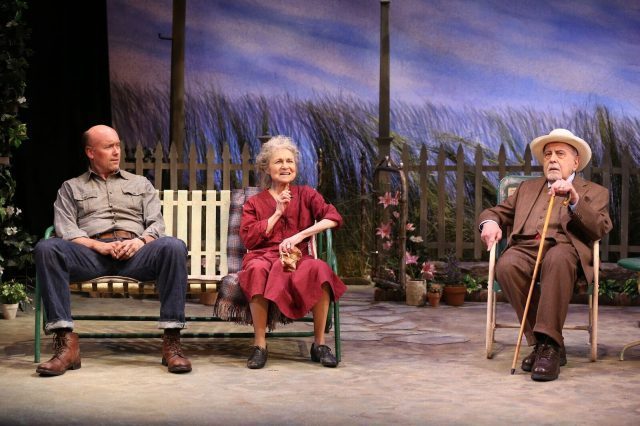
Slim (Larry Bull), Mrs. Mavis (Lynn Cohen), and Judge Robedaux (George Morfogen) discuss local matters in Horton Foote’s The Traveling Lade (photo by Carol Rosegg)
HORTON FOOTE’S THE TRAVELING LADY
Cherry Lane Mainstage Theatre
38 Commerce St.
Tuesday – Sunday through July 30, $65-$95 ($39-$49 with code TTLRED)
212-989-2020
www.cherrylanetheatre.org
Austin Pendleton’s revival of Horton Foote’s 1954 Broadway play, The Traveling Lady, is essentially a simple little diversion, a gentle, bittersweet slice-of-life drama that is singularly American. The show, which opened Thursday night at the Cherry Lane, takes place in a small town in Foote’s home state of Texas, where he set most of his works, including the Tony-nominated The Trip to Bountiful, the Pulitzer Prize-winning The Young Man from Atlanta, the Orphans’ Home Cycle, and the trio of shorts that make up Harrison, TX. It’s 1950, and folks are gathering in Clara Breedlove’s (Angelina Fiordellisi) quaint backyard (designed by Harry Feiner, who also did the lighting). Stopping by on the day of Miss Kate Dawson’s funeral are Mrs. Mavis (Lynn Cohen), a cranky old lady who enjoys torturing her daughter, the kindhearted Sitter Mavis (Karen Ziemba); Judge Robedaux (George Morfogen), a frail, elderly man who doesn’t mind a bit of gossip here and there; Mrs. Tillman (Jill Tanner), a fanatical Bible-thumping teetotaler who brings in reclamation projects to cure them of the evil ills of drink and crime; the friendly Clara, who welcomes the company; and Clara’s brother, Slim Murray (Larry Bull), a hardworking, soft-spoken man who has recently been widowed. Arriving on this hot day is Georgette Thomas (Jean Lichty) and her young daughter, Margaret Rose (Korinne Tetlow), who have ridden the bus all night and are looking for a place to live while waiting for her husband, Henry (PJ Sosko), to get out of prison. But she is surprised to discover that he has already been freed and is working for Mrs. Tillman, who is determined to reform him. But that’s a whole lot easier said than done.
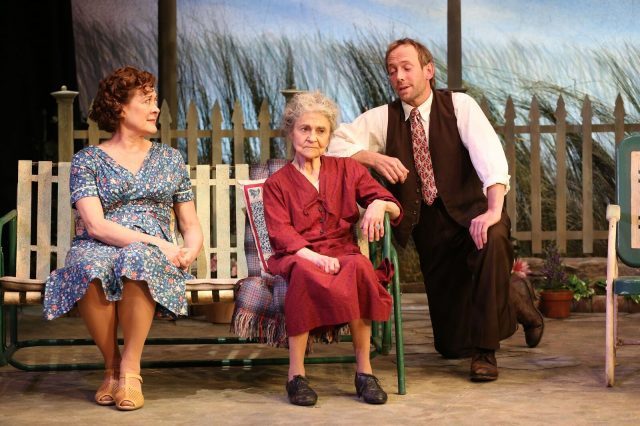
Sitter Mavis (Karen Ziemba), her mother (Lynn Cohen), and Henry Thomas (PJ Sosko) hang out in Clara Breedlove’s yard in Austin Pendleton production at the Cherry Lane (photo by)
A collaboration between Cherry Lane Theatre’s Founder’s Project and La Femme Theatre Productions to celebrate the centennial of Foote’s birth — the playwright was born in 1916 and passed away in 2009 at the age of ninety-two — The Traveling Lady is a creaky, old-fashioned tale of a more simpler time in America, a story that shows its age. Pendleton (A Day by the Sea, A Taste of Honey), one of the busiest off-Broadway directors around, has several characters enter and leave via the narrow Cherry Lane aisle, which is probably supposed to make the audience feel more a part of the atmosphere but instead becomes overused relatively quickly while also confusing the geography of the location. Cohen (I Remember Mama, Big Love), who also portrayed Mrs. Mavis in a 2006 revival at Ensemble Studio Theater, is wonderfully nasty as the ornery old soul, who might not be quite as doddering as she sometimes likes to appear. “Yep. I remember all of it. I remember everything that happened in this town,” she says. Bull (The Coast of Utopia, Rocket to the Moon) is strong and solid as Slim, a man’s man who is unable to share his true feelings. Tony winner Ziemba (Contact, Steel Pier), Tanner (Dividing the Estate, Enchanted April), and Cherry Lane founding artistic director Fiordellisi (Out of the Mouths of Babes, Catch the Butcher) are fine as the chatty women, but there is little chemistry between Sosko (Row After Row, Reentry) and Lichty (Nora, A Loss of Roses); of course, their characters have not seen each other for a long time, but the audience is unlikely to care whether they get back together or not. Lichty, who cofounded Le Femme with Pendleton and Robert Dohmen, fares better as the sensitive mother, but Sosko is hampered by Henry’s desire to form a band, a subplot that goes nowhere. Foote, who won screenwriting Oscars for To Kill a Mockingbird and Tender Mercies, instills the hundred-minute intermissionless The Traveling Lady with some charming moments, but there are not quite enough of them to sustain this production above being a nice, pleasurable detour.
 Auteur and film historian Bertrand Tavernier takes viewers on a fascinating, deeply personal trip into the world of early French movies in the extraordinary My Journey through French Cinema. Inspired by Martin Scorsese’s 1995 A Personal Journey with Martin Scorsese through American Movies and 1999 My Voyage to Italy, the French auteur recounts how he believes that going to the theater as a child helped him survive a serious illness and led to a lifelong love of cinema; he even battled and beat cancer while making this documentary. In more than three hours that fly by surprisingly quickly, Tavernier examines dozens and dozens of French films, not looking at them as a historian or a fan but as a fellow director; in addition, the film unfolds neither chronologically nor thematically but in a delightfully charming stream of consciousness as Tavernier shares personal anecdotes that lead him from film to film and director to director. He begins by describing the first movie that had a major impact on him, Jacques Becker’s Dernier Atout, and moves on to his days working with Volker Schlöndorff for Jean-Pierre Melville, who thought he was a terrible assistant and turned him into a publicist; Tavernier also wrote for Les Cahiers du cinema and Positif. Through voiceover and onscreen appearances, Tavernier spends a lot of time discussing Melville (Bob le flambeur, Le Doulos) and Claude Sautet (Classe tous risques), whom he considers his cinematic godfathers; Becker (Casque d’Or, Le Trou); Jean Renoir (A Day in the Country, Rules of the Game); Marcel Carné (Le jour se lève, Hôtel du Nord); Jean-Luc Godard (Contempt, Pierrot le fou); composers Maurice Jaubert (Port of Shadows, L’Atalante) and Joseph Kosma (Le Chat, House on the Waterfront); and actors Jean Gabin (La Bȇte Humaine, Grand Illusion) and Eddie Constantine (Alphaville, Cet homme est dangereux). Also garnering significant mention are Jean Sacha, Gilles Grangier, Henri Decoin, Jean Delannoy, Edmond T. Gréville, Lino Ventura, and Pierre Schoendoerffer.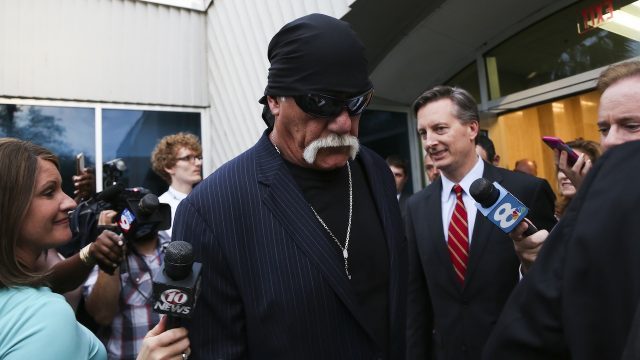
 After closing the 2017 Human Rights Watch Film Festival, Brian Knappenberger’s Nobody Speak: Trials of the Free Press is getting a theatrical run at IFC beginning June 23, the same day the Netflix original begins streaming on the channel. The film is a deeply troubling look into the growing battle between billionaires and the fourth estate, between a person’s right to privacy and freedom of the press. Knappenberger begins by exploring the landmark Bollea v. Gawker case, in which Hulk Hogan, whose real name is Terry Gene Bollea, sued online media outlet Gawker for posting nine seconds of a tape depicting Bollea having sex with Heather Clem, the wife of his then-best friend, Todd Alan Clem, better known as radio personality Bubba the Love Sponge. The jury awarded Bollea $140 million, bankrupting Gawker, but Knappenberger reveals that the case was about a lot more than invasion of privacy — it was really about control of the media by the extremely wealthy. And Hogan/Bollea is not that wealthy. “Don’t be fooled into thinking that just because this case is so sleazy and rests on sex that it’s not important; this is one of the most important First Amendment cases in American history,” says Leslie Savan, who blogs on politics and the media for The Nation. “We’re talking about the very notion of truth,” she later adds. Knappenberger speaks extensively with Gawker cofounder Nick Denton, who defends what the company did as well as its overall journalistic ethics, covering stories that others wouldn’t; Knappenberger also meets with Gawker cofounder Elizabeth Spiers; former editor in chief A. J. Daulerio, who posted the Hogan story and sees himself as a patsy; former deputy editor James Wright; Hogan lawyers David Houston and Charles Harder; and former Gawker executive editor John Cook, who is boldly outspoken about Gawker’s purpose. “I wanted to write true things about bad people, and that’s what Gawker gave us all the freedom to do,” he says. First Amendment lawyer Floyd Abrams notes, “The reason to save Gawker was not because Gawker is worth saving. The reason to save it is that we don’t pick and choose what sort of publications are permissible, because once we do, it empowers the government to limit speech in a way that ought to be impermissible.” Among the other talking heads offering compelling insight are Politico media writer Peter Sterne, associate professor of journalism Jay Rosen, Buzzfeed business reporter Will Alden, NPR media correspondent David Folkenflik, and former New York Times columnist David Carr. The story takes a strange turn when it is discovered that there were potential improprieties involving Judge Pamela Campbell and that the lawsuit is being funded by billionaire venture capitalist Peter Thiel, who was outed by Gawker in 2007 and is now exacting a dangerous kind of revenge.

 João Pedro Rodrigues reimagines the story of Fernando Martins de Bulhões, also known as Anthony of Lisbon and Saint Anthony of Padua, in the utterly bizarre and infectiously weird adventure drama The Ornithologist. Rodrigues, who also dealt with the thirteenth-century priest’s legacy in the 2013 zombie short Morning of Saint Anthony’s Day, puts ornithologist Fernando (Paul Hamy) through a series of tests after his canoe capsizes while he’s on a bird-watching expedition. He is found near death on the shore by a pair of Chinese pilgrims (Han Wen and Chan Suan), walking Camino de Santiago, who decide to do something very odd with him. His Stations of the Cross journey continues as he meets a deaf and mute goatherd (Xelo Cagiao), a group of colorful, masked caretos, and a trio of topless women on horseback (Juliane Elting, Isabelle Puntel, and Flora Bulcao), who in different ways challenge his sexuality and spirituality. Rodrigues (The Last Time I Saw Macao, To Die Like a Man) infuses the wild tale with references to Christianity, paganism, ritual, superstition, and Greek mythology as Fernando’s physical and psychological strength is tested in oddball events that get stranger and stranger until the director, who was already dubbing in Hamy’s Portuguese lines with his own voice, starts switching places with the actor.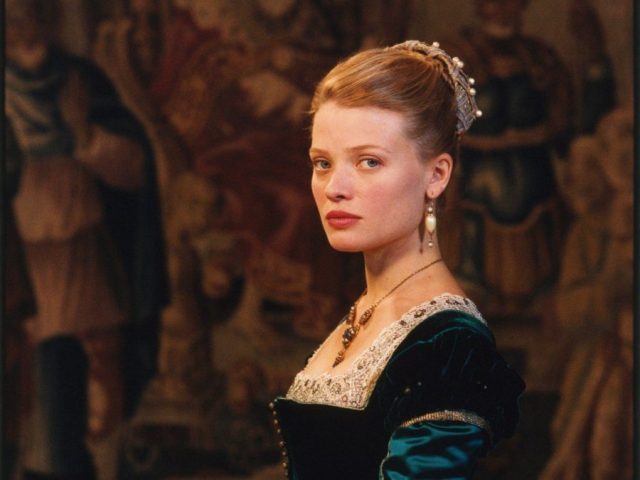
 In Bertrand Tavernier’s sweeping romantic epic, young and beautiful Marie de Mézières (Mélanie Thierry) has a big problem: It seems that every man she meets falls in love with her. Already in a passionate relationship with the heroic Henri de Guise (Gaspard Ulliel), a leader of the Catholics against the Protestant Huguenots in the French Wars of Religion of the 1560s, Marie is suddenly part of a shady deal between her father (Philippe Magnan) and the Duke de Montpensier (Michel Vuillermoz), marrying her off to the rather uninspiring though steadfast Prince Philippe de Montpensier (Grégoire Leprince-Ringuet), who warms to his bride much quicker than she to him. Returning to the battlefield, Philippe asks his mentor, the older and wiser Count de Chabannes (Lambert Wilson), to teach Marie in the ways of the court to prepare her for meeting Catherine de Medici, but even such a solid, moralistic man as Chabannes — who deserted from the army after killing a peasant family, supposedly in the name of his lord and saviour — cannot prevent himself from succumbing to the many charms of his unaware charge. And when she meets the wild and unpredictable Duke d’Anjou (Raphaël Personnaz), the king’s brother is smitten as well. But through it all, Marie, a modern woman who wants to learn to write and make her own choices, remains fiercely drawn to Henri, a forbidden love that threatens dire consequences. Based on the 1662 novella by Madame de La Fayette, The Princess of Montpensier is a thrilling tale of love and war, of honor and betrayal.