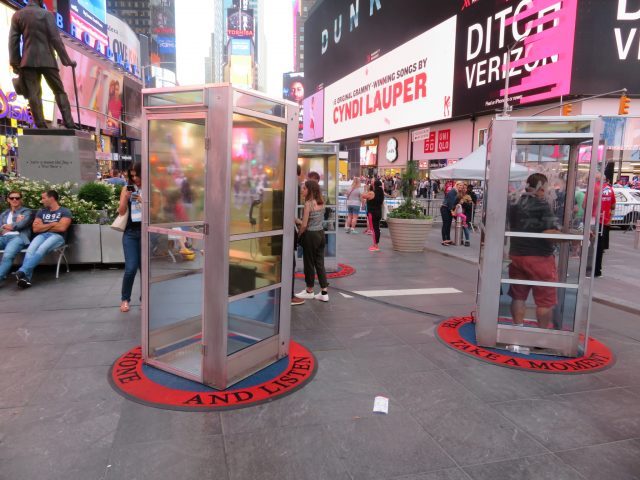
Aman Mojadidi’s “Once Upon a Place” brings poignant immigrant stories to “The Crossroads of the World” (photo by twi-ny/mdr)
Duffy Square, Times Square
Forty-Seventh St. at Broadway
Daily through September 5, free
www.timessquarenyc.org
www.amanmojadidi.com
When I was in Copenhagen earlier this summer, I saw an outstanding and important exhibition in historic Town Hall, “100% Foreign?,” portraits by Maja Nydal Eriksen of one hundred men and women who have escaped from twenty-nine countries and sought refuge in Denmark over the last fifty years, with statements focusing on how Danish they have come to feel. At the same time, an interactive installation arrived in New York City, Afghan-American artist Aman Mojadidi’s “Once Upon a Place,” in which visitors can listen to seventy prerecorded immigrant stories told by men and women who left their home nations to make a new life in New York. Continuing through September 5, the installation consists of three old-fashioned telephone booths, harking back to a time before cell phones, when many immigrants would use pay phones to call home and talk to the family members they left behind. The booths stand like beacons in what is famously called “The Crossroads of the World,” where people from across the globe gather to take in the wonder of New York City. The oral histories, some in English, others in the participant’s native tongue, last between two and fifteen minutes each, related by immigrants from Bangladesh, Belgium, Burkina Faso, Cameroon, China, Colombia, the Dominican Republic, Egypt, Gambia, Ghana, Ireland, Israel, Italy, Japan, Jordan, Liberia, Mexico, Nigeria, Philippines, Puerto Rico, Russia, Sierra Leone, Spain, Sri Lanka, Tibet, and Yemen. Mojadidi’s previous site-specific work includes “Commodified” at the Imperial War Museum in Manchester, England, which introduced such products as Conflict Bling and a Waterboarding Play Set in addition to pro-Palestinian items; “Squatters” in Dubai; and “What Histories Lay Beneath Our Feet” in Kerala, India.
“Once Upon a Place” also brings back the idea of the critical phone book — complete with the old Yellow Pages logo that meant, “Let your fingers do the walking” — where callers could look up the names and addresses of people, another ritual that has disappeared in the modern era. But in this case, the phone book supplies additional information about each speaker and their country of origin, a kind of mini-encyclopedia that sentimentally declares, “No matter where you are from, we’re glad you’re our neighbor.” Mojadidi recorded the stories across the five boroughs during his residency at Times Square Arts, in conjunction with the Times Square Alliance. “Beyond the immediate understanding that immigration, rather than some sort of social, cultural, economic, or political burden, is actually the foundation, the lifeblood, of great global cities such as New York,” Mojadidi explained in a statement, “for me the most important outcome of ‘Once Upon a Place’ is that no matter how different the experiences of migration might be among the storytellers, visitors will hear the common humanity in their voices that cannot, in fact should not, be confined by arbitrarily defined, historically drawn, and forcefully maintained geopolitical borders that will never truly reflect the realities of contemporary human experience.” The installation has gained even more power given the fierce current debate being waged in America and around the world over immigration and refugees since Donald Trump took office, particularly in the wake of White House political adviser Stephen Miller’s rejection of the value of Emma Lazarus’s “The New Colossus,” the poem that was added to the Statue of Liberty in 1903 and beautifully welcomed people to these shores: “Give me your tired, your poor, / Your huddled masses yearning to breathe free, / The wretched refuse of your teeming shore. / Send these, the homeless, tempest-tost to me, / I lift my lamp beside the golden door!” Mojadidi’s “Once Upon a Place” reminds us all what America once was, and what it might yet be again.

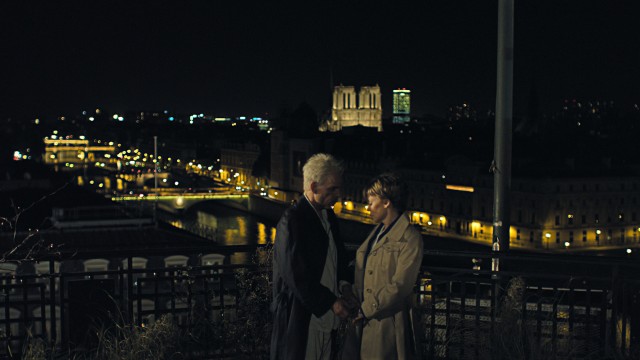
 French writer-director Léos Carax (

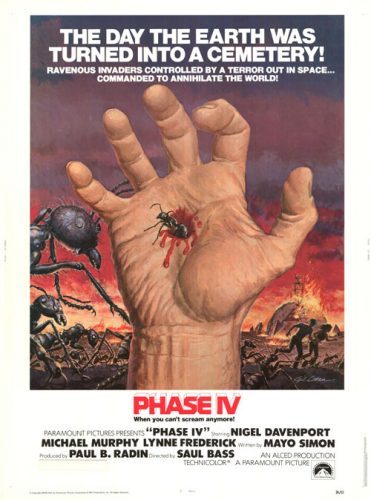
 Metrograph’s celebration of the career of logo designer, title credits innovator, and Oscar-winning director Saul Bass has just added his sole feature film, the 1974 sci-fi thriller Phase IV. The long-unavailable work, which was comically crucified on