Pierre Thomas (Pascal Cervo) uses Grindr as a GPS in Jérôme Reybaud’s 4 Days in France)
4 DAYS IN FRANCE (JOURS DE FRANCE) (Jérôme Reybaud, 2016)
Quad Cinema
34 West 13th St. between Fifth & Sixth Aves.
Opens Friday, August 4
212-255-2243
www.quadcinema.com
www.cinemaguild.com
 Jérôme Reybaud’s feature debut, 4 Days in France, is a hypnotic existential road movie about deep-set, pervasive loneliness, tinged with bittersweet dark humor. In the middle of the night, Pierre Thomas (Pascal Cervo) packs a bag and quietly walks out on Paul (Arthur Igual), who doesn’t notice he’s gone until he wakes up in the morning, mystified by his lover’s absence. Pierre heads out across the French countryside and through small towns in his white Alfa Romeo sedan, using Grindr as his GPS, seeking out anonymous sex with men in remote gay hook-up areas. The distraught Paul, meanwhile, goes to the opera — Mozart’s Così fan tutte, which can be translated as “Women are like that” — without Pierre and realizes how much he misses him, so he takes off after his errant partner. He follows him on Grindr as well, but he is already far behind. As this slow-speed “chase” goes on, both Pierre and Paul encounter a series of lonely individuals, played by well-known French actors and celebrities, including Fabienne Babe as Diane Querqueville, who performs at an out-of-the-way nursing home; Natalie Richard as a bookseller who Pierre doesn’t remember; Lætitia Dosch as a philosophical thief; Liliane Montevecchi as Pierre’s elegant aunt; Jean-Christoph Bouet as an older man who services strangers; Florence Giorgetti as a strong-willed woman protecting her turf; Corinne Courèges as a Happy Dough employee with a surprising proposition for Paul; Hervé Colas as an unfriendly butcher; Dorothée Blanck as a woman pulling a wagon; Bertrand Nadler as a traveling salesman Pierre encounters in a hotel parking lot; Marie France as a woman who has an unexpected task for Pierre to help her with; and Emilien Tessier as a man literally standing between two worlds. Neither Paul nor Pierre ever say that much, although we do learn that Pierre is rather fastidious and naturally polite, preferring to follow rules and not be touched unless he wants to be.
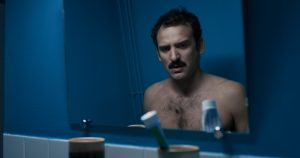
Paul (Arthur Igual) doesn’t understand why his lover left him in 4 Days in France)
We actually learn more about the minor characters, some of whom are onscreen for a very short period of time, than we do about Paul and Pierre; there’s no back story establishing who they are and what kind of relationship they have, no explanation of why Pierre left and what he is searching for, yet writer-director Reybaud gets us to become wholly involved in their lives, desperately hoping that Paul catches up to Pierre and they make up, even as neither is exactly faithful during this trying dilemma. But each vignette, in the spirit of such Jim Jarmusch films as Stranger Than Paradise, Night on Earth, and Coffee and Cigarettes, comments about the state of human existence in the twenty-first century in abstract, obscure, yet tantalizing ways. The wall that separates Pierre from the salesman in the hotel is the centerpiece of the film, the two men on opposite sides, both in need of almost any kind of connection. Another critical scene is when a young woman steals Pierre’s travel bag and they end up going through it together, figuring out what his various possessions are worth — compared to the value of being with other people. Reybaud prefers long scenes with little camera movement, particularly in cars; Pierre drives for miles and miles, through such gorgeous scenery as the Alps and vast green landscapes — the lovely cinematography is by Sabine Lancelin, who has worked with Manoel de Oliveira, Chantal Akerman, Michel Piccoli, Éric Rohmer, and Raoul Ruiz — and the camera mostly remains still, as if putting the viewer in the backseat in this strange yet involving journey.
And despite clocking in at 140 minutes, 4 Days in France is utterly addictive even though nothing of great significance ever really happens. Early on, when Pierre drives a stranded Diane to the nursing home, she asks if he wants to come in and watch her show. He says no; he would never do anything like that, at least partly because he is likely to be suffering from a fear of death, among several other private maladies. But Reybaud lets the audience see Diane as she whisper-sings in a sparkly costume. When it comes right down to it, this film is not about why Pierre walked out on Paul and set out on his own; it’s really just about how none of us wants to be alone. “Where are you going?” the woman with the wagon asks Pierre, who casually responds, “I don’t know.” 4 Days in France opens August 4 at the Quad, with Reybaud participating in Q&As following the 6:40 shows on Friday and Saturday night.
 On April 2, 2011, after ten years of building a devoted following that was still growing, electronic dance-punk faves LCD Soundsystem played what was supposed to be its