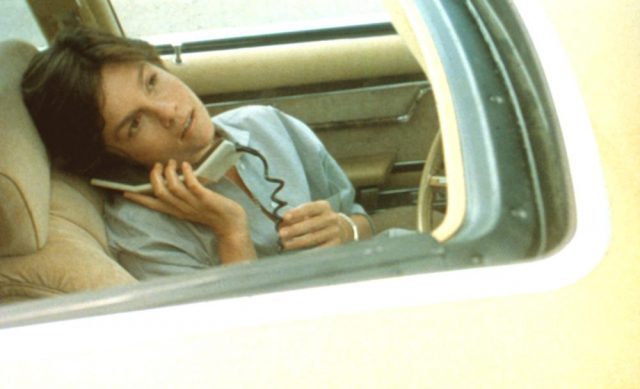
Geneviève Bujold stars as a radio love doctor in Alan Rudolph’s Choose Me
CHOOSE ME (Alan Rudolph, 1984)
Quad Cinema
34 West 13th St. between Fifth & Sixth Aves.
Thursday, August 10, 9:00, and Sunday, August 13, 1:00
Series runs August 10-16
quadcinema.com
 The Quad is celebrating French-Canadian actress Geneviève Bujold’s seventy-fifth birthday with the wide-ranging fourteen-film retrospective “The Beguiling Bujold,” running August 10-16. The Montreal native was on the cusp of becoming a major star after a 1968 Emmy nomination for playing Joan of Arc in Saint Joan and an Oscar nod the next year for her portrayal of Anne Boleyn in Anne of the Thousand Days, but she opted for a more quirky career of small, independent films, dotted with a handful of bigger pics. One of her best roles is Dr. Nancy Love in 1984’s Choose Me, the first of three consecutive films she made with Alan Rudolph. Nancy hosts a popular radio talk show about love and sex, two things she doesn’t enjoy much of herself until she meets Eve (Lesley Ann Warren), a lounge owner who goes home with a different person every night and is a regular caller into her program under a fake name. Among the men enamored of Eve are her bartender, Billy Ace (John Larroquette); the mean-spirited, married, well-connected Zack (Patrick Bachau); and the new guy in town, Mickey (Keith Carradine), who has lived a rather complicated life. Meanwhile, barfly Pearl (Rae Dawn Chong) has the hots for Mickey too. As part of her “research,” Nancy moves in with Eve, but neither knows that they actually talk to each other almost daily on the radio. Bujold is an intoxicating adult ingénue in Rudolph’s darkly comic tongue-in-cheek noir that features a riotous soundtrack by Teddy Pendergrass and Luther Vandross and lurid photography by Jan Kiesser. Choose Me is screening August 10 and 13 as part of both “The Beguiling Bujold” and “Quadrophilia,” the latter consisting of films relating to the LGBTQ community.
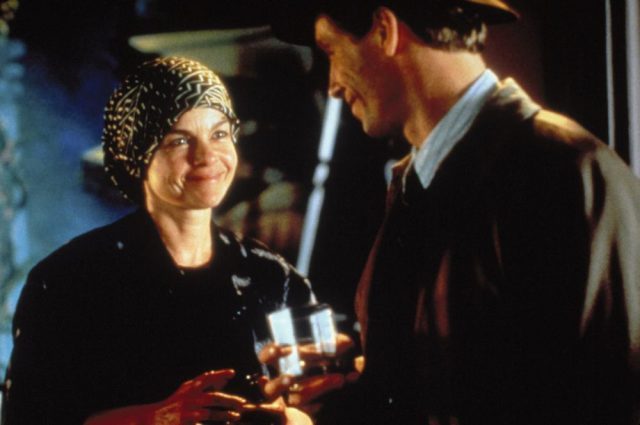
Geneviève Bujold plays cool and calm art dealer Libby Valentin in Alan Rudolph’s The Moderns
 Bujold comfortably settles into the background in her second film with Rudolph, 1988’s The Moderns, a wickedly sly riff on the Lost Generation in post-WWI Paris. Bujold is gallery owner Libby Valentin, the guiding conscience among the self-important literati, including Ernest Hemingway (Kevin J. O’Connor), who speaks in hysterical quotations that would wind up in The Sun Also Rises and other books; Gertrude Stein (Elsa Raven), and Alice B. Toklas (Ali Giron), who host high-falutin’ salon gatherings; gossip columnist Oiseau (Wallace Shawn), who never a met a story he couldn’t make up; wealthy art collector Nathalie de Ville (Geraldine Chaplin), who has more up her sleeves than she initially lets on; powerful, jealous businessman Bertram Stone (John Lone) and his wife, the sexy, troublesome Rachel (Linda Fiorentino); and expatriate painter Nick Hart (Keith Carradine), who has little time for nonsense as he homes in on Rachel. The beginning of the film is annoying, pretentious, and self-indulgent, but once it kicks into high gear, it wonderfully pokes fun at itself, especially via Oiseau, played to a comic T by Shawn — who likes to hang out at Bar Sélavy, owned by Rose (Marthe Turgeon), in a sweet homage to Marcel Duchamp. Cinematographer Toyomichi Kurita slowly switches from black-and-white to color as scenes change and the backstabbing heats up. The plot centers around forgeries, referencing the phoniness that resides within every character. The only one who remains steady throughout is Libby, who is played with just the right touch of mystery by Bujold. The Moderns is screening at the Quad on August 10 at 6:45.
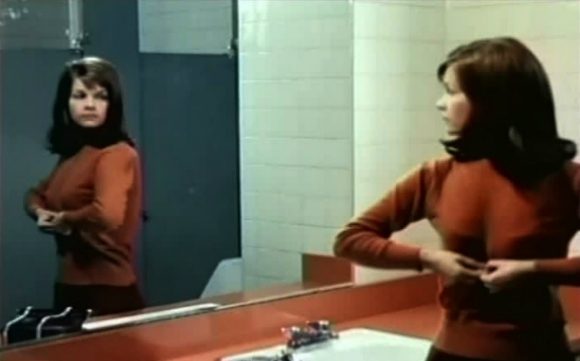
Devout choir girl Martha Hayes (Geneviève Bujold) has a sexual awakening in The Act of the Heart
THE ACT OF THE HEART (Paul Almond, 1970)
Quad Cinema
34 West 13th St. between Fifth & Sixth Aves.
Saturday, August 12, 5:45
Series runs August 10-16
quadcinema.com
 Bujold made three films with her husband, Paul Almond, during their six-year marriage. In between 1968’s Isabel and 1972’s Journey is the very strange, ultimately unsatisfying The Act of the Heart, which earned Bujold a Canadian Film Award for Best Actress. The low-budget 1970 film hints at being a horror movie, which would have been much better than the rather drab drama it turns out to be, save for a bizarre finale. Bujold is Martha, a shy, devout young woman who has arrived in a small town on the North Shore of Quebec to be a nanny to Russell (Bill Mitchell), a boy being raised by his widowed mother, Johane (Monique Leyrac). Martha auditions for the church choir, which is conducted by Augustinian monk Father Ferrier (Donald Sutherland). As she becomes deeply involved in Billy’s life, which includes his getting seriously injured in a hockey game, she and Father Ferrier take a liking to each other, severely testing their faith. Bujold excels as Martha, as she grows from a church mouse to a woman filled with desire, but Sutherland sleepwalks through the first half of the film, and the subplot with Russell and Johane turns soapy. Still, watching Bujold work her magic is always worth it. Winner of six Canadian Film Awards (Best Director, Best Actress, Best Art Direction, Best Sound Editing, Best Sound, and Best Musical Score), The Act of the Heart is screening August 12 at 5:45 at the Quad. “The Beguiling Bujold” also boasts such other diverse Bujold films as the Michael Crichton medical thriller Coma with Michael Douglas, the Brian De Palma Hitchcock homage Obsession with Cliff Robertson, David Cronenberg’s creepy Dead Ringers with Jeremy Irons, Michael Cacoyannis’s Euripides adaptation The Trojan Women with Katharine Hepburn and Vanessa Redgrave, and Alain Resnais’s The War Is Over with Yves Montand. And as a bonus, the Quad is showing Mark Robson’s Earthquake, starring Bujold with Charlton Heston, Ava Gardner, George Kennedy, Lorne Greene, Richard Roundtree, Walter Matthau, Victoria Principal, et al., on August 20 and 21 in the upcoming “Disasterpieces” series.
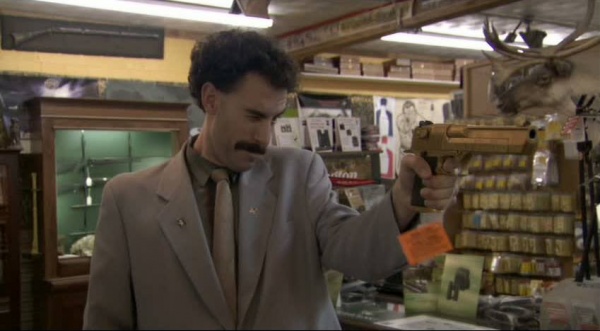
 Believe the hype. Sacha Baron Cohen holds a mirror up to America, and you might not like what you see — although you’ll laugh your head off while watching it. Cohen stars as bushy haired Kazakhstan journalist Borat Sagdiyev, a role he created for Da Ali G Show, the 2001 series in which he interviewed such luminaries as Newt Gingrich, Boutros Boutros-Ghali, Andy Rooney, and Norman Mailer while pretending to be a British hip-hop wigger (Ali G); he also disguised himself as a German fashionista (Bruno) and Borat, a reporter who likes to talk about sex, especially with his sister. In Borat: Cultural Learnings of America for Make Benefit Glorious Nation of Kazakhstan, Borat leaves his little village in Kazakhstan and travels across the United States with his producer, the rotund Azamat (Ken Davitian), in search of his true love, Baywatch’s Pamela Anderson. Along the way, he is making a documentary about the American way of life, turning a revealing lens on racism, anti-Semitism, sexism, misogyny, homophobia, blind patriotism, fundamentalism, and southern hospitality, with a healthy dose of toilet humor (literally).