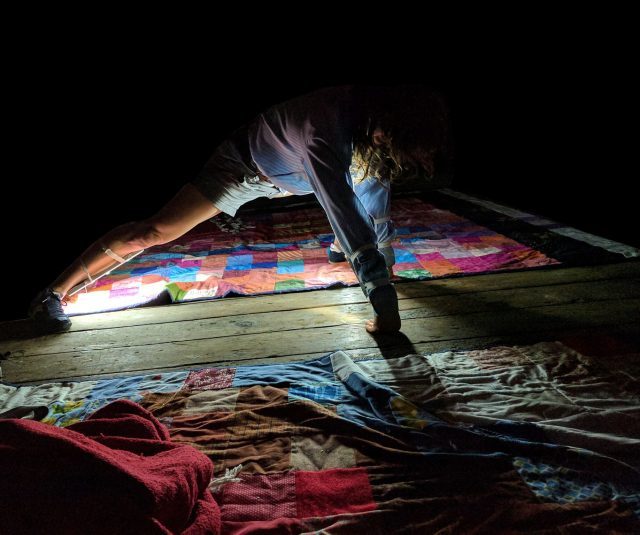
Emily Johnson in her Wassaic residency, laying the groundwork for Randall’s Island event (photo by Karl Allen)
Randall’s Island Park
Saturday, August 19, $50, dusk to after sunrise
www.catalystdance.com
www.ps122.org
Born in Alaska of Yup’ik descent, Bessie Award-winning multidisciplinary artist and Guggenheim Fellow Emily Johnson has been forging a unique identity as an innovative creator for more than fifteen years, engaging with a wide range of diverse collaborators to present immersive works that combine dance with other artistic forms, structured around a heartfelt connection with the natural environment, civic responsibility, and Indigenous cultures. A charming, ever-enthusiastic dancer and choreographer who recently moved from Minneapolis to New York City, Johnson and her aptly named Catalyst troupe have been crazy busy preparing her biggest project yet, Then a Cunning Voice and a Night We Spend Gazing at Stars, a PS122 production that takes place on Randall’s Island from 6:00 pm Saturday night until just after sunrise on Sunday morning, for an audience of three hundred very lucky people. Directed by three-time Obie winner Ain Gordon, the unique gathering will feature stories by Muriel Miguel of Spiderwoman Theater, Karyn Recollet leading a kinstillatory activation and roundtable discussion, specially researched food by futurist Jen Rae, visual design by textile artist Maggie Thompson, lighting by Lenore Doxsee, and performances by Johnson, Tania Isaac, and Georgia Lucas, all situated on and around four thousand square feet of quilts made at sewing bees around the United States and Australia and Taiwan. Johnson, whose previous pieces include Niicugni, Shore, and The Thank-You Bar, somehow found some time to discuss her latest project in this exclusive email interview.
twi-ny: A lot of years have gone into this project. Are you nervous about August 19? I imagine it’s a massive undertaking.
emily johnson: It’s so big. Everything about it. Moving the quilts from where we have them stored on Randall’s Island to the bit of land we lay them down on — that itself is a massive undertaking we do twice a day. The amount of story . . . the movement of light. The ideas written on the quilts — hundreds and hundreds of ideas from hundreds of people who have voiced what they want for their well-being, for their futures. The bringing of care packages, of blankets, of food to the audience. The connection between ground and sky. The hunting and fishing and harvesting. The continual learning of this land and these waters — the stories, plants, histories, and futures here. For two years now I’ve been saying — we can keep preparing. We could go on preparing forever. But in a way, there is only so much we can prepare for. We prepare and prepare and then — the more difficult part — we let go of needing it to go the way in which we’ve prepared. Not totally, of course. Even writing that is hard. But we have to be ready to hold the movement of the night. Because what we have been preparing for is a shared thing. A shared night. We will host you — we will hold you with these quilts, these stories, this movement, this food we’ve made. And we have a beautiful plan, but the biggest part of this plan (ha) is the unknown. We now also have to be prepared to move and respond and be with the collective energy. We have to hold the night, guide it, but listen, too. So, we’re ready. We have to be. I mean all of us. All of us who gather on this night — audience and cast and crew; beings seen and unseen — we have to be ready to listen, to let go of things moving in the direction they are on, and of course to put our actions into moving things in a direction that is good. We have to be ready to pay attention to one another, to rest and then gather the resources of time, energy, intent to actually make this world one we can continue to live in, one our kids can live in, one that the kids seven generations from now will not curse us for but, instead, be thankful for. That’s our job. And, of course, what is special about this night is that it is a continuation of this labor. We have gathered ideas, made quilts, made stories and dance, harvested food. . . . But really, what I can say is that hundreds of people have gathered these ideas, made these quilts, harvested, hunted, farmed, and gifted vegetables, meat, fish, fruits, herbs . . . so . . . What is there to be nervous about? (I say that with a smile, of course.) We are all in this together.
twi-ny: How did you come about choosing to do this on Randall’s Island?
ej: Randall’s Island is something special. To me it’s an energy. We are in the city but we are on another island in this city. The actual ground we lay the quilts on is backfill from one of the subway constructions, so it’s actually land from Mannahatta, built up for these baseball fields and picnic areas. We are on the bank of the East River — which you can’t really access in such a way most other areas in the city. There is a mix of baseball, soccer, families picnicking, people fishing, the farm on the island, also the industries — the hospital and fire department training grounds, the shelters. What I like is that through this night of community, of performance, of sharing, of discussion — in the morning, we are right here. In the city. In the place we need to begin. Baseball players coming to practice; people coming to fish. We see Rikers Island, we hear the Bronx and the traffic, we see tugboats and the barges moving by. We are not separating this art, this movement, this discussion, this imagination, this action from the world. It’s all here. We step into the day.
twi-ny: You’re very tuned in to the land and the environment; have you encountered anything particularly unique or surprising about the specific space where Then a Cunning Voice is being held?
ej: When I walk up to the spot at Sunken Meadow where we will be most of the night I immediately relax — maybe it’s the expanse of water. Maybe it’s the anticipation of gathering people there. It’s like the ground is waiting for this night. The other day we walked from Wards Meadow to Sunken Meadow through a Native flower garden and a praying mantis on Sweet Joe Pye Weed caught my eye. I spent time looking at it. It turned its head toward me. There is energy on Randall’s Island — one that is calling for this relationship, for this exchange.
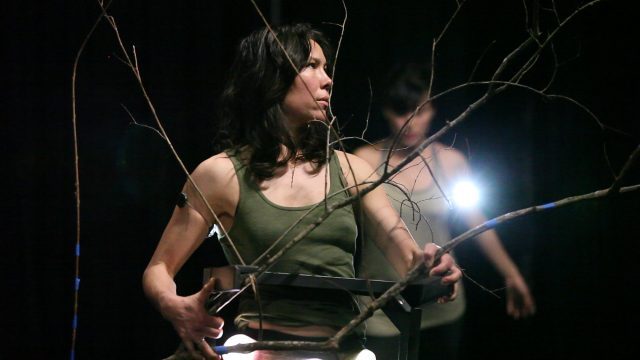
Emily Johnson communes with nature during MANCC residency (photo by Chris Cameron)
twi-ny: Your quilting events have been held all over the country as well as in Taiwan and Australia. When you started, did you ever foresee the kind of results you have gotten? What kind of community has been built around the quilts?
ej: What I have been so beautifully surprised with is the way in which the sewing bees have accumulated, how people and organizations have and keep asking if they can host them. I had no idea people love to sew so much! It’s showing me again and again how deeply people want to spend time together. I have many favorites — the times when the sewing bees are casual and people stop by for a brief time or spend hours. These have been hosted in living rooms, art centers, dance studios, museums, parks. . . . And there are more formal sewing bees, like Umyuangvigkaq, which we hosted with PS122 as part of the Coil Festival in January, a seven-hour-long sewing bee and Long Table Discussion centered on Indigeneity in the performing arts world and the world at large. We gathered a brilliant council of Indigenous women to lead the provocations — Karyn Recollet, Dr. Mique’l Dangeli, Lee-Ann Buckskin, Vicki Van Hout, myself — and built a day of deep discussion. I could feel the shifts happening. The cracks opening. I looked around and saw a large gathering of people dedicated to this conversation, to making the deep personal inquiries that go into healing. Because this is what we need. We need those deep personal inquiries that go into decision making but that come from our own narratives and histories. This is where change/shift/possibility comes from. This spring at a school in Melbourne, I was working with a group of students who are newly arrived refugees to Australia. They are separated from their families. They are having a difficult go. They are hopeful. As we sat and sewed, laughed, and talked about what we each wanted for the well-being of the world, one of the students looked up and said, “These quilts — they’re like maps to the futures we envision.”
twi-ny: You are working again with Georgia Lucas, who was part of Shore. She’s now twelve; what is so special about this young talent?
ej: During the first provocation of Umyuangvigkaq, which was about confronting perceived invisibility and led by Lee-Ann Buckskin and Dr. Mique’l Dangeli, Georgia looked up from her sewing and said to the large gathering of adults in the room, “This conversation makes me understand . . . I was born here . . . but the land does not belong to me. I belong to the land.”
She knows and learns and inquisites deeply. She shares her energy through her stories and movement in a way that is calculated — she knows and feels when is right and if she trusts you, you’ll receive what she has to share. I think this is a pretty brilliant way to perform. I’ve actually never seen someone perform like this before. We teach one another about sharing energy. Also, she’s just awesome to hang out with. And she knows the best superhero movies to see.
twi-ny: People will be spending ten to twelve hours on Randall’s Island, from dusk to after sunrise. What is the one thing they shouldn’t forget to bring with them?
ej: This process has brought us to create a work in which we are all part. We are all responsible for making this night a good one for one another. Partly that’s in being game — to be outside, through bugs and wind (oh god, hopefully not rain!), to be up all night or most of it, to be at but also inside of a performance, to engage in discussion, to be asked to understand the reality of being a guest here — if you are a guest here, which, if you are not Lenape or of one of the Indigenous Nations with deep ties to Lenapehoking, you/I/we are. How are we good guests — of this night, of this land? How do we let this knowledge be resonant in our lives and how does this change every single thing about how we relate to and understand where we live — the physical place and the circumstantial place of August 2017? So, how do I say — “Don’t forget to come with an open heart!” without sounding totally cheesy? But we need that. We need open hearts. I say it in one of my stories: “We unfold our hearts.” I hope for that. For this night but also for the shifts we must become ready to make for our future and our world. And on the practical side — we are sharing a gorgeous bounty of food and food knowledge conceived of, researched and prepared by food futurist Jen Rae (Metis) — as this is a zero-waste event — don’t forget your cup, your bowl, utensils, and cloth napkin!
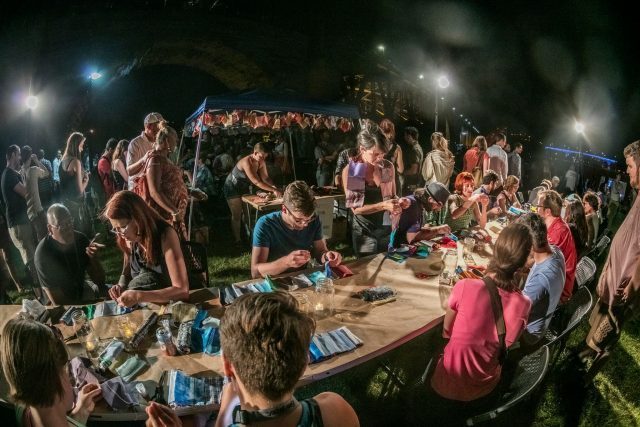
Emily Johnson leads sewing bee at Northern Spark in Minneapolis (photo by Erin Westover)
twi-ny: You’ve long been an Indigenous activist; what are your views about the Dakota Access Pipeline and Standing Rock Indian Reservation? What are some other Indigenous-related problems going on in America that are not getting as much publicity?
ej: I like this question, Mark. But first I need to shift the second part to read: Indigenous-related solutions. Because this is what I see — Indigenous people, Indigenous women especially, at the center, at the apex, at the front lines always, always, always of the solutions. We are a steady working, powerfully supple and surgent force. It is Indigenous women who began the stand against the Dakota Access Pipeline. It is Indigenous women who lead the legal, political, cultural, and familial decisions and discussions. I refuse to say fight. It is Indigenous women — with the help of our Indigenous men, Two-Spirits, children, ancestors, and non-Indigenous allies who see what needs to change and who work through language, art, politics, protections toward the solutions that are part of our everyday — food sovereignty, land rights, education, economic growth, and justice in our communities, healing. We are doing this work. Individually, collectively, in large circles and smaller ones. We need ally-ship. We need those of you who are from the dominant, settler side of things to take a step back, to listen more than you speak, to be in relation with us so we can do the work we need to — for all of us.
twi-ny: You were born in Alaska, lived for a long time in Minneapolis, and recently moved to New York. How are you liking it here? I see you out a lot, so you seem to make time to enjoy the city even as you prepare for Then a Cunning Voice.
ej: I love living here. Every time I come back here from tour, from Australia, from Alaska, I am so happy that this is now my home. The two places in this country I feel most myself are Alaska and NYC — it’s the landscape, I think. Different landscapes, of course. But huge. Huge landscapes that you must tune attention to, be in relation with. Both places call for a kind of looking out for one another. You help your neighbor. You ask for help. Because we all can see the reality of not helping. If you pass someone by broken down on the road in the bush in Alaska — well, you don’t — because you recognize the danger that the weather or the wilds can present. It’s the same here — just different weather and different wilds. I see more kindnesses extended here each day. And actually, as a shy person . . . it’s so nice to step out into it, become part of it.
twi-ny: Then a Cunning Voice is very much a positive look at our future. These are very tough times in America; do you really have that much hope in humanity?
ej: I do, Mark. I have that much hope.
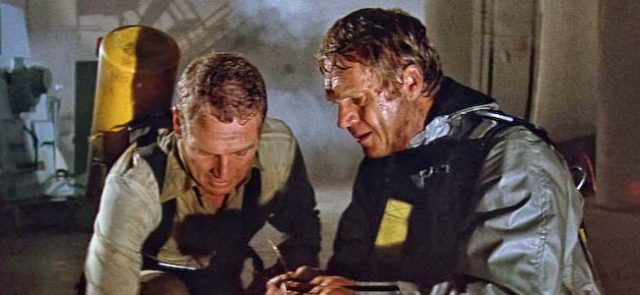
 Disaster flicks were a big thing in the 1970s, and none was bigger than The Towering Inferno. The $14.3 million epic, the first coproduction between two major studios, Warner Bros. and 20th Century-Fox, was based on two novels, Richard Martin Stern’s The Tower and Thomas N. Scortia and Frank M. Robinson’s The Glass Inferno and stars a host of Hollywood greats, led by the dynamic duo of Paul Newman and Steve McQueen. Newman is recently retired architect Doug Roberts, who has come back to San Francisco for the opening-night party celebrating the final building he designed, the 138-story Glass Tower, owned by wealthy businessman James Duncan (William Holden). When a small electrical fire starts in a storage room on the eighty-first floor, Roberts becomes suspicious that Duncan’s son-in-law, smarmy electrical engineer Roger Simmons (Richard Chamberlain), did not follow the specs exactly and cut critical corners. As the fire grows, security chief Harry Jernigan (O. J. Simpson) calls in the fire department, anchored by battalion chief Mike O’Hallorhan (McQueen) and his right-hand man, Kappy (Don Gordon). O’Hallorhan insists that Duncan move the elegant party in the Promenade Room on the 135th floor to the lobby, but by the time Duncan agrees, the flames have spread and escape options become more and more limited — and dangerous. Among the others struggling to survive are con man Harlee Claiborne (Fred Astaire, earning his sole Oscar nomination), his potential target, Lisolette Mueller (Jennifer Jones, in her last performance), U.S. senator Gary Parker (Robert Vaughn), slick public relations man Dan Bigelow (Robert Wagner), his secretary and mistress, Lorrie (Susan Flannery), Duncan’s daughter, Patty Duncan Simmons (Susan Blakely), the deaf Mrs. Allbright (Carol McEvoy) and her two children, Angela (Carlena Gower) and Phillip (The Brady Bunch’s Mike Lookinland), and Roberts’s fiancée, Susan Franklin (Faye Dunaway). Meanwhile, throughout it all, bartender Carlos (Gregory Sierra) remains cool and calm.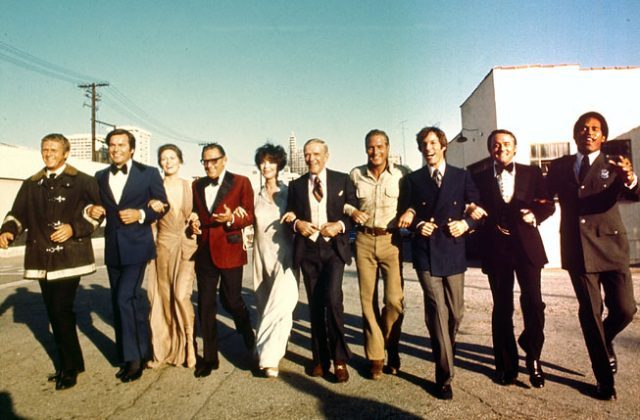
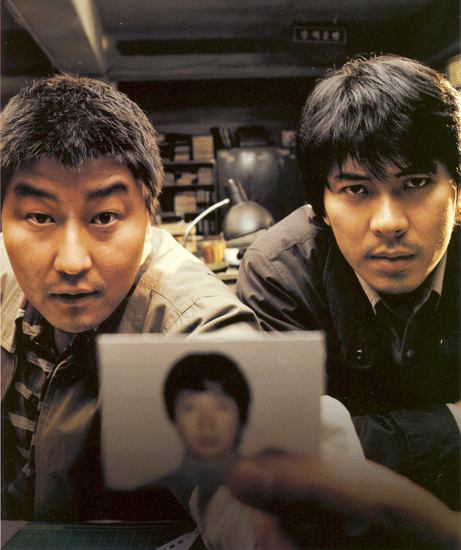
 In 2006, South Korean writer-director Bong Joon-ho burst onto the international cinematic landscape with the sleeper hit The Host, a modern-day monster movie with a lot of heart. He followed that up with the touching segment “Shaking Tokyo” in the compilation film
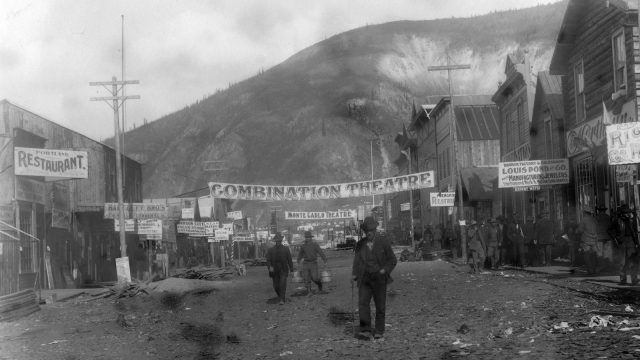
 “What power has gold to make men endure it all?” a title card asks in William Desmond Taylor’s 1928 silent film, The Trail of ’98, based on a novel by Robert Service. Both Taylor and Service were at one time residents of Dawson City, the town in the Yukon in Canada that was at the center of the Klondike Gold Rush in the late 1890s. In June 1978, while construction was just under way to build a new recreation center behind Diamond Tooth Gertie’s Gambling Hall in Dawson, Pentecostal minister and city alderman Frank Barrett uncovered a treasure trove of motion picture stock, hundreds of silent films that had been believed to have been lost forever. Writer, director, and editor Bill Morrison uses stunning archival footage from those films in his elegiac, beautiful documentary, Dawson City: Frozen Time, which brilliantly tells the story of greed, perseverance, and the growth of the entertainment industry in the late nineteenth and early twentieth centuries. After gold was discovered in Dawson, the indigenous Hän people were relocated to Tr’ochëk and some hundred thousand prospectors stampeded in, the gold mining destroying the Hän’s fishing and hunting grounds. Morrison also follows the invention of film itself, celluloid stock that would end up causing many fires, including one every year in Dawson for nine years. Bookended by an original interview with Michael Gates, Parks Canada curator of collections, and his wife, Kathy Jones-Gates, director of the Dawson Museum, the film traces the boom-and-bust fortunes and misfortunes of Dawson, as gambling casinos, movie theaters, hotels, and restaurants are built, including the Arctic, a hotel and restaurant owned by Ernest Levin and Fred Trump, the president’s grandfather, that might have served as a brothel as well. The film is supplemented with photographs by Eric A. Hegg, a giant in the field who left behind glass plates when he ultimately departed Dawson. Among others making their way through Dawson at one time or another are newsboy Sid Grauman, who went on to build Grauman’s Chinese Theatre; New York Rangers founder Tex Rickard; comic superstar Fatty Arbuckle; and Daniel and Solomon Guggenheim, who dominated the mining there.