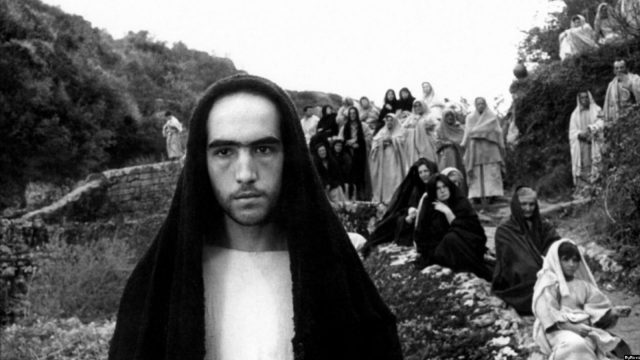
Film Society of Lincoln Center series highlights classic works featuring nonprofessional actors, including Pier Paolo Pasolini’s The Gospel According to St. Matthew
Film Society of Lincoln Center
Walter Reade Theater, 165 West 65th St. at Amsterdam Ave.
Francesca Beale Theater, 144 West 65th St. at Amsterdam Ave.
November 24 – December 10
212-875-5601
www.filmlinc.org
Ever since the invention of the motion picture, men and women have been trying to capture real life on film at twenty-four frames per second, not only in documentaries but in works of fiction. The more believable a situation or character feels, whether in a crime drama, sci-fi tale, Western, or romantic comedy, the more successful the movie often is. And now, in the age of social media and the YouTube star, the time is ripe for “The Non-Actor,” an ambitious twelve-day series at the Film Society of Lincoln Center consisting of more than forty films from around the world made between 1928 and 2013 featuring nonprofessional actors in lead or key roles. In addition to the below films, the series, running November 24 to December 10, includes such wide-ranging highlights as Ousmane Semebene’s Black Girl, Spencer Williams’s The Blood of Jesus, Lizzie Borden’s Born in Flames, Shirley Clarke’s The Cool World, Roberto Rossellini’s Germany Year Zero, Sergei Eisenstein’s October, and Robert Flaherty’s Louisiana Story. As the late Robin Williams famously said: “Reality . . . What a Concept.”
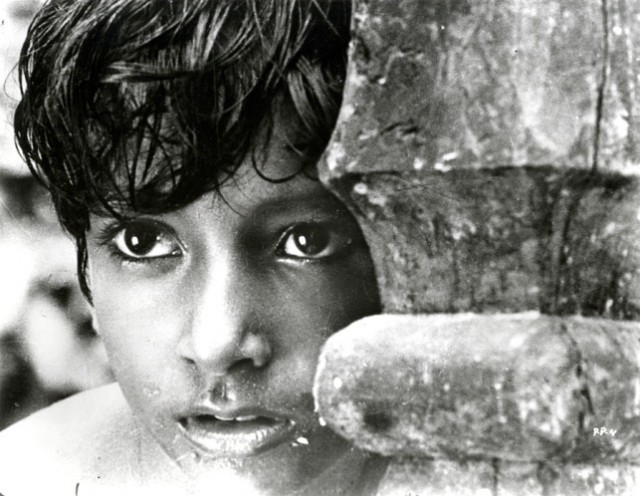
Apu (Subir Banerjee) watches life unfold in his small Indian village in Satyajit Ray’s Pather Panchali
PATHER PANCHALI (SONG OF THE LITTLE ROAD) (Satyajit Ray, 1955)
Friday, November 24, 1:30, and Sunday, November 26, 6:00
www.filmlinc.org
 A groundbreaking work in the history of world cinema, Satyajit Ray’s Pather Panchali and its two sequels, Aparajito and Apur Sansar, have been meticulously restored by the Criterion Collection and the Academy Film Archive following a nitrate fire in 1993 — the year after Ray was awarded an honorary Oscar on his deathbed. Inspired by a meeting with Jean Renoir in Kolkata, where Renoir was shooting The River, and watching ninety-nine films in six months while working as a graphic designer for an advertising agency in London, Ray decided to make his first film, adapting Bibhutibhushan Banerjee’s 1929 novel, which he knew well; Ray had contributed illustrations to a later edition of the book. The film took nearly five years to make as Ray faced repeated financing problems, such delays as cattle eating flowers that were needed for an important scene, and a cast and crew primarily of nonprofessionals. Despite all those issues, Pather Panchali is a stunning masterpiece, a bittersweet and captivating tale of a rural family mired in poverty, struggling to survive in extremely hard times. In a small village, Sarbajaya (Karuna Banerjee) is raising her daughter, Durga (Runki Banerjee), a rambunctious teen, and son, Apu (Subir Banerjee), while her husband, dreamer Harihar (Kanu Banerjee), a wannabe playwright and poet, goes off for months at a time, trying to find work in the city. (The actors shared a common surname but were not related in real life.) Sarbajaya is also caring for their elderly cousin, “Auntie” Indir (retired theater actress Chunibala Devi), who walks very slowly, hunched over and with impossibly leathery skin. The family goes about its business from day to day, as the kids play with friends, figure out how they can get something from the sweets man, and hang out with Auntie, who offers a fresh perspective on life. Sarbajaya is embarrassed that she cannot pay back several rupees she owes her relatively wealthy neighbor, who owns an orchard from which Durga steals fruit. It’s a meager existence, but it avoids being completely dark and bleak because of Auntie’s sense of humor and Apu’s wide-eyed innocence. The film is told from his point of view — in fact, the first time we see him, he is lying down, covered, and one of his eyes pops open, dominating the screen. It’s a difficult, challenging life, but there’s always hope.
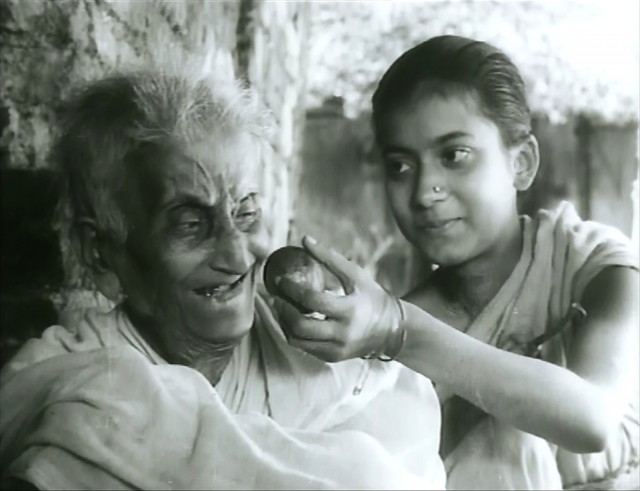
Durga (Runki Banerjee) offers Auntie (Chunibala Devi) a stolen treat in Pather Panchali
The episodic Pather Panchali was heavily influenced by Italian Neorealism while also evoking works by Ozu, Kurosawa, and Renoir, providing an alternative to the flashier, popular Bollywood style. First-time writer-director Ray and first-time cinematographer Subrata Mitra maintain a lyrical, poetic pace, accompanied by a traditional score by sitar legend Ravi Shankar. The film succeeds both as a cultural testament, lending insight into the poor of India, as well as a fully realized cinematic story; it won the country’s National Film Award for Best Feature Film while also earning Best Human Document honors at Cannes. Sarbajaya, Durga, Apu, and Auntie are almost always barefoot, wearing the same clothes, scraping the bottom of the pan with their fingers for that last grain of rice, but there’s an elegance and grace, an intoxicating honesty, to their simple, laborious daily lives. Ray would go on to make such other films as Teen Kanya, Jalsaghar, Ashani Sanket, Devi, and Agantuk, but he is most remembered for “The Apu Trilogy,” which looks absolutely gorgeous in the new 4K restorations, reaffirming its lofty place in the coming-of-age pantheon alongside François Truffaut’s Antoine Doinel series. Pather Panchali is being shown November 24 and 26 in the Film Society of Lincoln Center series “The Non-Actor.”
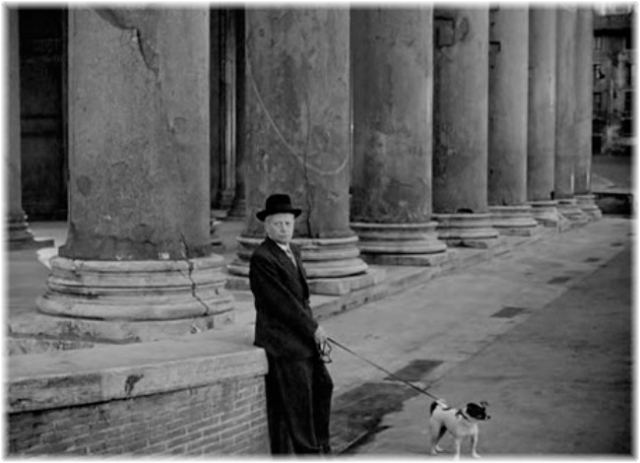
De Sica neorealist classic is the heartbreaking story of an elderly man and his faithful dog
UMBERTO D. (Vittorio De Sica, 1952)
Friday, November 24, 4:00, and Wednesday, November 29, 1:00
www.filmlinc.org
We don’t think we’ll ever stop crying. Vittorio De Sica’s neorealist masterpiece Umberto D. stars Carlo Battisti (a professor whom De Sica saw one day and thought would be perfect for the lead role; it would be Battisti’s only film) as Umberto Domenico Ferrari, an elderly former bureaucrat who is too proud to sacrifice his dignity in order to pay his mean-spirited landlady (Lina Gennari), who rents out his room by the hour while he’s out walking his beloved dog, Flag, and trying to find some way to get money and food. Umberto D. is befriended by the boardinghouse maid (Maria Pia Casilio), who is pregnant with the child of one of two servicemen, neither of whom wants to have anything to do with her. As Umberto D.’s options start running out, he considers desperate measures to free himself from his loneliness and poverty. His relationship with Flag is one of the most moving in cinema history. Don’t miss this remarkable achievement, which was lovingly restored last decade by eighty-six-year-old lighting specialist Vincenzo Verzini, known as Little Giotto. Umberto D. is screening November 24 and 29 at the Walter Reade Theater and will be preceded by Cesare Zavattini and Francesco Maselli’s half-hour Story of Caterina, from the omnibus Love in the City.
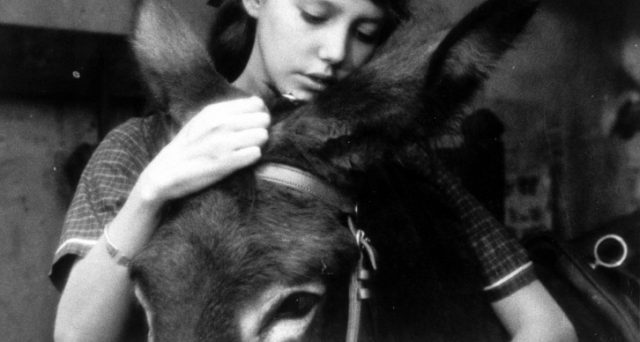
The tender love between a young girl (Anne Wiazemsky) and a donkey lies at the heart of Robert Bresson’s Au hasard Balthazar
AU HASARD BALTHAZAR (Robert Bresson, 1966)
Saturday, November 25, 4:00, and Tuesday, November 28, 4:00
www.filmlinc.org
Robert Bresson’s heartbreaking 1966 masterpiece, Au hasard Balthazar, is an unforgettable tale of the life and times of a most unusual yet completely ordinary donkey. As the opening credits roll, we hear writer and pianist Jean-Joël Barbier performing Franz Schubert’s Sonata No. 20, interrupted by the braying of a donkey and concluding with the sound of bells ringing. In a small rural community in France, a donkey has been born. Young Jacques and his sister baptize him and name him Balthazar, after one of the three Magi who presented the infant Jesus with gifts. Jacques and his neighbor, Marie, adore the donkey, treating him not only as their friend but their surrogate child, believing they are destined to marry. But they are torn apart by a land dispute between their fathers, and when they become teenagers, although the upstanding Jacques (Walter Green) still desires Marie (Anne Wiazemsky), she shamefully gives herself to Gérard (François Lafarge), the sinister leader of a local gang of bike-riding juvenile delinquents. Gérard abuses Marie as well as Balthazar, who soon sets off on a journey inspired by Fyodor Dostoyevsky’s The Idiot and the Stations of the Cross, going from owner to owner in a series of vignettes that also represent the seven deadly sins. His big, dark eyes appearing to understand what is happening to him, Balthazar encounters lust, gluttony, greed, sloth, wrath, envy, and pride but soldiers on, loved by Marie, who becomes ever-more helpless, unable and unwilling to take control of her destiny, much to the disappointment of her parents (Philippe Asselin and Nathalie Joyaut). Her sad fate seems predetermined, as does that of her beloved Balthazar, who literally and figuratively bears the heavy weight of the sins of all around him.
“Everyone who sees this film will be absolutely astonished because this film is really the world in an hour and a half,” Jean-Luc Godard famously said about Au hasard Balthazar, and that gets right to the heart of the film. (Godard went on to cast Wiazemsky in several of his movies; the two were married from 1967 to 1979.) Written and directed by Bresson (Pickpocket, Diary of a Country Priest), beautifully edited by Raymond Lamy, stunningly photographed in black-and-white by Ghislain Cloquet, and featuring primarily nonprofessional actors, Au hasard Balthazar is about young love, sacrifice, honor, family, life and death — and the very essence of humanity, most evidently seen in the form of an amazing animal. The film is rife with biblical overtones, but it is not merely citing dogma, nor is it a direct parable, instead exploring the contradictions inherent in religion. Marie is part Mother Mary, part Mary Magdalene, but mostly just a deeply troubled girl. One night Gérard and his gang beat Balthazar as Marie watches, saying nothing; the next morning, she looks up in church as he sings a Latin hymn that is bookended by the ringing of Balthazar’s bells and the chiming of the church bells.
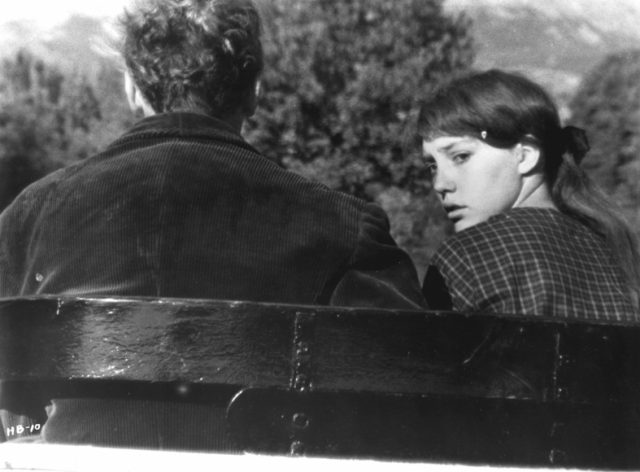
Metrograph will host week-long fiftieth-anniversary presentation of extraordinary Au hasard Balthazar
The Book of Proverbs explains that “idle hands are the devil’s workshop,” and Bresson expands on this concept by continually focusing on hands. Sitting on a bench in the dark, Marie puts her left hand over her heart, then slowly moves it onto the bench, where another hand emerges from the shadows to gently touch hers. She runs away, but Bresson’s camera still follows her hand as it closes and then opens a door. Later, as Gérard prepares to set Balthazar’s tail on fire, a car passes by, and the camera centers on Gérard’s hands, fidgeting nervously as he worries about being caught. When the drunkard Arnold (Jean-Claude Guilbert) is questioned by the police about a murder, Bresson zooms in on three men’s hands as Arnold gives his papers to the captain (Jacques Sorbets), who gives them to an associate, who then asks for Arnold’s hands so he can take his fingerprints, as if the hands themselves are guilty, stained with sin. “Holding on to me, too?” Arnold says. And when Balthazar performs a trick at a circus, his front hooves become the primary objects of attention. Screening at Lincoln Center on November 25 and 28, Au hasard Balthazar is filled with such glorious moments, layers of meaning attached to every sound and image, a staggering cinematic achievement that amply deserves its status as one of the greatest films ever made.
THE EXILES (Kent Mackenzie, 1961)
Wednesday, November 29, 8:45, and Friday, December 1, 4:45
www.filmlinc.org
www.exilesfilm.com
 Having restored Charles Burnett’s Killer of Sheep and My Brother’s Wedding, Milestone, the UCLA Film & Television Archive, and preservationist Ross Lipman teamed up again to bring back Kent Mackenzie’s black-and-white slice-of-life tale The Exiles, which debuted at the 1961 Venice Film Festival and screened at the inaugural 1964 New York Film Festival before disappearing until its restoration, upon which it was selected for the 2008 Berlin International Film Festival. The Exiles follows a group of American Indians as they hang out on a long Friday night of partying and soul searching in the Bunker Hill section of Los Angeles, centering on Homer (Homer Nish) and Yvonne (Yvonne Williams), who are going to have a baby. After Yvonne makes dinner for Homer and his friends, the men drop her off at the movies by herself while they go out drinking and gambling and, in Tommy’s (Tommy Reynolds) case, looking for some female accompaniment. As the night goes on, Homer, Yvonne, and Tommy share their thoughts and dreams in voice-over monologues that came out of interviews Mackenzie conducted with them. In fact, the cast worked with the director in shaping the story and getting the details right, ensuring its authenticity and realism, giving The Exiles a cinéma vérité feel. Although the film suffers from a poorly synced soundtrack — it is too often too clear that the dialogue was dubbed in later and doesn’t match the movement of the actors’ mouths — it is still an engaging, important independent work (the initial budget was $539) about a subject rarely depicted onscreen with such honesty. Mackenzie, who followed up The Exiles with the documentaries The Teenage Revolution (1965) and Saturday Morning (1971) before his death in 1980 a the age of fifty, avoids sociopolitical remonstrations in favor of a sweet innocence behind which lies the difficulties of the plight of American Indians assimilating into U.S. society. The Exiles is screening November 29 and December 1 at the Francesca Beale Theater.
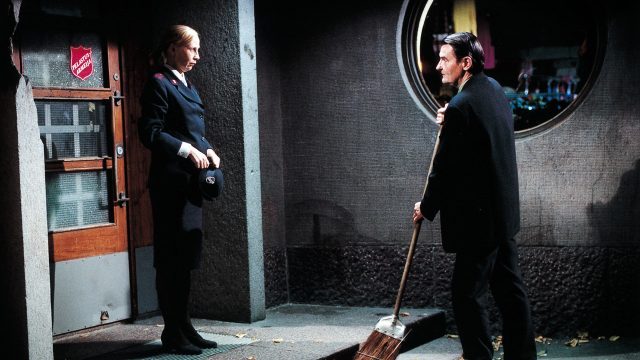
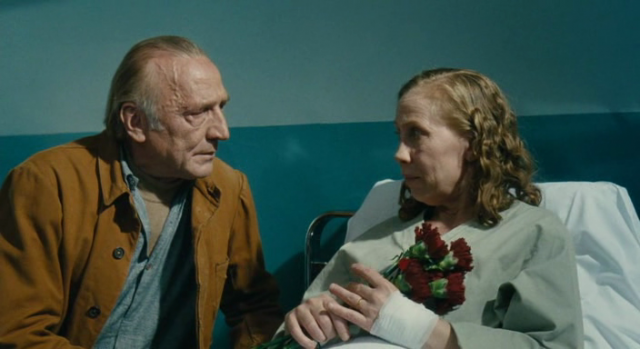
 For more than thirty years, Finnish auteur Aki Kaurismäki (Leningrad Cowboys Go America, Drifting Clouds) has been making existential deadpan black comedies that are often as funny as they are dark and depressing. Has there ever been a film as bleak as 1990’s The Match Factory Girl, in which a young woman (Kati Outinen) suffers malady after malady, tragedy after tragedy, embarrassment after embarrassment, her expression never changing? In his latest film, the thoroughly engaging Le Havre, Kaurismäki moves the setting to a small port town in France, where shoeshine man Marcel Marx (André Wilms), a self-described former Bohemian, worries about his seriously ill wife (Outinen) while trying to help a young African boy (Blondin Miguel), who was smuggled into the country illegally on board a container ship, steer clear of the police, especially intrepid detective Monet (Jean-Pierre Darroussin), who never says no to a snifter of Calvados. Adding elements of French gangster and WWII Resistance films with Godardian undercurrents — he even casts Jean-Pierre Léaud in a small but pivotal role — Kaurismäki wryly examines how individuals as well as governments deal with illegal immigrants, something that has taken on more importance than ever amid the growing international economic crisis and fears of terrorism. Through it all, Marcel remains steadfast and stalwart, quietly and humbly going about his business, deadpan every step of the way. Wouter Zoon’s set design runs the gamut from stark grays to bursts of color, while longtime Kaurismäki cinematographer Timo Salminen shoots scene after scene with a beautiful simplicity. Winner of a Fipresci critics award at Cannes and Finland’s official entry for the Best Foreign Language Film Oscar, Le Havre, the first of a proposed trilogy, is another marvelously unusual, charmingly offbeat tale from a master of the form. A selection of the 2011 New York Film Festival, Le Havre is screening at Film Forum on November 25 and 27.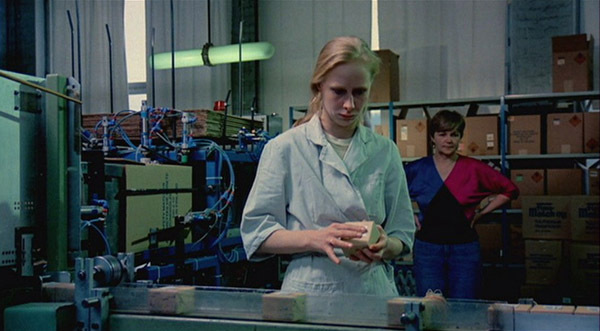


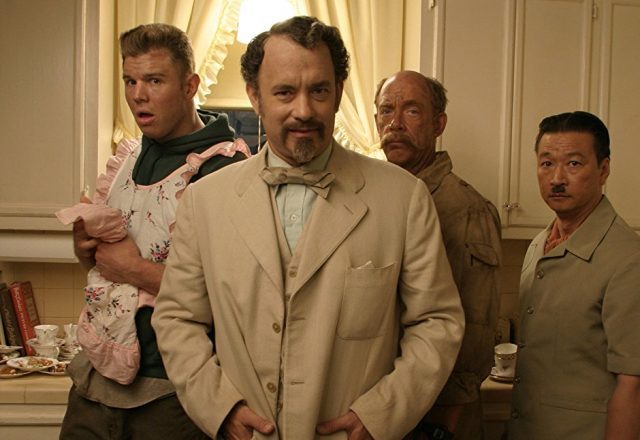
 By far the worst film the Coen brothers have ever made, this remake of the classic 1955 Alexander Mackendrick caper comedy is a travesty from start to finish, an absolute embarrassment to all involved, including Tom Hanks, Irma P. Hall, Marlon Wayans, J. K. Simmons, Tzi Ma, Ryan Hurst, and Diane Delano. Did anyone actually watch this film before they released it? We barely smiled once and never laughed at this ridiculous story of a group of losers using a woman’s root cellar as home base to rob a riverboat casino. Besides not being the slightest bit funny, the movie is also racist, as every black actor in the film is playing a stereotype. We get the Coens, but we don’t get this. Was it meant to be ironic? Cynical? Slapstick? All we know is that it’s just plain awful. The Ladykillers is screening at MoMA November 24.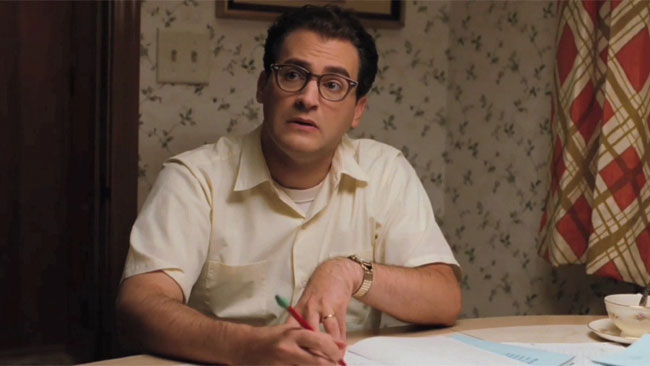
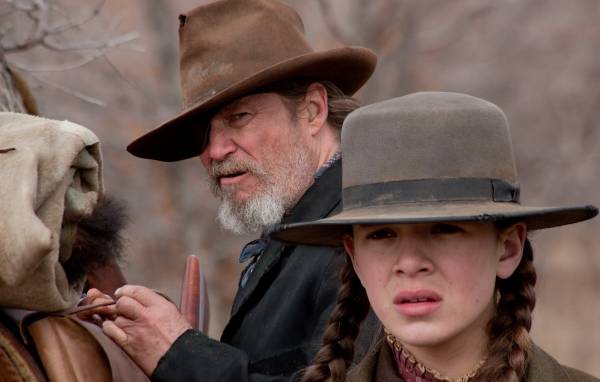

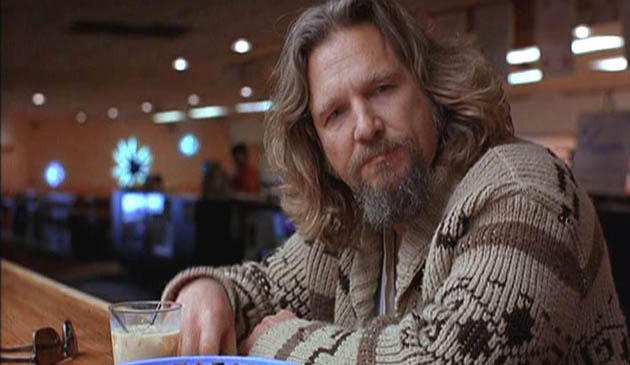
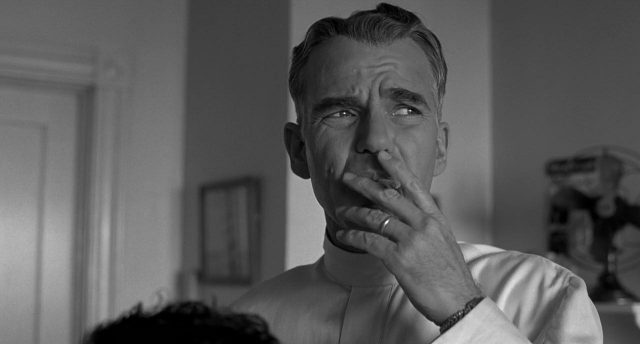
 The first half of this Coen brothers movie is stupendous. Shot in color by Roger Deakins and processed in magnificent black and white to get a richer palette, the film tells the story of Ed Crane, Billy Bob Thornton’s best role yet, a barber with almost nothing to say — ever. When he does talk, he talks slow, slower than he walks. Even his voice-over narration is delivered in a slow monotone. For about forty-five minutes, the pace is fabulous, but then it begins wearing down as the plot goes all over the place. It feels like the Coens had a bunch of different film ideas and decided to throw them all into the last hour of this movie, which seems to go on and on and on and on, with at least four places where you’ll think it’s over. The laughs go away, and a creepy, unfriendly moodiness pervades. At least you can still keep track of the awesome wigs that many of the male characters wear, and for the Californians out there it might be fun guessing the shooting locations, because much of the film was not shot on studio sets. Locations include Musso and Frank’s, a Presbyterian church on Wilshire Blvd., an empty Bank of America branch in Los Angeles, an abandoned furniture store in Glendale, Bungalow Heaven and Castle Green in Pasadena, and the streets of Orange in Orange County. The rather remarkable cast also includes Frances McDormand, Michael Badalucco, Richard Jenkins, Scarlett Johansson, Jon Polito, Tony Shalhoub, and James Gandolfini. The Man Who Wasn’t There is screening December 27 at MoMA.