twi-ny recommended events

STEFAN FALKE — MOKO JUMBIES: THE DANCING SPIRITS OF TRINIDAD

(photo © Stefan Falke)

Stefan Falke will be at Deutsches Haus at NY for special conversation about his moko jumbies photos on February 12 (photo © Stefan Falke)

Who: Stefan Falke, Laura Anderson Barbata
What: Exhibition opening and artist talk
Where: Deutsches Haus at NYU, 42 Washington Mews
When: Monday, February 12, free, 6:00
Why: From 1997 to 2004, German-born, New York-based photographer Stefan Falke photographed Trinidadian stilt walkers, known as moko jumbies, collecting his pictures in the book Moko Jumbies: The Dancing Spirits of Trinidad (Pointed Leaf Press, 2005, $65). Falke will be at NYU’s Deutsches Haus on February 12 at 6:00 for the opening of his latest exhibition, featuring photos of the Dragon Keylemanjahro School of Art & Culture in Cocorite, which have never been on view in New York City before. Falke, who has also published La Frontera, portraits of artists on either side of the US-Mexico border, will be speaking with Mexico City native Laura Anderson Barbata, a multidisciplinary artist who lives and works there and in Brooklyn and who has also photographed moko jumbies for her project “Transommunality.” “Moko Jumbies: The Dancing Spirits of Trinidad” continues at Deutsches Haus through March 31.

PARTY FACE

(photo by Jeremy Daniel)

Oscar-winning actress Hayley Mills returns to the New York stage in Party Face (photo by Jeremy Daniel)

Stage II at New York City Center
Thursday – Monday through April 8, $38-$128
212-581-1212
www.partyfaceplay.com

There’s a good amount of fun to be had in Isobel Mahon’s Party Face, continuing at New York City Center’s Stage II through April 8. But there’s also something just a little bit off, detracting from the overall impact of the play, which was named Best Production at the 1st Irish Awards. The night I went, the onstage clock was an hour fast, so when one character arrives early, the party host says, “It’s only twenty to . . . I said eight.” But the time on the clock was actually twenty to nine, and no one ever corrected the issue as the play continued and the clock kept real, running time. Of course, I don’t know if the clock is off for every performance, that maybe it is supposed to represent how everything is askew in this self-contained world, but there are other problems as well — in addition to some pure pleasures. Recently released after a stay in a psychiatric ward, Mollie Mae (Gina Costigan) is hosting a small gathering to show off the new extension on her kitchen, which features an impressive refrigerator, large cabinets, and a marble island in the center, with one corner smashed up. It’s her domineering, judgmental mother, Carmel (Hayley Mills), who has arrived early, bearing fancy nibbles to counteract her daughter’s low-rent crisps and hummus. She has also arrived with her share of quips belittling Mollie, complaining about her makeup, what she’s wearing, and even the flowers she has put out. “Oh, lovely flowers,” the impeccably dressed and styled Carmel, who is all about appearance, says. “’Course, in my day you never saw a lily outside of a funeral parlor.” Mollie is upset when Carmel tells her that she has taken the liberty of inviting one of Mollie’s neighbors, Chloe (usually played by Allison Jean White, but we saw her understudy, Alison Cimmet), an overly glamorous gossip queen who never misses a chance to stick it to Mollie, all in the guise of being a caring friend. They are soon joined by Mollie’s sister, Maeve (Brenda Meaney), a tough, cynical divorcee who rolls her eyes at most of what her mother and Chloe say. The last guest is Bernie (Klea Blackhurst), an oddball woman who met Mollie in the mental hospital and has a liking for wrapping everything in cling film, the British term for plastic wrap. Insults fly, secrets are revealed, and all kinds of objects get wrapped in cling film as the five very different women relentlessly go at it; the only sign of a man is an offstage topiary bush in the shape of male genitalia, trimmed by Mollie’s absent husband, an architect named Alan.

(photo by Jeremy Daniel)

A small gathering results in a series of revelations in Isobel Mahon’s Party Face (photo by Jeremy Daniel)

Party Face might not be The Women, but Mahon (So Long, Sleeping Beauty; Box of Frogs) has created five overly caricatured but recognizable ladies who deliver some very funny, if sometimes a bit obvious, dialogue. Mentioning her husband, the superficial and vapid Chloe states, “Turlough says, ‘Chloe, you’re such a good listener, you mustn’t let people take advantage.’ But as I say, ‘Turlough, it’s what gives my life meaning. And I think meaning is so important in life.” Carmel continually sides with Chloe, who is like the daughter she never had, as she keeps taking shots at both Mollie and Maeve. When Carmel discusses how she and her friends have all gotten Botox, Maeve says, “Jesus, it’s an epidemic; your lunches’ll be great gas, sixteen at the table and not a twitch between you.” Carmel replies, “Oh, you can mock, Maeve; wouldn’t do you any harm to have it done yourself. You’re not blessed with Mollie’s good skin.” But it’s Bernie who saves the day, and the play, with her strange pronouncements, her fear of germs, and her genuine honesty. When Chloe asks her if anyone else from their “little community” is coming, Bernie replies, “Well, I asked a couple from our obsessive-compulsive encounter group but they’re both agoraphobics, so they wouldn’t come out.” The audience is virtually another guest at the party, which takes place on Jeff Ridenour’s cozy kitchen / living room set. In her off-Broadway directing debut, Amanda Bearse (Married with Children, Fright Night) keeps all the characters busy, although some of the slapstick is too forced. It’s a joy to see Mills, a child star who appeared in such films as The Parent Trap, Whistle down the Wind, Pollyanna, and Tiger Bay, in such an intimate venue at City Center. No stranger to the stage, she won a Theatre World Award for her 2000 performance in Noël Coward’s Suite in Two Keys and more recently toured with her sister, Juliet Mills, in James Kirkwood’s Legends! Mills, now seventy-one, is delightful as Carmel, an extravagant, vain, and sexy woman who cares most about how things affect her. Costigan (The Suitcase under the Bed, Crackskull Row), Meaney (Indian Ink, Incognito), and Cimmet (Amelie, The Mystery of Edwin Drood) are all solid but they are overshadowed by Blackhurst (Everything the Traffic Will Allow, Hazel), who is impossible to stop watching as she delivers funny lines or keeps wrapping whatever she can get her hands on. Of course, she does so with see-through cling film, so the objects are still visible, much like the party faces that the other women first put on but ultimately pull away to reveal their true selves. Several of the late revelations come out of thin air, attempting to explain some of the interactions between Carmel and her daughters, but it reduces the energy, which is perhaps most evident in the ever-present chunk missing from Mollie’s marble kitchen island. Now, if only I could figure out what’s up with that clock.

CATS ON GLASS GALLERY

cats on glass

524 West 26th St. at Tenth Ave.
February 15, debut and launch party, 6:00
February 16-19, free with advance RSVP, 10:00 am – 6:00 pm
www.freshstep.com/cat-love

What would the internet be without cat videos to cheer up even our darkest days? The feline phenomenon has spread to cat conventions and cat cafés, and now the folks at Fresh Step, makers of cat litter, are lifting the housecat to the lofty position of work of art with the temporary Cats on Glass Gallery. From February 15 to 19, a pop-up interactive exhibit will feature combinations of cats and glass, and yes, you will have the opportunity to adopt a new pet. In addition, by taking pictures and posting them on Instagram, donations will be made to the Humane Society of New York for shelter cats. The exhibit kicks off with a party on February 15 with “Kitten Lady” Hannah Shaw and Nala Cat. Admission to the unpredictable experience is free, but you have to reserve your spot in advance, and times are filling up quickly, just like our cats’ litter boxes.

JULIANNE SWARTZ’S “SINE BODY” WITH ESTELÍ GOMEZ

Swartz

Julianne Swartz will activate her “Sine Body” installation at MAD with vocalist Estelí Gomez on February 11

Museum of Arts & Design
2 Columbus Circle at 58th St. & Eighth Ave.
Sunday, February 11, $20, 4:00
Exhibit continues through February 25, $12-$16 (pay-what-you-wish Fridays 6:00 – 9:00)
212-299-7777
madmuseum.org

On February 11, light, air, and sound artist Julianne Swartz will activate “Sine Body,” her contribution to the Museum of Arts & Design exhibition “Sonic Arcade: Shaping Space with Sound,” joined by Grammy-winning soprano Estelí Gomez. The installation on the fifth floor consists of a table occupied by translucent abstract vessels made of acoustically reflective ceramic and glass that use electronic feedback and air to emit sound with a mallet. For the forty-five-minute performance, the New York–based Swartz (“Digital Empathy” on the High Line, “The Sound of Light” at the Jewish Museum) will play the vessels like instruments, with Gomez (Roomful of Teeth) harmonizing with the resonant Sine tones to create unique frequencies emanating throughout the gallery. The exhibition continues through February 25; on February 10 at 7:00 ($10), as part of “At Play: Performing Artist-in-Residence Series,” Muscle Memory (Steven Reker and Matt Evans) will team up with Ka Baird and the trio War Bubble (Sarah Register, Christina Files, and Eli Lehrhoff) for “this / visitor,” an evening of new music inspired by “Sonic Arcade.”

TICKET ALERT: FORCE MAJEURE / THE SQUARE DOUBLE FEATURE WITH RUBEN ÖSTLUND

FORCE MAJEURE

A close-knit Swedish family is about to face a serious crisis in Ruben Östlund’s Force Majeure

FORCE MAJEURE (Ruben Östlund, 2014)
THE SQUARE (Ruben Östlund, 2017)
Scandinavia House
58 Park Ave. at 38th St.
Tuesday, February 20, $20, 4:00
212-847-9740
www.scandinaviahouse.org
www.magpictures.com

After three skiing films and two documentaries, Swedish writer-director Ruben Östlund experienced near-instant success with his fiction work, which has included five features and two shorts since 2004, earning him numerous international awards. Scandinavia House will be honoring the Styrsö native on February 20 with a double feature of his two latest gems, Force Majeure, which was shortlisted for a Best Foreign Language Film Oscar, and The Square, which is competing for the award at this year’s Oscars. Östlund will be at the Park Ave. cultural institution for a Q&A following The Square, which won the coveted Palme d’Or at Cannes. First up at 4:00 is Force Majeure, one of the best films you’ll ever hear. Not that Fredrik Wenzel’s photography of a lovely Savoie ski resort and Ola Fløttum’s bold, classical-based score aren’t stunning in their own right, but Kjetil Mørk, Rune Van Deurs, and Jesper Miller’s sound design makes every boot crunching on the snow, every buzzing electric toothbrush, every ski lift going up a mountain, every explosion setting off a controlled avalanche a character unto itself, heightening the tension (and black comedy) of this dark satire about a family dealing with a crisis. On the first day of their five-day French Alps vacation, workaholic Tomas (Johannes Bah Kuhnke) and his wife, Ebba (Lisa Loven Kongsli), are enjoying lunch on an outdoor veranda with their small children, Harry (Vincent Wettergren) and Vera (Clara Wettergren), when a potential tragedy comes barreling at them, but in the heat of the moment, while Ebba instantly seeks to protect the kids, Tomas runs for his life, leaving his family behind. After the event, which was not as bad as anticipated, the relationship among the four of them has forever changed, especially because Tomas will not own up to what happened. Even Harry and Vera (who are brother and sister in real life) know something went wrong that afternoon and are now terrified that their parents will divorce. But with Tomas unwilling to talk about his flight response, Ebba starts sharing the story with other couples, including their hirsute friend Mats (Kristofer Hivju) and his young girlfriend, Fanni (Fanni Metelius), who are soon arguing in private about what they would do in a similar situation.

FORCE MAJEURE

There might be no going back in beautiful-looking and -sounding Swedish satire

Winner of the Jury Prize in the Un Certain Regard sidebar of the Cannes Film Festival and the Swedish entry for the 2014 Academy Award for Best Foreign Language Film, Force Majeure is a blistering exploration of human nature, gender roles, and survival instinct. The often uncomfortable and utterly believable tale, inspired by a real-life event in which friends of Östlund’s were attacked by gunmen, recalls Julia Loktev’s The Loneliest Planet, in which an engaged couple encounter serious trouble and their immediate, individual reactions change their dynamic. Östlund (Play, Involuntary), who was also influenced by statistics that show that more men survive shipwrecks than women and children on a percentage basis, often keeps dialogue at a minimum, revealing the family’s growing predicament by repeating visuals with slight differences, from the way they sleep in the same bed to how they brush their teeth in front of a long mirror to the looks on their faces as they move along a motorized walkway in a tunnel at the ski resort. The ending feels forced and confusing, but everything leading up to that is simply dazzling, a treat for the senses that is impossible not to experience without wondering what you would do if danger suddenly threatened you and your loved ones.

The Square

Ann (Elisabeth Moss) and Christian (Claes Bang) discuss more than just art in Ruben Östlund’s The Square

The plot of Östlund’s 2014 absurdist satire, Force Majeure, turns on a man’s momentary act of surprising cowardice when an avalanche threatens him and his family at a ski resort. In the Swedish writer-director’s absurdist satire The Square, screening at 6:30 at Scandinavia House, the plot is set in motion when a man’s momentary act of surprising bravery leads him into a spiral of personal and professional chaos. The Tesla-driving chief curator of the fictional X-Royal contemporary art museum in Sweden, Christian (Claes Bang) is walking through a busy plaza when he hears a woman crying for help as bystanders do nothing. After his initial hesitation, Christian intervenes and is ultimately quite pleased with himself and his decision to do the right thing — until, a few moments later, he realizes he’s been robbed. Back at the museum, Christian listens to a pair of millennial marketers pitching their campaign for the institution’s upcoming exhibit, “The Square,” which is highlighted by a four-meter-by-four-meter square positioned on the cobblestones in the museum’s front courtyard. An accompanying plaque reads, “‘The Square’ is a sanctuary of trust and caring. Within it we all share equal rights and obligations.” As the museum contemplates a cutting-edge ad campaign for the exhibit, Christian has to deal with an arts journalist, an angry kid, the museum board, and his own moral decisions.

The Square

Oleg (Terry Notary) takes performance art to another level in The Square

The film opens as Christian is being interviewed by Ann (Elisabeth Moss) in a gallery, in front of a neon wall sign that says, “You have nothing.” Later, the sign says, “You have everything.” This dichotomy is central to Christian’s inner dilemma; he seemingly does have everything, but his world is slowly shattering, just like the artworks heard crashing to the ground later while he is in a deep personal discussion with Ann. Östlund skewers the art world, political correctness, class conflict, freedom of speech, privileged social groups, and the concept of “safe spaces” in the film, which was inspired by a real exhibition by Östlund and producer Kalle Boman that ran at the Vandalorum Museum in Sweden in 2015. Immediately following the opening interview, which reveals Ann has no feel whatsoever for contemporary art, workers remove the statue of King Karl XIV Johan that stands in front of the museum; on the base is his royal motto, “The love of the people my reward.” As the monument is being taken off its plinth, the crane drops it and the king’s head falls off. “The Square” takes its place, signaling the old being replaced by the new, physical objects replaced by lofty ideals, with an utter disregard for what has come before. Östlund (The Guitar Mongoloid, Incident by a Bank) is not above making such obvious analogies and references, including naming his protagonist Christian, a man who spends much of the film attempting to do what he considers the right thing. (Östlund, who also edited the film with Jacob Secher Schulsinger, has said that “The Square” installation is a place where the Golden Rule and the Universal Declaration of Human Rights should take precedence.)

Wriet-director Ruben Östlund (standing) on the set of The Square

Writer-director-editor Ruben Östlund (standing) on the set of The Square

The film focuses on the issue of trust, and particularly how humans lose their ability to have faith in others as they mature. At the entrance to the “Square” installation, visitors are given the option of deciding between two paths, one marked “I Trust People,” the other “I Mistrust People.” Christian’s two daughters both take the former. The older daughter is a cheerleader, showing trust in her teammates as the girls are tossed high in the air and wait to be caught — but not without several men hovering right behind them to try to prevent any possible falls. The difference between childhood and adulthood is also evident in how Christian deals with a determined young boy in trouble because of the divorced curator. Bang is stoic as Christian, a man who feels more at home among works of art than with other people. He wants so desperately to be good, but it’s getting harder and harder to make the right decision in the current politically correct atmosphere, and he is so self-absorbed that he even fights over possession of a used condom, in one of the film’s most bizarrely comic moments. Those choices come to the fore in two wildly uncomfortable scenes involving an American artist named Julian (Dominic West), first at a public Q&A where he is bedeviled by an audience member with Tourette syndrome, and later at a gala fundraiser where a bare-chested performer (motion-capture actor Terry Notary) moves around the luxurious room, acting like an ape, but as he begins breaking physical and socially acceptable boundaries, no one knows how to react. (His acting like an ape is in direct contrast to Ann’s roommate, an ape who is far more civilized and is never commented on.) Both situations frustrate the viewer as well, as we are as hamstrung as the people in the film, all of us experiencing the bystander effect together. And the mood is further joyfully complicated by the lighthearted, satiric music. Despite a few minor missteps, The Square is a searingly intelligent exploration, and condemnation, of where humanity stands as a society in the twenty-first century, fearful of our every move, searching for that imaginary safe space where we can live and breathe freely with our fellow beings, consequences be damned.

AI WEIWEI: GOOD FENCES MAKE GOOD NEIGHBORS

One hundred banners throughout the city identify the plight of specific refugees (photo by twi-ny/mdr)

One hundred banners throughout the city identify the plight of specific refugees (photo by twi-ny/mdr)

Multiple locations in all five boroughs
Through February 11, free
www.publicartfund.org
aiweiwei.com
good fences slideshow

There’s less than a week left to experience as much as you can of dissident Chinese artist Ai Weiwei’s extraordinary “Good Fences Make Good Neighbors” Public Art Fund project, consisting of a variety of works at more than three hundred locations in all five boroughs. The massive installation went up October 12, in conjunction with the release of his stunning documentary, Human Flow, in which he visited twenty-three countries in order to personalize the global refugee crisis. The exhibition takes its title from the last words of Robert Frost’s poem “Mending Wall,” which includes the line “We keep the wall between us as we go.”

Ai Weiwei takes on the international migrant crisis in widespread exhibition (photo by twi-ny/mdr)

Ai Weiwei takes on the international migrant crisis in widespread exhibition (photo by twi-ny/mdr)

As Congress and the president battle over immigration reform, sanctuary cities, deportation, the fate of the Dreamers, and the construction of a wall on the Mexico border, Ai, whose family was exiled for political reasons when he was a child, shares hundreds of works in five main groups. Banner photographs of two hundred individual refugees, printed on double-sided cut black vinyl, jut out from lampposts that make it appear as if the person is disappearing into thin air right before our eyes. Ai has also created one hundred “Good Neighbors” photos of refugees arriving in countries and settling in makeshift camps in Bangladesh, Turkey, Lebanon, Gaza, and Greece. Classical Greek–style friezes, called “Odyssey,” depict scenes of the refugee crisis in black-and-white, from military maneuvers to people living in tents. “Exodus” is a series of black-and-white linked banners on Essex St., filled with symbolism, showing families leaving their homes and searching for a new place to live. (One part hovers over a pizzeria called Roma, evoking the plight of Romani refugees.) Fences have been installed in between buildings on the Lower East Side, a major immigrant area where Ai lived in the 1980s. And gates have been added to bus shelters in Brooklyn, Harlem, and the Bronx, equating borders with public transportation that can take riders just about anywhere.

Ai Weiwei has installed a unique passage underneath the Washington Square arch (photo by twi-ny/mdr)

Ai Weiwei has installed a unique passage underneath the Washington Square arch (photo by twi-ny/mdr)

Several one-of-a-kind site-specific works further connect with the history of the city. Inside the Washington Square arch, Ai has installed a thirty-seven-foot steel cage with a passage in the outline of two giant people; off to the side are empty jail-like cells. Washington Square Park, of course, is famous for its diversity and acceptance of everyone; however, it has also been the site of protests and class and race riots. Five fences cover large windows on the facade of the Cooper Union, the institution where Abraham Lincoln gave a critical speech on slavery and the two major political parties on February 27, 1860.

Gilded Cage sits on the edge of busy Central Park entrance (photo by twi-ny/mdr)

Gilded Cage sits on the edge of busy Central Park entrance (photo by twi-ny/mdr)

“Gilded Cage” resides on Doris C. Freedman Plaza at the Scholars’ Gate entrance to Central Park on Fifth Ave. and Sixtieth St., a large circular cage, bathed in gold, with a door so tourists and New Yorkers can go inside, where there are hard-to-reach turnstiles that represent yet another blockage. The first time I was there, I watched as a white couple in tuxedo and wedding dress went in and had pictures taken by their photographer, none of whom were quite getting the irony. It reminded me of wealthy people who pay to spend a night in jail as part of a fundraising gathering.

Rope barrier around Unisphere isolates the globe from the one of the most diverse places in the world, (photo by twi-ny/mdr)

Rope barrier around Unisphere isolates the globe from the one of the most diverse places in the world (photo by twi-ny/mdr)

Finally, “Circle Fence” is a hammock-like rope barrier surrounding the Unisphere in Flushing Meadows Corona Park, a giant globe constructed for the 1964–65 World’s Fair in Queens, welcoming visitors from all over the planet to one of the most diverse areas on Earth. The fence is only a few feet high, sectioned off by geometric shapes in a repeating sequence. Feel free to sit or lie down on it, although not every area is conducive to comfort. While I was walking around it, a Chinese bride and groom, wearing traditional red outfits, and their wedding party arrived for pictures. They all pulled themselves over the barrier relatively easily, then posed for pictures with the Unisphere behind them. I have a feeling Ai would have gotten a big kick out of this timely interaction.

LIFE IS A DREAM — THE FILMS OF RAÚL RUIZ: NIGHT ACROSS THE STREET

NIGHT ACROSS THE STREET

Raúl Ruiz’s final film, Night Across the Street, is an abstract, surreal examination of time and memory

THE NIGHT ACROSS THE STREET (LA NOCHE DE ENFRENTE) (Raúl Ruiz, 2012)
Film Society of Lincoln Center
Elinor Bunin Munroe Film Center: Francesca Beale Theater, Howard Gilman Theater
144 West 65th St. between Broadway & Amsterdam Ave.
Sunday, February 11, 8:00; Sunday, February 18, 6:15
Series runs February 9-18
212-875-5601
www.filmlinc.org

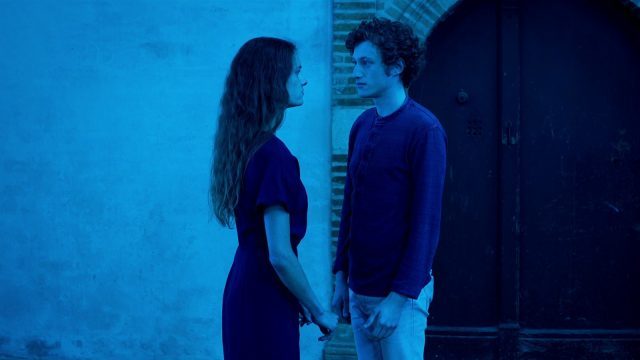
In December 2016, the Film Society of Lincoln Center held the first of its two-part tribute to Chilean-French auteur Raúl Ruiz, a prolific writer and director who passed away in 2011 at the age of seventy. “Life Is a Dream: The Films of Raúl Ruiz” is now back for the second half of the celebration, from February 9 to 18, consisting of fourteen more works by Ruiz, highlighted by a week-long run of a new digital restoration of his 1999 magnum opus, Time Regained, a dramatization of Marcel Proust on his deathbed, thinking back on his own life as well as the fictional life of his characters. The festival also includes Ruiz’s last film, Night Across the Street, which proves to be a fitting finale for Ruiz, who left behind a legacy of more than one hundred movies and one hundred plays. An adaptation — or as Ruiz explained it, “adoption” — from a pair of short stories by Imaginist writer Hernán del Solar, Night Across the Street follows the odd meanderings of Don Celso (Sergio Hernandez), an old man about to retire from his office job. Past, present, and future, the real and the imagined, merge in abstract, surreal ways as Don Celso goes back to his childhood, where he (played as a boy by Santiago Figueroa) takes his idol, Beethoven (Sergio Schmied), to the movies and gets life lessons from Long John Silver (Pedro Villagra). As an adult, he hangs out with the fictional version of French teacher and writer Jean Giono (Christian Vadim), whose real self and family appear to be elsewhere. And he visits a haunted hotel run by Nigilda (Valentina Vargad) where he believes he will meet his doom.

Memories and hallucinations mingle in front of obviously fake backgrounds, strange, unexplained characters appear then disappear, and Don Celso (and Ruiz, of course) has fun with such words as “Antofagasta” and “rhododendron” in a film that Ruiz created to be shown only after his death. (He made the film after being diagnosed with liver cancer, which he survived by getting a transplant, only to die shortly thereafter of a lung infection.) And at the center of it all is one of Ruiz’s favorite themes, time — Don Celso is regularly interrupted by an annoying alarm clock that signals him to take unidentified medication, keeping him alive even as the end beckons. Screening at Lincoln Center on February 11 and 18 (the first show will be introduced by actress Chamila Rodríguez), Night Across the Street is an elegiac swan song by a master filmmaker. The series continues with such other Ruiz films as Klimt, starring John Malkovich as the Austrian artist, the American thriller Shattered Image, with Anne Parillaud and William Baldwin, the deeply personal improvised Dutch film On Top of the Whale, and the haunting Comedy of Innocence, with Isabelle Huppert and Jeanne Balibar.