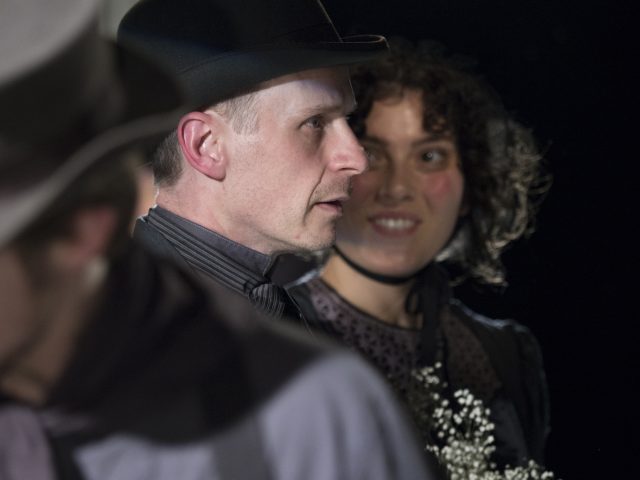
Will Barnon (Brian Barnhart) is waiting on a train in reimagined theatrical version of High Noon (photo by by Pavel Antonov)
Axis Company
One Sheridan Sq. between West Fourth & Washington Sts.
Thursday – Saturday through March 24, $10-$30, 8:00
866-811-4111
www.axiscompany.org
Axis artistic director and founder Randy Sharp transforms a classic American Western into an existential purgatory in the world premiere of High Noon, continuing at Axis’s Sheridan Square theater through March 24. This is a stripped-down High Noon, utilizing elements from both Fred Zinnemann’s 1952 Oscar-winning film and John Cunningham’s 1947 short story for Collier’s, “The Tin Star.” The sixty-five-minute drama takes place on Chad Yarborough’s sparse, all-white stage, with a horizontal saloon bar, a slightly raised platform in one corner, and white fencing along the walls; even the permanent stanchions are painted white. That brightness is more than offset by Karl Ruckdeschel’s costumes, nearly all of which are black; it not only references good and evil but also High Noon itself, which Zinnemann decided to shoot in black-and-white instead of color for aesthetic rather than financial reasons. In an unidentified small town, the marshal, Will Barnon (Brian Barnhart), has just married his sweetheart, a Quaker named Alice (Katie Rose Summerfield), and turned in his badge. Meanwhile, Guy Jordan, a man Will sent away for murder, has unexpectedly been released from prison and is believed to be coming back on the noon train to take his revenge on all those who’d done him wrong, primarily Will. Guy’s brother, Check (Nicholas McGovern), is already in town and looking for trouble. Will and Alice are preparing to start a new life together, minding her family’s store far away, but Will suddenly decides that he must stay and face Guy. “I’ll never know what’s behind me,” he tells Alice. “I’ve got to stay. That’s the whole thing. That’s the whole thing.” (The dialogue features a lot of purposeful repetition.)
While Henry (Phil Gillen), who runs the local hotel, can’t wait to see Will get his comeuppance, Judge Mettrick (Spencer Aste) is packing his things and thinks Will ought to do the same, as does Will’s deputy, Senator (Jon McCormick), who wants to become the marshal. Caught in between is Helen Rivera (Britt Genelin), who went from being Guy’s lover to Will’s and then Senator’s — and she does not want to be around when Guy arrives. Will might have cleaned up the town, but nearly all his supposed friends, including Senator, Helen, Mettrick, Baker (George Demas), Sam (Andrew Dawson), and stationmaster Oliver (Brian Parks), are turning their back on him, preferring that he leave immediately; their community might have been more dangerous when Guy ran things, but there was also much more business and cash flowing in. Through it all, Will is stalwart, refusing to sacrifice his principles, even if he has to face Guy Jordan and his gang alone.
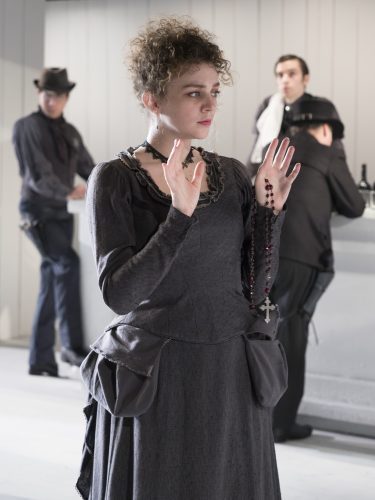
Helen Rivera (Britt Genelin) has had enough and wants to get out of town in Axis Company’s High Noon (photo by by Pavel Antonov)
Samuel Beckett’s Waiting for Godot meets Clint Eastwood’s High Plains Drifter in Sharp’s involving staging. All of the actors are onstage through the entire production as if trapped; their words move the tale from the hotel and the depot to the court and the prairie. In writing the High Noon screenplay, Carl Foreman was influenced by the House Un-American Activities Committee investigation into communism in Hollywood; Cooper had refused to name names when he was summoned before the committee in 1947, and Foreman was later blacklisted. Sharp steers clear of that angle, instead situating High Noon in a kind of way station where there are no genuine heroes and everyone has to face their sins, both individually and as a community. The stationmaster is like St. Peter, waving his white flag as if surrendering to the murderous Supreme Being on board the coming train. “My God, it is the end of the world. Holy Jesus,” he says. A few moments later, Mettrick repeats, “By God. This is the end of the world.” Barnhart portrays the icy Will as more of an everyman than a hero, talking in old-fashioned Americana. “Alice, I’m going to try and be the best man you think I am. I’ll do my best,” he tells his new bride. Wearing his badge like a halo, Will tries to put together a posse of apostles, but no one is going to join him on what they consider a suicide mission; he is even spurned by his wife and Helen, his Mary Magdalene, as his execution awaits. High Noon is famous for, among other things, the building tension leading to the action-packed finale, but Sharp chooses another path there as well, providing a surprising, subtle twist. The key to Sharp’s (Last Man Club, Dead End) cunning plot lies in the words of Helen. Early on, she says, “Things’ll go straight back to before. They’ll be the same. The same way. The same story.” Later, she adds, “I want a different ending.” She doesn’t quite get what she desires in this uncompromising morality tale about mid-twentieth-century America — and today.


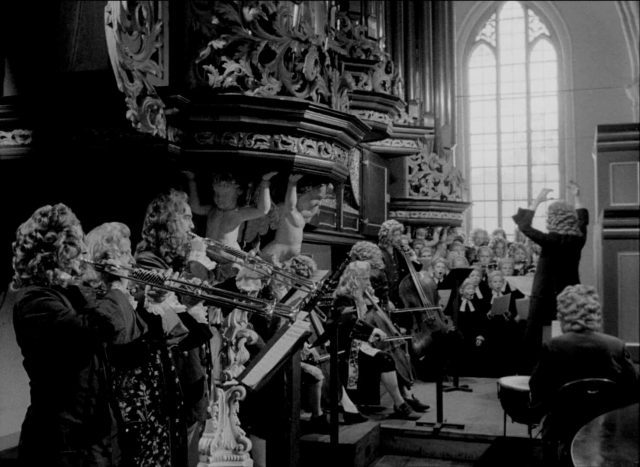
 Jean-Marie Straub and Danièle Huillet’s debut feature, The Chronicle of Anna Magdalena Bach, looks and sounds better than ever in a fiftieth anniversary restoration print that opened at the Quad on March 2. Exquisitely written, directed, and edited by the longtime partners, the film is a multilayered romance made on an exceedingly tight budget, shot in sublime black-and-white and recorded with live music. The life of Johann Sebastian Bach (Dutch musician and conductor Gustav Leonhardt) is told primarily through voiceover narration by his second wife, Anna Magdalena Bach (Christiane Lang, in her only movie), reading selections from her fictionalized journal; the film also includes letters penned by Johann, close-ups of music manuscripts, and concert posters and programs. The vast majority of the film consists of extended performances of Bach works by professional musicians (the Austrian baroque ensemble Concentus Musicus Wien, conducted by Nikolaus Harnoncourt, who plays the prince of Anthalt-Cöthen and sings a solo in the film). The musicians appear onscreen, wearing period costumes and wigs and playing in some of the actual locations where Bach’s compositions were originally heard; in addition, the music was recorded and synced live with the performances, not added in postproduction. There are only a few scenes with dialogue and actors, and they feel somewhat out of place when they appear. The music is simply magnificent, consisting of excerpts and complete versions of such compositions as Brandenburg Concerto No. 5, Suite #1 in D, Magnificat in D major, Cantata BWV 205, the opening chorus of St Matthew Passion, Cantata BWV 42: Sinfonia, Ascension Oratorio, Clavier-Uebung, Goldberg Variations, and the Art of Fugue. There are few cuts within scenes; cinematographers Giovanni Canfarelli Modica, Saverio Diamante, and Ugo Piccone keep their cameras focused and steady, with occasional slow tracking shots.